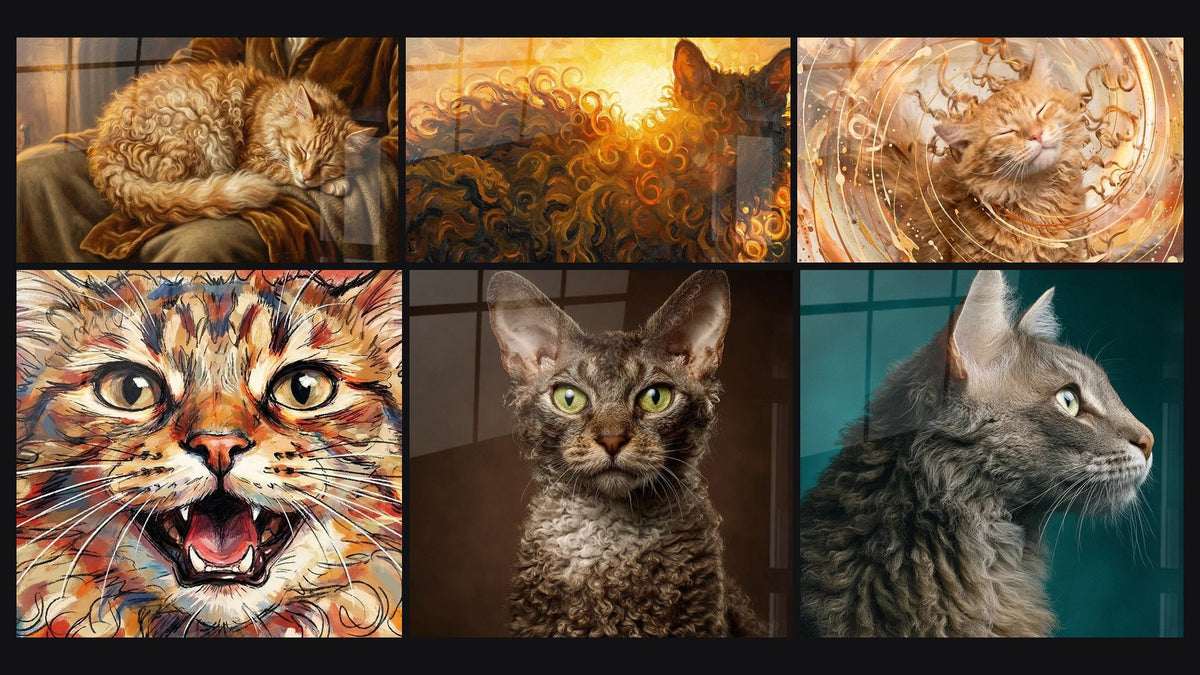
Laperm cat painting with curly coat: showcasing its texture in a modern living room
7 min read · by Walensky
LAPERM CAT PAINTING
A coat that ripples like merino wool, locks that curl up instead of falling flat: the Laperm cat looks like no other feline. Placing its portrait in a living room of clean lines and smooth surfaces introduces a living texture where everything else is calm. The contrast almost works on its own.
The direct answerThe curly coat of the Laperm cat works in a modern living room because it introduces an organic texture against clean lines. To make the most of it, choose a painting that treats the curls as a graphic motif (watercolour, precious fabric, shattered mirror effect) rather than a simple realistic portrait, and carry this texture through with velvet, curly wool or rattan in the rest of the room.The paintings shown here are exclusive digital creations, imagined by Walensky artists and printed in Italy on acrylic glass or Dibond aluminium, without a frame, ready to hang.
- The curly coat of the Laperm is a rare material in interior decoration: it breaks the monotony of a living room with smooth surfaces.
- Watercolour softens the texture, precious fabric magnifies it, and the shattered mirror effect turns it into pure graphic pattern.
- Velvet, curly wool and rattan extend the texture of the painting through the rest of the room, without overloading it.
The Laperm, a breed with a unique coat
The Laperm is recognised at a glance: its coat, often medium-length, forms irregular curls, sometimes loose on the back, tighter around the neck. Unlike the smooth coat of a classic European cat, this texture catches the light unpredictably, much like a bouclé wool sweater under a lamp.
It is precisely this irregularity that makes it a decorative subject in its own right. A portrait of a smooth-coated cat remains a portrait; a portrait of a Laperm becomes almost an abstract motif, a study of material before being a study of an animal.
On a painting, it is the zones of contrast — light curls against a dark background, locks against the backlight — that create the illusion of relief, without any actual material on the surface: everything happens within the printed image.
Why the curly texture works in a modern living room
A minimalist modern living room often lives on little: waxed concrete, white walls, furniture with sharp lines. This bareness needs a point of visual friction, otherwise the room breathes but never catches the eye.
Contrast between clean lines and organic material
The curly coat provides exactly this friction. Where a straight sofa, a glass coffee table and a slender wall shelf draw crisp lines, the controlled disorder of the Laperm's curls breaks the geometry without contradicting it. It is the same principle as a rattan armchair placed in a very spare living room: texture lets minimalism breathe.
Playing with natural and artificial light
Light reveals or flattens a curly texture depending on its angle. Raking light, at the end of the day, carves every undulation of the depicted coat; overhead lighting flattens everything. This is why the choice of support — glossy or matte — matters as much as the motif itself, which we come back to below.
A well-chosen Laperm cat painting is not an animal portrait placed on a wall: it is a texture in dialogue with those already present in the room.

Which media and finishes best showcase the curls
The rendering of the same curly texture changes radically depending on how it is treated in the image. Three approaches stand out clearly in the collection.
Watercolour painting vs printing on precious fabric
A watercolour, like the Green-Eyed Watercolour Cat Painting, softens the curls: the outlines blend, the material becomes suggestion rather than precise description. This is the choice for a living room where you want softness, not display.
Conversely, a precious fabric treatment, as on the Golden Laperm Cat Painting on Precious Fabrics, densifies each lock: the effect approaches an embroidered textile, almost tactile to the eye. In both cases, format matters: on a living room wall, the artwork should ideally occupy 60 to 75% of the width of the piece of furniture beneath it, so the texture reads without being swallowed by the empty space around it.

Shattered mirror effect for a graphic rendering
The Shattered Mirror Laperm Cat Painting pushes the principle even further: reflective fragments recompose the cat's silhouette like a puzzle of light, an almost cubist echo of the natural curls of its coat. It is the boldest choice, the one that frankly turns the animal into a contemporary graphic motif rather than a portrait.

For a very bright living room, facing south or in front of a large window, prefer Dibond aluminium: its matte surface avoids reflections that would flatten the nuances of the texture. In a more subdued room, acrylic glass restores more vibrant colours and genuine depth.
— Our selection


Pairing the painting with complementary materials in the living room
The texture of a painting never lives alone. It converses with its surroundings, and this is where the success of a modern living room built around a Laperm painting truly lies.
- Velvet : a cushion or armchair in deep velvet responds softly to the golden tones of the coat, without ever competing with the curly texture itself.
- Curly wool : a throw or pouf in curly wool (the famous "bouclé") creates a direct, almost literal echo of the painting's motif. It is the most obvious pairing, to be dosed so as not to overload the room.
- Rattan : a hanging armchair or rattan pendant light brings a complementary organic material, less dense than wool, which lightens the whole.
The classic mistake is to multiply textured materials without a point of visual rest. Keep at least one wall, a floor or a large section of smooth furniture so the room can breathe.
To go further with warm tones pairing with this type of coat, the collection of paintings in brown tones offers pieces that naturally extend the golds and browns of the Laperm.
Our Laperm cat designs that play with texture
Each piece in the collection treats the curls differently, depending on the atmosphere sought.
The Laperm Cat Profile Portrait Painting favours contemplation, while the Laperm Kitten Painting with Golden Curls plays the card of morning softness, light chestnut fur bathed in raking light. Enough to cover every register, from the most graphic to the most tender.


Also to discover
LaPerm Cat Profile Portrait Painting - Contemplative Gaze - LaPerm Cat Edition
From €213.90
Discover this painting →Frequently asked questions
How to showcase the texture of an animal painting in a modern living room?
By playing on contrast: surround the painting with smooth surfaces (a plain wall, furniture with straight lines) so that the organic material of the coat becomes the visual anchor point of the room.
Which material should I choose for a cat painting with a texture effect?
A matte Dibond aluminium support avoids reflections and lets the texture read fully in a very bright room; acrylic glass, more glossy, intensifies colours in softer light.
Does a Laperm cat painting suit a minimalist décor?
Yes, and it is even one of the animal subjects that works best in this context: its texture brings the extra soul that a minimalist interior often needs without knowing it.
How to pair a Laperm cat painting with the rest of the décor?
Pick up one or two materials present in the painting (velvet, curly wool, rattan) in a cushion, a throw or a seat, without multiplying textures so as to keep visual balance.
A Laperm cat painting is far from a simple animal portrait hung out of affection for the breed. Well chosen, it becomes a graphic piece in its own right, capable of turning a modern living room wall into a dialogue of materials. To find the model that will best suit what you already have — velvet, curly wool, rattan — the Laperm cat painting collection brings together all the treatments, from the softest to the most graphic.
Explore our collections