

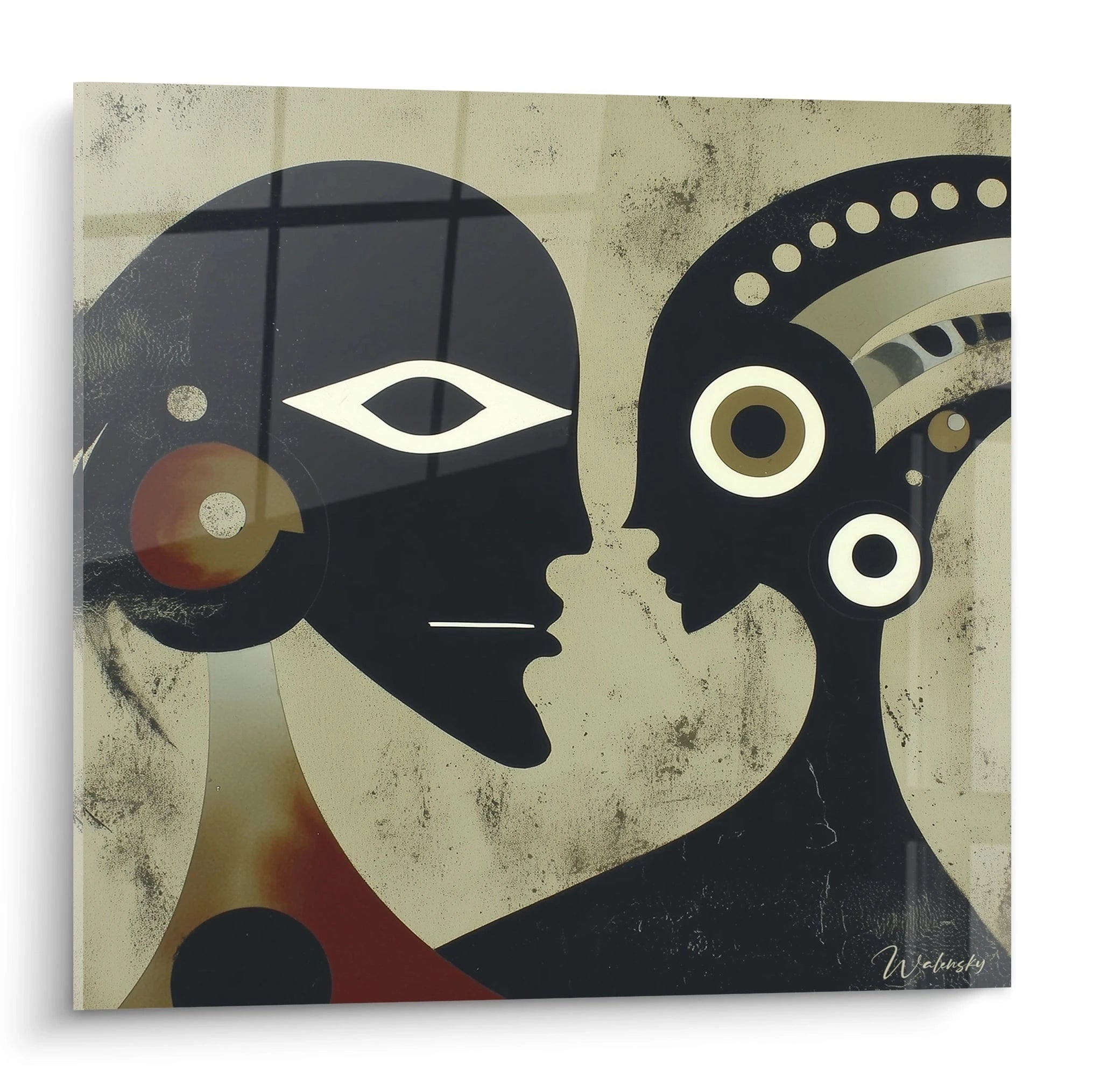






Dog painting square format for the entrance: which dimensions to choose?
7 min read · by Walensky
You are standing in front of this stretch of wall, between the front door and the start of the hallway, tape measure in hand. Forty-five centimeters wide, no more. A mirror right beside it, a console table already eating thirty centimeters of depth. And you wonder whether a square dog painting can really find its place in this pocket-sized space without overwhelming everything.
The answer rests on simple geometry, and that is exactly what we will untangle: no lengthy talk about style, but numbers, proportions, and a method to avoid mistakes.
The direct answerThe square format is particularly well suited to entrances because it imposes neither a horizontal nor a vertical dominance: it adapts as well to a narrow wall as to a wider hall. For a standard entrance, allow a painting occupying 60 to 75% of the width of the available wall, leaving at least 15 to 20 cm of margin on each side. Below 80 cm of free wall, turn toward a made-to-measure format rather than the standard sizes in the shop.- The square neither pulls the eye up nor to the side: it simply settles in place.
- The 150 cm rule for the center of the painting also works in a low-ceilinged entrance.
- One large square unit structures a space better than a row of small, crowded formats.
Why the square format excels in small entrances
A hallway is, by definition, an architectural constraint: it is longer than it is wide, often lower-ceilinged than the rest of the house, and crossed in a few seconds. A landscape-format painting, too wide, emphasizes that corridor feeling. A vertical format, for its part, crushes the height when the ceiling is already low. The square plays neither card.
It establishes a stable presence without imposing a direction. This is why interior architects often recommend it for transitional spaces: hall, landing, passageway. The eye rests on it without being pulled elsewhere.
In an entrance, a painting does not need to tell a long story: it simply needs to make you want to slow down for three seconds before moving on.
Which dimensions to choose based on your wall width
The available wall width is the only figure that truly matters before choosing a size. Measure the free stretch of wall, subtract the safety margins, and you will have your range.
Very narrow entrance (less than 80 cm wide)
In this case, the standard shop sizes starting at 100x100 cm will be too imposing: there would be almost no visual breathing room on either side. The most honest solution is a made-to-measure format, available from 80x46 cm to 190x190 cm depending on the painting. A made-to-measure 70x70 cm square, for example, lets an 80 cm wall breathe without saturating it.
Standard entrance (80 to 150 cm)
Here, the L format at 100x100 cm becomes relevant, and the XL at 120x120 cm too if the wall exceeds 140 cm. We apply the same logic as for a sofa or a sideboard: the painting occupies roughly 60 to 75% of the wall width, no more.
For a 120 cm wall, an L format at 100x100 cm falls almost exactly within this range. It is often the most comfortable configuration to live with day to day.

Favorite
Dog Painting with Amber Eyes on Watercolor Background - Piercing Gaze - Briard Edition
From €213.90
Discover this paintingWorking with existing furniture: console, mirror, coat rack
An entrance is never a bare wall: there is almost always a console table, sometimes a mirror, often a coat rack that bites into the available space. The painting must work with these elements, not fight against them.
- Above a console table : the painting follows the width of the piece of furniture, not that of the entire wall. A 100x100 cm square above a 110 cm console works very well.
- Beside a wall mirror : avoid aligning them at the same height if the space is limited, as this creates visual competition. Offset the painting slightly, vertically or along the wall.
- Above a coat rack : leave at least 15 cm between the top of the hooks and the bottom of the painting, so that hanging coats do not cover it.
The standard hanging height places the center of the artwork about 1.50 m from the floor, roughly eye level. In an entrance, this rule still holds even if the ceiling is low: you do not hang higher to "gain height", you hang at eye level.
A warm-toned painting such as the Dog Painting with Golden and Copper Tones works particularly well above a light wood console in a Scandinavian-style entrance where minimalist framing is the rule.

For a more graphic entrance, with cement-tile flooring or light walls, the contrast of a portrait such as the Dog Painting with Blue and Orange Geometric Accents provides a clear focal point without overloading the space.

— Our selection


One large square or several small ones in a staggered arrangement?
Two schools of thought compete here, and both can be defended depending on the configuration of the wall.
The single large square is the simplest and safest solution in a narrow entrance: a single visual anchor point, no spacing calculations between several frames, quick installation. This is the choice we recommend for a wall less than 150 cm wide.
A staggered composition, with two or three small square formats arranged on a rising diagonal along a hallway, creates an interesting sense of movement. But it requires a longer wall, at least 2 meters, to avoid giving an impression of clutter. In a short entrance, it visually compresses the space rather than opening it up.
If your entrance falls into the more generous configurations, a hallway serving several rooms for example, the made-to-measure format also lets you plan the hanging at the scale of the entire wall, without being limited to standard sizes. our article on the portrait format for an entrance hallway details the other possible option if your wall lends itself better to verticality than to a square.
Discover our square-format dog paintings
Dog paintings naturally suit the square format: a portrait focused on the animal's gaze finds strong presence within this frame, without needing extra space around the subject.
The Dog Painting with Amber Eyes on Watercolor Background suits an entrance with neutral tones, where one seeks a touch of softness without breaking the palette. The Dog Painting with Amber Tones and Stained Glass plays more on contrast, with its coppery reflections catching the light of an entrance ceiling lamp. The White Dog on Colored Background, livelier, asserts itself in an already sober entrance that needs a bit of pep.

Also to discover
Dog Painting with Blue and Orange Geometric Bursts - Crystalline Mosaic - Akita Inu Edition
From €213.90
Discover this painting →Frequently asked questions
What size painting for a small entrance?
For a wall less than 80 cm wide, favor a made-to-measure format between 70 and 90 cm per side. Beyond 80 cm of available wall, the L format at 100x100 cm becomes a serious option.
At what height should a square painting be hung in an entrance?
The center of the artwork is placed about 1.50 m from the floor, the standard hanging height valid in any room, entrance included, even with a low ceiling.
Can several square paintings be hung side by side?
Yes, but only if the wall exceeds 2 meters in width: below that, a single large square format gives a cleaner result than a row of small paintings.
Does the square format suit every entrance?
It suits most configurations, narrow or standard, because it imposes no directional dominance. The rare exceptions concern very tall and very narrow walls, where a portrait format sometimes remains more suitable.
A square dog painting, properly sized, can transform that strip of wall that has been taunting you for months into a true welcoming point. But everything starts with the tape measure, not instinct: measure your wall before deciding, not after. That single piece of data separates an L format from a made-to-measure piece, a unique work from a staggered composition.
Once you have the width in hand, head to the collection of dog paintings to compare the available formats and find the portrait that will last, every day, as you walk through the door.
Explore our collections


