

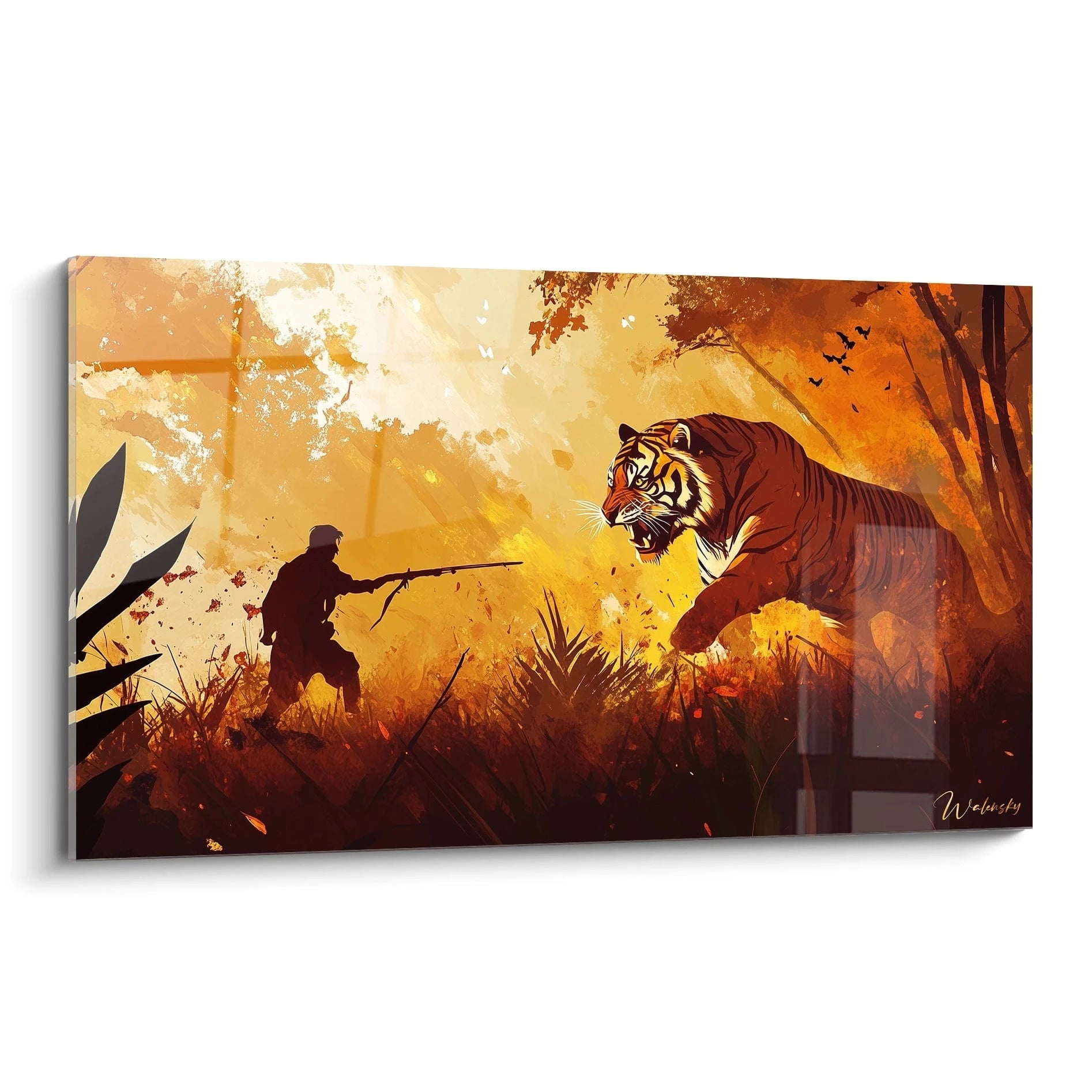






Unusual animal paintings for a child's bedroom: sparking curiosity in a different way
8 min read · by Walensky
OTHER ANIMALS
A roaring lion, a giraffe stretching toward the sky, an elephant fooling its companions with a big flap of its ears: your child has already seen them a hundred times, on pajamas, in a book, on the plastic zoo sitting on the shelf. The marmot watching the valley from its rock, on the other hand, they don't know yet. And that's exactly where it gets interesting.
The direct answerAn unusual animal painting — marmot, crab, hippopotamus, albatross, ibex, wild boar or hen — stimulates a child's curiosity more than a familiar safari animal, because it invites questions rather than recognition of a stereotype. On the practical side, favor an L format (120x70 cm) for a first piece, in Dibond aluminum if the room receives a lot of natural light, in acrylic glass for more vibrant colors.The paintings presented here are original digital creations, exclusive to Walensky artists, printed in Italy on acrylic glass or Dibond aluminum. No copies, no identical reproductions: works designed to tell the story of an animal, not to illustrate an encyclopedia.
- Lesser-known animals spark a child's curiosity better than safari stereotypes already seen everywhere
- Montessori pedagogy values the careful observation of a real subject over the accumulation of generic images
- An L format (120x70 cm) is more than enough for a child's bedroom; colors should remain consistent across the paintings of the same wall gallery
Why move beyond the lion and the giraffe to decorate your child's room
A child who already knows everything about an animal has nothing left to ask. That is the silent limit of safari decor: it reassures, but it doesn't provoke questions. Show them a crab with intricate patterns on its shell, and the first question comes within a minute: "what are those drawings, why does it have them on its back?"
Montessori pedagogy has insisted on this point for more than a century: a child learns better by observing a real, precise, singular object than a generic image repeated endlessly. A hippopotamus emerging from the water, its head barely visible, tells something different than a cartoon elephant: a posture, an expectation, a mystery.
It is not the best-known animal that holds a child's fascination the longest, but the one they didn't expect to find on their wall.
This approach also nourishes sensory awakening: unexpected colors, suggested textures, framings that isolate a detail — the eye of an ibex, the shell of a crab — rather than showing the whole animal in a conventional setting.
Unusual animals that fascinate children (and why)
Some animals don't need to be exotic to intrigue. They just need to be rarely shown.
The marmot and the wild boar: the fauna of our mountains and forests
The marmot, you hear it whistle on a hike, but you almost never really see it. The marmot painting depicts this rodent perched facing the mountains, in a palette of blues and whites that immediately evokes altitude and silence. A good subject for talking about hibernating animals, mountains, and seasons.
The wild boar, for its part, carries a reputation as a fierce beast that a painting can nuance. In brown and gray tones, against a forest backdrop, it becomes an almost familiar figure — a good opportunity to explain the wildlife that lives very close to home, without ever having to cross an ocean.
The crab, the hippopotamus and the albatross: discovering aquatic and coastal environments
The crab intrigues with its geometric shell, almost like armor. The hippopotamus, often reduced to a gray mass in books, regains power here: an orange and gray version evokes street art, another in black and gray emerges from the water in a more mysterious atmosphere. Two ways of telling the same animal's story, two different room moods.
The albatross, finally, is the animal almost always forgotten in children's decor. Perched on its post, facing the blue of the sea, it introduces a simple and strong idea: some birds spend their lives above the ocean, far from any land.
Each unusual animal can become a pretext for a little bedtime story: where does it come from, what does it eat, why does it live there. Children remember better what is tied to a specific image they see every day.
The impala, the ibex and the hen: between savanna, peaks and farmyard
The impala doesn't have the build of the lion, but its leap and golden light at sunset tell the savanna in a very different way. The ibex, with its impressive horns against a brown and golden mountain backdrop, evokes patience and calm more than speed. As for the hen — or rather the rooster, dazzling in red and green in this version — it reminds us that the unusual animal isn't always the one that comes from far away: it can be the one from the farmyard, which we forget to truly look at.
For the youngest, a collection of various paintings for children allows you to vary subjects without breaking the coherence of the room.

How to choose and compose a wall of unusual animals
Format makes all the difference in a child's bedroom, where proportions are often more modest than in a living room. The L format, at 120x70 cm, suits most bedroom walls and remains the smallest format offered for these creations — there is no mini format in this collection.
As for finish, two options, two moods:
- Acrylic glass : glossy surface, very vibrant colors, gallery-art effect — ideal if the room has controlled evening lighting
- Dibond aluminum : matte surface, zero glare, softer colors — perfect facing a window or in full daylight
Avoid mixing too many different graphic styles on the same wall. A coherent gallery keeps a common palette — ochres and browns for forest and mountain animals, blues and whites for aquatic animals — even if the subjects change.
— Our selection


Combining several unusual species: creating a unique animal gallery
Three paintings are worth more than a single isolated one, as long as they tell a story. Think in terms of environments: earth, sea, air. An ibex for the mountain, a hippopotamus for the water, an albatross for the sky — and there you have a room that crosses three landscapes without moving a single piece of furniture.
The alignment matters as much as the choice of subjects. Keep the same hanging height between the frames, space them evenly, and let one animal slightly "dominate" the others in size — the child's gaze naturally falls on it first.
For parents who prefer to rely on one strong animal rather than a gallery, the wild boar painting works very well as a single piece, in a room with natural tones.
— Also to discover


To go further: exploring other animal worlds
If the child already has a well-identified favorite animal — a teddy bear that never leaves them, a guinea pig recently adopted — the most soothing paintings often start from there. Our article on the brown bear painting for a children's room explores this reassuring path, and our guide to the watercolor guinea pig painting for a children's room offers a softer version, full of nuances.
For families who want a more assertive room, visible from the hallway, our article on the large-format wild animal painting in contemporary style details how to go bigger without losing balance.

In the same spirit
Hippopotamus painting No. 1 - Animals Edition
From €233.90
Discover this painting →Frequently asked questions
What age to hang an animal painting in a child's bedroom?
From birth for simple colors and shapes, and especially from ages 3-4 for subjects that invite storytelling: that's the age when children start asking questions about what they see.
Which unusual animals do children like most?
Those with an easy anecdote to tell: the marmot that sleeps all winter, the crab that walks sideways, the albatross that spends months without touching land. The originality of the subject matters more than its size or apparent strength.
How do you combine several animal paintings in a room?
Choose a common thread — natural environments, a shared color palette — and keep the same format or a clear hierarchy of sizes among the works, to avoid a patchwork effect.
Which painting size should you choose for a child's room?
The L format (120x70 cm) suits most bedrooms. For a narrower wall, made-to-measure from 80x46 cm remains the best option, rather than aiming for a standard format that is too wide for the available space.
A lion on a child's wall closes the question before it is even asked — we already know everything about the lion. A marmot, a crab, an albatross, on the other hand, open a door: where does it come from, what is it doing there, why that color. Perhaps that is all one can ask of a children's room painting: that it makes you want to ask one more question. To vary the subjects, the Other animals collection brings together other equally little-known species, and the large contemporary-style format will suit families who want a more assertive room in the hallway or the older children's bedroom.
Explore our collections


