

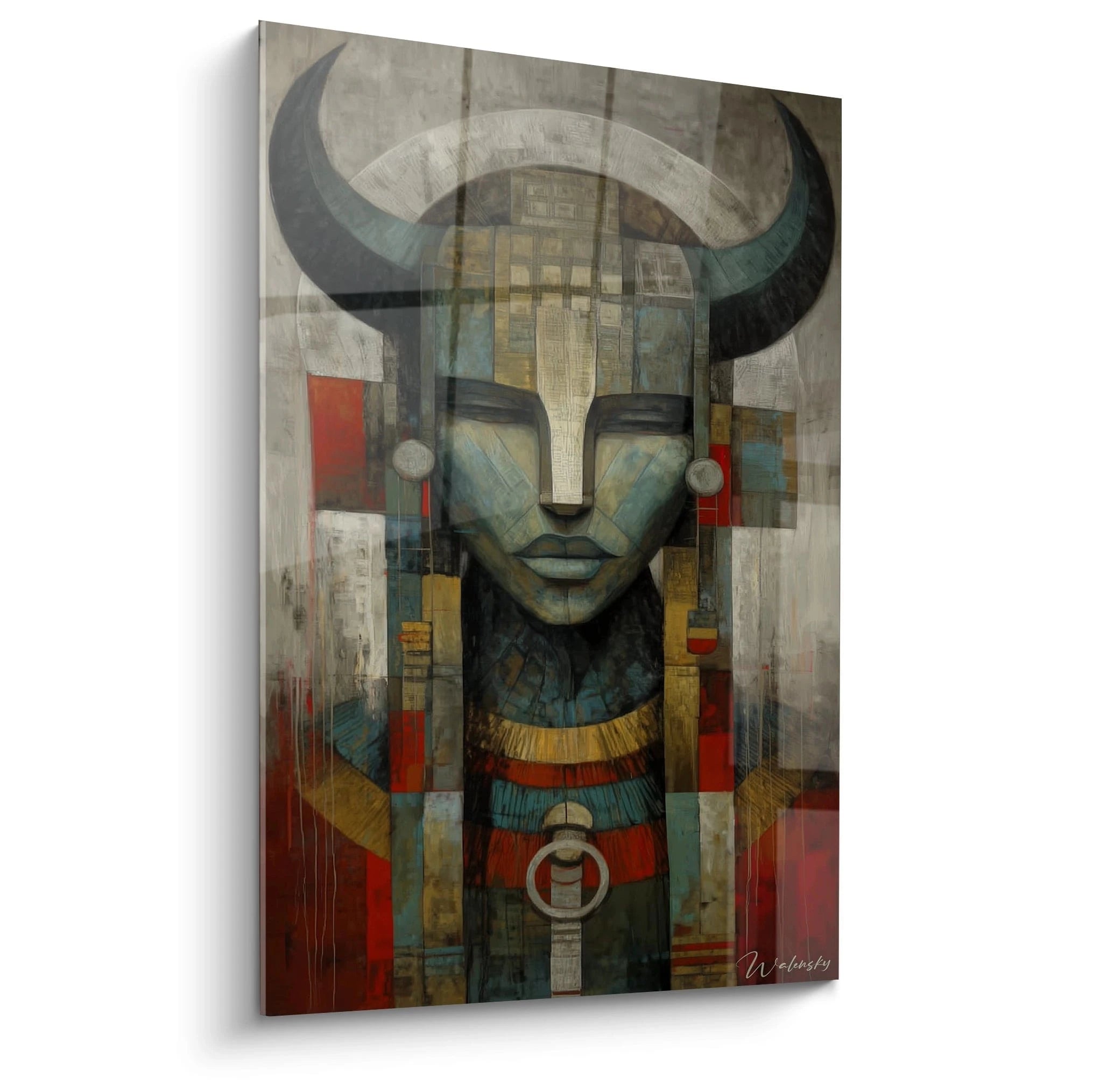






Understanding visual cultural language in wall art
11 October 2025 · 18 min read · by Walensky
You are standing before this magnificent painting in this chic gallery, it instantly moves you, but you can't explain why. You feel this deep, almost magical connection, as if the artwork were speaking to you in a language you understand without ever having learned it.
The colors dance before your eyes, the shapes seem to tell you a familiar story, and your heart races. You know that this painting would make a statement in your living room, but a little voice whispers to you: "What if my guests don't understand it? What if I'm wrong about its true meaning?"
You've already tried buying "safe" artworks, neutral abstracts, or classic reproductions. The result? Your interior remains impersonal and cold, as if something essential were missing. These paintings don't tell your story, they don't create the magic you're looking for.
It's perfectly normal to feel lost when facing the visual cultural language. Most people think you need to be an art expert to decode these references, but that's not true. In reality, we all carry within us a rich and intuitive cultural library.
By the end of this article, you will know how to decipher the hidden cultural codes in wall art and choose artworks that resonate authentically with your personal universe, creating an interior that truly resembles you.
Why does cultural visual language transform your relationship with art?
Understanding the visual cultural language today is like learning to read between the lines of an exciting conversation. The longer you wait, the more artworks you miss that could transform your living space. Imagine your living room as an open book: each painting tells a chapter of your personal story. Without this understanding, you miss the opportunity to create an authentic and memorable interior.
💡 Collector's Revelation: Sarah, a contemporary art enthusiast, long decorated her Parisian apartment with artworks she found "pretty". One day, she discovers a painting with subtle oriental references - stylized cherry blossom motifs mixed with modern urban elements. This artwork instantly reminds her of her travels to Japan and her philosophy of life. Today, this painting has become the focal point of her living room, consistently generating rich conversations with her guests.
Conversation with a Decor Expert
Art cultivates your visual identity: Each cultural reference you recognize in a work reinforces your sense of belonging and creates a lasting emotional connection. In a few weeks, your eye naturally sharpens and your confidence grows.
What really happens when you "don't understand" a work?
Have you ever felt overwhelmed in front of some paintings? Have you felt that everyone understood something that escaped you? Have you even given up buying a work that you liked for fear of "not being up to it"?
Rest assured, this is not a lack of culture on your part. It's simply that no one has explained to you how the cultural visual language actually works. It's not about encyclopedic knowledge, but about recognizing familiar patterns.
Think of music: you instantly recognize a melody that reminds you of your childhood, even without knowing the composer's name. Visual art works exactly the same way.
The truth about the "hidden codes" in art
Contrary to what many think, the cultural references in art are not enigmas to be solved. They are invitations to recognition, like knowing winks between the artist and you.
Imagine you are looking at a painting with colorful geometric patterns. Your eyes immediately recognize the reference to Berber rugs if you grew up in a North African family, or to American quilts if you are passionate about American culture.
This instant recognition creates a feeling of pride and belonging that transforms your relationship with the work. Instead of suffering art, you dialogue with it.
🔍 Immediate recognition test: Look at the painting that attracts you the most in your favorite gallery. Close your eyes and describe the first three images that come to mind. These spontaneous associations reveal your personal cultural references.
The illusion of the "correct" interpretation
Many people think that there is only one correct interpretation for each work of art. This paralyzing belief prevents them from trusting their natural cultural intuition .
In reality, contemporary art works like a kaleidoscope: each look reveals new facets, each observer brings their own cultural richness. Your interpretation is legitimate because it comes from your authentic experience.
This awareness frees you from the pressure to "do well" and allows you to choose works that truly resemble you, creating a coherent and personal interior.
The trap of cultural uniformity
You have noticed how many interiors look alike? It's because their owners choose "safe" works rather than pieces that reflect their unique cultural heritage.
This uniformity kills the personality of your space. You can easily spot it: neutral abstracts, classic reproductions, colors that "go with everything". Result? An interior that could belong to anyone.
When you embrace your cultural references in your artistic choices, you create a distinctive environment that tells your story and leaves a lasting impression.
3 signs that your art lacks cultural personality:
- Your guests never ask questions about your wall art: This means they don't spark any curiosity, like anonymous pieces of furniture.
- You could swap your artworks with those of a hotel: This interchangeability reveals a lack of personal and cultural connection.
- You can't explain why you chose them: This difficulty indicates that your selection isn't rooted in your cultural identity.
The trigger of cultural recognition
The magic happens when you stop searching for the "right" culture and embrace your personal culture. It's like turning on a light in a dark room: suddenly, everything becomes obvious and natural. This trigger often occurs in front of a work that mixes familiar references in an unexpected way. You instantly recognize "your" visual language, even revisited by the artist.
Golden rule of cultural art: If a work instantly makes you think of a memory, a tradition, or an emotion from your past, it means it speaks your cultural language. Trust this first impression.
| ❌ Intellectual approach | ✅ Intuitive cultural approach | 💡 Why it works | 🎯 Result in your interior |
|---|---|---|---|
| Searching for the "right" meaning | Listening to your authentic feelings | Your emotions are your cultural guides | Works that truly resemble you |
| Choosing safe bets | Assuming your personal references | Authenticity creates distinction | Unique and memorable interior |
| Fearing the judgment of others | Celebrating your cultural heritage | Pride generates confidence | Rich and natural conversations |
| Reproducing trends | Creating your own style | Originality makes an impression | Distinctive and personal living space |

How to Naturally Develop Your Cultural Eye
Developing your cultural visual language sensibility is no more complicated than learning to recognize the flavors of your family's cuisine. It's an organic process that is nourished by your curiosity and your experiences. Like a gardener who learns to recognize plants, you will first identify the "families" of visuals that speak to you, then gradually refine your gaze. The result? An authentic interior that tells your unique story.
🌱 Your cultural awakening journey: We will explore your personal visual roots, then develop your ability to recognize cultural references in contemporary art, and finally create your own decorative language. Each step strengthens your confidence and refines your taste.
Step 1: Reveal Your Personal Visual DNA
Before deciphering the art of others, you must first understand your own visual heritage. It's like laying the foundations of a house: the stronger they are, the more harmonious the construction will be. This step is the most rewarding because it reconnects you with precious memories and authentic emotions. You will rediscover hidden treasures in your cultural memory.
What You Need for This Exploration
- A visual reference notebook: Choose a beautiful notebook that inspires you, not just a notepad. It will become your personal cultural journal. Opt for thick pages that can handle collages and sketches, available at any good stationery store. Quality matters because you will consult it often and with pleasure.
- A collection of personal images: Gather family photos, postcards from travels, magazines that mark you. These elements reveal your unconscious visual patterns. The goal is to create a visual corpus that authentically represents you.
- A moment of creative calm: Reserve 2 hours in your schedule, ideally on the weekend. This visual introspection cannot be done in a hurry. It requires a mental availability that allows memories to surface naturally.
Now, let's move on to recognition practice
Your personal cultural exploration
Create your visual identity card: Spread out all your personal images and observe them like a detective. What colors recur? What patterns? What landscapes? This analysis reveals your deep cultural preferences, often inherited from your childhood and significant experiences.
⏱️ Time: 45 minutes | ✅ Success when: You identify 3-4 recurring visual constants | ⚠️ Attention: Don't seek perfection, let patterns emerge naturally
Trace your visual genealogy: Reflect on the cultural influences of your family, your travels, your readings. Note the visual traditions that have marked you: patterns of grandmother's fabrics, colors of family celebrations, architecture of your childhood region. These elements form your personal visual alphabet.
⏱️ Time: 30 minutes | ✅ Success when: You have listed 5-6 specific cultural influences | ⚠️ Attention: Avoid judging your references, even the most popular or obvious
Identify your cultural emotions: For each influence identified, note the emotion it evokes: nostalgia, pride, serenity, dynamism. This emotional mapping will guide you in your future artistic choices. It reveals why certain works touch you instantly.
⏱️ Time: 20 minutes | ✅ Successful when: Each reference has its associated emotion | ⚠️ Warning: Be honest with your emotions, even contradictory
✨ Validation of your cultural profile: You should now have a clear vision of your visual identity: your signature colors, your favorite motifs, your cultural emotions. If some elements remain unclear, that's normal - they will become clearer with experience. The essential thing is to have laid the foundations for your exploration.
Step 2: Decoding Contemporary Visual Languages
Now that you know your visual DNA, you can approach contemporary art with confidence. It's like learning a new language when you already master your native language: you have the basics to understand and create connections. This step is more challenging as you will discover how contemporary artists reinvent traditional cultural codes . You will develop your ability to recognize references even when transformed.
Your Cultural Decryption Tools
- A methodical eye: Learn to "read" a painting like a text. First observe the whole, then the details, and finally the links between the elements. This systematic method reveals the hidden cultural references that the artist has integrated.
- Your reference notebook: Use it to note your discoveries and create links between artworks. Draw the motifs that intrigue you, note the associations of ideas. This personal archiving work enriches your visual library.
- A playful approach: Turn each gallery visit into a cultural scavenger hunt. Look for winks, détournements, unexpected mixtures. This joyful curiosity facilitates learning and makes art more accessible and vibrant.
Your Artistic Decryption Method
Master the three-step reading: When facing a work, first observe the overall impact (colors, composition, emotion), then the cultural details (motifs, symbols, techniques), and finally the connections with your experience. This structured method prevents you from feeling lost and reveals the cultural layers of the work.
⏱️ Time: 10 minutes per artwork | ✅ Successful when: You identify at least 2 cultural references | ⚠️ Warning: Do not force the interpretation, some works are intentionally hermetic
Create your personal visual dictionary: Photograph or draw the elements that speak to you in different artworks. Classify them by cultural family: geometric motifs, nature references, urban symbols. This collection becomes your cultural database for future artistic choices.
⏱️ Time: 15 minutes per visit | ✅ Successful when: You have constituted 3-4 families of references | ⚠️ Warning: Respect copyright, photograph only for personal use
Develop your comparative eye: Compare artworks with each other: how do two artists treat the same cultural theme? What are their different approaches? This comparative analysis refines your cultural sensitivity and enriches your understanding of contemporary visual languages.
⏱️ Time: 20 minutes per session | ✅ Successful when: You perceive stylistic nuances | ⚠️ Warning: Avoid value judgments, focus on differences in approach
🎯 Validation of your decoding: You should now spontaneously identify cultural references in 7 out of 10 works. Your gaze naturally stops on significant details and you make connections with your own culture. If you still feel hesitation, that's normal - continue to practice with kindness.
Step 3: Creating your coherent cultural collection
Now you are ready to take the step towards personal expertise: composing a collection of wall art that tells your cultural story in a coherent and refined way. This is the level where you no longer suffer art, you direct it to create the exact atmosphere you want. This final step gives you the rare confidence to be able to justify each artistic choice and inspire your surroundings with the richness of your cultural selection.
Your enlightened collector's arsenal
- A clear overview: Define the cultural message you want to convey in your space. Think about the story your walls will tell. This narrative coherence transforms your interior into a personal gallery that is memorable.
- A thoughtful budget: Establish a progressive acquisition strategy. It's better to have a remarkable work than a mediocre collection. Allow for an evolving budget that allows for cultural crushes from time to time.
- A discovery network: Identify your sources of inspiration: galleries, artists, collectors who share your cultural sensitivity. This network introduces you to works that resonate with your visual universe.
Your cultural collection strategy
Define your cultural guiding thread: Choose the unifying theme of your collection: cultural mix, revisited tradition, contemporary travel. This red thread guides your acquisitions and creates a strong visual identity. Your works dialogue with each other instead of competing.
⏱️ Time: 1 hour of reflection | ✅ Successful when: You formulate your concept in a clear sentence | ⚠️ Attention: Stay flexible, your vision can evolve with your discoveries
Orchestrate your acquisitions: Plan your purchases by alternating major works and complementary pieces. Start with a flagship work that embodies your vision, then add elements that support it. This progressive approach avoids cultural inconsistencies and optimizes your budget.
⏱️ Time: Planning over 6-12 months | ✅ Successful when: Each acquisition enriches the whole | ⚠️ Attention: Resist impulsive purchases that disrupt the harmony
Create your cultural staging: Think of the hanging as a personal exhibition. What visual dialogues between your works? What enriching cultural contrasts? This final staging reveals your cultural expertise and definitively marks your visitors.
⏱️ Time: 2 hours of installation | ✅ Successful when: The whole creates a unique atmosphere | ⚠️ Attention: Let your works breathe, avoid visual overload
👑 Validation of your expertise: Your collection tells a coherent and personal cultural story. Your guests naturally ask questions about your choices and leave inspired. You can easily explain why each work corresponds to you. You have reached the level of enlightened collector who fully assumes his cultural references.
Rule of cultural evolution: Your collection must be able to accommodate new discoveries without losing its coherence. Keep 20% of space and budget for unpredictable crushes that will enrich your cultural vision.
You've now moved beyond the steps of an informed amateur to that of a cultural collector. Here are the expert subtleties that will make the difference in your future choices and give you that rare confidence when it comes to contemporary art.
🎯 Expert collector tip: Look for works that create a "cultural bridge" between your personal references and traditions you are discovering. These hybrid pieces reveal your open-mindedness while remaining rooted in your identity. They generate the richest conversations and evolve with your own cultural journey.
Frequently asked question from our readers
"How can I be sure that a work with mixed cultural references won't look out of place in my classic interior?"
This hesitation is very understandable! In reality, culturally rich works often adapt better than neutral pieces because they bring a depth that transcends decorative styles. The secret lies in choosing works where cultural references are expressed with refinement rather than ostentation. A piece that subtly evokes Japanese calligraphy in subtle tones will fit perfectly into a Haussmann living room, even creating an elegant cultural contrast.
💡 Cultural integration test: Temporarily place the work in your space and observe it at different times of the day. If it makes you smile or think regularly, then it authentically enriches your cultural environment.
— Our selection


Avoid these cultural pitfalls that ruin your selection
Even with a good understanding of cultural visual language, some mistakes can sabotage your artistic choices. I prefer to warn you about these frequent pitfalls to avoid frustration and regrets.
- ⚠️ Collecting through superficial exoticism: Being attracted to a work only because it comes from somewhere else can lead to skewed choices. The fascination with the exotic fades quickly and you end up with a piece that no longer speaks to you. Always prioritize authentic emotional resonance rather than fleeting curiosity.
- ⚠️ Overloading on cultural references: Trying to show all your cultural wealth at once creates a visual chaos. Too many references kill the reference. Your interior becomes an indigestible museum instead of a harmonious living space. It's better to have three coherent works than ten disparate pieces.
- ⚠️ Copying codes without understanding them: Reproducing a cultural aesthetic because it is trendy without understanding its deep meaning leads to artificial choices. Your guests perceive the inconsistency and you lose credibility. Only adopt codes that resonate with your personal experience.
- ⚠️ Ignoring the evolution of your taste: Staying fixed on youthful cultural references without evolving them limits your artistic development. Your collection stagnates and loses its relevance. Remain open to new cultural influences that enrich your perspective.
- ⚠️ Prioritizing authenticity over quality: Choosing a mediocre work under the pretext that it is "authentically" cultural rather than a beautiful piece inspired by that culture. Authenticity never compensates for artistic mediocrity. Demand quality AND cultural relevance.
🔍 Your pre-acquisition checkpoints: Does the artwork spontaneously evoke personal memories or emotions? Can you simply explain why it touches you? Does it naturally integrate into your overall vision? Are you proud to show it to your loved ones? If an answer is negative, take the time to reflect further.
— Also to discover


Your questions about cultural art decrypted
Allow 3 to 6 months of regular practice to develop your cultural eye. The ideal is to visit a gallery per week and analyze 2-3 artworks per visit according to the described method. To optimize your progress, keep a notebook of discoveries and review it regularly. Sarah, our example collector, gained confidence after the 2nd month and now perfectly masters her cultural approach.
A collection of 3 to 5 significant artworks represents an investment of 1500€ to 5000€ depending on your means and ambitions. Always prioritize quality over quantity: a remarkable artwork at 1000€ will be more valuable than five average pieces at 200€. Allocate 20% of the budget for framing and professional installation that enhance your acquisitions.
The golden rule: only choose artworks that evoke authentic emotions within you. Avoid purchases guided by trends or fashion effects. If you are unsure about a cultural reference, research its context with the artist or gallery owner. Always test the artwork in your space before the final acquisition. Your cultural intuition remains your best guide.
Absolutely! Cultural blending reflects our globalized era and enriches your collection. Contemporary art excels in these intercultural dialogues. Simply ensure that the artworks share a chromatic or thematic harmony. Avoid gratuitous juxtapositions and prioritize pieces that create bridges between cultures. Your collection then becomes a reflection of your open-mindedness.
Neutral contemporary interiors are perfect for enhancing cultural art! White or gray walls highlight cultural colors and patterns. Choose artworks with cultural references expressed with restraint rather than ostentation. A refined calligraphy or geometric patterns inspired by traditional crafts blend in perfectly. Cultural art brings the warmth and personality often lacking in minimalist interiors.
Your new identity as an enlightened cultural collector
In a few months, you will enter your living room with this discreet pride of seeing your walls tell your unique cultural story. Your guests will naturally be drawn to this rare authenticity, asking questions that reveal your developed artistic sensibility.
This transformation goes far beyond simple decoration. You have developed a cultural confidence that enriches your perspective on the world and your social interactions. Your ability to decipher contemporary visual languages gives you an advantage in many areas.
The hardest part was understanding that your personal cultural sensitivity is your best guide. Now, start by carefully observing the works that already surround you. You will discover cultural details that had escaped you. Your artistic adventure begins now.
🌟 Your first step towards cultural excellence: Each work you choose from now on will be a genuine reflection of your cultural richness. You have all the tools to create an interior that truly resembles you and inspires those around you.
Also to read: 🎨 Explore artistic symbolism

In the same spirit
Painting Metropolis copper soul - trompe l'oeil edition
232.90€
Discover this painting →Explore our collections


