When Picasso arrives in Horta de Ebro during the summer of 1909, he is unaware that he will revolutionize our way of looking at nature. This small Catalan village, with its ochre houses clinging to the hillside, becomes his laboratory. There, under the Spanish sun, he systematically fragments every element of the landscape, transforming buildings into cubes and hills into geometric pyramids.
Imagine for a moment looking at a tree not in one glance, but by turning around it, seeing it from above, from the front, from the side – then trying to capture all these visions on a single canvas. That's exactly what Picasso does with his Cubist landscapes. He breaks the rule of gold that has dominated painting since the Renaissance: the unique point of view.
From Catalan villages to the Cubist revolution
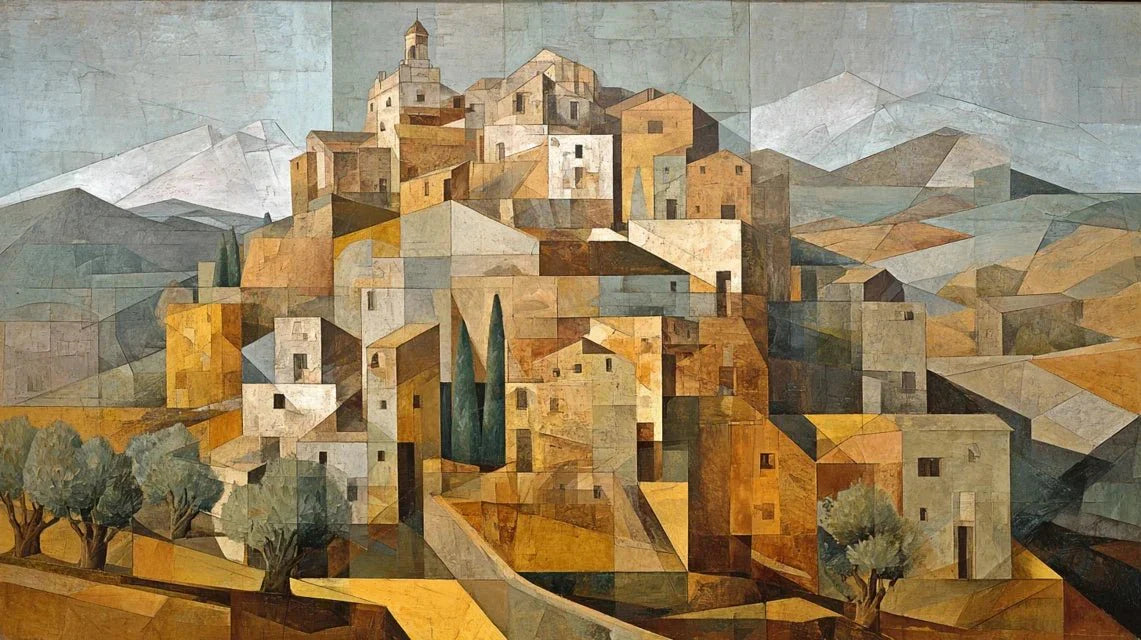
In Horta de Ebro, Picasso produces Landscape, Horta de Ebro, a work where the village houses literally explode into geometric fragments. Volumes are no longer solid: they decompose into angular planes that slide over each other. The reservoir, roofs, walls – everything becomes a mosaic of shapes that interlock like pieces of a three-dimensional puzzle compressed on the canvas.
Two years later, in 1911, head to Céret in the French Pyrenees. There, Picasso pushes his logic even further. His Landscape of Céret borders on total abstraction. Only a few visual clues remain – a schematic staircase here, an arched window there, a few touches of earthy color. The viewer must mentally reconstruct the landscape from these scattered fragments. It's like a visual rebus where each element must be deciphered.
During these years of intense creativity, Picasso creates more than 300 works between 1911 and 1913 (Source: Musée Picasso Paris). A dizzying production that testifies to his fascination with this new pictorial territory.
Seeing nature from all angles
Picasso's great discovery? To show multiple perspectives at once. This fragmentation of space allows to capture the essence of a landscape rather than its superficial appearance. A hill reveals all its facets simultaneously. A tree is revealed from all sides.
The planes do not simply coexist: they interpenetrate, become translucent, create fascinating areas of ambiguity. Georges Braque, Picasso's companion, summed it up perfectly: “Fragmentation served me to establish the space and the movement of space” (Source: Centre Pompidou). This statement illuminates the entire Cubist enterprise: it is not a matter of destroying nature, but of rebuilding it according to a new logic.
Specifically, in the landscapes of Horta, here's what Picasso accomplishes:
- He deconstructs the spatial homogeneity inherited from the Renaissance
- He superimposes multiple angles of vision on the same surface
- He fragments each natural element into autonomous but related planes
- He creates a paradoxical depth without traditional linear perspective
To truly understand these paintings, you must accept that they require effort. The cubist landscape must be « thought » as much as « seen », reconstructed by the mind from the fragments offered. It's a bit like reading a musical score rather than passively listening.
Color at the service of structure
Another radical choice: Picasso abandons bright colors. His palette is limited to ochres, grays, browns and beiges. Why this austerity? To focus all attention on spatial structure and geometry. In Landscape of Céret, these earthy tones create a subtle play of chiaroscuro that sculpts depth without resorting to vibrant colors.
The touches of paint, applied with systematic small brushstrokes, recall pointillism. But here, they serve to define the different geometric planes, each facet retaining its autonomy while participating in the unity of the work. It's like an architecture where every stone counts, but where the overall building takes precedence.
Braque explained it this way: « With color, only the aspect of light concerned us. Light and space are two things that touch each other » (Source: Centre Pompidou). Tonal variations therefore become tools to sculpt fragmented space, create volume without classically modeling, suggest depth without perspective.
A legacy that endures
This reinvention of natural space reaches its peak between 1911 and 1912, a period known as « analytical cubism ». Picasso finds a perfect balance between readability and abstraction. Landscapes remain identifiable, but transformed, reinvented according to a radical geometric logic.
The influence of this pictorial revolution continues today in contemporary art. If you want to discover how current artists engage with this Cubist heritage, explore the collection of wall art landscapes which shows the continuity of this reflection on the representation of nature.
Picasso’s Cubist landscapes are not mere formal exercises. They constitute a complete conceptual refoundation of how art can capture nature. By fragmenting, superimposing and reducing, Picasso destroys nothing: he rebuilds everything. It is this tension between apparent destruction and real construction that makes these works so powerful a century later.
FAQ : Cubist Landscapes by Picasso
Q: Why do Picasso’s cubist landscapes seem so fragmented?
R: Picasso deliberately fragments natural space to show multiple perspectives simultaneously. Instead of representing a landscape from a single point of view, he decomposes volumes into geometric planes that reveal different facets of the same place. This technique, called analytical cubism, allows to capture the structural essence of a landscape rather than its superficial appearance.
Q : What are the major landscape works by Picasso during his Cubist period?
R : The most emblematic Cubist landscapes by Picasso include Landscape, Horta de Ebro (1909) and Landscape of Céret (1911). Created during stays in Catalonia and the French Pyrenees, these works mark the peak of his approach to geometrizing the natural landscape. Between 1911 and 1913, he created more than 300 works in Céret, testifying to the intensity of his research.
Q : Why did Picasso use such muted colors in his Cubist landscapes?
R : The monochrome palette of ochres, grays and browns is not a limitation but a strategic choice. By reducing colors, Picasso focuses the viewer's attention on the spatial structure and geometric fragmentation. Tonal variations serve to sculpt space and define superimposed planes without the distraction of bright colors, allowing for better readability of the fragmented composition.