







What meditative function do Zen dry gardens serve compared to painted landscapes?
February 3, 2026 · 9 min read · by Walensky
I spent three months in Kyoto in 2019, staying in a small Buddhist temple where every morning at dawn I contemplated the dry garden from the wooden veranda. This rectangle of raked white gravel and its fifteen stones arranged in an invisible order mesmerized me. One day the monk showed me an ancient scroll: a painted landscape depicting exactly the same mineral composition. I then understood that these two arts did not tell the same story, but conversed in a language our restless era has forgotten.
Here is what this distinction brings to our interiors and our lives: Zen dry gardens offer a living, bodily meditation where painted landscapes offer static contemplation, they turn the observer into an active participant in the meditative process, and they create a space of mental silence through physical engagement rather than vision alone.
You may have hung a magnificent Asian landscape in your living room, hoping to find the serenity promised by magazines. But something is missing. The calm stays on the surface, like an idea of calm rather than calm itself. Why this disappointment?
Because we confused representation with experience. Reassure yourself: understanding the specific meditative function of Zen dry gardens will transform your relationship not only to your decoration, but to your daily practice of presence. I will reveal what fifteen years of studying Japanese contemplative spaces have taught me.
The dry garden: a meditation that breathes with you
In the Zen tradition, the karesansui (dry garden) is never fixed. Unlike the painted landscape that captures an eternal instant, the dry garden evolves with light, season and viewing angle. The monks of Ryoan-ji temple rake the gravel daily into undulating patterns that evoke water, creating each day a new mineral calligraphy.
This impermanence lies at the heart of its meditative function. When you contemplate a dry garden, you observe time passing : the shadow of a stone that shifts, a fallen leaf that breaks the symmetry, moss that imperceptibly gains ground. Your mind anchors itself in the present because the garden itself breathes to the rhythm of the hours.
The painted landscape, however masterful, shows you an artist's vision at a single moment. Its meditative function rests on imagination : you project your mind into this distant landscape, you escape mentally. It is meditation by substitution, by mental transport. The dry garden, for its part, brings you back here and now, into your body, before these real stones that catch the current light of your day.
Bodily engagement: when contemplating becomes acting
Here is the revelation that transformed my practice: a traditional dry garden is not meant merely to be looked at. In Zen monasteries, the monks rake it themselves. This repetitive, meditative gesture turns maintenance into spiritual practice. The rake traces furrows that represent water, emptiness, the flow of existence.
Even in our Western interiors, this bodily dimension persists. I have installed at home a tray of fine sand with three stones and a small bamboo rake. Every Sunday morning, I redraw the patterns. My hands move slowly, my breathing regulates, my anxious thoughts dissolve into the gesture. This is not art therapy, it is embodied meditation.
The painted landscape engages only your gaze. Its meditative function remains contemplative, passive in the noble sense of the term. You sit, you observe, you let the image work on your imagination. It is precious, but fundamentally different. The dry garden engages your body in space : you move to see the stones from another angle, you lean forward, you feel the gravel crunch under your steps if you are permitted to step on it.
The kinesthesia of emptiness
Neuroscience confirms what the monks knew intuitively: movement anchors consciousness. When your eyes follow the raked curves of the dry garden, when you walk around the stone tray, your vestibular and proprioceptive systems are activated. Your meditation becomes sensory, multidimensional. The painted landscape, however sublime, cannot offer this bodily immersion.

Active emptiness versus full contemplation
Observe a classic painted landscape: misty mountains, waterfalls, twisted pines, perhaps a small human figure. It is a full composition, rich in detail, even in the minimalist style of ink wash paintings. Your eye travels from element to element, your mind identifies, names, appreciates.
The Zen dry garden works in reverse. It is a predominantly empty space : white gravel, a few scattered stones. According to legend, the garden of Ryoan-ji contains fifteen stones arranged so that from no single viewpoint can all of them be seen at once. This visual incompleteness is deliberate.
The meditative function of the dry garden rests on this fertile emptiness. Your mind, confronted with the absence of narrative information, stops telling stories. It enters a state of pure receptivity. The stones represent nothing precise (islands in the ocean? mountains emerging from clouds? tigers crossing a river?), and it is precisely this ambiguity that frees your consciousness from habitual patterns.
The painted landscape, even when spare, guides you. The artist made choices, told a visual story. You receive it, you interpret it, but you remain in dialogue with an external intention. The dry garden tells you nothing. It simply is. You simply are. Meditation emerges from this silent co-presence.
— Our selection


These stones that never move teach you about change
A fascinating paradox: the elements of a Zen dry garden are among the most stable that exist (stones placed centuries ago, unchanging gravel), and yet it is art that best teaches impermanence. How?
Through what the Japanese call ma (間), the interstitial space-time. The dry garden reveals ma : the interval between the stones, the silence between forms, the distance that allows each element to exist fully. By meditating before a dry garden, you learn to perceive these intervals in your own life : the pauses between thoughts, the fertile emptiness between actions.
A painted landscape captures a perfect moment. Its beauty lies in its frozen completeness. The dry garden, by contrast, always remains unfinished, always open. Its meditative function consists in making you experience incompleteness as perfection. The fifteen stones you never see simultaneously become a metaphor for existence: there is always something beyond the field of perception, and that is as it should be.
The lesson of daily raking
Each morning, the patterns of the day before are erased and redrawn. This ritual practice teaches non-attachment. You create something beautiful knowing it will be destroyed tomorrow. Meditation lies not in preservation but in the act of creation itself. No painted landscape can transmit this wisdom in the same embodied way.

— Also to discover


Bringing This Wisdom Into Your Daily Life
You do not need an outdoor garden to benefit from this meditative function. I have worked with clients living in apartments who created miniature dry gardens of remarkable power. A 40x60 cm tray placed on a console, three carefully chosen river pebbles, fine sand, a small bamboo rake.
The key lies in regular interaction. Not in aesthetic perfection. Each week, take ten minutes to rake new patterns. Not to create something Instagram-worthy, but to feel the movement slow your breathing. To observe how your mood unconsciously influences the curves you draw.
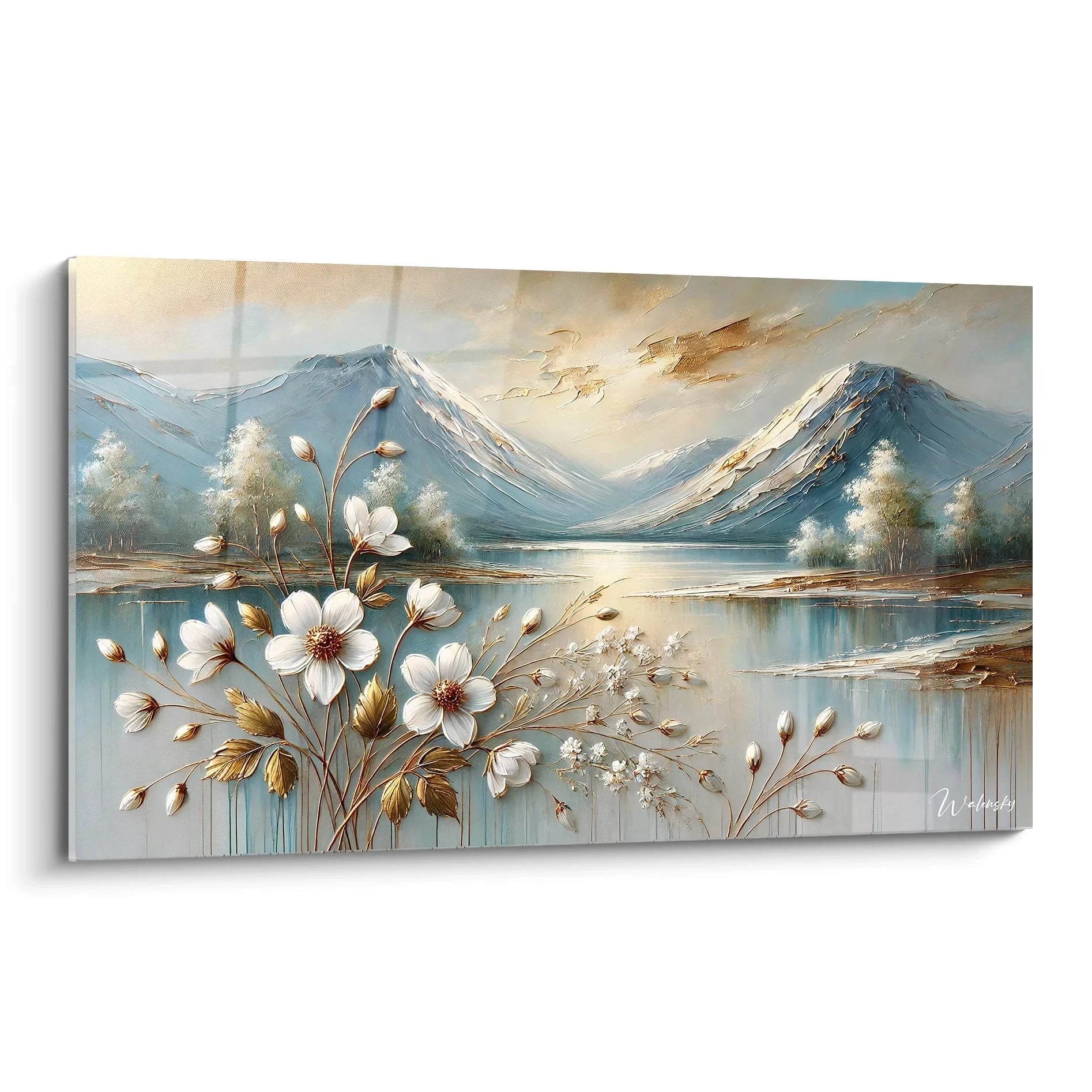
Consciously contrast this practice with your nature paintings hanging on the walls. They inspire escape, dreaming, the longing for beauty. Precious. But with a different meditative function. The painted landscape takes you elsewhere. The dry garden brings you back here.
In my consulting practice for contemplative spaces, I often recommend this conscious complementarity : an Asian landscape in the bedroom to nurture the imagination before sleep, a small dry garden in the entrance or office to anchor your return to the present several times a day.
Transform your space into a sanctuary of presence
Discover our exclusive collection of nature paintings that will harmoniously converse with your meditative practice, creating a perfect balance between contemplation and grounding.

Your new way of seeing silence
Since I understood this distinction, my Lyon apartment has become a laboratory of presence. My ink mountain landscape makes me dream of distant horizons when daily life weighs on me. My sand tray with its four stones brings me back to my breath when anxiety scatters my thoughts.
Zen dry gardens fulfill an irreplaceable meditative function : they transform contemplation into a bodily experience, emptiness into a space of awakening, impermanence into a daily practice. Painted landscapes, for their part, open the doors of imagination, preserve eternal beauty, and nourish aesthetic aspiration.
We don't have to choose. We can honor both dimensions of our consciousness : the one that dreams and travels, the one that grounds and breathes. Start modestly: a small tray, sand, three stones you collect on a walk. And observe, over the weeks, how this simple gesture of raking the void gradually shapes a space of peace amid the turmoil of your days.
FAQ: Your questions about Zen dry gardens
Can you really meditate with a small indoor dry garden, or is a large outdoor space necessary?
Absolutely! Size matters much less than the quality of presence. I have seen 30 cm trays generate deep meditative states. The essential lies in regular interaction : raking, observing the variations of light, adjusting a stone. A large outdoor garden is visually impressive, but a miniature garden on your desk accompanies you daily, accessible every day. The meditative function is built through repetition, not scale. Start small - a rectangular tray, three pebbles, fine white sand - and give it five minutes three times a week. You will quickly feel its soothing influence, the unique way it slows your mental rhythm simply by raking it consciously. The spatial constraint even becomes an advantage: it forces you toward simplicity and minimalism, precisely where Zen's power lies.
Can a painted landscape not also serve as a meditation support, like a dry garden?
Yes, but differently. The painted landscape encourages imaginative meditation : you project yourself mentally into the scene, you travel inwardly toward those misty mountains or that waterfall. It is a valuable form of visualized meditation, close to certain Tibetan Buddhist practices. But the dry garden activates a somatic and present meditation : your body is involved (you rake, you move to change perspective), your attention remains anchored in the real physical space. The painted landscape says: 'Go elsewhere, into the imagination'. The dry garden says: 'Be here, fully'. Both have their place. I even recommend combining them deliberately : a painted landscape to nourish aspiration, fertile reverie, imaginative openness; a dry garden to cultivate grounding, bodily presence, acceptance of what is. Your meditative practice is enriched by this complementarity rather than choosing one over the other.
How do you choose stones and compose your first dry garden without technical knowledge?
Forget the rules at first. Follow your aesthetic intuition. On a nature walk, pick up three to five stones that attract you - interesting shapes, contrasting colors, varied textures. Avoid stones that are too round (less character) or too pointed (visually aggressive). Favor different sizes to create a natural hierarchy. At home, take a shallow rectangular tray (3-5 cm high) and fill it with fine white or light beige sand. Place your stones avoiding obvious symmetry: never in the center, never aligned. Create irregular groupings (two stones close together, one isolated). Rake the sand in parallel curves around the stones, like aquatic ripples. Step back, observe, adjust. There is no possible mistake: your dry garden is perfect if it invites you to return and contemplate it. Technical sophistication will come naturally if you persist. The essential is to begin, imperfectly, today.


