

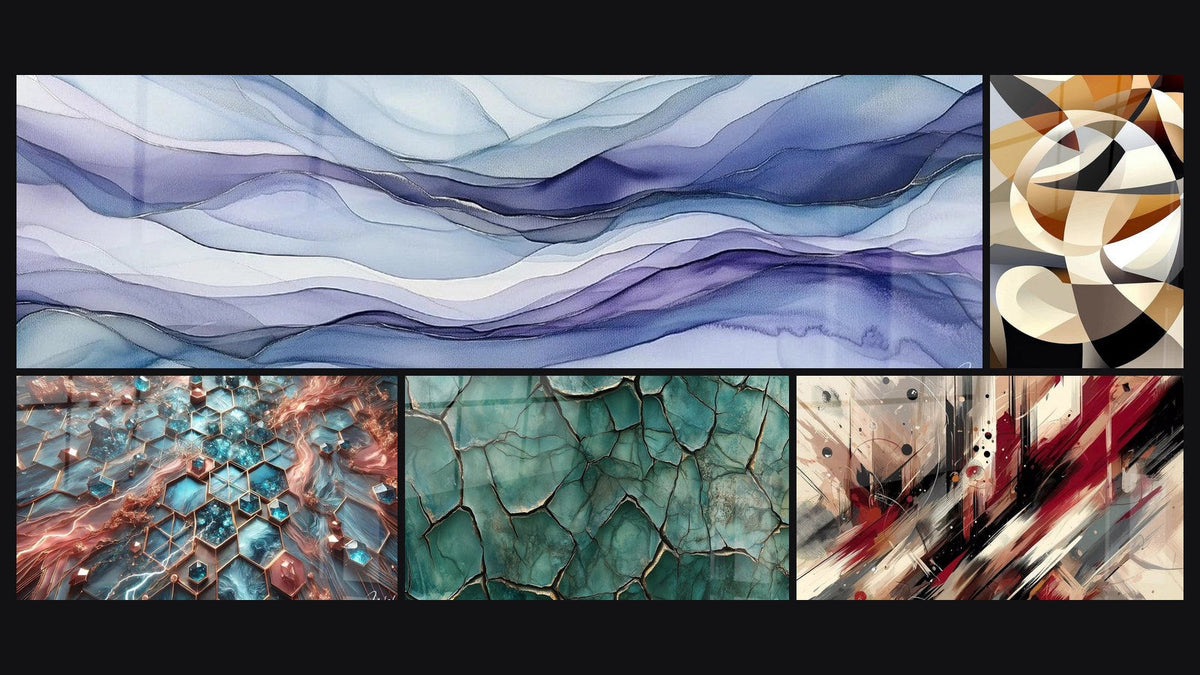
The first time I stepped into a cave adorned with millennia-old formations, I understood why so many artists across the centuries have been fascinated by these mineral architectures. These geological formations, suspended like cathedral chandeliers or rising from the ground like petrified organ pipes, embody an aesthetic that only time can sculpt. Their artistic representation bears witness to our ancestral fascination with hidden worlds, those spaces where light and darkness engage in a mineral ballet.
Here is what the depiction of stalactites and stalagmites brings to your aesthetic world: a poetic dimension that evokes the mystery of the earth's depths, a rich cultural reference spanning painting, sculpture and decorative arts, and an invitation to a sensory journey toward unexplored spaces where the imagination is set free. These underground formations offer contemporary creators a powerful visual vocabulary, blending organic and mineral, dramatic verticality and evocative texture.
Yet many hesitate to bring this subterranean theme into their décor, fearing an effect that is too dark or too specialized. How can one evoke the world of caverns without falling into the picturesque or the scientific? How can these natural architectures engage in dialogue with a contemporary interior?
Rest assured: the artistic representation of stalactites and stalagmites goes far beyond a simple geological documentary. It belongs to a sophisticated aesthetic tradition, from Romanticism to contemporary art, offering varied interpretations suited to every interior style. This article guides you through the fascinating history of this underground iconography and its current decorative applications.
The emergence of the underground world in artistic imagination
As early as the eighteenth century, the scientific exploration of caves nourished the imagination of Romantic artists. Stalactites and stalagmites became recurring motifs in landscape painting, symbolizing nature's creative power and the infinitely slow. British watercolorists, in particular, immortalized the caves of Castleton and Cheddar with meticulous attention to the play of light on these calcareous formations.
This fascination was not merely aesthetic: it revealed a spiritual quest. Caverns adorned with these mineral formations evoked natural temples, sanctuaries where geological time meets human time. Artists saw in them a manifestation of the sublime, that emotion blending terror and admiration before natural forces. Suspended stalactites embodied a threatening fragility, while rising stalagmites symbolized perseverance and imperceptible growth.
In period engravings, one observes particular attention to striated textures, the ochre and white hues of the concretions, and the watery reflections that multiply these vertical architectures. This documentary precision served a poetic ambition: to make the viewer feel the unique atmosphere of these underground cathedrals.
When sculpture draws inspiration from millennia-old formations
Contemporary art has reinterpreted these geological forms with renewed boldness. Sculptors use resin, glass, metal or ceramic to recreate the essence of these natural concretions. Their works do not seek faithful reproduction but capture the spirit: dramatic verticality, irregular surfaces, the patient accumulation of matter.
Monumental installations play on the inversion of scales and contexts. Translucent glass stalactites suspended in urban spaces create a poetic collision between the underground world and contemporary architecture. These pieces question our relationship with time: where a real stalactite grows one centimeter per century, the artwork instantly freezes this geological temporality.
Reinvented materiality
Artists explore diverse materials to evoke these formations. Patinated bronze imitates mineral flows, glazed ceramic reproduces calcareous concretions, while phosphorescent materials add a dreamlike dimension to artificial stalagmites. This diversity makes it possible to adapt the evocation of the underground world to different decorative contexts, from the most classical to the most avant-garde.

Painting and engraving: mapping the invisible
The pictorial representation of stalactites and stalagmites poses a fascinating technical challenge: how to translate complex volumes, damp translucencies and dark depths punctuated by flickering lights into two dimensions? Painters have developed specific techniques, using glazes to suggest the translucency of limestone and dramatic contrasts to sculpt forms through light.
In the Eastern tradition, particularly Chinese, rock and mineral formations hold a central place in landscape painting. Although different in their genesis, depictions of karst peaks and ornate caves share with Western figuration of stalactites this same fascination for vertical natural architectures, these same play of precarious balance and eroded matter.
Japanese woodblock prints also explored these themes, integrating caves and mineral formations into compositions where water, rock and vegetation harmoniously interact. These Eastern works offer a valuable aesthetic alternative, less dramatic than the Western Romantic approach, favoring serene contemplation.
The underground imaginary in decorative arts
The influence of stalactites and stalagmites extends well beyond the fine arts to permeate the entire decorative universe. Art Nouveau furniture, with its organic lines and nature-inspired motifs, sometimes incorporates references to mineral concretions. Certain Belle Époque chandeliers explicitly evoke crystalline stalactites, transforming domestic lighting into a fairy-tale evocation of the underground world.
In contemporary ceramics, many creators explore flowing textures and accumulations of glazed material that evoke the slow growth of calcareous formations. These pieces function as habitable sculptures, bringing a tactile and organic dimension to interiors.
Textiles and wallpaper inspired by caves
Even more surprising, textile design has embraced this underground imagery. Motifs depicting stalactites and stalagmites adorn upholstery fabrics and wallpapers, translating these vertical architectures into stylized two-dimensional forms. These creations oscillate between geometric abstraction and naturalistic evocation, offering sophisticated decorative solutions for those who wish to integrate this theme without the literalness of a photographic reproduction.

Exploration photography: documenting hidden beauty
Cave photography constitutes a genre in its own right, where technique meets poetry. Capturing stalactites and stalagmites requires particular mastery of lighting: too harsh, it flattens the volumes; too diffuse, it drowns the details in darkness. Specialized photographers develop unique approaches, using long exposures, multiple light sources and subtle post-production to reveal the magnificence of these formations.
These images, when printed in large format and carefully framed, become true contemporary paintings. They bring into our interiors a window onto inaccessible worlds, an invitation to motionless travel. The documentary quality of these photographs in no way prevents their aesthetic dimension: balanced composition, refined chromatic palette ranging from milky whites to deep ochres, play of symmetries and repetitions.
Integrating the underground imaginary into your décor
How can you concretely invite this aesthetic of the depths into your living space? Several approaches are available, depending on your sensitivity and decorative boldness. The most accessible option remains hanging a work depicting stalactites and stalagmites: artistic photography, antique engraving or contemporary interpretation.
For a more subtle integration, favor evocations over literal representations. A light fixture with flowing lines, a vertical sculpture with irregular textures, cushions with abstract motifs inspired by mineral concretions: each touch creates an atmosphere without imposing an explicit theme. The essential is to capture the spirit: verticality, mineral organicity, the interplay between light and darkness, suspended temporality.
The color palettes associated with this underground universe also offer rich decorative avenues. Mineral tones – limestone grey, chalky white, ferrous ochre, deep black – create a neutral and sophisticated base against which more vibrant accents can stand out. These colors naturally evoke geological formations without requiring figurative representation.
Transform your interior into a poetic journey
Discover our exclusive collection of nature paintings that capture the majesty of natural formations and bring depth and mystery to your spaces.
The symbolic dimension: beyond aesthetics
Why this lasting fascination with stalactites and stalagmites in art? Beyond their undeniable formal beauty, these formations carry a powerful symbolic charge. They embody long time, that geological temporality which defies our human perception. Every millimeter of growth represents decades, sometimes centuries, of patient mineral accumulation.
This symbolism resonates particularly in our era of constant acceleration. Contemplating the representation of stalactites offers a form of meditation on creative slowness, on natural processes that escape our control and our impatience. It is an invitation to reconsider our relationship with time and transformation.
Moreover, the underground world traditionally evokes the unconscious, the psychic depths, what is hidden yet nonetheless active. Surrealist artists did not fail to exploit this dimension, integrating caves and concretions into their dreamlike landscapes. Even today, this symbolic resonance enriches any artistic representation of these formations, lending it a depth that goes beyond simple naturalistic reproduction.
Imagine your living room transformed by a large photograph of illuminated stalactites, creating a contemplative focal point. Picture your entrance welcoming visitors with a sculpture evoking the mysterious verticality of stalagmites. These decorative touches are not mere ornaments: they invite inner travel, creating spaces for questioning and reverie. Begin by identifying a wall or a corner that could benefit from this poetic dimension, then let your sensibility guide you toward the work that will resonate with your personal universe.
Frequently asked questions
How can you integrate the stalactite theme without creating an overly dark atmosphere?
The key is to play on the balance between evocation and subtlety. Favor representations that capture play of light rather than darkness: photographs of backlit translucent stalactites, paintings with light palettes dominated by luminous whites and greys, or sculptures in reflective materials such as glass or light glazed ceramic. Pair these elements with careful lighting – directional spotlights, indirect illumination – that enhances volumes and creates depth without darkening the space. The idea is not to recreate the darkness of a cave, but to evoke the mineral poetry of its formations within a bright and welcoming context.
Which decorative styles pair well with this underground imagery?
Contrary to popular belief, the representation of stalactites and stalagmites adapts to a wide variety of styles. In a minimalist contemporary interior, a refined sculpture evoking these formations brings a welcome organic touch. For an industrial style, large-format photographs of caves create a poetic contrast with raw materials. Ethnic or bohemian settings naturally welcome references to primordial nature. Even in a classical decor, an antique engraving of an ornate cave finds its place naturally. The key lies in the choice of the work and its treatment: abstract or figurative, monochrome or colored, spectacular large format or series of small pieces. Adapt the representation to your existing universe rather than creating a thematic break.
Where can you find artworks depicting stalactites and stalagmites?
Several sources are available to enthusiasts of this theme. Galleries specializing in nature photography regularly offer prints of ornate caves made by explorer-photographers. Online contemporary decor shops often include graphic or abstract interpretations of these formations in their wall art collections. For more classical pieces, flea markets and print fairs sometimes hold magnificent antique engravings depicting famous caves. Contemporary ceramists and sculptors also offer unique pieces inspired by these mineral architectures, often presented at art fairs or on platforms dedicated to fine craft. Do not hesitate to explore various sources to find the work that will resonate with your personal sensibility and blend harmoniously into your space.


