

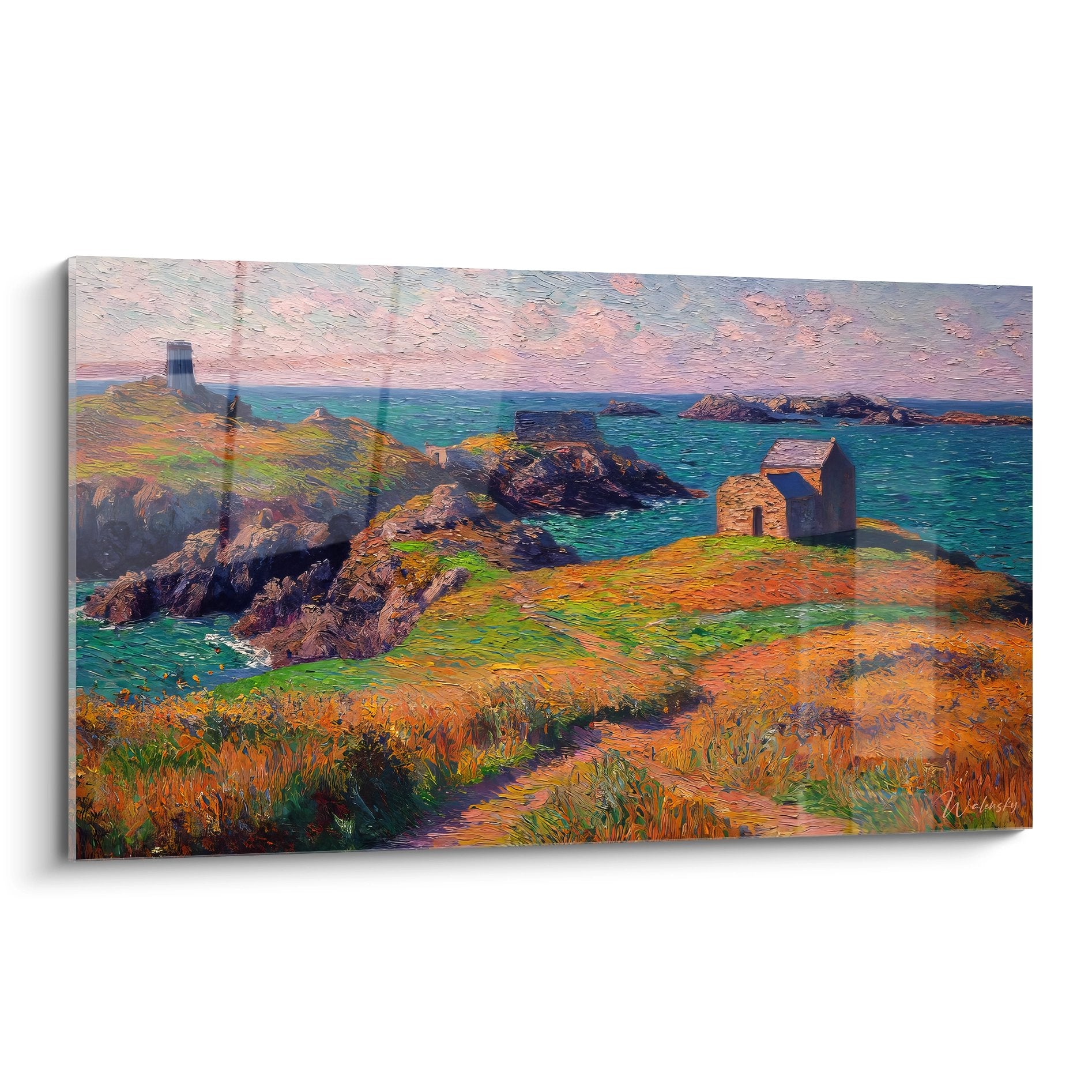






Acrylic glass print in open space : deployment guide for large areas
9 min read · by Walensky
MEETING ROOM PAINTING
A floor of forty workstations, two thousand two hundred square meters, floor-to-ceiling windows that change the light every two hours, and three zones that have nothing in common: the reception, the circulation aisles, the concentration pods. Hanging a painting in this kind of space has nothing to do with choosing a piece for a closed office. It is an exercise in planning, almost in mapping, before it is an aesthetic choice.
Acrylic glass printing has its place in this setting, provided it is thought of at the scale of the entire floor rather than workstation by workstation. This zone-by-zone deployment is what we detail here.
The direct answerEquipping an open space with acrylic glass printing means mapping the space into zones (reception, aisles, collaborative areas, fixed workstations), allocating the budget per square meter rather than per isolated painting, and keeping chromatic consistency across the whole floor while varying the formats. For a floor of 50 workstations, plan on roughly 6 to 10 works spread across the passage and break areas, rather than one painting per desk.- An open space is handled by zones (reception, aisles, collaborative spaces), not desk by desk.
- Acrylic glass reflects light: reserve it for areas where lighting is controlled, not directly facing a fully south-facing window wall.
- Visual coherence comes from a shared palette, not identical works everywhere.
Why do open spaces pose different challenges than an individual office?
In a closed office, a painting is judged from a single point of view: the armchair, the door, the reception sofa. In an open space, the work is seen from fifty different angles, at distances ranging from two to twenty meters, often glimpsed quickly between two meetings.
The light, too, changes in nature. An oriented window wall floods the floor in the morning, then fades in the afternoon while artificial lighting takes over. A painting in acrylic glass, whose glossy surface reflects part of the light, will react very differently depending on the time of day and where it is hung.
Finally, there is the question of visual noise. An open space is already saturated with screens, cables, signage, and green plants lined up in rows. Adding works without logic only adds noise. A well-placed work, on the other hand, creates a landmark: one says "I'm near the gold painting" far more naturally than "I'm at partition three."
An open space does not need more art, it needs better-placed art.

Mapping your open space before choosing the works
The first mistake, common among hurried planners, is to buy the paintings before knowing where they will go. In a large space, the reverse works better: draw the plan first, then place the works on it.
Identifying key zones: reception, aisles, collaborative spaces, fixed workstations
A floor is always divided into a few main families of zones, even when the architecture varies:
- Reception : the first wall seen by visitors, often the largest possible format.
- Circulation aisles : walls passed through quickly, which call for works that read well from a distance, with strong contrasts.
- Collaborative spaces : break rooms and brainstorming zones, where the work can be contemplated for longer.
- Areas around fixed workstations : here, overly imposing formats directly above a screen are best avoided, but a side wall at the end of a row can hold a more discreet piece.
This division is not merely aesthetic. It also determines how the acrylic glass renders, since it requires controlled light: a dim aisle suits it better than a wall directly opposite a fully south-facing glass wall.
Setting a budget and a distribution per square meter
Reasoning in terms of budget per square meter, rather than number of works, avoids two classic pitfalls: the under-equipped floor where three lost paintings float across a thousand square meters, and the overloaded floor where every wall carries its canvas without an overall logic.
A simple, proven decorating rule: a work ideally occupies 60 to 75% of the width of the wall or piece of furniture it hangs above. Applied to an open space, it helps calibrate the format without guessing by eye.
For formats, the shop offers pieces ranging from size L (120x70 cm) up to 4XL (240x140 cm), as well as made-to-measure options. That covers everything from a narrow aisle wall to an entire panel behind a reception desk.
the Paintings for Professionals collection— Our selection


Creating visual coherence across several zones without monotony
Coherence does not mean repetition. Hanging the same work on every floor of a building gives an impression of uniformity, not identity. In an open space, coherence is built on a shared palette and a family of subjects, not on a cloned painting.
A chromatic thread works particularly well with contemporary abstract art, which comes in variations of tones without ever repeating formally. For example, one can keep a dominant gold and beige across the whole floor while varying the compositions from one zone to another.
These two pieces, for instance, share the same family of golden and beige tones while remaining visually distinct: one plays on fluid, sophisticated curves, the other on a more assertive movement. Placing them in two different zones of the same floor creates a common thread without a sense of duplication.
For areas where you want a deliberate break, such as a break room livelier than the rest of the floor, a multicolored and dynamic work like the Cosmic Viscosity painting changes register without fully breaking with the overall spirit, as long as the palette is tied together elsewhere.
— Also worth discovering


Deployment examples depending on the size of the open space
The number of works needed depends directly on the number of workstations and the configuration of the walls, not on a universal formula.
Small open space (10-20 workstations)
On a floor of this size, two to four works are generally enough: a strong piece at reception, one or two in the break or collaboration area, and possibly one more at the end of a row of workstations. The L or XL format suits most cases, except for the reception wall, where a more generous format makes its impact.
Large floor (50+ workstations)
Here, one reasons in blocks of workstations rather than by a single painting. A floor of fifty workstations is often divided into three or four clusters, each with its own visual anchor point. A total of six to ten works is then counted: large formats (3XL, 4XL) for reception and the large aisle walls, L or XL formats for the areas around workstations.
| Floor size | Recommended number of works | Dominant formats |
|---|---|---|
| 10-20 workstations | 2 to 4 | L, XL |
| 20-50 workstations | 4 to 6 | XL, XXL |
| 50 workstations and more | 6 to 10 | XXL to 4XL, targeted zones |
For a reception area that must make an impression from the entrance, a work with fluid curves and a gray and gold palette, such as the Nuances Enveloppantes painting, creates a sophisticated atmosphere without tipping into garishness.
Torn between several styles to harmonize your zones? the acrylic painting collection lets you compare the available palettes before validating a distribution.

In the same spirit
Painting Ebony Pearls - Abstract Artistic Edition
From €273.90
Discover this painting →Frequently Asked Questions
What budget should you plan to equip an entire open-plan office with acrylic paintings?
Acrylic glass paintings in the shop start from €273.90. For a floor of fifty workstations with six to ten works spread across the key zones, the overall budget depends mostly on the sizes chosen: the largest formats, used for reception walls, naturally weigh more than the L formats placed near workstations.
How many paintings does an open-plan office of 50 workstations need?
Generally between six and ten works, grouped in clusters rather than spread evenly. The goal is not to cover every metre of wall, but to place visual landmarks in the circulation and break areas, where the eye naturally lands.
Does acrylic glass printing hold up against the ambient noise of an open-plan office?
Acrylic glass has no particular acoustic property: it neither absorbs nor amplifies sound. The "visual noise" mentioned above is a different matter: it concerns an overload of decorative elements, not sound. For acoustics in the literal sense, other solutions (absorbent panels, partitions) come into play, independently of the choice of wall artworks.
How do you harmonise several paintings in a large open space?
By first setting a common palette (two or three dominant tones present in every work), then varying compositions and formats from one zone to another. Chromatic consistency, more than repeating the same motif, is what unifies a large space without making it monotonous.
For more intimate areas, such as rooms dedicated to client meetings, the approach follows that developed in our article on acrylic glass printing for meeting rooms, where the logic of visual calm takes precedence over the welcoming effect.
Conclusion
Equipping an open-plan office is not simply a matter of buying pieces as empty walls appear. It is a deployment project, with its mapping, its distributed budget, and its colour consistency designed at the scale of the whole floor. Done seriously, this work turns an anonymous workspace into a recognisable place, where teams find their bearings as much as they feel comfortable.
It is also a question of image: visitors passing through an open space that is coherent and well cared for, down to its smallest walls, keep an impression that far exceeds the cost of the works. To extend this coherence beyond the floor, see our guide to cityscape paintings for meeting rooms, or the coworking painting collection for more informal shared spaces. And for the individual offices that punctuate the floor, our article on professional office wall decoration naturally completes this overall reflection.
Explore our collections


