

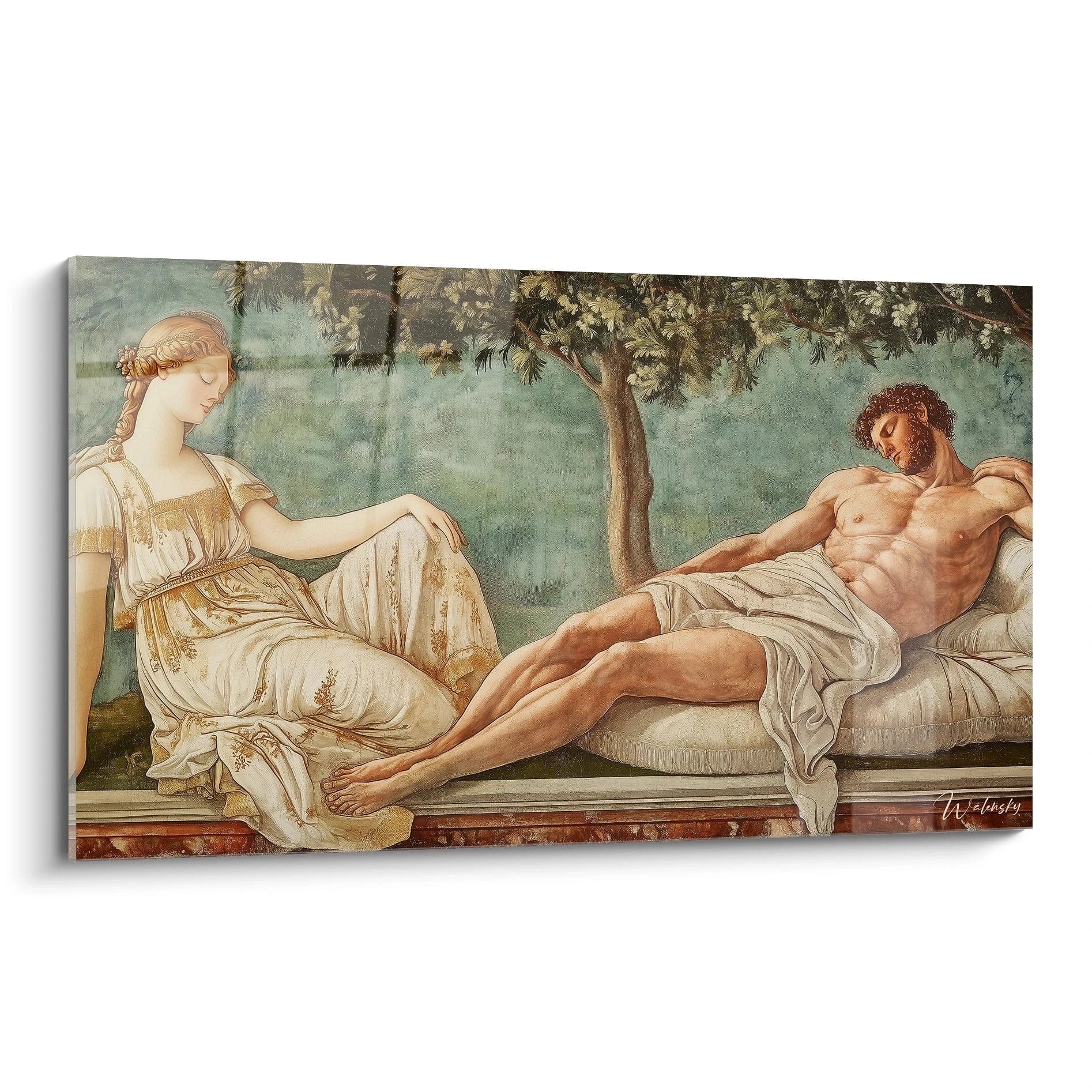






Do screen-printed paintings hold up better than inkjet prints?
May 2, 2026 · 8 min read · by Walensky
I still remember the disappointed collector who contacted me two years ago. On the wall of his office hung a Warhol reproduction he had bought on a trip to New York. Five years later, the vibrant colors he had so admired had faded into dull, washed-out tones. "How is this possible?" he asked me, disappointed. The answer came down to one word: the printing process.
Here is what screen printing brings to your paintings: exceptional resistance to light that preserves the brilliance of the colors for decades, durability that lasts across generations without visible alteration, and recognized artistic value that turns your wall into a true personal gallery.
You may have lived through this frustration: investing in a work that moves you, proudly hanging it in your interior, and noticing a few years later that its beauty has evaporated. The colors have paled, the contrasts have dulled, and the piece that gave character to your space no longer stirs the same emotion.
The good news? By understanding the fundamental differences between screen printing and inkjet printing, you can make informed choices that protect your investment and preserve the soul of your decor for years to come.
Screen printing: an artist's legacy that defies time
Screen printing is not a simple printing technique. It is an artisanal process in which each color is deposited in a thick layer through a stretched silk screen. Andy Warhol, Roy Lichtenstein, Banksy: all these masters chose screen printing for one essential reason – its unmatched durability.
Screen-printing inks form a deep chemical bond with the support. Unlike liquid inks that rest on the surface, they literally soak into the paper or canvas, forming an inseparable whole. This fusion ensures that your screen-printed paintings retain their chromatic intensity even after fifteen or twenty years of display.
I once had the opportunity to appraise screen prints dating from the 1960s. Their condition amazed me: the scarlet reds remained vibrant, the blacks as deep as on the first day. This exceptional stability of the pigments is explained by the very nature of the inks used – polymer-resin formulations that resist UV and oxidation remarkably well.
Inkjet printing: modern technology, real limits
Don't get me wrong: inkjet printing has revolutionized access to reproduction art. It offers extraordinary fineness of detail and an almost infinite chromatic palette. But its fundamental composition reveals structural weaknesses.
Inkjet inks, even in their high-end pigment versions, are deposited as surface microdroplets. Picture thousands of tiny ink dots placed delicately on the paper, without any real deep anchoring. This surface application makes them vulnerable to three silent enemies of your decor.
First, light. UV rays gradually break down the dye molecules. An inkjet painting exposed near a window can show signs of fading in only two to three years. Next, atmospheric humidity: it makes the paper fibers swell, creating microcracks in the ink layer. Finally, temperature variations that cause differential expansion between the support and the ink.
Giclée prints: the best of inkjet
There is, however, an aristocracy within the inkjet world: giclée prints. Using archival-quality pigment inks and museum-grade papers, they offer markedly superior durability. Their life expectancy can reach 75 to 100 years under optimal conditions – compared with 200 years or more for a screen print.
But these performances demand strict conditions: framing with anti-UV glass, keeping away from direct light sources, humidity control. Constraints that screen printing does not face.


Favorite
Jet-ski Urban Action Painting - Dynamic Splashes - Jetski Edition
€232.90
Discover this paintingThe pigment battle: thickness versus precision
When I physically compare a screen-printed painting and an inkjet print, the difference is obvious – and to the touch. Run your finger gently over a screen print: you feel a slight relief, proof of the substantial thickness of the deposited ink. This layer can reach 30 to 50 microns, compared with 2 to 5 microns for inkjet.
This thickness is not merely a matter of texture. It determines the optical density of the work. The blacks of a screen print are wells of depth, the whites burst with luminosity. This color saturation creates a visual impact that inkjet prints, despite their fineness, struggle to match.
Inkjet, on the other hand, excels in the subtlety of gradients and photographic reproduction. If your painting features delicate transitions between shades or microscopic details, inkjet technology will render them with astonishing fidelity. That is why many art photographers favor this process for their limited editions.
— Our selection

Your environment determines longevity
A screen-printed painting in a medical office, exposed daily to artificial and natural light, will keep its brilliance for decades. This resilience makes it the preferred choice of professional spaces where frequent renewal of works would be costly and tedious.
I supervised the fit-out of a care center where screen-printed works installed twelve years ago look as if they were hung yesterday. Patients gaze at them in the waiting room, day after day, and they continue to bring that touch of humanity and color essential in a medical setting.
Conversely, a standard inkjet print in the same context would have required two or three replacements over that period. The real cost of a work is measured not only by its purchase price, but by its ability to cross time without losing its soul.
High-risk areas in your interior
Some locations mercilessly test the resistance of your paintings. Facing a south-facing picture window: red zone for inkjet. In a kitchen where humidity fluctuates: beware of paper prints. Near a radiator or fireplace: thermal variations accelerate the aging of surface inks.
Screen printing tolerates these difficult environments with remarkable robustness. Its cross-linked inks resist humidity, its deep bond with the support protects it from thermal shock, and its UV stability makes it nearly indifferent to light exposure.

The long-term investment: calculating the true cost
A screen-printed painting generally costs 40 to 60% more than an inkjet print of equivalent dimensions. This initial gap puts some buyers off. Yet a financial analysis over ten years reveals a surprising reality.
Take a concrete example: an inkjet painting at €150 will probably need replacing after 5 to 7 years of normal exposure. Over fifteen years, you will therefore invest around €300. A €250 screen print will go through the same period without flinching, and will likely continue to embellish your wall for two more decades.
Beyond the purely financial aspect, there is this emotional continuity. Your painting becomes a lifelong companion, a silent witness to your changes, a visual anchor for your memories. Having to replace it breaks the intimate relationship we build with the objects that inhabit our daily lives.
— Also to discover


Authenticating quality: the signs that don't deceive
How can you tell a genuine screen print from an inkjet print presented as one? Several telling clues guide the discerning eye.
Look at the edges of the color areas: a screen print often shows slight irregularities, evidence of the manual passage of the squeegee. The colors appear laid down in distinct strata. Against the light, you sometimes distinguish a characteristic micro-texture.
Inkjet, by contrast, shows a uniformly smooth surface. The details are surgically sharp, almost too perfect. No relief is perceptible to the touch. If you have a magnifying glass, you will see the tiny dot screen that is the hallmark of the digital process.
Also demand a certificate of authenticity stating the process used. Screen prints are numbered (e.g. 15/100), indicating a limited edition. This controlled rarity helps preserve the value of your investment.
Transform your professional spaces with works that last
Discover our exclusive collection of paintings for medical offices that resist time and bring serenity to your patients for decades.

In the same spirit
Eternal Tranquility Painting - Tree Nature Edition
€233.90
Discover this painting →Making the choice that suits you
Imagine your interior ten years from now. Will the paintings you choose today still move you with the same intensity? Will their colors still tell the story you had imagined?
If your answer is yes, if you seek that reassuring permanence in a constantly changing world, screen printing stands out as the obvious choice. It turns your decorative choice into a potential heritage, an investment that outlasts trends and years.
Quality inkjet has its place: for photographic series, temporary reproductions, or spaces where you frequently renew your decor. But for these centerpiece pieces that define the identity of your living or working space, favor the technique that honors their importance.
Start by identifying the strategic locations in your space. Those where your gaze naturally rests, where your visitors instinctively stop. That is where screen printing will deploy its full power, today and for all the years to come.
Frequently asked questions
How long does a screen-printed painting keep its colors?
A screen print made with professional-grade inks keeps its chromatic brilliance for 200 years or more under normal display conditions. I have personally examined screen prints from the 1950s whose colors rival recent productions. This exceptional longevity is explained by the nature of the pigments used and their deep bond with the support. Even exposed to daily natural light, a screen print will show no visible fading for several decades. It is this permanence that justifies the higher initial investment: you acquire a truly durable work.
Can an inkjet print be suitable for a professional space?
Yes, provided you choose a giclée print with pigment inks on museum-grade paper, and observe certain precautions. Favor framing with anti-UV glass that filters 97% of harmful rays. Avoid direct sun exposure and maintain stable humidity between 40 and 60%. Under these optimal conditions, your print can last 75 to 100 years. However, for very bright spaces such as waiting rooms with large picture windows, or demanding environments like high-traffic medical offices, screen printing remains the safest choice to guarantee flawless durability without particular installation constraints.
How can I tell if a seller is offering me a genuine screen print?
Several simple checks protect you from false claims. First, examine the surface by touch: a screen print shows a slight perceptible relief, proof of the thickness of the deposited ink. Then look closely at the edges of the color areas – they often show micro-irregularities characteristic of manual passage. Always demand a certificate of authenticity explicitly mentioning the screen-printing process and the numbering of the edition. A genuine screen print rarely costs less than €200 for a standard format; a suspiciously attractive price should raise your vigilance. Finally, don't hesitate to ask for close-up photos or, better still, to see the work in person before buying so you can observe these telling signs with your own eyes.
Explore our collections


