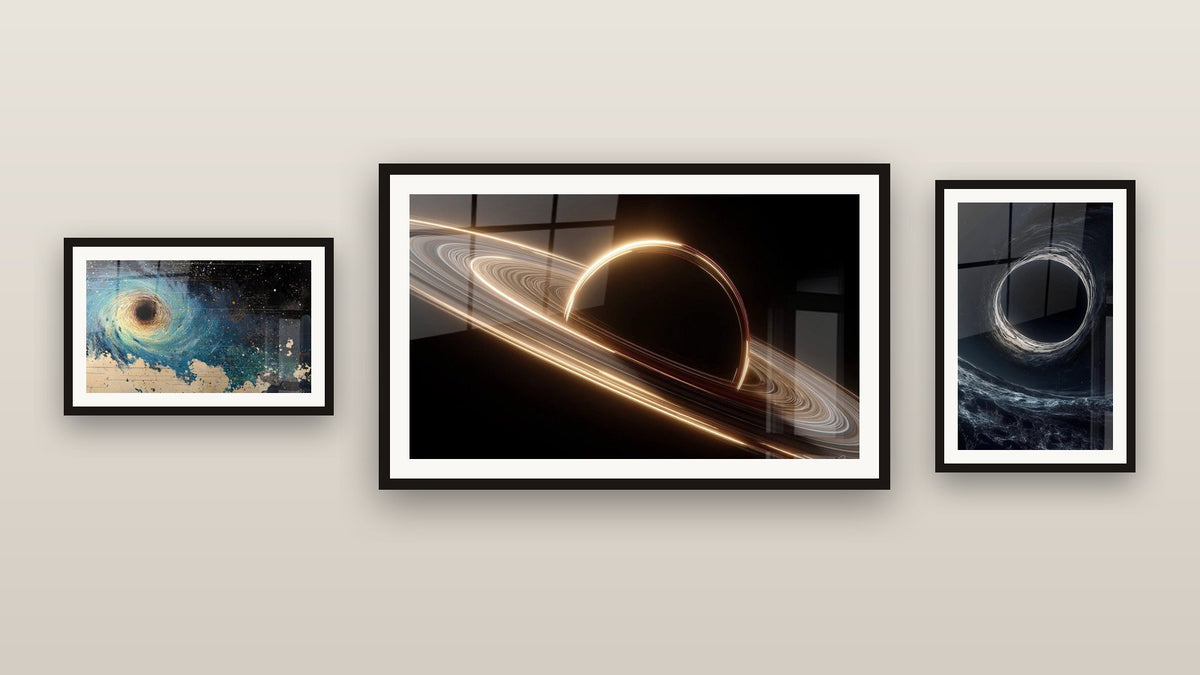
Acrylic glass print black hole galaxy: the light effect that changes everything
7 min read · by Walensky
BLACK HOLE MISCELLANEOUS SPACE PAINTING
A black wall that pulls in light, and at its center, a golden spiral that seems to turn before your eyes. This is the effect everyone seeks when they install a black hole painting in their living room, and it is also the one most people miss by choosing the wrong support. Because a black hole on a flat, matte surface remains just a dark circle. Nothing more.
The direct answerAn acrylic glass print recreates the luminous effect of a black hole thanks to the gloss of its surface, which reflects and intensifies the ambient light on the bright areas of the visual (halo, spiral) while keeping the blacks very deep. Combined with high-definition UV printing, this finish gives an impression of depth and contrast that paper or a matte surface cannot reproduce.No need for built-in LEDs or complicated electrical installation: the magic comes from the support itself, combined with the light already present in the room.
- Acrylic glass reflects the ambient light onto the bright areas of the visual, creating a luminous halo effect around the black hole.
- Dibond aluminum, by contrast, is matte and glare-free: better suited to a very bright room, but less spectacular for this specific effect.
- The rendering changes noticeably between day and night, depending on the intensity and angle of the light striking the surface.
Why acrylic glass reveals a black hole's light better
Acrylic glass is not simply "shinier": it adds a layer of optical depth between the eye and the image. Light falling on the surface is partially reflected, and this reflection blends with the golden or bluish tones of the visual to give an impression of shimmering, almost living light.
On a classic matte print, the contrasts remain flat. Black stays black, gold stays gold, with no interaction. On acrylic glass, these two zones respond to each other: the deep black absorbs the surrounding light, while the bright edges of the galactic spiral catch it and project it slightly toward you.
A black hole only exists through contrast. The absolute darkness, and the light escaping just before it disappears.
This is the whole point of this finish for this type of subject: it does not merely display the image, it makes it breathe with the room. Moreover, this logic applies to other cosmic themes too; it is explained very well in our article on acrylic glass printing for a galaxy-themed bedroom.
Technical criteria for a successful light effect
A good black hole rendering depends not only on the support: it also depends on the quality of the printed file and the thickness of the chosen glass.
Resolution and contrast of the source file
High-definition UV printing reproduces very fine gradients, essential for a subject like this one: the transition between absolute black and the orange or bluish shades of the rotating matter must be gradual, without any visible band. A file poorly processed for contrast will give a "flat" black hole, without the famous sensation of depth.
Thickness and finish of acrylic glass
The thicker the glass, the more pronounced the depth effect: the image seems slightly suspended beneath the surface, somewhat like looking into an aquarium from above. It is this thickness that creates the sensation of a "window into space", far more than on a simple printed sheet.
The glossy rendering of acrylic glass is not always an advantage: in a room very exposed to the sun, reflections can hamper viewing the image in broad daylight. In that case, matte Dibond aluminum remains the wiser finish.
For a very concrete example of this "galactic spiral" logic, the cosmic black hole painting illustrates well how the blue-gold gradient benefits from acrylic glass, with an almost hypnotic sense of motion.

Day and night effect: how the black hole changes with ambient light
In full daylight, under strong natural light, acrylic glass catches ambient reflections and slightly softens the deep blacks: the black hole appears more "cosmic", almost iridescent depending on the viewing angle. In the evening, under subdued lighting, the opposite occurs: the blacks become very dense again, and the bright zones of the spiral or the event horizon stand out with an almost electric intensity.
- South-facing living room, daytime : the glass reflection accentuates the art gallery feel; the image "shines" without being aggressive.
- Bedroom or living room in the evening, subdued light : the contrast increases, and the black hole seems literally to draw in the light around it.
- Windowless corridor : to avoid with acrylic glass without supplementary lighting; prefer Dibond aluminum, whose matte rendering remains legible even without reflections to catch.
It is this variation between day and night that makes a black hole painting almost alive: it is never seen exactly the same way twice.
Which model to choose based on the desired mood
Each black hole visual plays on a different balance between deep black and luminous halo, and depending on what you are looking for, the choice changes.
For a very science-fiction, almost cinematic mood, the Black Hole painting relies on a glowing golden horizon that stands out sharply against the black background: perfect for a living room where you want a strong focal point. For a more abstract and mystical rendering, the black hole painting No. 1 depicts a black hole in grey and black tones, more subdued, which fits well into a minimalist decor.
These last two versions rely more on the galactic swirl in blue and orange, a relevant choice if your room already has a dominant warm or cool colour palette to extend. In general, these compositions find their natural place in our collection of galaxy paintings, where you will find several variations of cosmos and spirals.
Installation tips to maximize the light effect
The placement of the painting matters as much as the choice of support. A black hole on acrylic glass gives its best rendering facing an indirect light source: a supplementary lamp, an angled spotlight, or natural light entering at an angle rather than head-on.
A supplementary LED light, placed slightly above or to the side, clearly accentuates the contrast without creating a troublesome reflection in the line of sight. It is the simplest solution for obtaining, in the evening, that "window into space" effect which is the whole interest of the acrylic glass finish.
As for height, keep the classic wall decoration benchmark:
If you are looking for a similar rendering on another marine and luminous subject, our article on acrylic glass printing of a manta ray details the same contrast principles applied to a very different visual.

Frequently asked questions
How can an acrylic glass print create a light effect without a built-in LED?
Thanks to the natural gloss of the surface, which captures and reflects the ambient light onto the bright areas of the image. No electronics are required: it is a purely optical effect, linked to the material and to high-definition UV printing.
What is the difference between an acrylic glass print and another finish for a black hole visual?
Acrylic glass adds depth and contrast thanks to its reflections, whereas matte Dibond aluminum offers a softer rendering without reflections, better suited in front of a window or in full natural light.
Is specific lighting needed to enhance a black hole painting on acrylic glass?
Not necessarily, but a supplementary LED light placed at an angle clearly accentuates the luminous halo effect, especially in the evening. On the other hand, avoid direct window light facing the painting.
Which format should you choose for an optimal light effect in a living room or bedroom?
Aim for a width representing 60 to 75% of that of the wall or furniture beneath the painting. Formats L (120x70 cm) to 2XL (180x100 cm) cover most living rooms; beyond that, made-to-measure allows up to 280x160 cm.
Working with light, not just with the image
A black hole painting on acrylic glass is never fixed: it changes with the time of day, with the lighting, with the angle from which it is viewed. This is precisely what makes it a visual experience, and not a simple enlarged poster. The right choice depends less on the visual itself than on the light in your room — it is up to you to compose the two.
To go further, our collection of black hole and galaxy paintings brings together all the models mentioned here, also available in the collection of paintings in acrylic glass finish.
Explore our collections