

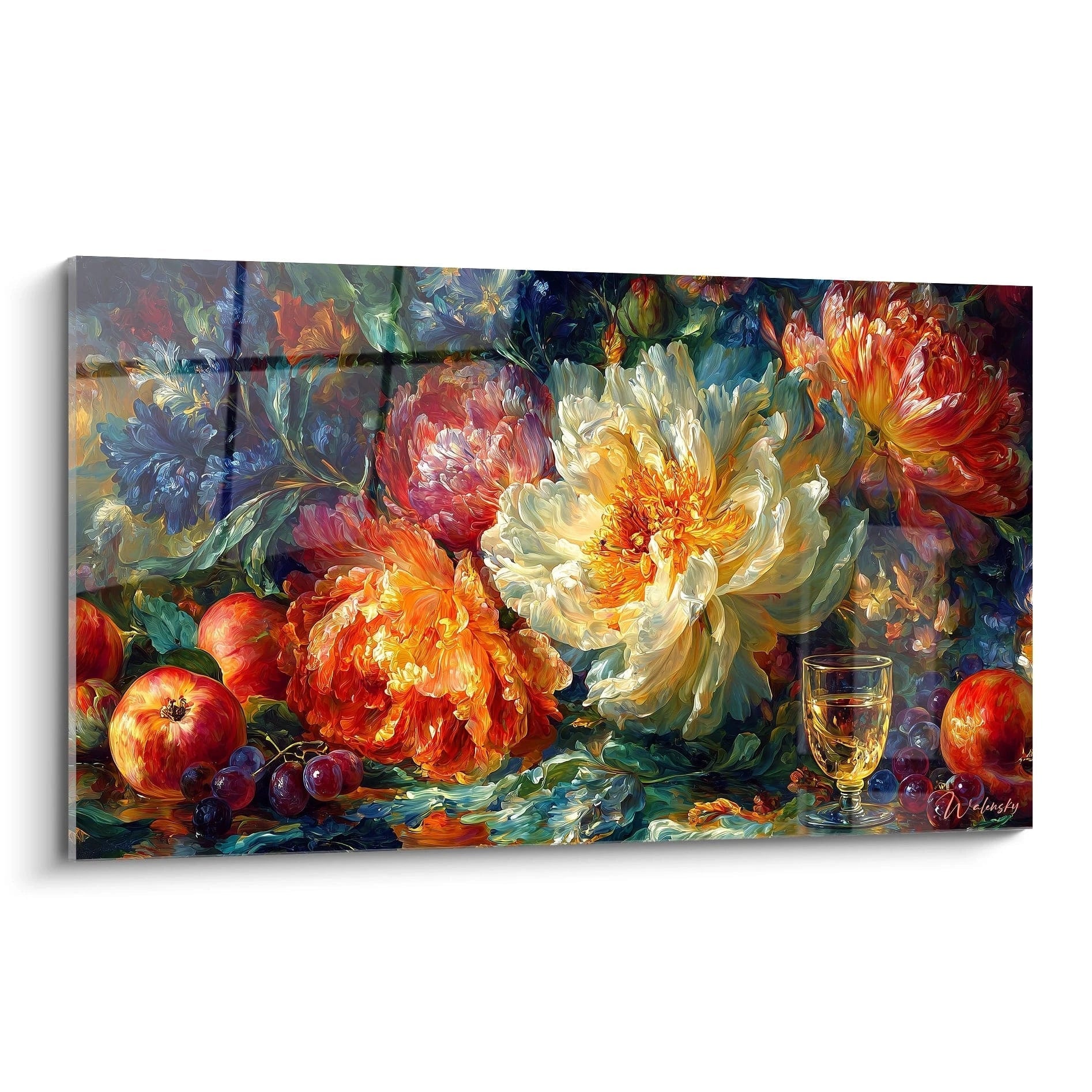






How to position a panoramic painting in a room with a corner bookcase?
June 5, 2026 · 9 min read · by Walensky
I have spent fifteen years orchestrating hundreds of interior staging projects, and I can assure you: the encounter between a panoramic painting and a corner bookcase creates one of the most fascinating compositions in contemporary interior design. Yet this delicate pairing intimidates even the most confident. You have found this magnificent canvas, invested in this custom bookcase, but when faced with your walls, doubt sets in: where should this painting hang so that it converses with your bookcase without creating visual cacophony? Rest assured, this uncertainty is universal. In reality, positioning a panoramic painting in a room with a corner bookcase follows principles of spatial dialogue that I will share with you today. Here is what this well-managed pairing brings: it creates a fluid visual circulation, balances architectural masses, and transforms two imposing elements into a harmonious conversation. In the next few minutes, you will discover exactly how to orchestrate this encounter to transform your space.
The visual triangle rule: creating a geometry that breathes
In my interior projects, I systematically apply what I call the visual triangle rule. When you enter a room with a corner bookcase, your gaze naturally seeks anchor points. The bookcase, with its verticality and mass, already constitutes a powerful magnetic pole. The panoramic painting, with its pronounced horizontal format, must become the counterpoint that stabilizes the whole.
Concretely, imagine a triangle whose three vertices are: the corner bookcase (first vertex), the panoramic painting (second vertex), and an architectural element such as a window or a sofa (third vertex). This invisible geometry guides the eye in a soothing circular movement. To position your panoramic painting, first identify the wall that forms the opposite or perpendicular angle to your bookcase. That is usually where the most elegant solution lies.
The optimal viewing angle: 60 to 90 degrees
Technically, the ideal placement positions the panoramic painting at an angle of 60 to 90 degrees relative to the main face of your corner bookcase. Why this precision? Because at this angle, the two elements complement each other without competing. They create what I call spatial breathing : your eye can appreciate one, then the other, in a natural movement that enriches the experience of the room.
The three strategic locations based on your configuration
After analyzing dozens of configurations, I have identified three preferred locations for positioning a panoramic painting in a room with a corner bookcase. Each responds to a specific spatial logic.
Location no. 1: The dominant perpendicular wall
If your corner bookcase occupies a corner of the room, the longest perpendicular wall becomes your ideal playing field. Position your panoramic painting at the center of this wall, at eye level (approximately 145-155 cm at the center of the artwork). This arrangement creates a horizontal axis that beautifully counterbalances the verticality of the shelves. I applied this solution in a Parisian apartment where a 2.40 m corner bookcase converse with a 180 cm panoramic on the adjacent wall: the effect of fluidity was striking.
Location no. 2: Above a low piece of furniture opposite
When your room has a low piece of furniture (console, sideboard, sofa) on the wall opposite the corner bookcase, hanging your panoramic painting just above it creates a soothing visual symmetry. This configuration works particularly well in rectangular spaces where the bookcase occupies a short corner. The panoramic format then follows the length of the furniture, creating a strong horizontal line that stabilizes the overall composition.
Location no. 3: The adjacent wall for small spaces
In compact rooms where every centimeter counts, I often opt for the wall immediately adjacent to the corner bookcase. Here, the panoramic painting is positioned a few dozen centimeters from the last module of the bookcase, creating narrative continuity. This intentional proximity transforms the two elements into a single, almost sculptural installation. Simply ensure a breathing space of at least 30 cm between the edge of the bookcase and the frame of the painting.

Favorite
Painting with gold veins and rust on a pearly white background - Mineral Fusion - Marble Abstract Edition
€233.90
Discover this paintingHeight and proportions: the measurements that change everything
The question of height haunts my clients, and rightly so. A panoramic painting poorly positioned in height can visually overwhelm a corner bookcase or, conversely, seem to float without anchor. The museum rule remains your best ally: the center of your artwork should sit between 145 and 160 cm from the floor, depending on your average height and that of your usual visitors.
But be careful, this rule is refined according to the height of your bookcase. If it reaches 2.20 m or more, favor the upper end of the range (155-160 cm) to create a dialogue at the same vertical scale. Conversely, with a low 180 cm bookcase, lower your painting slightly (145-150 cm at the center) to harmonize the horizontal lines.
The magic ratio: 1/3 - 2/3
To position a panoramic painting within the available space, I apply the 1/3 - 2/3 ratio. If your wall measures 3 meters wide, your panoramic painting should ideally occupy between 1 meter (1/3) and 1.80 meters (a little more than half) of this width. This proportion avoids the "postage stamp" effect of an artwork that is too small or the saturation of a format that is too imposing. In a room with a corner bookcase, this measurement becomes even more critical because you are composing with an already voluminous element.
— Our selection


Lighting: revealing the dialogue between painting and bookcase
The mistake I see most often? A panoramic painting magnificently positioned but drowned in the shadow of the corner bookcase. Lighting does not merely showcase your artwork: it orchestrates the visual conversation between your two protagonists.
Install dedicated indirect lighting for your painting (adjustable LED spotlights, articulated wall sconce) with a color temperature of 3000K that respects colors without harshness. Simultaneously, integrate LEDs into the shelves of your bookcase to create nocturnal depth. When evening falls, these two light sources create a subtle play of correspondences: the painting glows while the bookcase reveals its treasures in a sophisticated chiaroscuro.
Avoiding reflections: the 30-degree angle of incidence
When positioning your lighting for the panoramic painting, respect an angle of incidence of 30 degrees relative to the wall. This angle eliminates unsightly reflections on glass or varnish while sculpting the relief of the canvas. In a room with a corner bookcase, also check that the bookcase lighting does not create lateral light pollution on your painting.

— Also to discover


Colors and styles: creating harmony or controlled contrast
The chromatic palette of your panoramic painting determines its emotional positioning relative to the corner bookcase. Two approaches coexist, and I use one or the other depending on the desired character.
Tonal harmony suits calming interiors. If your bookcase features warm woods (oak, walnut), select a panoramic painting in earthy, ochre or forest green tones. The two elements then converse in a chromatic continuum that envelops the room in softness. I recently applied this principle in an office where a natural oak bookcase conversed with a panoramic Tuscan landscape in honey tones: a permanent invitation to serenity.
Dynamic contrast appeals to bold personalities. A dark bookcase (wenge, black lacquer) becomes the ideal foil for a panoramic painting in vivid colors: a blazing sunset, a dazzling abstract composition. This tension electrifies the space and asserts a confident decorative stance. To succeed with this approach, ensure that a third element in the room (cushion, rug, object) echoes a color from the painting, thus creating a visual bridge that unifies the composition.
Transform your space into a harmonious composition
Discover our exclusive collection of bookcase paintings that naturally converse with your reading spaces and create the visual alchemy you seek.

In the same spirit
The Invisible Bonds Painting - Contemporary Abstract Art Edition
€233.90
Discover this painting →Seasonal adjustments: evolving your composition
Here is a secret few decorators share: positioning a panoramic painting is not a definitive decision carved in stone. In my own spaces, I practice what I call seasonal rotation. Your corner bookcase remains fixed, certainly, but your painting can subtly migrate according to the seasons and your mood.
In summer, I favor a placement that captures natural light, sometimes slightly shifted toward the window. In winter, I bring the painting closer to artificial light sources to create an intimate cocoon. This controlled nomadism (a few dozen centimeters is enough) renews your perception of the space without requiring any renovation. It only requires drilling two or three alternative hanging points during the initial installation.
Visualize your transformation today
You now possess the keys to position your panoramic painting in a room with a corner bookcase with the confidence of a professional. Picture yourself in three weeks, entering your transformed space: your gaze glides naturally from the bookcase filled with stories to the panoramic painting that opens a window onto elsewhere. The balance is there, palpable, and your guests instinctively pause, struck by a harmony they cannot name but feel intensely.
Start by photographing your current room from different angles. Print these photos and sketch in pencil the placements I have described. Test with painter's tape on your walls to mark the dimensions of your future painting. This playful exploratory phase will help you refine your intuition before the first drill hole. The most rewarding part of this exercise? Discovering that your space holds unsuspected possibilities, and that the encounter between your panoramic painting and your corner bookcase can become the unique visual signature of your interior.
Frequently asked questions
What minimum distance should be kept between the panoramic painting and the corner bookcase?
The ideal distance depends on your configuration, but I recommend a minimum of 30 cm between the edge of the frame and the last module of the bookcase when they are adjacent. This visual breathing space allows each element to retain its identity while creating a dialogue. If your painting and bookcase sit on perpendicular or opposite walls, this constraint disappears naturally. The essential thing is to avoid the crowding effect where the two elements seem to fight over space. In my projects, I like to create a neutral zone between the two, sometimes occupied by a tall plant or an architect's lamp, which becomes the visual mediator of the composition. This approach transforms three distinct elements into a coherent installation that enriches the entire room.
My ceiling is low (2.40 m), how should I adapt the positioning?
Low ceilings require a particular approach when positioning a panoramic painting in a room with a corner bookcase. Systematically favor very elongated panoramic formats (ratio 1:3 or more) that accentuate horizontality and create an illusion of space. Position your painting slightly lower than the classic rule: 140-145 cm at the center rather than 150-160 cm. This lowered height draws the eye toward the median line of the room rather than toward the ceiling, easing the sensation of vertical compression. If your corner bookcase already reaches the ceiling, create contrast by leaving space above your painting (at least 40 cm up to the ceiling). I recently solved this challenge in a studio with 2.35 m ceilings by installing a 150 cm wide panoramic at 135 cm from the floor: the effect of depth was spectacular.
Can I position several paintings around my corner bookcase?
Absolutely, but this multiple composition requires precise orchestration to avoid visual cacophony. Your corner bookcase already constitutes a strong visual pole, so if you wish to integrate several artworks, favor a clear hierarchy: one dominant panoramic painting (the hero of your composition) and one or two smaller formats as satellites. For example, position your large panoramic on the main perpendicular wall, then add a 50 cm square artwork on the opposite wall. This controlled asymmetry creates a sophisticated visual rhythm. I apply the odd-number rule: three artworks work better than an even number. In a Brussels loft, I orchestrated a 180 cm panoramic, a 60 cm watercolor and a 40 cm print around a monumental corner bookcase: the bookcase became the central pivot of a captivating personal gallery.
Explore our collections


