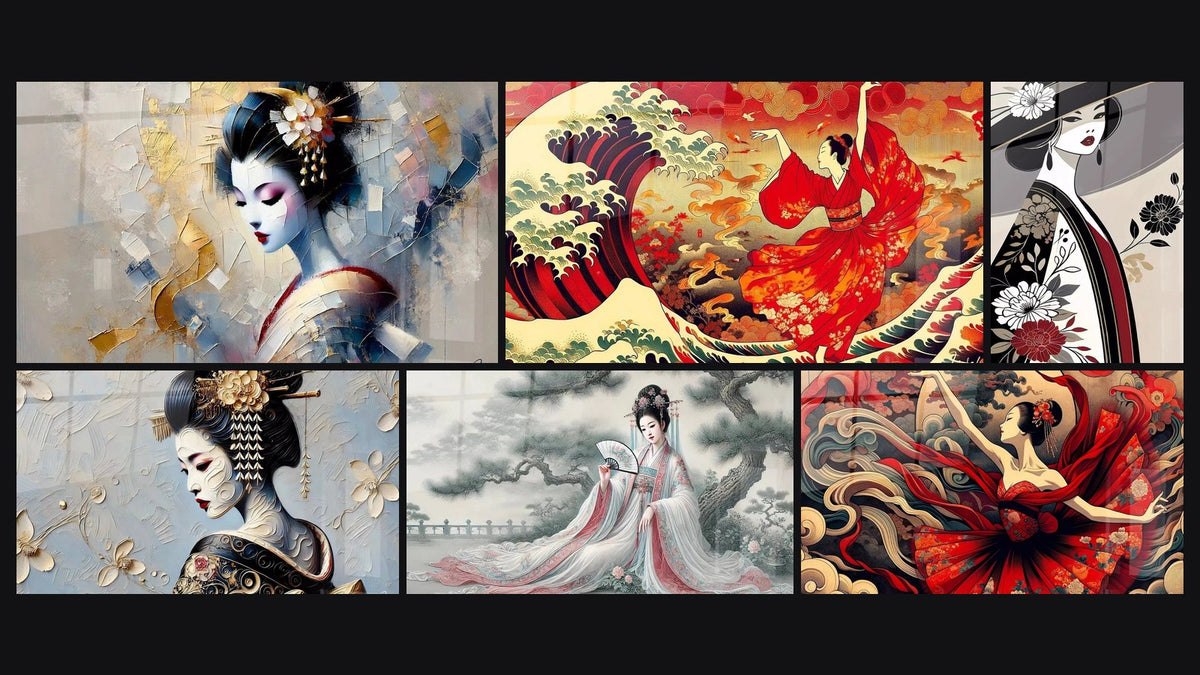
Geisha painting for a modern living room: which colour to choose for your decor
9 min read · by Walensky
You've fallen for a geisha in a kimono, fan in hand, a graceful silhouette against a textured background. You love the subject. But once you're in front of the screen, faced with twenty variants in gold, pink or blue, doubt sets in: which one will really go with your grey sofa, your off-white walls or that midnight blue you spent three years committing to on the feature wall?
The good news is that the choice isn't made at random. It can be read directly from your existing walls.
The short answerFor a modern living room, the colour of the geisha painting should extend the palette already present: gold and amber on a neutral background (beige, white, light grey), fuchsia or coral pink in a room that is already warm and colourful, blue or ivory in a Scandinavian or Japandi interior with cool tones. The geisha subject stays constant; it's the shade of the kimono that does all the work of harmonising with the room.- A neutral living room (beige, white, light grey) suits a gold or amber geisha painting best.
- A room that is already coloured or cosy can carry fuchsia pink and coral without becoming overloaded.
- A Scandinavian or Japandi interior pairs naturally with blue and ivory.
- Two or three geisha paintings can coexist if a single dominant shade ties the composition together.
Why the colour of a geisha painting changes everything in a modern living room
A gold geisha on a black background looks visually nothing like a geisha in a powder-pink kimono under a pale moon. Same subject, same Japanese-inspired refinement, but two radically opposed atmospheres. That is the whole challenge: the geisha theme is a common thread, not a guarantee of harmony.
In a modern living room, the dominant colours already in place (walls, sofa, rug, lighting) dictate what the painting can or cannot bring. An electric blue kimono placed on a terracotta wall will create dissonance, even if the artwork is beautiful in itself. Conversely, the same Japanese colour palette, well chosen, can turn an empty wall into a focal point consistent with everything else.
The right geisha painting is never a matter of taste for the subject, but of colour harmony with what already exists.
This is also what distinguishes a decor that breathes from wabi-sabi, that Japanese aesthetic which values imperfection and simplicity, from a room where the painting seems to have been hung as an afterthought, unconnected to the rest.
Neutral, minimalist living room: go for gold and amber
A living room with off-white, light grey or sand beige walls calls for a warm touch that warms without clashing. Gold does exactly that: it catches natural light and adds a depth that neutral alone never provides.
Geisha painting with gold fan and bells
On a dark background, the golden touches of the unfolded fan and the hanging bells create a sharp contrast with a room with light walls. Hung on a beige or pearl grey wall, this painting becomes the anchor point of the room, without needing to repaint anything.
Woman in gold and amber kimono painting
Here, the whole kimono vibrates in amber tones, almost unreal. In a minimalist living room where the furniture remains sober (light wood, linen, waxed concrete), this golden warmth avoids the overly cold effect that some stripped-back interiors can give.
Gold works particularly well printed on acrylic glass: the glossy surface enhances the brilliance and gives a rendering close to a gallery piece, provided the room does not receive too intense direct light all day long.
These two works share the same colour family but not the same format: one comes in a square version (from 100x100 cm to 200x200 cm), the other in a longer landscape format (from 120x70 cm to 240x140 cm). The choice depends mainly on the shape of the available wall.

Favorite
Painting Geisha praying before a red torii - Prayer at the shrine - Geisha edition
From €228.90
Discover this paintingColoured or cosy living room: dare fuchsia pink and coral
In a living room that already embraces colour — terracotta velvet, mustard cushions, a sage green accent wall — gold can on the contrary look flat. This is where fuchsia pink and coral take on their full meaning, echoing rather than breaking away.
Woman in pink and fuchsia kimono painting
A geisha standing still under a pale moon, wrapped in a kimono in pink tones that blend into the evening mist. In an already warm living room, this shade does not clash: it extends the cosy atmosphere rather than contradicting it.
Pink and coral floral kimono painting
The powdery pink of this portrait, combined with coral accents, pairs naturally with living rooms in terracotta or brick tones. It is also a choice that works in a room where antique pink or rosewood already dominate.
For a living room that already dares colour on its textiles, this type of painting naturally finds its place among pieces designed for living spaces: our collection of living room paintings offers several variants in this colour family.
— Our selection


Blue or Scandinavian Japandi living room: blue and ivory kimonos
A Japandi living room relies on simplicity: light wood, natural linen, a few touches of deep blue or celadon green. In this universe, a geisha painting that is too gold or too vivid would disrupt the room's muted balance. Blue and ivory, on the other hand, blend in effortlessly.
Geisha painting with blue kimono fan
A suspended moment just before stepping on stage, the geisha adjusts her fan in a kimono with blue and ivory folds. On a white or very light grey wall, this artwork keeps all the restraint characteristic of the Japandi style, without ever visually overloading the space.
Ivory and brown kimono painting on a bamboo path
The draped silhouette walking through a misty bamboo grove, in ivory and brown tones, directly evokes traditional Japonisme art. In a living room with natural tones (linen, rattan, driftwood), this painting extends the atmosphere without adding any colour foreign to the room.
This square format, ranging from 100x100 cm up to 200x200 cm including made-to-measure sizes, is particularly suited to wide walls above a low sofa, typical of Scandinavian living rooms.
If your living room leans more towards a zen spirit than pure Scandinavian style, our article on the pastel watercolour geisha painting details a different, softer approach to the Japanese palette.
— Also to discover


Combining several geisha paintings: composing a coherent wall gallery
Two or three geishas on the same wall, is that too much? Not necessarily, as long as you follow one simple rule: a single dominant shade ties the whole together, even if the formats or scenes differ.
- Torii and tradition option: pairing a geisha praying before a red torii with a gold kimono creates a dialogue between red and gold, two colours that coexist well in Japonisme art.
- Romantic night option: marrying a geisha lighting a lantern in the rain with a fuchsia pink kimono plays on close violet and pink tones, for a homogeneous wall gallery.
- Panoramic format option: a painting in black and gold fan with swirling volutes, in an elongated format (120x40 cm and above), can serve as a horizontal centrepiece with a gold square format as a vertical complement to the space.
Avoid, however, combining three radically different shades (blue, fuchsia, gold) on the same wall: the result quickly looks like a collage rather than a deliberate composition.
These two works, one playing on red and black, the other on pink and nocturnal violet, illustrate well how two distinct atmospheres can still echo each other thanks to a shared shade — here, deep warm tones.

In the same spirit
Geisha painting in pink kimono lighting a lantern - Flame in the rain - Geisha edition
From €228.90
Discover this painting →Frequently asked questions
Which geisha painting colour should you choose for a grey living room?
Grey, neutral by nature, accepts almost any shade, but gold and amber provide the best contrast. A blue and ivory kimono also works very well on light grey, for a cooler, more understated look.
Can you mix several geisha paintings of different colours?
Yes, provided a common shade runs through the works, even in a subtle touch. Three completely independent palettes on the same wall create an impression of disorder rather than a successful wall gallery.
Does a gold geisha painting suit a Scandinavian living room?
It depends on the Scandinavian style in question. A warm Scandinavian (honey wood, cream textiles) easily accommodates gold. A cooler Scandinavian, closer to Japandi, will pair better with blue or ivory.
What size geisha painting for a modern living room?
The usual rule is that the artwork should occupy 60 to 75% of the width of the sofa or the wall concerned. Landscape formats start at 120x70 cm, square formats at 100x100 cm: refer to the precise dimensions of each product sheet to adjust to the actual wall.
Ultimately, choosing a geisha painting for a modern living room is never about picking between several pretty images. It means looking at your walls, your sofa, the morning light, and letting the colour of the kimono respond to what is already there. The Japonisme subject itself remains timeless — it is the shade that decides whether it becomes the favourite wall of the house.
To compare all the shades and formats available, the Japanese geisha painting collection brings together all the variants mentioned here, and the Japanese paintings range lets you broaden the search beyond the geisha motif alone.
Explore our collections