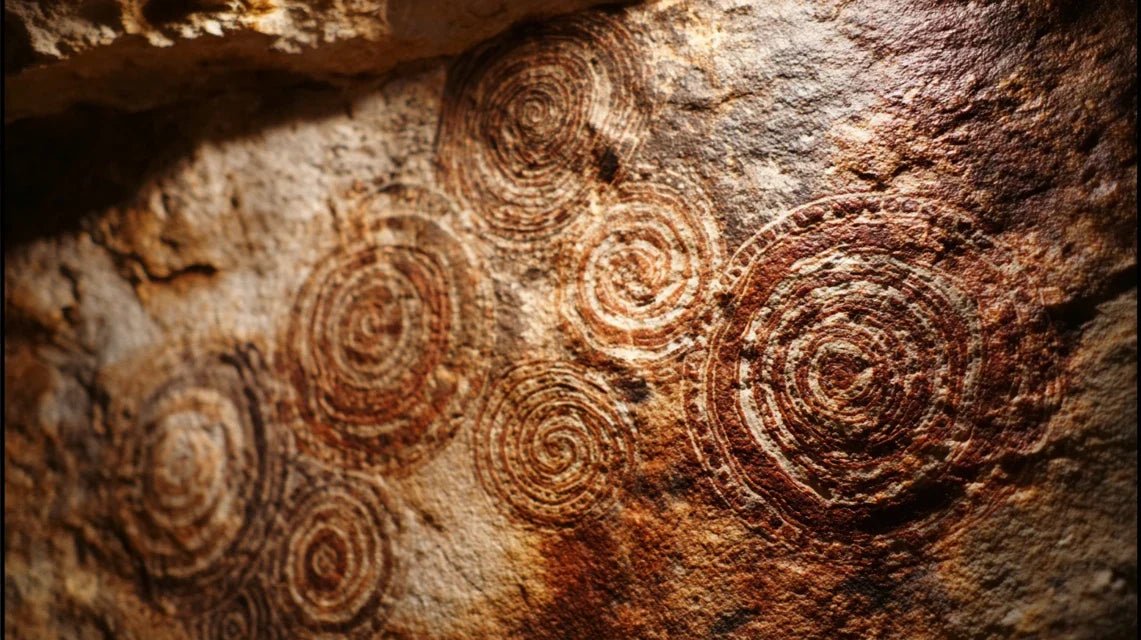
The first time I laid eyes on these circles engraved in rock, in the heart of a cave in Périgord, something ancestral awoke within me. These concentric motifs, these mysterious spirals traced millennia ago, seemed to pulse with a life of their own. As if our ancestors had left us a coded message, a universal language that transcends time and finds a fascinating echo today in our contemporary interiors.
Here's what the interpretation of concentric motifs in rock art brings: a deep connection with our human origins, an understanding of universal symbols that transcend cultures, and timeless inspiration to create spaces imbued with meaning and authenticity.
You admire these circular forms in museums or on reproductions, but their meaning remains opaque. This frustration is legitimate: how to decipher a language 40,000 years old without falling into fanciful interpretation? The good news? Archaeologists and anthropologists have developed fascinating reading keys that allow us to approach the meaning of these concentric rock motifs, while preserving their share of mystery. I am going to pass on what twenty years of research in the field has taught me about these symbols that continue to inspire contemporary design.
The circles of the cosmos: when our ancestors mapped the universe
In the caves of Lascaux, Altamira or Kimberley in Australia, concentric motifs appear with a disturbing constancy. These nested circles are not mere decorations: they probably represent the cosmology of our ancestors. The sun, the moon, the waves in the water, the growth rings of trees - as many natural phenomena that shaped their perception of the world.
Researchers have observed that these rock concentric circles are often located in particular acoustic zones of caves, where sound resonates amplified. This correlation suggests a ritual dimension: visible sound waves materialized in circles on the wall. A visual translation of the invisible, a bridge between the tangible and spiritual world.
In many indigenous cultures still alive today, these motifs symbolize the expansion of consciousness, the propagation of vital energy from a creative center. Australian Aboriginals speak of the Tjukurrpa, the Time of Dreams, where each concentric circle marks a sacred site, an emergence point of ancestral creators.
Altered states of consciousness: neuropsychology of symbols
Here's a discovery that has revolutionized our understanding of concentric motifs in rock art: neuropsychological research has shown that the human brain, in certain altered states of consciousness (deep meditation, trance, sensory deprivation), spontaneously generates geometric hallucinations. And guess which shape appears most frequently? Concentric circles.
David Lewis-Williams, South African anthropologist, developed the theory of phosphenes: these luminous patterns that we all see when we close our eyes and press our eyelids. Our shamanic ancestors, during rituals involving fasting, repetitive rhythms or psychoactive substances, probably saw these geometric shapes which they then transcribed onto cave walls.
The three stages of visual trance
Concentric motifs in rock art correspond to the first stage of trance, that of pure geometric forms. The second stage sees these shapes transform into figurative representations (a circle becomes an eye, a sun), while the third stage plunges into complex visions mixing humans, animals and symbols. This progression explains why some caves present isolated concentric circles, while others integrate them into elaborate narrative scenes.
This neurological dimension does not diminish the symbolic scope of these motifs. On the contrary, it reveals a constant human biological: our brain is wired to perceive and create these forms. Finding them in our contemporary spaces creates a deep resonance, almost cellular.

Discover this inspiring artwork
Territorial markers and collective identity
Another fascinating interpretation of concentric motifs in rock art relates them to the notion of territory. Each human group developed its own repertoire of symbols, a kind of visual signature. Concentric circles, by their infinite variation (number of rings, spacing, association with other forms), made it possible to identify belonging to a clan, a lineage.
In the Australian sites of Kimberley, I documented concentric motifs associated with dot lines that represent the migration paths of totemic ancestors. Each family jealously preserves its specific motifs, passed down from generation to generation. Reproducing the motif of another clan constitutes a serious transgression.
This identity dimension resonates today in our desire to personalize our interiors. Integrating rock art concentric circles into your decoration is to enroll yourself in a millennial human lineage, to affirm belonging to humanity in what is most universal and timeless.
The language of water and fertility
Water, the source of life, naturally creates concentric circles when a stone is dropped into it. This obvious observation for our ancestors charged the motif with an aquatic and fertile symbolism. In many rock art sites in southern Africa, these circles appear near depictions of aquatic animals or scenes of rain.
The San of the Kalahari, whose pictorial traditions date back over 27,000 years, explicitly associate concentric motifs with spiritual energy (n/om) that bubbles within the bellies of shamans during trance dances. This energy spreads in circles from the healer's body to the community, just like ripples on water.
The symbolism of expansion
All cultures that have created concentric circles in rock art share this idea of expansion from a center: the navel as the origin of life, the hearth as the heart of the community, the watering hole as the center of the territory. The concentric motif visualizes this centrifugal movement of vital energy.
In our modern interiors, this symbolism retains all its power. A painting depicting concentric motifs creates a natural focal point, organizes space around it, generates a visual dynamic that guides the eye and structures the atmosphere.

Discover this inspiring artwork
Decoding the variations: from simple to complex
Not all concentric motifs in rock art are alike. Their interpretation depends on several factors that I have learned to observe systematically during my archaeological survey missions.
The number of rings: three circles often evoke a triad (sky-earth-underworld, past-present-future), while seven or nine circles appear in cultures that sacralize these numbers. Concentric circles composed of an odd number of rings seem more frequent, possibly to create a distinct center.
The spacing between the rings varies considerably. Tight circles suggest a concentration of energy, while spaced rings evoke expansion, dispersion. Some motifs have irregular spacing, perhaps to represent pulsations, a rhythm.
Symbolic associations enrich the meaning: a concentric circle crossed by a line evokes the sun and its diurnal path in many cultures. Combined with handprints, it suggests human action on the cosmos. Surrounded by dots, it can represent stars or seeds.
From prehistoric past to your interior: inspiration continues
This dive into prehistoric concentric motifs reveals their extraordinary semantic richness: cosmology, neurology, identity, fertility, spirituality. But above all, it demonstrates why these forms continue to fascinate us 40,000 years after their first appearance.
Contemporary designers draw abundantly from this ancestral repertoire. Concentric circles bring symbolic depth to spaces, create a dizzying temporal anchoring, transform a wall into a portal to our common origins. Unlike ephemeral trends, these motifs possess a historical and anthropological legitimacy that makes them timeless.
Choosing a work inspired by concentric motifs in rock art, is inviting a fragment of this collective human memory into your daily life. It's creating a silent dialogue between the Paleolithic era and the present, reminding us that we are heirs to a lineage of creators, dreamers, seekers of meaning.
Transform your space into a sanctuary of ancestral memory
Discover our exclusive collection of African paintings that celebrate millennial motifs and bring symbolic depth to your contemporary decor.
The living heritage of sacred circles
Interpreting concentric motifs in rock art is not an exact science but a respectful approach to a partially accessible mystery. We will never know for sure what the Paleolithic artist was thinking when engraving these circles into the damp stone of a Pyrenean cave.
But we certainly know that these forms have crossed continents and millennia, that they spontaneously emerge from our consciousness, that they structure our relationship to the sacred and territory. This universality makes them a visual language that everyone can appropriate without cultural betrayal: concentric circles belong to all of humanity.
Start by observing these motifs in your daily life: the growth rings of a cut trunk, the ripples on your coffee, the rings of Saturn. Then choose a work that resonates with your personal sensitivity. The essential thing is not to display encyclopedic knowledge, but to let these ancestral motifs create their silent magic in your space, remind your millennial brain that it has recognized these forms forever.
Frequently asked questions about prehistoric concentric motifs
Do concentric patterns have the same meaning in all prehistoric cultures?
No, and that's precisely what makes them fascinating! While concentric circles appear on every continent, their significance varies according to cultural contexts. In Australia, they often represent sacred sites or watering holes. In Europe, they are frequently associated with shamanic experiences. In Africa, they evoke spiritual energy and fertility. However, constants emerge: the idea of center, expansion, connection between visible and invisible worlds. This universality in diversity reflects our common humanity while celebrating the richness of local interpretations. In your interior, this plurality of meaning enriches the work: each contemplation can evoke a different dimension depending on your state of mind.
How to distinguish a genuine prehistoric pattern from a modern creation inspired by it?
Authentic prehistoric concentric patterns exhibit specific technical characteristics: differential patination (the pigment or engraving has aged differently from the rock), integration into natural wall features, ancient manufacturing techniques (percussion, abrasion, finger in clay). But here's the essential point: for your decoration, archaeological authenticity is less important than spiritual authenticity. A contemporary creation that respects the symbolism, draws inspiration from original forms and honors their meaning possesses total aesthetic and emotional legitimacy. Contemporary African artists, for example, perpetuate millennial iconographic traditions with modern techniques. Their work constitutes a living temporal bridge, more accessible and ethical than possessing a fragment torn from a heritage site.
Can concentric patterns be integrated into a modern interior without creating a museum effect?
Absolutely, and that's even one of the great strengths of these ancestral motifs! Their pure geometry harmonizes perfectly with minimalist contemporary aesthetics. The secret lies in dosage and context. A large painting with concentric circles on a clean wall creates a sophisticated focal point without clutter. Combine it with natural materials (raw wood, linen, stone) to reinforce the organic connection, or conversely with metal and concrete for an assumed contrast between ancestral and industrial. Avoid accumulation of ethnographic objects which would effectively create a cabinet of curiosities effect. A single strong element, treated as a major work of art rather than a souvenir from a trip, transforms the space with elegance. Concentric motifs possess this rare quality of being simultaneously timeless and resolutely contemporary.