The first time I held a Korhogo textile in my hands, in the back room of an Ivorian workshop, I understood that I was touching much more than just decorative fabric. The geometric patterns, traced by hand with millennial precision, told stories that my Parisian clients desperately sought: authenticity, cultural connection, character. After incorporating these Korhogo painted fabrics into over eighty high-end decoration projects, I can say that no artwork transforms an interior with such visual power and symbolic depth.
Here's what Korhogo paintings bring to your space: an incomparable artistic presence that immediately captures the eye, an authentic cultural heritage passed down for centuries by Sénoufo artisans, and a rare decorative versatility that adapts equally well to contemporary interiors as well as bohemian or ethnic atmospheres.
You have probably already felt this frustration: wanting to create an interior that resembles you, escaping the standardization of large stores, but not knowing which authentic art to turn to without falling into folklore or impersonal decoration. Korhogo fabrics precisely respond to this quest for meaning and originality.
Rest assured: contrary to popular belief, these artisanal canvases integrate surprisingly easily into our European interiors. Their natural color palette, their clean graphic lines, and their organic texture create unexpected aesthetic bridges with Scandinavian design, industrial style, or even Japanese minimalism.
In this article, I reveal everything that fifteen years of artisanal sourcing and decorative integration have taught me about these exceptional painted fabrics: their fascinating history, their ancestral manufacturing techniques, and above all how to choose them and highlight them to radically transform your living space.
The ancestral heritage of Korhogo textiles: when art meets Sénoufo tradition
Korhogo paintings take their name from the city of the same name, located in northern Côte d'Ivoire, the historical cradle of the Sénoufo people. For centuries, artisans in this region have perpetuated a unique textile know-how, initially reserved for initiation ceremonies and sacred rituals. Each traditional motif carries a precise meaning: stylized masks invoke protective spirits, turtles symbolize wisdom and longevity, birds represent messengers between the visible and invisible worlds.
What makes these painted fabrics so special is their entirely manual manufacturing method. The cotton is first woven on traditional looms, creating a thick and resistant canvas with an incomparable texture. This raw textile is then washed and beaten for a long time to obtain this characteristic softness to the touch. The magic happens during the application of pigments: artisans use vegetable dyes extracted from bark, leaves and local roots, mixed with ferruginous mud which gives these deep browns and intense blacks so recognizable.
The painting technique itself requires exceptional mastery. The artisan traces the motifs freehand, without preliminary sketches, using rudimentary tools such as metal spatulas or carved calabash pieces. This intuitive approach explains why each Korhogo canvas is truly unique, with its subtle variations and charming imperfections that mark the authenticity of the artisanal work.
Iconic motifs and their profound symbolism
Understanding the meaning of the motifs greatly enriches the decorative experience. Korhogo fabric paintings are never mere ornaments; they function as a codified visual language that the Sénoufo have mastered for generations.
Masks and anthropomorphic figures
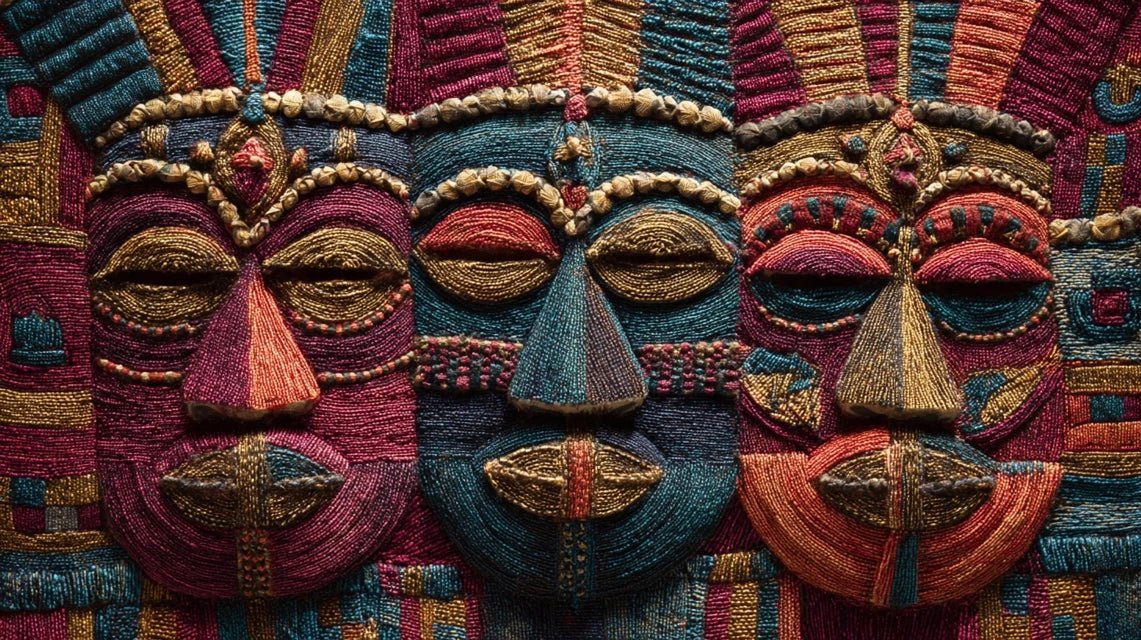
Representations of masks constitute the most iconic motif of Korhogo fabrics. These stylized faces, often flanked by horns or geometric protrusions, reproduce the sacred masks used during the Poro initiation society ceremonies. In contemporary decoration, these masks bring a powerful graphic presence, an instant focal point that structures space with authority.
Symbolic fauna
Turtles, chameleons, birds, fish and crocodiles populate the painted Korhogo canvases with a recurrence that is never arbitrary. The chameleon embodies adaptability and patience, the crocodile represents primordial strength, while birds symbolize spiritual communication. I have noticed that my clients are particularly sensitive to these animal representations: they create an immediate emotional connection, evoking a wild and preserved nature.
Geometric motifs
Beyond the recognizable figures, Korhogo paintings integrate complex geometric compositions: broken lines, interlocking triangles, rhythmic checkerboards, cosmic spirals. These abstract patterns bring a graphic sophistication that remarkably dialogues with contemporary aesthetics, creating unexpected bridges between African tradition and Western modernity.

Discover this inspiring work
Faced with the growing popularity of these African textiles, the market has been flooded with screen-printed or digitally printed reproductions. Here are the infallible criteria that I use to authenticate a genuine Korhogo fabric painting when purchasing for my clients.
First, the texture of the fabric: an authentic Korhogo has a visible irregular weave, with characteristic variations in thickness from hand weaving. Run your hand over the surface: you should feel a subtle relief, a certain natural roughness that industrial fabrics never reproduce. The weight also testifies to authenticity: these traditional canvases have substantial density, a reassuring tactile presence.
Secondly, the application of paint: on an authentic Korhogo fabric, the pigments penetrate deeply into the fibers rather than resting on the surface. Turn the canvas over: the patterns should appear translucent on the back, albeit attenuated but clearly visible. Printed reproductions generally show a nearly blank reverse side. Also observe the outlines of the motifs: they present slight irregularities, charming smudges, and varying thicknesses that betray manual application.
Thirdly, the color palette: traditional vegetable dyes produce characteristic earthy tones – chocolate browns, deep blacks slightly bluish, warm ochres, natural beiges. Industrial versions often use blacks that are too intense, artificially uniform browns. Subtle nuances and tonal variations within the same color sign authenticity.
Integrating Korhogo Paintings into Your Contemporary Décor
The common mistake is to think that these ethnic fabrics require a decor entirely dedicated to African style. My practice demonstrates exactly the opposite: Korhogo paintings reveal their full potential in eclectic interiors, where they create sophisticated contrasts.
In a Scandinavian interior, a large framed Korhogo canvas brings that warm and organic touch that avoids minimalist coolness. The clean lines of Nordic furniture and African geometric patterns share the same formal rigor which creates a harmonious aesthetic dialogue. I recently installed a Korhogo panel of two meters in a pristine white loft: the effect was striking, instantly transforming the space into a contemporary art gallery.
For a bohemian chic style, Korhogo fabrics act as visual anchors that structure the composition. Rather than accumulating ethnic textiles, use a single large Korhogo piece as a focal element, complemented by natural materials (linen, rattan, raw wood) and neutral tones. This refined approach highlights the artisanal authenticity without falling into decorative overload.
In a contemporary interior with graphic lines, the Korhogo paintings bring humanity and imperfection that prevent rigidity. Pair them with designer furniture, black metal, polished concrete: the contrast between industrial technology and ancestral craftsmanship generates a fascinating aesthetic tension. One of my favorite projects combined a Le Corbusier sofa with an immense painted Korhogo textile stretched behind it: pure visual magic.

Discover this inspiring artwork
The different decorative uses of Korhogo canvases
The versatility of these African textiles goes far beyond traditional wall hanging. After dozens of custom installations, I have identified several particularly successful applications.
The framed painting remains the most obvious but remarkably effective option. Choose a simple frame – natural wood or matte black aluminum – that does not compete with the visual richness of the Korhogo textile. For maximum impact, prioritize large formats (minimum 100x150 cm) which assert their architectural presence.
The wall tapestry offers a more relaxed and authentic alternative. Simply fix the Korhogo canvas with decorative pins or a wooden rod. This raw approach preserves the textile character of the work, creating a more intimate and bohemian atmosphere. The advantage: you can easily vary your seasonal decoration.
The screen or room divider is an ingenious use that I particularly like. Stretch several Korhogo panels over a lightweight structure to create a movable partition that subtly defines areas in an open space. This solution simultaneously brings function and aesthetics.
Cushion covering allows you to introduce these motifs on a smaller scale. Cut sections of Korhogo textile (preferably in less detailed areas to preserve the integrity of the patterns) to create original cushion covers. Mix them with plain linen or velvet cushions for a sophisticated layering effect.
The throw or quilt transforms your seating into a decorative focal point. Drape a Korhogo textile carelessly over your neutral sofa: the effect is instant, bringing texture, pattern and cultural history in one gesture.
Ready to transform your interior with African authenticity?
Discover our exclusive collection of African paintings that will bring character and cultural depth to your living space.
Maintenance and preservation: preserving the beauty of your Korhogo canvas
Korhogo paintings on fabric require minimal but specific maintenance to last for decades without losing their intensity. Unlike ordinary textiles, these artisanal canvases react differently to conventional treatments.
Regular dusting is your main maintenance routine. Use a vacuum cleaner set to the lowest power with a soft brush attachment, or gently brush with a natural hair garment brush. This monthly operation prevents the accumulation of particles that gradually tarnish the pigments. Avoid damp cloths which risk migrating vegetable dyes.
Strategic positioning significantly extends the lifespan of your Korhogo fabric. Avoid direct sunlight, which inevitably fades natural pigments. If your wall receives intense light, install filtering curtains or slightly offset the canvas. Likewise, maintain a reasonable distance from heat sources (radiators, fireplaces) which dry out the fibers and weaken the textile.
Deep cleaning should remain exceptional and always be entrusted to a professional specializing in ethnic textiles. If an accidental stain occurs, blot immediately (without rubbing) with a dry white cloth. For persistent dirt, consult a textile restorer rather than risk irreparably damaging your authentic Korhogo painting.
Temporary storage, if you need to store your canvas, requires specific precautions. Always roll the Korhogo canvas face outwards (contrary to intuition) to avoid pigment cracking. Wrap it in acid-free tissue paper, then in a white cotton cloth. Store it flat or upright in a dry, temperate and dark place. Never in a plastic bag which promotes humidity and mold.
Investing in Korhogo art: cultural value and appreciation
Beyond their decorative beauty, authentic Korhogo paintings represent a cultural and potentially financial investment. The market for traditional African art has been steadily revalued for two decades, driven by increased awareness of global artisanal heritage.
Vintage Korhogo textiles, dating back several decades, are now achieving significant valuations in the ethnographic art market. Exceptional pieces – large dimensions, rare motifs, remarkable condition, documented provenance – can be negotiated for several thousand euros with informed collectors.
But beyond speculation, owning a Korhogo textile means preserving a fragile intangible heritage. Each purchase directly supports the artisan communities that perpetuate these ancestral techniques. Faced with increasing industrialization and rural exodus, younger generations are gradually abandoning these traditional crafts. By choosing authenticity, you actively participate in the transmission of this millennial know-how.
When selecting your Korhogo painting, prioritize ethical and traceable supply chains. Inquire about the precise origin of the piece, the workshop that produced it, and the working conditions of the artisans. This transparency guarantees not only authenticity but also fair remuneration for creators, far from multiple intermediaries who capture most of the value.
Conclusion : The soul of a continent on your walls
Imagine: you return home after a trying day, and your gaze falls upon this large Korhogo textile that adorns your living room. Ancestral motifs, traced by expert hands thousands of miles away, instantly reconnect you to the essentials. It's no longer simply a decorated wall; it’s a window open onto a living cultural heritage, a history that dialogues with your present.
Korhogo fabric paintings offer this rare alchemy: a powerful visual presence that structures space, an artisanal authenticity that humanizes our standardized interiors, and a symbolic depth that nourishes our need for meaning. In a world saturated with ephemeral objects and disposable decor, these textiles represent the perfect antidote – durable works, rich in history, that will cross generations.
Start with a single piece, carefully chosen and strategically installed. Observe how it subtly transforms the energy of your space, how it generates conversations and emotions among your visitors. You will then understand why so many experienced decorators consider Korhogo art to be the most impactful and rewarding decorative investment they have ever made.