Feng shui northeast japandi painting: the art of sand and brown tones
7 min read · by Walensky
NORTHEAST FENG SHUI EARTH PAINTING
An empty wall corner in an entrance that leads nowhere in particular. It is often there, in the northeast of the home, that feng shui places the earth element — and it is precisely there that japandi, with its textured restraint, finds its most natural ground. No need for desert sand or endless dunes: there is a finer, more lived-in version of this meeting between two cultures that never needed to speak to understand each other.
- The northeast in feng shui calls for the earth element: sand, ochre, brown, light terracotta tones.
- Japandi favors raw materials, simple lines and inhabited emptiness rather than decorative overload.
- An asymmetrical organic motif (bark, silhouette, mineral vein) suits japandi better than a figurative desert.
Feng shui and japandi: two philosophies, one shared quest for harmony
Feng shui and japandi were never conceived for one another, yet they answer each other almost too well. The first organizes space around energies and elements; the second, born from the meeting of Japanese minimalism and Scandinavian hygge, organizes space around light, material and emptiness. Both reject the superfluous.
Wabi-sabi, that Japanese aesthetic of embraced imperfection, almost word for word joins the earth spirit of feng shui: accepting the crack, the irregular texture, the wood that keeps its knots. A painting that carries this philosophy needs not say much to say a great deal.
True japandi luxury is not emptiness — it is emptiness that has been chosen.
The sand and brown palette: why it works in the northeast
The northeast sector calls for the earth element, and the earth element speaks in ochre, beige, warm brown and sand-toned shades. It is a happy coincidence: this same palette is the chromatic DNA of japandi, which banishes garish colors in favor of matte, natural tones close to raw clay or unbleached linen.
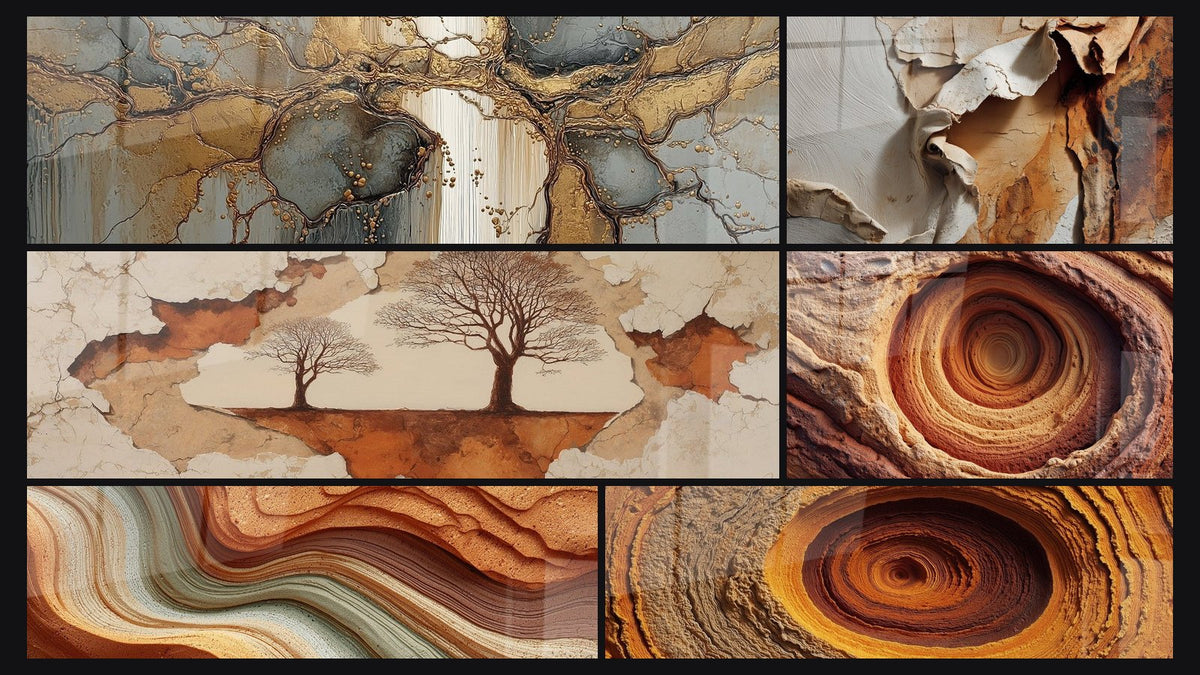
Still, there is no question of slipping into the cliché of a desert landscape — an angle already covered elsewhere on this blog, and one that remains highly figurative. Here the idea is more subtle: a cracked texture, peeling bark, a golden marble catching the raking light. Color makes the feng shui link, material makes the japandi link.
In the theory of the five elements, fire feeds earth. A touch of terracotta or discreet coral in a sand-brown painting therefore strengthens the energy of the sector, without ever dominating the composition.

Favorite
Wall painting of tree silhouettes on ochre and beige crackled background - Natural serenity - Feng shui Northeast Earth Edition
From €232.90
Discover this paintingChoosing a japandi painting suited to the northeast sector
A good japandi painting for the northeast is recognized first by what it avoids: no flashy shine, no busy motif, no overly perfect symmetry that would sound false in an interior designed to breathe.
Materials and textures to favor
Even when printed, the visual can evoke linen, raw wood, crumpled Japanese paper or hand-worked clay. These trompe-l'oeil textures give a tactile depth often missing from overly smooth flat areas.
- Fluid marble-like or raw-material textures, in ochre and grey
- Bark, plant fibers, mineral veins
- Crumpled papers or cracked surfaces, never too smooth
The Tree Bark painting in Ochre and Beige Tones illustrates this register well: organic material is at the heart of the subject, without sliding into chatty figuration.
Japandi motifs compatible with earth energy
Simplified tree silhouettes, abstract mineral lines and asymmetrical compositions work particularly well. Organic asymmetry — a leaning tree, a cliff spilling beyond the imagined frame — is a japandi signature rarely found in classical feng shui, which is more attached to visible balance.
Prefer Alu Dibond, with its matte, non-reflective surface, if the northeast wall faces a window: natural light enhances the sand tones without crushing them with reflections.
Styling: integrating the painting into a northeast japandi interior
In a minimalist entrance, an elongated format — such as an L 120x40cm format — hung alone above a light wood console is enough to set the mood. No need to accumulate objects: japandi prefers one strong gesture to ten small touches.
In a study oriented to the northeast, a square format centered above the work surface, in ochre and beige tones, creates a point of visual focus without distracting. For a living room, the rule remains the same as everywhere else: the work ideally occupies 60 to 75% of the width of the piece of furniture beneath which it is placed.
For furniture, favor natural unvarnished wood, rattan and washed linen. Avoid chrome metal or glossy glass right next to the painting: they break the matte coherence of japandi.
the complete collection of feng shui paintings— Our selection


Combining several works for a zen gallery effect
Can you hang several japandi paintings in the same room? Yes, on one condition: respect a simple principle — emptiness is as much a part of the composition as the works themselves.
Three paintings of different sizes, generously spaced, are worth more than five lined up without breathing room. The organic asymmetry of japandi lends itself very well to this controlled imbalance.
For this gallery effect, the Two Trees on Cliff painting in Ochre and Beige works well as a centerpiece, surrounded by a more textured abstract composition such as the golden and grey marble.

If you are looking for a more narrative starting point for this gallery, our article on the earth-toned abstract painting for the northeast offers another entry into this palette, more focused on pure abstraction.

Also to discover
Golden and Grey Marble Abstract Painting - Mineral Fusion - Northeast Earth Feng Shui Edition
From €232.90
Discover this painting →Frequently asked questions
What is the difference between japandi style and classical feng shui?
Classical feng shui organizes space according to elements and sectors; japandi is an aesthetic, born from the meeting of Japanese minimalism and Scandinavian hygge. The two can be applied together: feng shui dictates color and sector, japandi dictates form and material.
Which colors should you favor for a feng shui japandi living room?
For an earth sector like the northeast, sand, light ochre and warm brown tones dominate. A touch of terracotta can be added, since the fire element feeds earth, but without ever saturating the composition.
Can you mix several japandi paintings in the same room?
Yes, provided you keep the same color family and leave space between the works. It is this emptiness that gives the wall its calm, not the quantity of paintings hung.
Does japandi style suit all feng shui orientations?
Yes, japandi adapts to each element simply by changing palette: earth tones in the northeast, greens and wood in the east, blues and blacks in the north. Only the color changes; the minimalist spirit remains the same.
Composing your northeast japandi corner
Let us return to that bare entrance wall. It does not need a painted desert to breathe earth and harmony: a bark, a tree silhouette, a vein of golden marble, and the right amount of emptiness around them are more than enough. That is the art of japandi — saying much with little, and letting feng shui do the rest in silence.
To go further on this earth palette, our article on the ochre desert landscape painting explores a more figurative version of the same sector. And to compose your wall directly, the northeast earth feng shui painting collection gathers all the works in this sand and brown spirit.
Explore our collections