

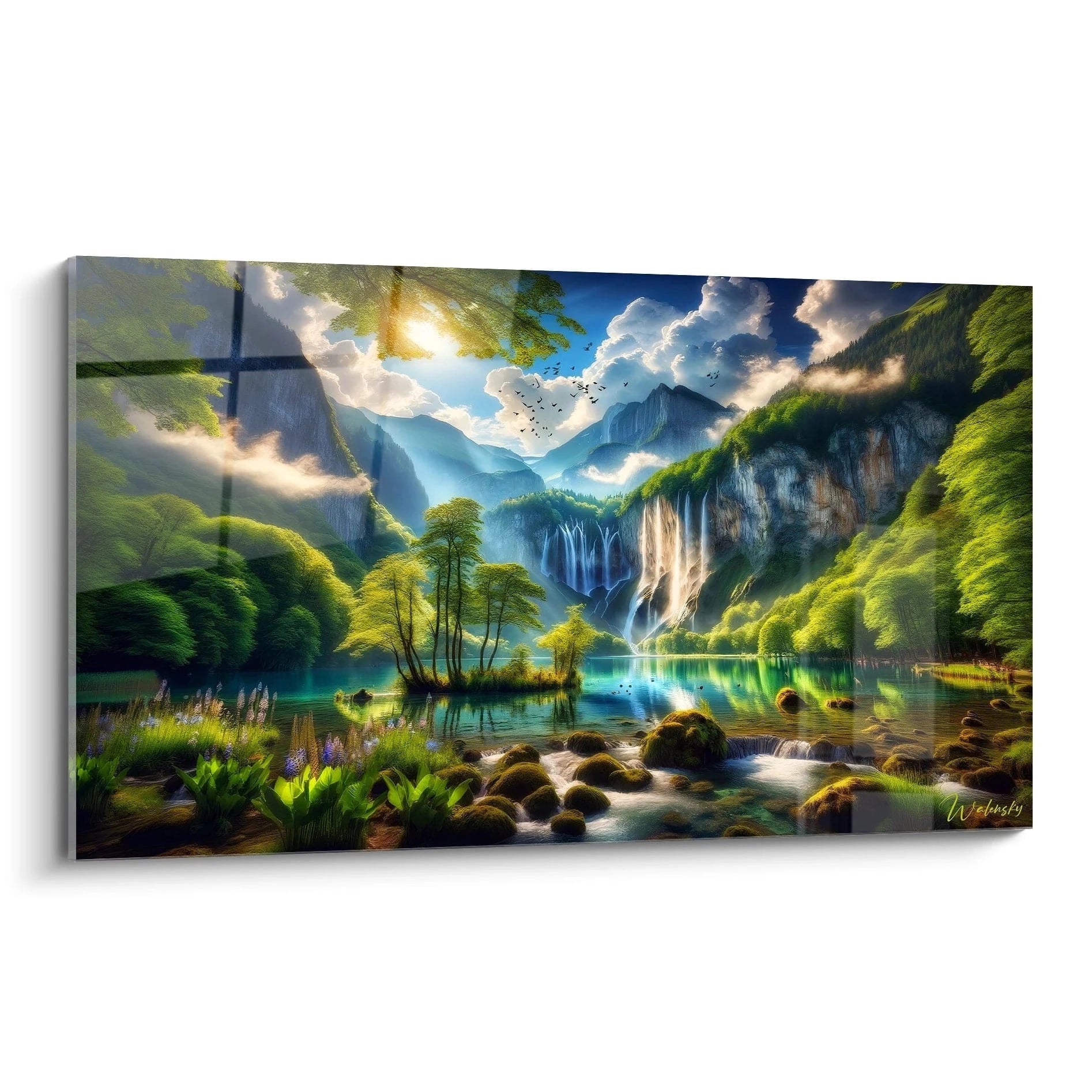






Are very large formats overwhelming in a standard-width hallway?
13 July 2026 · 7 min read · by Walensky
A few years ago, I was helping a client renovate her Haussmann-style apartment. Long hallway, high ceiling, bare walls. She wanted to hang a 120 cm wide canvas there. Everyone had told her it was madness. Too big. Too imposing. That the hallway would suffocate. We hung it anyway. And this hallway, once anxiety-inducing, has become the room everyone talks about.
So, are very large formats overwhelming in a standard-width hallway? No, not necessarily — and often, it's quite the opposite. A large format in the right place opens up the space visually, creates an unexpected breath of air and turns a functional passage into a true aesthetic experience. What the reader fears — the oppressive effect, the irreparable mistake — is in fact a matter of proportion, placement and artistic choice. And that can be learned. This guide is here to show you how.
The standard hallway: enemy or playground?
A standard-width hallway in France measures between 80 cm and 110 cm. Not much, at first glance. Yet this size has an asset few rooms can claim: a often generous length and continuous walls, without windows or doors to fragment the surface. It's a vertical blank canvas, almost perfect.
Most people hang small frames there, out of habit, out of caution. The result: walls that seem even narrower, a space that shrinks instead of opening up, and a succession of small formats that end up drowning in the void. The very large format, on the other hand, plays a radically different role. It immediately captures the eye, creates a powerful focal point and, paradoxically, makes you forget the narrowness of the hallway.
Why large formats expand space instead of shrinking it
It's counterintuitive, but it's a reality every interior design professional knows: a large format in a narrow hallway acts like a window open onto another world. The eye, drawn by the composition, color or movement of the work, mentally escapes beyond the walls. The perceived space exceeds the actual space.
Very large format hallway paintings work particularly well when they rely on compositions with strong depth of field — landscapes receding toward the horizon, abstractions with luminous flat areas, architectural photographs with pronounced vanishing lines. These subjects visually extend the hallway and give it a third dimension that bare walls are incapable of offering.
Conversely, a format that is too small on a large expanse of wall creates an effect of framed emptiness : the work gets lost, the wall looks immense and the hallway psychologically shrinks. The large format, on the other hand, fills the space with intention.

Favorite
Painting golden veins and white pearly crystals - Mineral Brilliance - Abstract Marble Edition
€233.90
Discover this paintingThe golden rules of placement in a standard-width hallway
The two-thirds rule
For a standard-width hallway, aim for a painting whose width represents between 55% and 70% of the available wall width. In a 100 cm wide hallway, this corresponds to a canvas 60 to 75 cm wide. For height, don't hold back: in a hallway with high ceilings, a vertical format 100 to 150 cm tall will create a majestic verticality that draws the eye upward and enlarges the sense of space.
Hanging height, a key often overlooked
The center of your painting should be located at 145-150 cm from the floor — the eye height of a standing adult. In a standard-width hallway, this rule is even more important because you view the work head-on, with no possibility of stepping back. A hanging that is too high or too low in a hallway immediately creates a visual discomfort that the brain perceives as imbalance. The large format, centered at eye level, asserts its presence naturally.
The lateral breathing space
Imperatively leave 15 to 20 cm of bare wall on each side of the painting. This strip of visible wall is the breath that prevents the crushing effect. It signals that the large format is a deliberate choice, not a measurement error. In a standard-width hallway, this breathing space reassures the eye and showcases the work like a setting.
— Our selection


Which subjects and styles to choose for a large format in a hallway?
Not all very large formats are equal in a standard-width hallway. Some subjects amplify the effect of spatial opening; others, on the contrary, can generate a feeling of confinement.
What works exceptionally well:
- Open horizontal landscapes — sea, plain, forest seen in depth — which create an illusion of spatial escape
- Abstractions with light, luminous tones — off-white, sky blue, sage green — which reflect light and visually widen
- Black and white architectural photographs, with clean lines that harmonize with the linear space of the hallway
- Large format botanicals on a light background — a trend that brings nature without weighing down
What is best avoided:
- Very large formats with dark, dense backgrounds in hallways that are already poorly lit
- Very busy and chaotic compositions that generate excessive stimulation in a passage space
- Extreme close-up portraits, whose gaze can create a feeling of discomfort in a narrow space
Your hallway deserves much more than a simple passage
Discover our exclusive collection of hallway paintings that transform every linear meter into an unforgettable visual experience.

— Also to discover


Lighting: the invisible partner of the large format
In a standard-width hallway, natural light is often absent or very limited. This is where artificial lighting becomes the indispensable accomplice of your large format. An adjustable spotlight positioned at 30° to the wall will create a theatrical staging effect. A wall sconce on each side of the painting will frame the work with light and double the sense of depth.
Avoid central ceiling lights, which flatten textures and dull colors. A large format in a hallway deserves directional lighting that reveals its material, texture and depth. It is this attention paid to lighting that makes the difference between a hung picture and an artwork staged.

In the same spirit
Floating Hope Blue Painting - Multicolor Abstract Edition
€232.90
Discover this painting →A single large format or a wall composition: which approach to choose?
The question often arises: is it better to have one very large format or several medium-sized works arranged as a gallery? In a standard-width hallway, the answer depends above all on the length of the hallway.
For a short hallway (less than 3 meters), a single large format centered on the back wall creates a striking perspective effect. The work literally becomes the vanishing point of the hallway, a destination to walk toward. For a long hallway (more than 4 meters), a rhythmic succession of two or three large formats, evenly spaced, creates an aesthetic journey. The key: maintain consistency of style and color palette to avoid a cluttered effect.
In all cases, avoid mixing very disparate formats in a narrow hallway. Regularity of sizes brings the visual order that will offset the architectural constraint of narrowness.
Conclusion: dare the large format, transform your hallway
A standard-width hallway is not a constraint — it is an invitation to boldness. The very large format, well chosen and well placed, does not crush it: it reveals it. It gives it a soul, a direction, an intention. This passage you crossed in a few seconds becomes a moment, a pause, an encounter with an artwork that belongs to you.
The next time you walk past this bare wall, stop thinking in centimeters. Think in emotions. Choose big. Choose bold. And watch your hallway become the room everyone talks about.
FAQ — Your questions about large formats in hallways
Is a 100 cm wide painting really suitable for a 90 cm wide hallway?
Yes, provided you respect the lateral breathing space. In a 90 cm hallway, a 100 cm wide painting would indeed be too wide and would exceed the limits of the wall. Aim instead for 60 to 65 cm in width, which represents about 70% of the available width — large enough to create a strong visual impact without exceeding reasonable proportions. The height, however, can be generous: 90 to 120 cm in height in a hallway with ceilings of 2.50 m or more is perfectly suitable and very elegant.
How can you avoid the oppressive effect of a large format in a dark hallway?
The key lies in the choice of colors and lighting. Opt for a painting with light, luminous tones — beige, off-white, pale blue, sea green — which will naturally reflect the available light. Then install an adjustable spotlight aimed at the painting: it will create an additional light source that illuminates the area and gives an impression of space. A dark large format in a poorly lit hallway can indeed weigh down the atmosphere; a light large format in that same hallway becomes a true source of visual light.
Can you hang a very large format in a rental hallway without risking problems?
Absolutely, using the right tools. Professional-grade drill-free fixings (high-strength adhesive hooks, picture rail systems hung from the molding) allow you to hang works weighing several kilos without making a single hole in the walls. For a large format, always check the weight of the work and choose fixings whose load capacity is double the actual weight. Most large canvas paintings do not exceed 3 to 5 kg, which is well within the capacity of the drill-free hanging systems available on the market.
Explore our collections


