

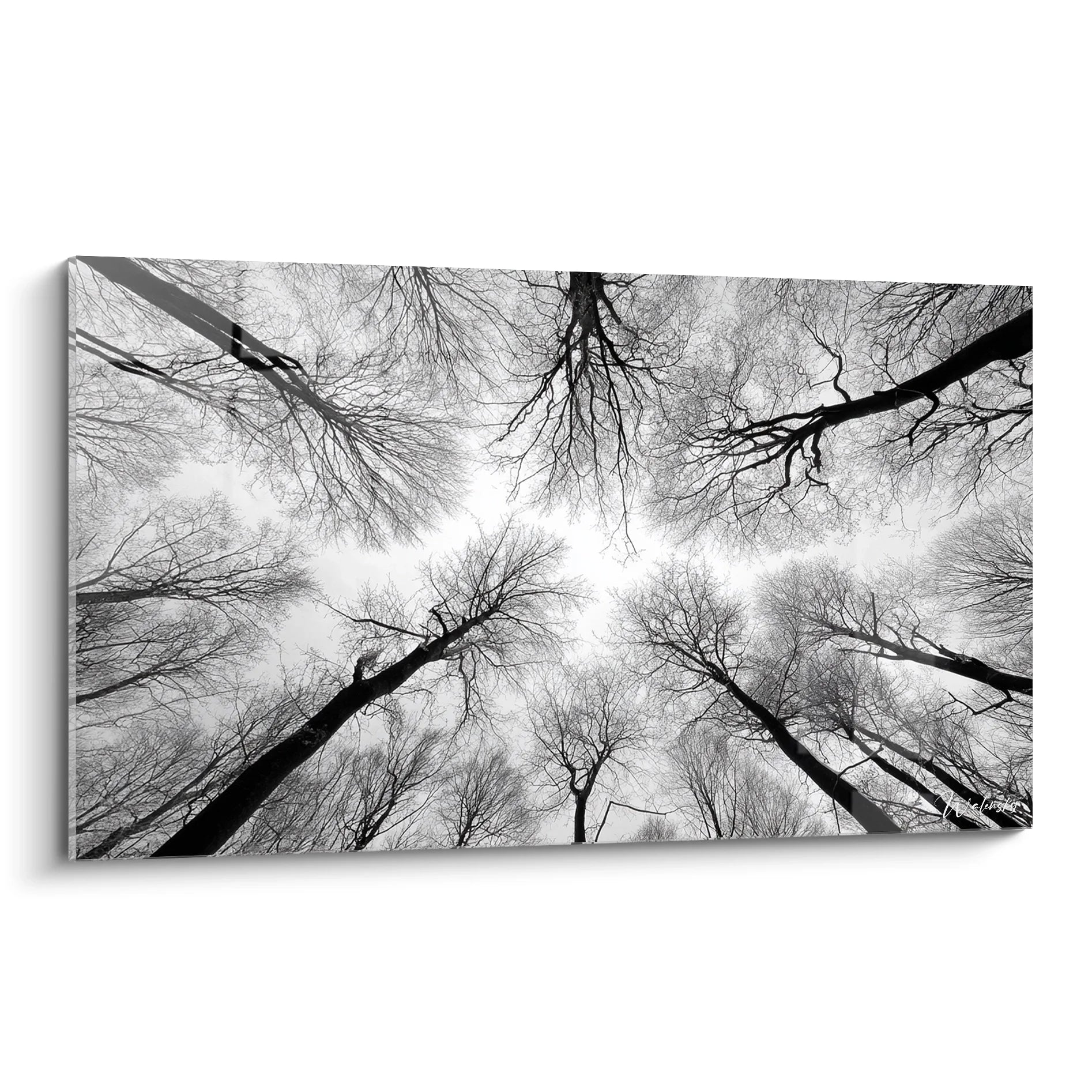






Do architectural facade photographs create a geometric structure?
July 12, 2026 · 7 min read · by Walensky
Sometimes a single upward glance is enough, on a street you thought was ordinary, for everything to shift. A Haussmann building, a glass tower, a repurposed industrial warehouse: suddenly your eyes no longer see a facade, but a geometric score, a ballet of lines, grids and hypnotic repetitions. This moment of revelation is what architectural photographers pursue every day.
Here is what architectural facade photographs concretely bring: a powerful geometric structure that organizes the gaze, a visual tension between symmetry and apparent chaos, and a decorative depth capable of transforming any interior space. Yet many still hesitate to bring this type of image into their home, fearing a result that is too cold, too technical, too removed from their sensibility. This fear is understandable, and entirely unfounded. For behind every architectural photograph lies not the rigidity of an architect's plan, but the raw poetry of matter and light organized. Let me show you why.
When the lens reveals what the naked eye misses
Standing before an architectural facade, our brain takes in the whole: it sees a building, a street, a context. The camera, on the other hand, frames, isolates, amplifies. It is this revealing function that gives facade photographs their very particular geometric power.
By choosing a raking angle, the photographer brings out the latent geometric structures : the repetition of windows becomes a rhythmic grid, stone reliefs create play of shadow and light that draw alternating bands, running balconies trace horizontal lines as precise as a draftsman's ruler. Architectural photography does not document a building, it extracts its visual skeleton.
This extraction is a form of abstraction. A photographed facade shot head-on, in raking light, can rival the works of Mondrian or Vasarely. The geometry is not artificially added by the photographer: it was already there, buried in the constructive logic of the building, and the image simply makes it surface.
The secret grammar of facades: lines, rhythms and repetitions
Every architectural facade follows an internal grammar. Architects think in modules, grids and proportions. They organize windows, pilasters, cornices and balconies according to precise rules, often inherited from ancient mathematical systems, from the golden ratio to Vitruvian proportions. When a photographer captures this facade, they are actually capturing this grammar made of stone, steel or glass.
The three geometric tools of a successful facade
In an architectural facade photograph, three geometric mechanisms operate simultaneously:
Modular repetition : each window, each column reproduces the previous one with slight variation due to perspective. This repetition creates a hypnotic effect, a visual pulse that invites the eye to travel across the image from top to bottom and left to right.
The tension between vertical and horizontal : window mullions pull toward the sky, cornices and floor slabs hold them back. This constant opposition generates a geometric energy that one physically feels in front of a large print.
Simulated depth : even on a flat wall, the architectural photograph conveys the thickness of mouldings, the recess of openings, the projection of balconies. A geometric structure in three dimensions asserts itself on a two-dimensional support.

Favorite
Fluid mother-of-pearl gold and black painting with golden veins - Luxure Minérale - Marble abstract edition
213,90€
Discover this paintingHaussmannian, brutalist, modernist: each style, its geometry
Not all architectural styles produce the same geometric structures when photographed. That is precisely what makes the collection of facade photographs so rich and so adaptable to varied interiors.
The Haussmannian facade offers a reassuring and noble geometry : rigorous symmetry, hierarchy of floors, regular alternation of openings. A black and white photograph of a building in the 7th arrondissement brings a corridor or living room an elegant, almost classical monumentality.
The brutalist facade (raw concrete, giant masses, radical repetition) produces geometric images of almost oppressive intensity, perfectly calibrated for contemporary interiors that embrace their character.
The modernist facade of glass and steel plays instead on transparency and reflection: photographs of these glass curtain walls layer reflections of the sky and surrounding buildings, creating geometries in perpetual mutation, almost kinetic.
— Our selection


Decorating with an architectural photograph: the wall as geometric score
Introducing an architectural facade photograph into an interior means bringing a powerful visual order into your space. This geometric structure functions like a magnet for the eye: it anchors the room, gives it an assumed verticality or horizontality, and creates a dialogue between inside and outside.
How to choose your photograph according to your space's geometry
A narrow corridor will benefit from an architectural photograph with a strong vertical dominance (a tower, a facade shot from a low angle) that will accentuate the perceived height and turn a passageway into an art gallery in its own right. An facade photograph with pronounced horizontal lines, on the other hand, will visually widen a compact room.
Close-up framings of details of façades — the repetition of a row of windows, the pattern of a cast-iron grille, the texture of cladding — create near-abstract effects. These photographs read like geometric paintings while retaining the material richness of real architecture.
Your corridor deserves an architecture that gives it height.
Discover our exclusive collection of paintings for Corridor that turn every linear metre into an invitation to architectural travel.

— Also to discover


Light: the secret ally of architectural geometry
An architectural facade photograph is never just an image of stone or glass. It is above all an image of light. And it is light that reveals, intensifies or softens the underlying geometric structure.
The raking light of morning or evening models the reliefs in sharp shadows, turning the slightest relief of a facade into a miniature geometric canyon. The diffuse light of an overcast sky unifies tones, slightly flattens volumes and brings out the purity of the architectural lines. The harsh frontal light of midday, hard and merciless, reveals textures and imperfections, giving facade photographs an almost documentary, raw and powerful dimension.
This is why two photographs of the same architectural facade, taken at different hours, can produce radically different geometries : one soft and poetic, the other tense and dramatic.

From street to wall: transforming a space with architectural photography
Imagine this moment: you walk into your corridor, and your gaze is immediately caught by a large architectural facade photograph. The lines unfold, the geometry asserts itself with quiet obviousness. The space seems larger, more built, more lived in. You are no longer in a mere passageway, you are in a space that tells a story, that has a point of view on the built world.
This is the true power of architectural photographs : they do not passively decorate a wall, they reinvent it. They import into your interior a geometric structure from outside, alive, carrying the history of a place, an era, a way of conceiving human space. Choose an image that speaks to you, that resonates with your own sense of order and beauty, and let the geometry do its work.
FAQ: your questions about architectural photography and geometry
Does an architectural facade photograph suit all interior styles?
Absolutely. This is in fact one of the great strengths of architectural photography : its versatility. A black and white Haussmannian facade will blend perfectly into a classic or eclectic interior, bringing a touch of Parisian nobility. A modernist facade with glass reflections will naturally merge into a minimalist contemporary space. Industrial facade photographs (brick, metal, concrete) dialogue beautifully with loft or Scandinavian interiors. The key is to choose a geometric structure that echoes the lines already present in your space, rather than clashing brutally with them.
What print size should you choose so the geometry is truly legible?
The geometry of an architectural facade fully reveals itself from a certain format. Below 40x60 cm, details get lost and the effect of structure weakens. For a living room or bedroom, you can go up to the large 100x150 cm format, or even a horizontal panoramic that unfolds the full geometric richness of a facade across its width. Don't be afraid of large formats; that is often where the magic truly happens.
Colour or black and white: which option best enhances the geometric structure?
Both options have their own virtues, and the choice depends on the effect sought. Black and white is the great revealer of geometry : by removing chromatic information, it concentrates all attention on lines, volumes, and contrasts of shadow and light. A black and white architectural photograph is often more immediately legible in its geometric structure. Colour, on the other hand, adds a material and atmospheric dimension: the ochre yellow of an Italian facade, the bluish grey of Parisian concrete, the dazzling white of Mediterranean architecture. It tells more about the place and the moment. If you hesitate, start with black and white; you will never be disappointed.


