

ART & DECORATION
Wall decor natural: ideas and tips for an authentic interior
This living room wall has been staring back at you for weeks. White, empty, a little accusing. You've leafed through magazines and scrolled Pinterest for hours, and the same thing keeps coming up: raw materials, textures that breathe, shades that recall the forest after rain. That something is natural wall decor — and it's no coincidence it's taking over everywhere right now. Not a passing whim or a trend: a genuine response to a need to rediscover something essential within our four walls. Materials, styles, compositions, mistakes to avoid — here is everything you need to know to turn your walls into something that truly reflects you.
Why natural wall decor is so appealing in 2024
There is something almost visceral about the appeal of natural materials. No psychology degree is needed to understand it: when you spend your days under fluorescent lights, in front of screens and in standardized spaces, coming home and touching wood — quite literally — feels good.
Biophilic design: when nature enters our walls
Biophilic design starts from a simple observation: human beings need nature to feel well. Not necessarily a garden or a forest within reach — a driftwood plank on a wall, a painting with botanical motifs, or a woven rattan panel is enough to awaken something in our brain. Studies in environmental psychology show that the presence of organic materials in a space reduces stress and improves concentration. Interior architects have understood this well, and homeowners are beginning to follow.
The benefits of an interior with raw and organic materials
Durability, first. A solid wood painting or a piece incorporating natural plant fibres never goes out of style. Where a canvas print that was trendy in 2019 may look dated today, a piece in raw material ages through the years with quiet elegance. Visual warmth, next: sand, burnt ochre, moss green and tobacco brown tones create a palette that instantly warms a space, even without repainting the walls. And then there is the timelessness of Japanese wabi-sabi — the philosophy that celebrates imperfection and the patina of time — which gives natural materials a depth no synthetic material can imitate.
A wall dressed in natural materials does not simply decorate a space: it gives it a soul, a memory, a texture you want to touch.
The essential materials for a successful natural wall decor
Not all natural materials are equal on a wall. Some are obvious choices, others require a little more finesse. Here are the essentials.
Wood, rattan and plant fibres: the stars of natural decor
Driftwood is perhaps the most poetic. Salvaged, polished by water and time, it brings a story to your wall. It comes as decorative panels, frames and wall sculptures. Rattan, meanwhile, has made a strong comeback in recent years — and not only on chairs. Mirrors framed in rattan, woven panels, wicker shelves mounted on the wall: it offers an organic lightness that solid wood cannot always provide. Macramé in natural cotton remains a safe choice for bohemian interiors, while jute and woven linen bring a more discreet texture, perfect for Scandinavian or Japandi atmospheres.
Decorative paintings in natural materials: art serving the natural
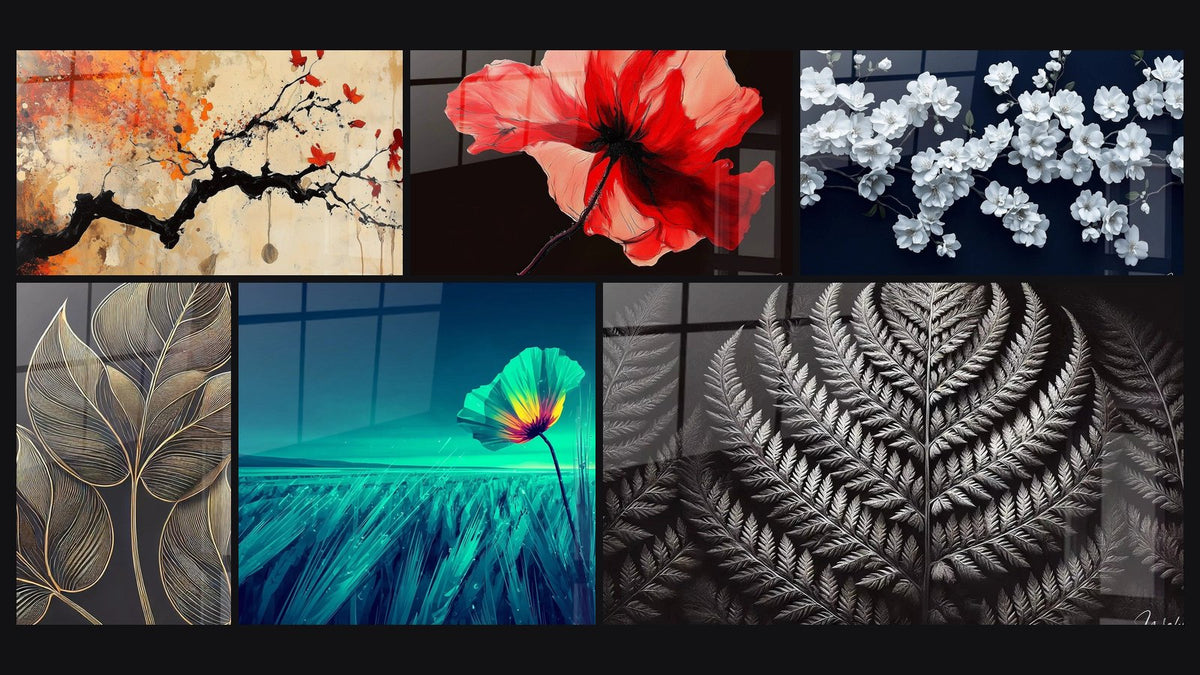
This is where it gets really interesting. A decorative painting incorporating organic materials — plant fibres, wood, natural pigments, pressed dried leaves — combines the advantages: it brings the textural richness of a handcrafted object and the visual clarity of an artwork. Botanical motifs on natural linen backgrounds, landscapes in mixed media combining paint and material — like a misty forest painting in acrylic print with zen tones — or earthy-toned abstract compositions are particularly effective. A single well-chosen painting can structure an entire wall and set the tone for a whole room — without overloading the space.
A painting with natural materials works as a visual anchor: choose it first, then build the rest of your composition around it. It is simpler — and more coherent — than the reverse.
How to choose your natural wall decor according to your interior style
The classic trap: buying beautiful natural elements separately, hanging them, and ending up with something that looks like a well-lit flea market. Stylistic coherence is what makes the difference between a successful wall and a muddled one.
Bohemian and ethnic chic style: dare textures and contrasts
In a bohemian ethnic chic interior, the rule is simple: there are no rules, but there is a logic. You layer textures — raw cotton macramé, a painting in terracotta and indigo tones, a raw wood plank, a wicker basket hung like a work of art. The idea is to create a wall that tells a journey, a collection, a life. Varied formats work very well: a large central painting surrounded by small objects at different heights. Be careful, however, to keep a coherent colour palette — two or three dominant colours at most — to avoid visual chaos.
Scandinavian and Japandi style: minimalism and raw materials
Japandi style — this fusion of Scandinavian simplicity and Japanese sensibility — is perhaps the most fertile ground for natural wall decor. Here, less is truly more. A single painting with sober lines, a black-and-white botanical print on rice paper, a light wood panel with visible grain: each element must breathe. Neutral tones dominate — off-white, ash grey, linen beige, very muted sage green. Light ash or bleached oak naturally prevails. And above all, leave empty space. In this style, emptiness is not an absence: it is a decorative element in its own right.
Ideas and inspiration for composing a harmonious natural wall
Moving from inspiration to execution is often where things go wrong. Here is a concrete approach that works.
Creating a gallery wall with natural paintings and objects
Start by laying all your elements on the floor, in front of the wall, before drilling anything. This obvious step is often overlooked — yet it avoids many regrets. For a successful natural gallery wall, mix the formats: one large painting (at least 60×80 cm) as the centrepiece, two or three medium formats as satellites, and a few small elements to balance. In narrow spaces, a panoramic nature painting for a hallway can play this role of centrepiece very effectively. Integrate three-dimensional objects — a small driftwood shelf with a dried plant, a rattan mirror, a flat wicker basket — to create depth. The spacing rule: 5 to 8 cm between each element, no more. Too much space and it floats; too little and it suffocates.
Photograph your composition laid on the floor before hanging. Look at the photo on your phone: imbalances jump out on a screen, whereas you no longer see them when standing in front of the wall.
Advanced tips to enhance your natural wall decor
Natural materials have their quirks. A few points not to overlook.
The wall colour : natural materials flourish on soft backgrounds. Off-white, dove grey, pale sage green, diluted terracotta — avoid pure white, which flattens textures and drowns them in light. A slightly coloured background brings out the wood grain and the texture of fibres spectacularly.
Lighting : this may be the most underestimated factor. An adjustable spotlight at 45° on a natural-material painting creates shadows that reveal every relief. Warm evening light, low and raking, turns a driftwood wall into something that almost resembles a sculpture. Invest in warm-spectrum bulbs (2700K) rather than cold white bulbs that kill the warmth of organic materials.
Maintenance : unvarnished wood should be fed with linseed oil twice a year. Rattan dislikes excessive humidity — avoid poorly ventilated bathrooms. Plant fibres can be dusted with a soft brush or a hairdryer on the cool setting. And decorative paintings? A slightly damp cloth is enough for most surfaces, avoiding harsh household products that alter natural pigments.
The mistake to absolutely avoid : overloading. Natural wall decor has a natural tendency to accumulate — each piece is beautiful, so we add another, then another. The result: a wall that shouts instead of whispering. Ask yourself after each addition: does this element add something, or does it dilute what was already there?
Frequently asked questions about natural wall decor
Which materials should be used for natural wall decor?
The most accessible and versatile: wood (driftwood, solid, whitewashed), rattan and woven wicker, jute and linen, cork panels, pressed leaves and flowers under glass, reconstituted stone as a light cladding, and natural cotton for macramé. Each has its own personality: wood brings warmth, rattan lightness, stone sturdiness. It is up to you to choose according to the atmosphere you want.
How do you combine natural wall decor with a modern style?
The secret: play on controlled contrast. A raw wood piece on a concrete-effect wall, a plant-fibre painting in a matt black metal frame, a rattan panel in a room with very clean architectural lines — the tension between the raw and the refined creates something interesting. The key is not to mix too many different materials: choose one or two natural materials and stick to them.
Which painting should you choose for natural wall decor?
Look in three directions: paintings with botanical motifs (foliage, tropical plants, herbariums), natural landscapes treated with earthy pigments and mixed techniques, or abstract works with organic textures incorporating real materials. Avoid overly smooth or overly photographic reproductions — textural richness is what makes the difference in successful natural wall decor.
How do you maintain natural wall decor elements?
The golden rule: dust regularly (once a month) with a soft brush or a dry microfibre cloth. Unvarnished wood is maintained with linseed or natural wax once or twice a year. Rattan is cleaned with a slightly damp cloth — never soaked. Plant fibres (jute, linen, cotton) tolerate prolonged humidity poorly: avoid very damp rooms or ensure good ventilation. For paintings, keep them away from direct heat sources and intense sunlight, which degrades natural pigments.
Natural wall decor, a way of living that starts with a wall
We started from an empty wall that taunted you. We arrive at something bigger: a way of thinking about your interior, of choosing what you hang and why, of creating a space that looks like only you. Natural wall decor is not a trend adopted to follow the crowd — it is an aesthetic choice that says something about what we value: authenticity, durability, the beauty of imperfect and living things. A well-chosen painting, a material that breathes, a composition that breathes too: that is enough to transform an entire room. No need to redo everything. Just start in the right place — and that right place is often a single painting that sets the tone for everything else.
Your wall is waiting. It deserves better than default white. Explore our collection of natural decorative paintings and find the piece that will finally give your walls what they have been asking for all along.

— Our selection


— Also to discover


In the same spirit
White and green flowers in a textured cascade - Spring Cascade - Nature Flower Edition
From €273.90
Discover this painting →
— Our take


— Our choice


Explore our collections


