





Cheap interior wall cladding: comparison of solutions and real budgets
8 min read · by Walensky
ART & DECORATION
The living room wall that has turned yellowish since the last tenant. The crack above the sofa you've been hiding behind a piece of furniture for three years. That bare stretch of partition that makes the apartment feel like a student studio even though you've lived there for five years. We all know that wall: the one you look at thinking "I really should do something about it" without ever getting out the tape measure or the wallet.
Good news: dressing up an interior wall on a budget doesn't mean patching things up with an ugly stopgap while you wait for something better. There are genuine options, with genuine price differences, and an honest comparison lets you choose without getting it wrong.
- Paint remains the cheapest option per m², but it won't hide a badly damaged wall.
- Non-woven wallpaper offers the best design-to-price compromise for a wall in good condition.
- A large decorative painting dresses up a wall with no work and no heavy drilling, and can be changed in five minutes if you move.
Why dressing up an interior wall doesn't have to break the bank
The need is often the same: a tired wall, a tight budget, and the wish to avoid heavy work. A tenant who doesn't want to invest in a home they'll leave, a homeowner renovating room by room, a young couple furnishing their first flat on a shoestring but with plenty of enthusiasm: everyone is looking for the same thing, maximum visual impact for minimum spending and hassle.
The difficulty is that cheap solutions are not all equal. Some hide a damaged wall well but require irreversible work. Others go up quickly but don't hold up over time. And some, too often overlooked, need neither glue, paint nor a drill.
Comparison of budget solutions: price per m²
Here are the real budget differences between the five main families of solutions, materials included, DIY installation.
| Solution | Price per m² (materials) | Installation | Reversible |
|---|---|---|---|
| Acrylic paint | €8 to €20 | Easy, 1 to 2 days | No (work must be redone) |
| Decorative plaster | €15 to €35 | Technical, requires practice | No |
| Non-woven wallpaper | €10 to €25 | Medium, adhesive required | Partially |
| 3D wall panels | €15 to €30 | Easy, glued or clipped | Yes, removable |
| PVC cladding | €12 to €25 | Medium, fixed on rails | Yes |
| Decorative painting | varies by format, bought per piece | Very easy, hung in 5 minutes | Yes, completely |
Paint and decorative plaster
Acrylic paint remains the cheapest option per m² on the market. A 2.5-litre tin covers about 25 m² in one coat and rarely costs more than €25 to €30 at a DIY store. The catch: it hides neither cracks, nor irregularities, nor a wall that has really lived.
Decorative plaster (concrete-effect, trowelled, sand-effect) moves up a little in range and price, but it hides small flaws better. In return, it requires real application skill: badly smoothed plaster shows across the entire wall, not just part of it.
Wallpaper and 3D wall panels
Non-woven wallpaper is often the best compromise between price and design effect for a wall that hasn't suffered too much. Graphic patterns, wood imitation, botanical effects: the choice is wide, installation is relatively simple, and the result radically changes a room's atmosphere.
3D wall panels in polystyrene or PVC play on relief and shadow. Their thickness hides small imperfections well, and they can be stuck up without any particular skill. Their weak point: the look can sometimes feel a little kitsch if you cover a whole wall without restraint.
Paintings and wall compositions
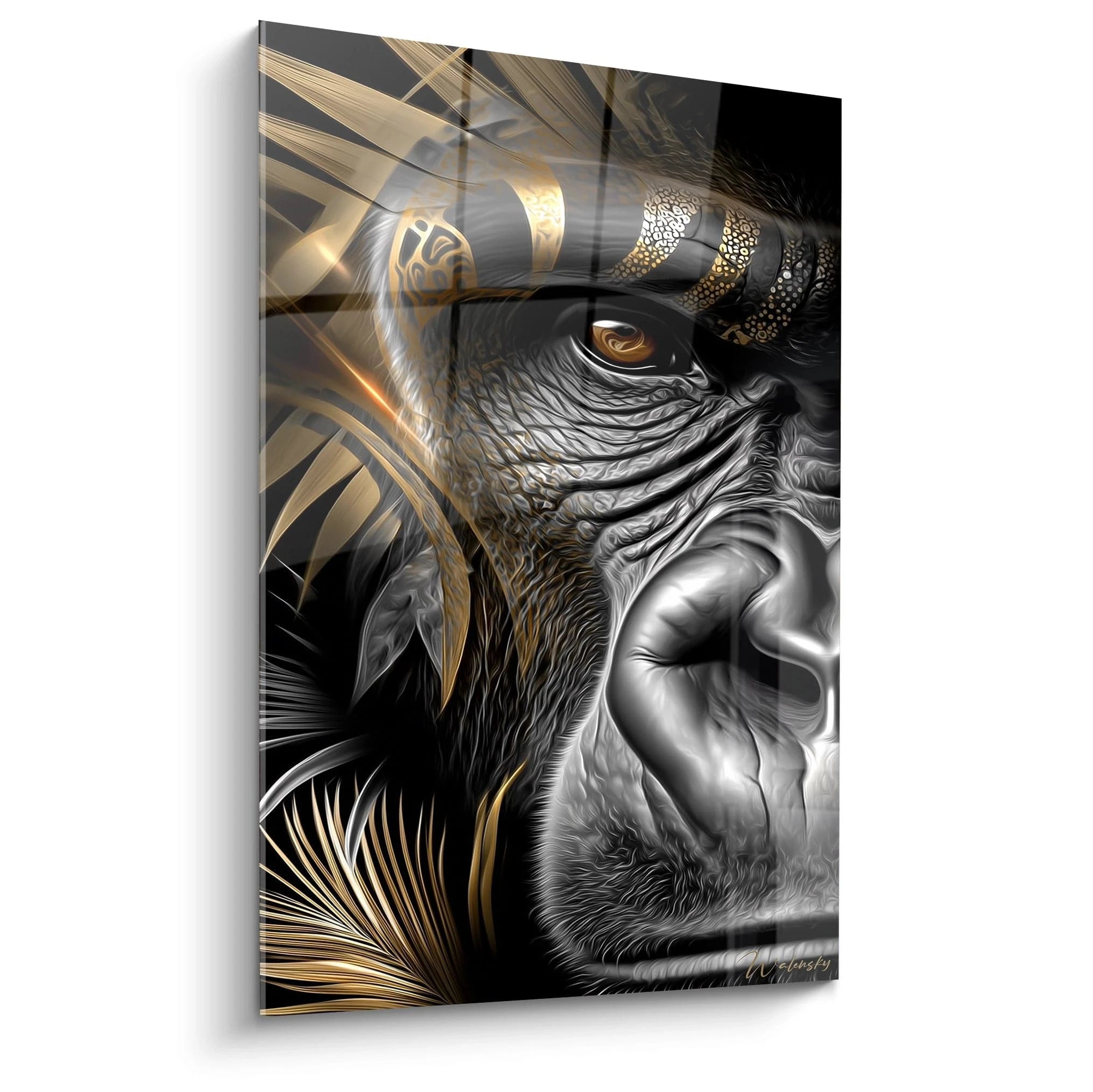
The decorative painting changes the whole logic. You don't pay a price per m² of wall to be covered: you buy a single artwork that hangs on the existing wall, painted, damaged or bare, without ever altering the surface in depth.
A large, well-chosen painting often makes more impact than a whole wall repainted, for a fraction of the renovation budget.
It is the only solution in this comparison that requires no surface preparation, no glue and no drying time. It is particularly suited to tenants: you take it down, take your paintings with you, and the wall returns to its original state.
The shop's creations are printed in Italy on acrylic glass (glossy finish, intense colours, ideal in a room with controlled light) or on Alu Dibond (matt surface with no glare, ideal opposite a window). All are delivered without a frame, fixings included, ready to hang.
An L-format painting (120 x 70 cm) already covers a good part of a standard living room wall without overwhelming it. Aim for a size roughly 60 to 75% of the width of the sofa or furniture placed beneath it; check exact sizes on the product page.
Which solution to choose based on your situation
The right choice depends less on the price displayed than on the real constraint: tenant or homeowner, damaged or sound wall, wish to change often or to fix something lastingly.
- Tenant, damaged wall : avoid paint and plaster (work not permitted or to be redone when you leave). Favour one or several paintings, which draw the eye without touching the surface.
- Homeowner, tight renovation budget : paint remains unbeatable per m², to be combined with a painting to avoid the "flat wall with no soul" effect.
- Wanting to change your decor often : removable 3D panels or paintings, never wallpaper glued across the whole wall.
- Very damaged, cracked, stained wall : thick 3D panels or a large painting placed strategically over the problem area.
Economical and effective combination ideas
The best results rarely come from a single solution pushed to the extreme, but from a smart combination — a logic we also apply in our approach to budget home interior decoration, room by room.
- Light paint + a large painting : the most cost-effective combo. Wall repainted in a neutral shade (8 to 20 €/m²), then a painting that becomes the focal point of the room.
- Wallpaper on a single wall section + frames or paintings on the adjacent walls : avoids visual overload and spreads the budget.
- 3D panels on the lower part of the wall (chair rail paneling) + painting above : a technique often seen in entrances or hallways, which structures the space without repainting the full height.
In a living room with a damaged wall behind the sofa, the combination of neutral paint + an L-shaped painting generally costs less than premium wallpaper installed by a professional, for a comparable effect, and even greater personality.
Tips to reduce the bill further
A few simple habits can save you even more budget, whichever solution you choose.
- Buy during sales : decor sale periods (end of year, back-to-school) often lower the prices of paints and wallpapers noticeably.
- Do it yourself (DIY) : installing it yourself can halve the bill compared to professional installation, especially for paint and 3D panels.
- Share purchases : a paint tin or a roll of wallpaper shared across several rooms of the same home optimizes the quantity-to-price ratio.
- Buy online rather than in-store for decorative paintings: specialized online shops often avoid physical distribution margins, for a more competitive final price at equivalent quality.
Before buying a large quantity of paint or wallpaper, measure the actual wall surface precisely (height x width, minus openings). Many people buy 20% too much "just in case" and pay for unused material.
Frequently asked questions
What is the cheapest wall covering per m²?
Classic acrylic paint remains the cheapest, between 8 and 20 euros per m² including supplies. It is only suitable, however, for a wall in good condition, without cracks or major irregularities to hide.
How to dress a wall without work or drilling?
One or more decorative paintings are the most direct solution: fixings included, hanging in a few minutes, no surface preparation required. It is also the only fully reversible option if you move house.
Paint or wallpaper: which is the most economical option in the long run?
Paint costs less to buy, but it scratches and gets dirty faster in high-traffic areas. Quality non-woven wallpaper often lasts longer without touch-ups, which offsets the initial price difference over several years.
How to dress an interior wall for under 50 euros?
A tin of light paint (about 25 to 30 euros for 25 m²) is enough for a clean base. Complete it with an inexpensive wall accessory or a mid-size painting to add character without exceeding the budget.
Conclusion
That wall that has been staring at you for months doesn't need a full renovation budget to change its look. Affordable interior wall dressing is above all a matter of trade-offs: knowing where to put the few euros available for maximum effect, rather than sacrificing everything on a single solution.
Paint, wallpaper, 3D panels: each has its place depending on your wall and your constraints. But if you're looking for the fastest, lightest and most reversible option, head to our decorative painting collection to find the artwork that will transform this wall without a single brushstroke or drill hole.