

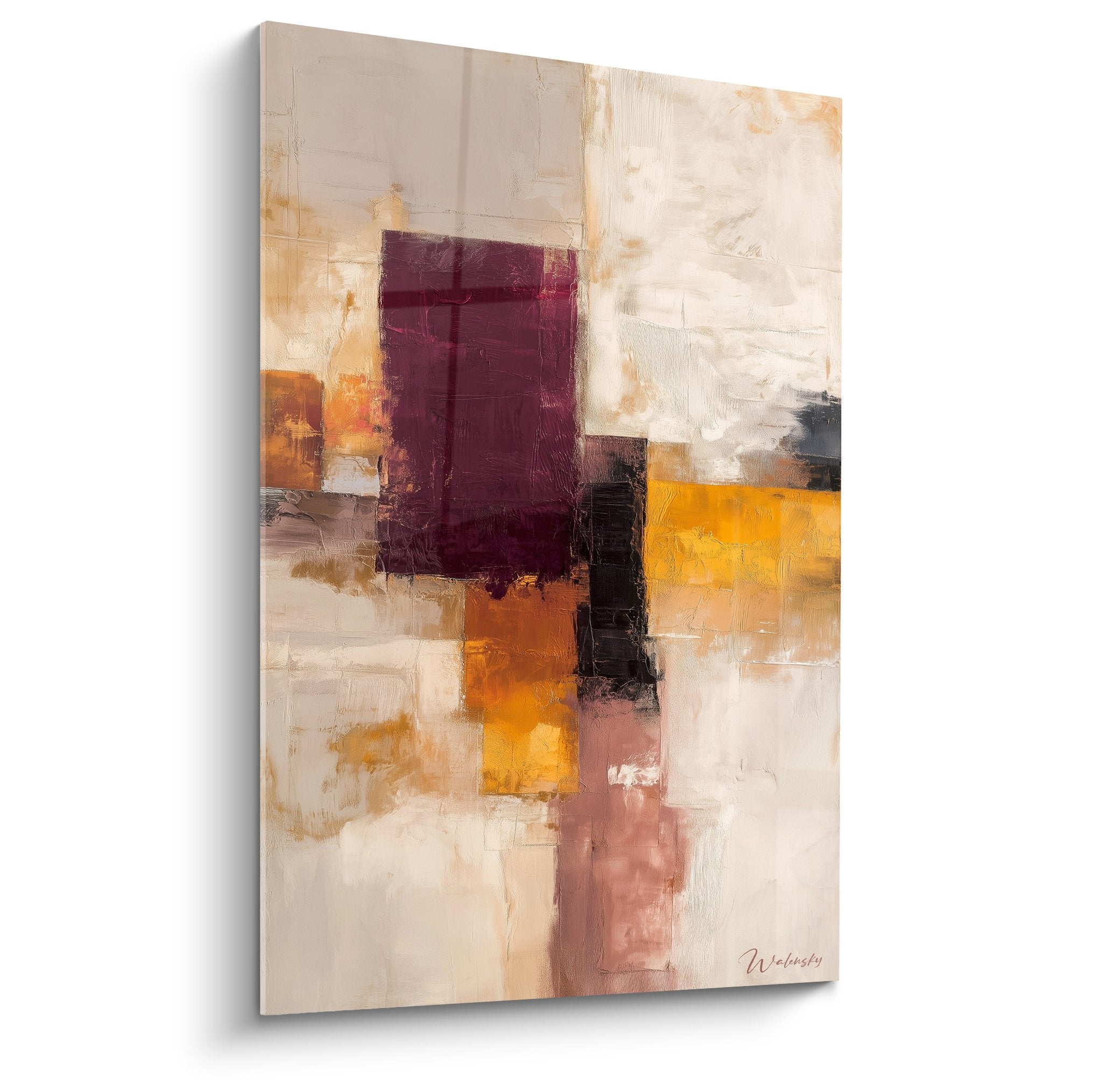






Which size to choose for a fluid epoxy painting depending on its location
8 min read · by Walensky
You've fallen for a fluid epoxy painting, those compositions where turquoise blends with gold like a tide that never stops receding. Then, when it's time to choose the format, doubt sets in. L 120x70, XL 140x80, 2XL 180x100: the numbers line up on the product sheet, but nothing tells you which one truly suits your wall.
Good news: this choice isn't guessed, it's calculated. And the formula fits in one line.
The direct answerFor a fluid epoxy painting, the size is calculated from the width of the furniture or reference wall: allow 60 to 75% of that width. Above a 200 cm sofa, aim for a painting between 120 and 150 cm wide (L or XL format depending on the sheet). Above a headboard or sideboard, the same rule applies, with numerical benchmarks that change depending on the location.- The basic rule: the painting should occupy 60 to 75% of the width of the furniture or wall concerned.
- A format that is too small flattens the depth effect specific to epoxy resin; one that is too large suffocates it on a narrow wall.
Why size changes everything for a fluid epoxy painting
A fluid epoxy painting does not work like a classic painting. Its effect relies on movement: the pours, marbling and transparent zones created by the resin give an impression of depth that needs space to unfold. On a format that is too small, this movement folds back on itself, the shades crowd together and the eye perceives only a coloured stain without relief.
Conversely, on a large format, the light playing on the glossy surface of the acrylic glass — or the matte finish of Dibond aluminium — has room to circulate. The depth effect specific to fluid art truly reads, almost like a window opening onto an ocean current.
A fluid epoxy painting that is too small loses its movement; too large, it loses its balance with the room. Between the two lies a formula, not chance.
The one-third method: the basic rule for calculating the right size
The most reliable decorating rule is no mystery: a painting should occupy 60 to 75% of the width of the element it relates to. This may be a sofa, a headboard, a sideboard or, in the absence of furniture, the wall itself.
In practice: a 220 cm sofa calls for a painting roughly 130 to 165 cm wide. A 160 cm sideboard pairs well with a format around 100 to 120 cm. This range always leaves some breathing room on either side, avoiding the "painting glued to the furniture" effect seen too often.
How to measure your wall or furniture in 2 minutes
- Measure the exact width of the main piece of furniture (sofa, bed, sideboard) with a tape measure.
- Multiply this width by 0.6 and by 0.75: you get your ideal width range for the painting.
- Compare this result with the formats available on the product sheet (L, XL, XXL, 2XL, 3XL, 4XL) and choose the closest one, without necessarily matching the exact figure.
- No reference furniture (hallway, entrance)? Apply the same calculation to the available wall width, leaving at least 15 to 20 cm of air on the sides.
If your calculation falls between two formats on the sheet, always prefer the larger one. A slightly more imposing painting is noticed; a slightly too small one is lost.

Which size for each location in the home
Each room imposes its own constraints of height, visual distance and use. Here are the benchmarks that really matter, location by location.
Above a sofa or sideboard
This is the most common location, and the one where undersizing is most obvious. For a standard 180 to 220 cm sofa, the XL (140x80 cm) to 2XL (180x100 cm) formats cover the right range.
For a lower, narrower sideboard, the L format (120x70 cm) is usually enough, unless the wall above is particularly clear.
Above a headboard
A bedroom calls for a slightly more restrained format, to preserve the soothing atmosphere specific to this room. For a 160 cm bed, an L or XL painting works well; for a 180 cm bed, move up to the XXL (160x90 cm).
In a bedroom, soft tones matter as much as size. The Emerald Mist Painting and its pastel shades, or more serene bluish compositions, suit this room better than a highly contrasted visual.
In an entrance, hallway or office
These spaces are often narrow but constantly traversed: the painting must be seen at a glance without overwhelming the passage. The L format (120x70 cm) remains the smallest reasonable format in the shop; for a truly narrow hallway, custom sizing from 80x46 cm becomes the best option.
In a hallway, favour a format taller than it is wide: the eye naturally follows height when crossing a space, which reinforces the movement effect specific to fluid epoxy.
Two flagship pieces illustrate these size differences well. The Burning Tide Painting, with its turquoise and orange shades, is especially striking in 2XL above a wide sofa, while a more modest entrance is perfectly served by an L format.
If you are still torn between two supports, know that the choice depends mainly on the room's light: acrylic glass enhances reflections and depth in controlled light, while matte Dibond aluminium suits a position facing a window better. This finish choice does not change the size calculation method, but it influences the final rendering.
— Also to discover


Single painting or multi-panel composition: impact on size choice
A wall more than 250 cm wide poses a different problem: a single very large painting becomes heavy, costly and sometimes difficult to transport to your home.
The idea: spread the same total width across two or three panels rather than a single piece. The movement effect specific to fluid art even gains dynamism, as the eye moves from panel to panel as one follows a wave spreading outward.
For this type of project, the custom formats, which go up to 280x160 cm on several of the shop's paintings, let you adjust each panel to the millimetre rather than settling for standard formats.
— In the same spirit


The most common sizing mistakes to avoid
Three mistakes come up again and again, and they are all avoidable once you know the one-third rule.
| Mistake | Consequence | Solution |
|---|---|---|
| Painting too small for the wall | "Postage stamp" effect, epoxy movement crushed | Recalculate with 60-75% of the furniture's width |
| Centre of the painting too high or too low | Distorted perspective, uncomfortable viewing | Centre at about 1.50 m from the floor, at eye level |
| Painting glued to the furniture with no air | Composition suffocated, no visual breathing room | Leave 15 to 20 cm of space on either side |
Hanging height deserves particular attention: a magnificent painting, badly placed, loses much of its impact. The rule of centring at 1.50 m applies to most living spaces, living room and bedroom alike.
If you want to compare the two technical approaches — epoxy and fluid acrylic — before deciding on size, our article on choosing between epoxy and fluid acrylic painting details the rendering differences between these two finishes. And to understand why these formats vary so much from one room to another, the explanation of the artisanal manufacture of an epoxy fluid art painting also sheds light on the link between technique and ideal size.

Other selected pieces
Emerald Fusion Painting - Epoxy Style Edition
From €233.90
Discover this painting →Frequently asked questions
What is the ideal hanging height above a sofa?
The centre of the painting should sit about 1.50 m from the floor, leaving 15 to 25 cm between the bottom of the frame and the sofa backrest.
How do you know if a painting is too small for a wall?
If its width is less than 50% of that of the furniture or reference wall, it looks floating and isolated. The 60 to 75% range remains the most reliable benchmark.
Can you hang a small epoxy painting in a large room?
The L format (120x70 cm) is the most compact in the range, and it works very well in a large room if paired with a dedicated wall, for example in a hallway or above an isolated low cabinet, rather than on the main living room wall.
What painting size for a bedroom?
For a 160 cm bed, L or XL formats are suitable. For a 180 cm bed, prefer the XXL (160x90 cm), always keeping the 60 to 75% rule relative to the width of the headboard.
The right size for a fluid epoxy painting therefore isn't a matter of luck or a blind crush: it follows from a simple calculation, the one-third rule applied to your furniture or wall. Once you have this measurement in hand, all that remains is to browse the epoxy painting collection to find, among the formats offered, the one that will match your space exactly.
the epoxy painting collectionExplore our collections


