Large green epoxy painting: the striking effect on a white wall
8 min read · by Walensky
A large white wall can be intimidating. We repainted it first thing when we moved in, promising ourselves we would hang "something" on it, and two years later it is still bare, watching us walk past without saying a word. The problem isn't the wall: we keep trying to fill it, when we should learn how to make the most of it.
The short answerA large green epoxy painting works on a white wall because neutral white absorbs light without tinting it, letting shades of emerald or forest green stand out through contrast. For a striking effect, the artwork should cover 60 to 75% of the width of the furniture piece or wall section it hangs over, rather than sitting as a medium-sized piece lost in empty space. Deep emerald green suits bright rooms, while lighter sea green suits darker rooms that need some air.Here, we won't sell you filler. We will talk about scale, contrast and placement, the three things that separate a painting that simply "looks nice" from one that stops the eye the moment you walk into the room.
- The white wall is an optical ally: it never competes with the green epoxy, it reveals it.
- A piece that is too small on a large wall creates a "postage stamp" effect, the most common mistake.
- The choice of green shade depends mostly on the room's natural light, not on trends.
Why a white wall is the green epoxy painting's best ally
A matte white wall does nothing: it does not reflect light like a lacquered white, nor does it drift toward yellow like an off-white. That very neutrality makes all the difference. Against a deep emerald green, matte white creates a clean chromatic contrast with no visual noise around it.
Epoxy art plays precisely on this tension. The resin creates depth and movement with an almost three-dimensional quality, a subtle optical relief produced by the transparency play within the material. On a coloured or textured wall, this effect gets diluted. On a white wall, it becomes the only element of relief in the whole room: the eye has nowhere else to go.
A white wall is not a problem to solve, it is a silence waiting to speak.
This is where the notion of a focal point becomes meaningful. In a room where the furniture is restrained and the walls are neutral, a single object can concentrate all the attention. The green epoxy painting becomes that anchoring point, provided you respect a few scale rules, which we will detail right away.
Choosing the right size: what dimensions create maximum impact
Size is the primary cause of failure on a large white wall. A piece that is too small floats, isolated, and gives the impression the room was forgotten halfway through its decoration.
Proportion rules based on wall size
The rule that works almost every time: the artwork should occupy between 60 and 75% of the width of the furniture or wall section it hangs over. Above a 220 cm sofa, aim for a painting width of roughly 130 to 165 cm, that is an XL (140x80cm) or XXL (160x90cm) format depending on the brand.
For a completely free wall with no reference furniture, such as an entrance, a staircase or a wide corridor, you can go even bigger: the 2XL (180x100cm) and 3XL (200x112cm) formats literally transform the architecture of the room. This is where green epoxy works best, because it does not have to compete with other coloured masses.
A wall that is too tall often makes you want a wide horizontal format rather than a square one: the eye follows the line of sight, not the line of the ceiling.
Viewing distance and the perception of epoxy relief
The 3D effect of the resin reads differently depending on distance. In a living room where you step back 3 to 4 metres, large formats such as the 4XL (240x140cm) fully reveal their shades and transparency effects. In an entrance where you only pass through, a more contained format such as the L (120x70cm) or XL is more than enough, since the eye has no time to linger on fine details.
If your wall is narrow, it is better to aim for an L format rather than force an XXL that would touch door frames or mouldings. The epoxy painting collection offers exactly this variety of sizes, from L to made-to-measure, so you can adjust the scale to the centimetre.

Which green epoxy shade for a bright or dark white wall
Not all greens behave the same way in natural light. This is often the mistake people make when choosing on a screen, without considering the room's actual orientation.
- Deep emerald green : ideal in a very bright room, facing south or with large windows. Its chromatic density holds up well against strong light without looking washed out.
- Sea green or light green : perfect for offsetting a lack of natural light. It brings freshness without making an already dark room darker.
- Forest green or green mixed with gold : suits interiors with indirect lighting, warm LEDs or accent lamps, where the desired mood is more subdued, almost cocooning.
The rule of thirds in decoration applies here too: rather than centring the green in the middle of the room, visually shift the focal point toward one third of the wall, near a window for example, to create an imbalance that energises the space instead of freezing it.
— Our selection


Staging: where and how to hang your large green epoxy painting
The best location is not always the one you would instinctively choose. In a living room, the wall behind the sofa remains a classic, but a side wall visible from the entrance often creates a stronger welcome effect, the first thing the eye catches as you cross the threshold.
In an entrance in particular, an L or XL format is enough to turn a corridor of passage into a moment of visual pause. On a staircase, imposing vertical formats such as the 3XL or 4XL accompany the rising line of the eye, creating a kind of decorative spine running through the whole house.
Place the centre of the painting at eye level, about 1.50 m from the floor in a living space. On a staircase, this rule adapts to the line of the banister rather than the floor.
Indirect lighting makes all the difference to the 3D effect of the resin. A discreet LED strip, placed just above the top edge of the painting, reveals the transparency play of the epoxy far better than a central ceiling light that flattens everything. Many people also opt for warm light at the end of the day, which accentuates the golden reflections present in some green and gold compositions.
To explore the question of placement further, our article on choosing the right shade of green epoxy for your living room details pairings with existing furniture, sofa included.
— Also to discover


Our large green epoxy creations that enhance a white wall
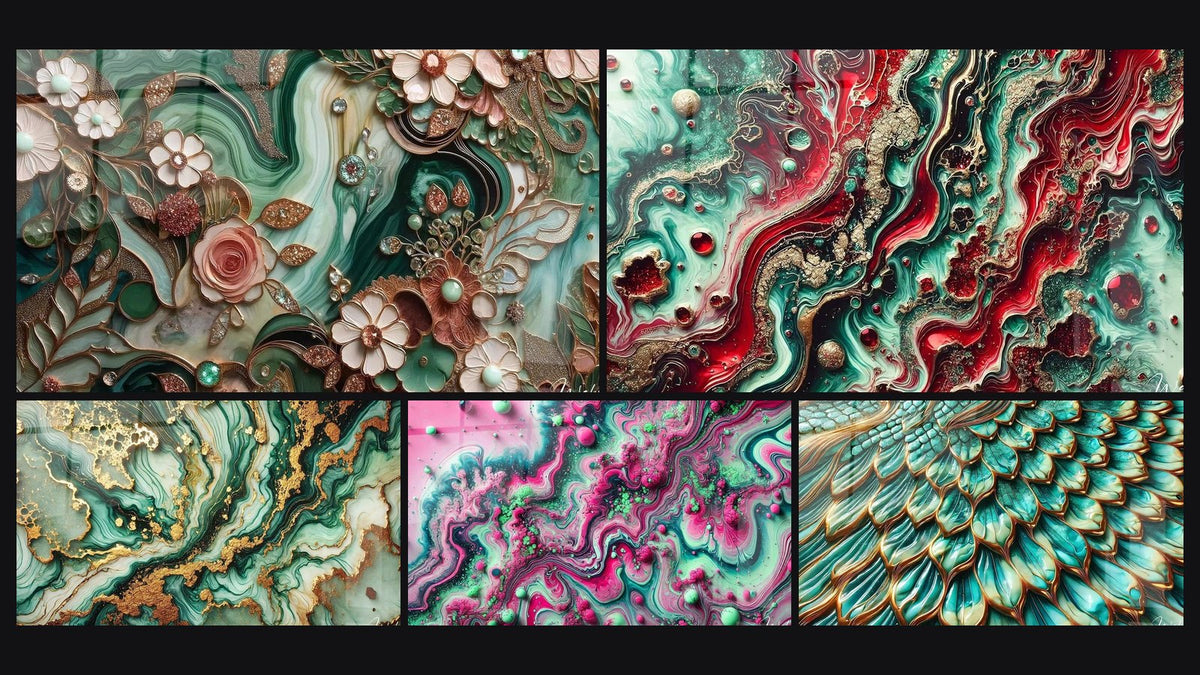
Each composition plays on a different variation of green to suit distinct moods. The Fusion Emerald painting blends red and green in a dynamic composition, better suited to an interior that already embraces bold touches of colour. Conversely, the Emerald Mist painting, with its softer pastel tones, suits calm, muted atmospheres.
The Crystal Waves painting combines turquoise and emerald green in fluid curves evoking water, an excellent choice for a bathroom or a room opening onto the outdoors. The Mystic Marbling painting, with its golden flecks on an emerald background, adds a more refined, almost mineral touch that works particularly well under warm indirect lighting.
All these formats range from the L (120x70cm) up to made-to-measure (80x46cm to 280x160cm), with prices from 233.90 €, in a glossy Acrylic Glass or matte Alu Dibond finish depending on the brightness of your room.

In the same spirit
Mystic Marbling Painting - Epoxy Style Edition
From €233.90
Discover this painting →Frequently asked questions
Which painting size for a large white wall?
Aim for 60 to 75% of the width of the reference furniture or, for a completely free wall, a format that fills the space visually without cramping it, often XXL or larger on a wall more than 3 metres wide.
Which green to choose for a white wall?
Deep emerald green suits very bright rooms, while lighter sea green suits rooms that receive less light. Forest green or gold-toned green pairs well with warm ambient lighting.
How to enhance a painting on a white wall?
Indirect lighting placed above the painting reveals the shades and transparency effects of the resin far better than a frontal ceiling light. Hanging height at eye level remains essential.
Is epoxy art sensitive to direct light?
The Acrylic Glass finish reflects part of the light and can create glare when facing a very exposed window. In that case, the matte, glare-free Alu Dibond finish is more suitable.
A white wall has never been an empty space to fill, it is a waiting canvas, the only decor capable of letting a deep emerald green express itself without compromise. To find the piece that will create this striking effect in your home, the green epoxy painting collection brings together all the formats and shades discussed here, from L to made-to-measure. And if you are still torn between several styles, our article on current trends in emerald green epoxy paintings usefully complements this reflection.
Explore our collections