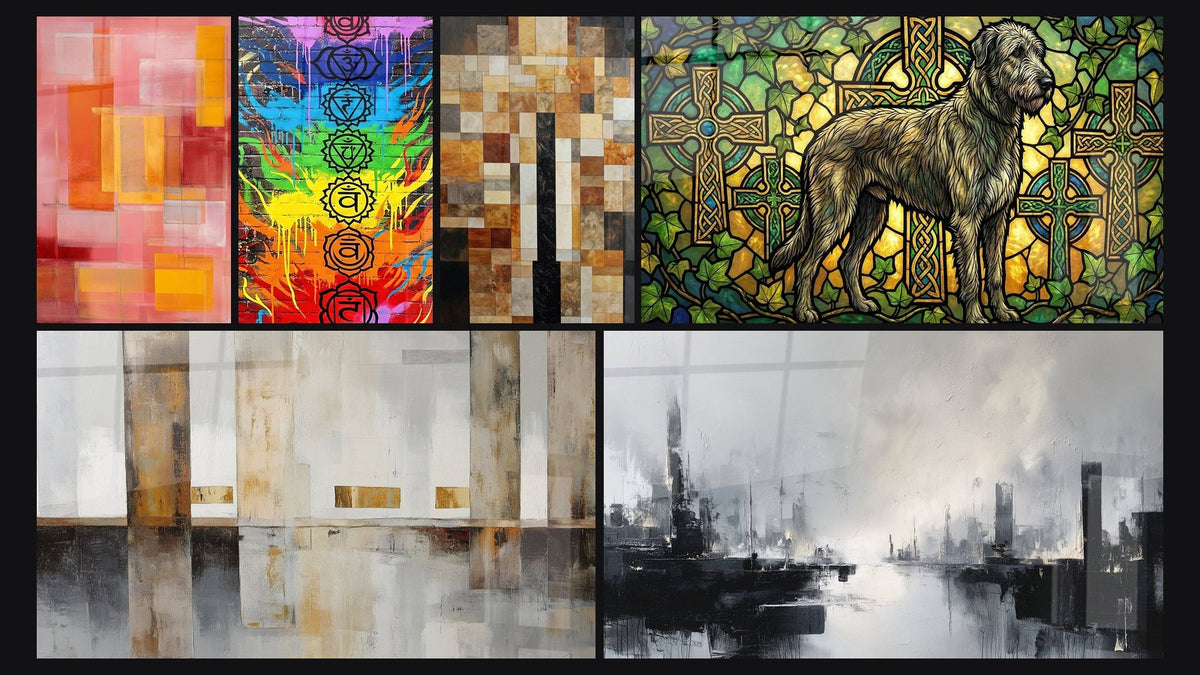
How to harmonize several rectangular paintings on the same wall
8 min read · by Walensky
WALL HANGINGS FOR PAINTINGS
Three rectangular paintings leaning against the wall, ready to hang, and already that little vertigo: which one goes where? The one wider than the other two, do we put it in the centre or to the side? And if we hang them two centimetres off level, will it show or not?
The rectangle, unlike the square, has no natural symmetry. It has a direction, an orientation, a ratio. And that is precisely what makes its staging more demanding — but not more complicated, provided you follow a method rather than instinct alone.
- Aligning a shared edge matters more than aligning all the dimensions.
- A constant gap between frames (5 to 10 cm) creates unity, even with different sizes.
- Portrait and landscape can coexist if a horizontal or vertical axis links them visually.
- Fixings (rail, aligned hooks) are a harmonizing tool in their own right, not a mere technical detail.
Why the rectangular format poses a harmonization challenge
A square settles, a rectangle must be composed. That is the fundamental difference between the two formats: the square has an obvious centre and symmetry in all four directions, while the rectangle imposes a direction — horizontal in landscape, vertical in portrait — that changes the whole balance of the wall.
When you combine several rectangles of different proportions, the eye instinctively looks for a logic: an alignment, a progression in size, a symmetry. If it doesn't find one, the composition looks muddled, even if each painting taken on its own is successful.
The real trap is not the difference in size between the works. It is the absence of a rule linking them together.
A wall of rectangular paintings is not improvised by eye: it is plotted, like a plan.
The 3 technical criteria for harmonizing rectangles together
Three elements are enough to judge whether a composition of rectangles will work: the proportion ratio, the alignment of the axes, and the spacing between the works. Neglecting any one of the three is enough to unbalance the whole. Choosing the right starting format is just as decisive — our guide on the ideal size of a rectangular painting for a large empty wall can help you lay this foundation.
The common proportion ratio
The ratio is the relationship between a painting's width and its height. Two works of different sizes but identical ratio — for example a 120x70 cm L format and a 140x80 cm XL format — pair naturally, because their silhouette remains coherent to the eye, even if one is larger.
Conversely, mixing a very elongated rectangle and an almost square one in the same composition creates visual tension. This is not forbidden, but it requires compensating elsewhere — through a very strict alignment, for instance.
The alignment of horizontal and vertical axes
This is the most decisive criterion, and the most often overlooked. It is not about aligning all the dimensions of the paintings, but choosing ONE common axis and sticking to it: either the top of all frames on the same line, their centre, or their bottom.
- Alignment by the top : ideal for paintings of different heights, it creates a clean skyline.
- Alignment by the centre : works well when the paintings have similar heights.
- Alignment by the bottom : useful above a piece of furniture, the furniture becoming the reference line.
A laser spirit level, set once to trace the reference line, avoids the few-millimetre discrepancies that, accumulated over three or four paintings, end up catching the eye.

Favorite
Abstract geometric composition painting in black, white and grey - Urban harmony - Feng Shui West Metal Edition
From €273.90
Discover this paintingStep-by-step method: composing a wall of rectangular paintings
The most reliable method does not start on the wall but on the floor, then on paper. Three steps are enough to avoid unnecessary holes.
- Lay the paintings on the floor, in front of the wall concerned, testing several arrangements until you find the one that respects the chosen ratio and alignment.
- Cut out a kraft paper template to the exact dimensions of each work, and tape it to the wall to visualize the real spacing before drilling.
- Transfer the fixing points onto the wall from the templates, checking each axis with the spirit level before reaching for the drill.
Mixing portrait and landscape without breaking the balance
Pairing a landscape rectangle with a portrait rectangle is possible, but it requires a common anchor point: an alignment by the top, or a shared centre on the vertical axis. Without this link, the two orientations contradict each other visually and the wall loses its coherence.
In practice, the paintings in the shop are all offered in landscape or panoramic format — width greater than or equal to height. So to compose a wall mixing several visual orientations, it is rather the interplay of ratios (a very stretched panoramic format beside a more compact one) that creates this variation, rather than a true portrait-landscape alternation.
— Our selection


The role of fixings in visual harmonization
A poorly chosen fixing can ruin the most precise alignment. Conversely, the right hanging system becomes a harmonizing tool in its own right, not a mere technical detail relegated to the end.
For a line of several rectangular paintings, a wall hanging rail offers a clear advantage: all frames rest on the same horizontal line, without multiplying individual drilling points. This is particularly useful when the formats differ in width, since the hanging height stays identical for all.
For a tighter composition, invisible wall fixings give a floating effect that highlights the ratio of each rectangle without the eye being distracted by hardware. this landscape rectangular painting designed for a modern kitchen illustrates this principle well: a wide format hung cleanly, with no fuss.
— Also to discover


Examples of harmonious compositions with abstract and geometric paintings
Geometric compositions lend themselves particularly well to the exercise, because their internal lines reinforce the alignment of the wall rather than contradicting it. A geometric composition painting in red and blue tones, for example, already follows a logic of interlocking rectangles that converses naturally with a second aligned format beside it. This logic also applies in more intimate living spaces: a warm-toned abstract rectangular painting for the kitchen works on the same principle of visual harmony.
For a wall that combines several formats without losing coherence, mosaic-based or interlaced-shape series work well, because their colours stay within one family while the motifs vary. This is the case of an ochre and beige geometric mosaic painting, which can pair with a work of translucent orange and pink rectangles without any chromatic clash.
pairing two paintings for a structured wall effect is a good entry point if you start with just two works before considering a larger composition. And if your paintings are square rather than rectangular, the method for combining several square paintings on a wall follows a different, more modular logic.
In the same spirit
Red and White Diagonal Abstract Painting - Earth Harmony - Southwest Earth Feng Shui Edition
From €273.90
Discover this painting →Frequently asked questions
Can you mix portrait and landscape paintings on the same wall?
Yes, provided they share a common alignment axis, by the top or by the centre. Without this visual link, the two orientations create tension rather than harmony.
What distance should be left between several rectangular paintings?
A spacing of 5 to 10 cm remains the most reliable reference: enough for each work to breathe, tight enough for the whole to read as a single composition.
Which fixing system should you choose to align several paintings?
A wall hanging rail is the most precise option for a line of paintings at identical height. For a more occasional composition, hooks aligned with a spirit level are enough, provided each point is transferred from a kraft paper template.
Must all rectangular paintings be the same size?
No. It is actually rarely the case in successful compositions. What matters is a coherent proportion ratio and a strict alignment on at least one axis, not the identity of the dimensions.
Harmonizing several rectangular paintings is neither a matter of feeling nor luck. It is a question of a common ratio, a shared axis and a regular spacing — and, too often overlooked, of a fixing chosen according to this logic, not at the last minute.
The wall that has been teasing you for weeks only needs a kraft paper template and a spirit level to become the composition you had in mind. To go further in choosing hanging systems suited to several frames, the collection of wall painting fixings gathers the solutions discussed here, rails included.