

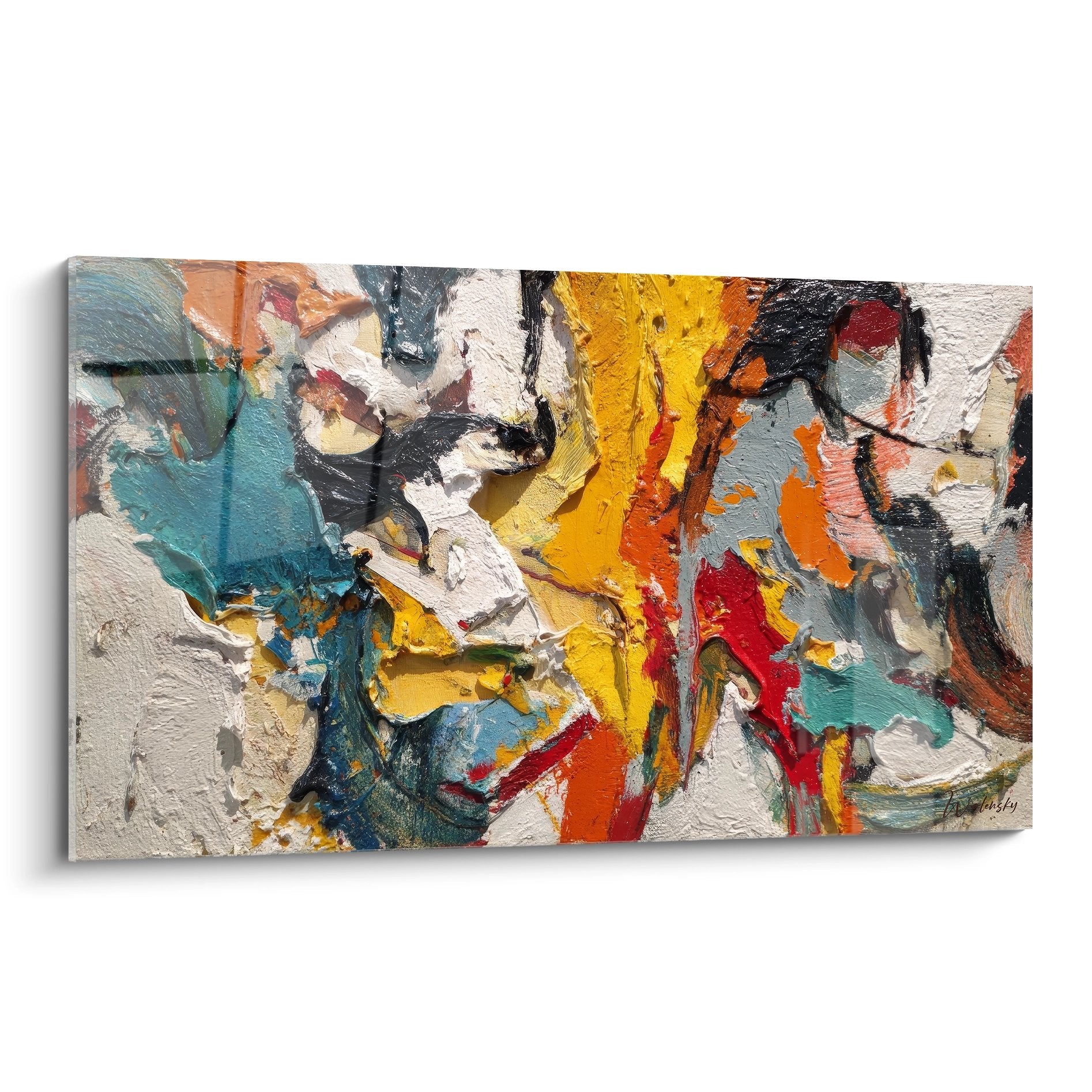






Invisible fixings: elegance and discretion for designer artworks
11 October 2025 · 15 min read · by Walensky
You've just acquired the perfect artwork for your living room, the one that expresses your personality and enhances your interior. But here's the problem: installing it becomes a nightmare. Traditional fixings ruin the visual effect, shiny screws catch the eye, and these awful metal supports turn your work of art into simple wall decoration.
Every time you look at your wall, your eye automatically focuses on these unsightly details rather than the beauty of the artwork. The reflections of the metal capture the light, the contours of the fixings create parasitic shadows, and this feeling of "visible DIY" completely ruins the premium effect you're looking for.
You may have tried discreet hooks, thin nails, or even adhesive systems. Result? Either it's still too visible, or it's not strong enough for your valuable pieces. Commercial solutions all seem to overlook the essential: total invisibility.
It's not your fault. Manufacturers of classic fixings prioritize ease of installation and cost over pure aesthetics. They assume that "it's barely noticeable," without understanding that for an art lover, even "barely visible" is too much.
By the end of this article, you will master the invisible fixing systems that transform your wall into a professional gallery, where only the artwork counts, as if it floats naturally in the space.
Why invisible fixings revolutionize wall art?
The era of accepting " it's a bit noticeable but that's normal" is over. Today, discerning collectors and decorators discover that wall art can reach an unprecedented level of sophistication. It's like the difference between desk lighting and museum lighting: the details make all the difference. The longer you wait, the more accustomed you become to an amateur rendering while the professional is within your reach.
🎨 Customer testimonial: "I installed my 80x60cm abstract canvas with an invisible system 6 months ago. My guests still ask me how it 'holds up'. The effect is striking: it looks like it's an integral part of the wall, like a window to another world."
Conversation with a decor expert
Total invisibility transforms the perception of the artwork: Your gaze focuses exclusively on the art, creating an emotional immersion that visible fixings systematically break. In 2 weeks, you will no longer be able to stand seeing visible fixings at your friends' homes.

Finally understand why your current fixings disappoint you
You feel that muted frustration each time you look at your wall. The artwork is beautiful, the frame perfect, but something is off. Your eye catches on the technical details, the artistic illusion breaks, and you feel like you have a "homemade" work despite all your efforts.
What is really happening is that your brain processes visual information hierarchically. Fixings disrupt this hierarchy by creating "parasitic attention points". It's like trying to admire a sunset with power lines in the field of vision.
Rest assured: the problem is not your demanding nature, but the conventional approach to hanging. Imagine watching a movie in a cinema with small flashing lights around the screen. Even if they are discreet, they spoil the experience.
The first hidden cause: the "involuntary contrast" effect
Contrary to what one might think, it is not the fixings themselves that are disturbing, but the micro-contrasts they create with the wall. Even a white nail on a white wall generates shadows and reliefs that your eye unconsciously picks up.
It's like wearing a garment with a tag sticking out: it's not huge, but it spoils the elegance of the outfit. Your brain is programmed to detect these visual anomalies, even minor ones.
These micro-contrasts create visual fatigue that prevents you from fully indulging in contemplation. You miss the emotional experience that the artist wanted to offer you.
🧠 Instant test: Fix your painting for 30 seconds. Count how many times your gaze leaves the artwork to settle on the hanging elements. More than 2 times? Your fixings are parasitizing your artistic pleasure.
The second cause: the "apparent installation syndrome"
Many think that a well-installed painting should show its fixings to "prove" its solidity. In reality, it is a reflex of technical mistrust that has nothing to do with the artistic experience.
It's like leaving scaffolding around a finished building: it gives an impression of permanent construction. Art requires total visual completion to reveal its emotional power.
This "technical first" mentality deprives you of the magic of wall art : that feeling that the artwork naturally belongs to your space, as if it had always been there.
The third cause: ignorance of museum standards
Most people ignore the fact that art professionals have been using invisible systems exclusively for decades. They reproduce the domestic DIY methods out of habit, without knowing the alternatives.
Pay close attention during your next visit to a museum: no visible fixings anywhere. Curators know that the invisible reveals art, the visible diminishes it.
This lack of knowledge keeps you in an amateur standard when professional tools are now accessible to the general public, often for the same price as traditional fixings.
🔎 5 signs that your fixings are harming your artworks:
- You first notice the hanging: Your eye settles on the fixings before the artwork, a sign that the installation visually dominates
- Your guests ask technical questions: Instead of talking about artistic emotion, they ask "how is it fixed?"
- The artwork seems "stuck" to the wall: Lack of harmonious integration, like a sticker on a surface
- Photos are disappointing: The fixings appear in your photos and spoil the Instagram rendering
- You're hesitant to invest in art: Unconsciously, you know the final result won't live up to expectations
The trigger moment: the revelation of "the floating effect"
The magical moment arrives when you discover the artistic levitation effect : the artwork seems suspended in space by its own aesthetic force. It's a powerful psychological phenomenon, like a domino effect that transforms your entire perception of wall art. Once experienced, it's impossible to go back.
The golden rule of invisible mounting: If you see how it's fixed, it's failed. True art must seem to exist naturally in space, without visible technical explanation.
| ❌ Traditional fixing | ✅ Invisible fixing | 💡 Key difference | 🎯 Perceived benefit |
|---|---|---|---|
| You can see how it holds | Total mystery of suspension | Magic vs apparent technique | Wonder and prestige |
| The eye flits between art and fixing | Pure concentration on the artwork | Distracted vs focused attention | Total emotional immersion |
| DIY effect | Professional gallery finish | Amateur vs expert | Pride and sophistication |
| Questions about installation | Conversations about artistic emotion | Technique vs feeling | Recognition of your taste |
The 3-step method for perfect invisible mounting
Breathe: you don't need to be a DIY expert to succeed. Invisible mounting follows a simple logic, like building a house starting with the foundations. Each step prepares the next, and the final result will give you the profound satisfaction of having created something truly elegant.
🎯 Overview of the transformation: Support preparation (solid foundations) → Discreet system installation (invisible structure) → Aesthetic finalization (magic revealed). Result: your wall becomes a window to pure art.
Step 1: Preparing the wall surface
It all starts by creating perfect conditions for invisibility. It's like preparing a canvas before painting: without this base, even the best system will fail. This step will already give you immense satisfaction as you feel the difference in quality from the first gestures.
Materials needed for a professional result
- Electronic stud finder: A small device that precisely locates the load-bearing structures in your wall. Essential for maximum strength, unlike "hit-or-miss" methods that weaken the installation. Choose a model with an audible signal, available at hardware stores.
- Professional 60cm spirit level: Millimetric precision that makes the difference between "roughly straight" and "perfectly aligned". Short levels give approximate results. A good level transforms your amateur installation into a gallery-worthy finish.
- Specialized drill bits depending on your wall: Concrete, drywall, brick... each material requires its specific tool. A suitable drill bit avoids cracks, guarantees hold, and preserves the wall's aesthetics. Savings on this item always backfire.
Now, let's move on to the practical part with the method that transforms your wall into a professional support.
Execution of the perfect preparation
Locating load-bearing points: Scan the installation area with the stud finder, tracing imaginary lines. The signal indicates areas of maximum strength, typically spaced 40-60cm apart. These points determine the absolute safety of your installation.
⏱️ Time: 5-10 minutes | ✅ Successful when: Clear and repeatable signal in the same location | ⚠️ Attention: False signals near electrical outlets - always check with multiple passes
Tracing the reference axis: Position the spirit level horizontally at the desired height and gently trace a line with gray pencil. This line becomes your absolute reference for perfect alignment, even with multiple paintings.
⏱️ Time: 3-5 minutes | ✅ Successful when: Perfectly straight line over the entire length | ⚠️ Attention: Too much pressure from the pencil that permanently marks the wall
Precise marking of fixing points: Transfer the exact dimensions of your invisible system while respecting the millimeter spacing. Each point must coincide with a load-bearing area detected previously.
⏱️ Time: 2-3 minutes | ✅ Successful when: Points aligned and in the load-bearing areas | ⚠️ Attention: Confusion between system spacing and painting width
✅ Validation of step 1: Your wall has precise, aligned markings located on reliable load-bearing areas. You already feel that sense of satisfaction from well-prepared work. If you have any doubts about a point, repeat this part - it's the guarantee of success in the following steps.
Step 2: Installing the invisible fixing system
You are now entering the heart of the transformation. This step reveals the magic of discreet engineering : creating unparalleled strength without any visible trace. It's more rewarding than preparation because you see the system that will change your perception of wall art come to life. The feeling of satisfaction multiplies with each component installed.
Components of the professional invisible system
- Hidden suspension rails: Thin metal bars that integrate into the thickness of the frame, totally invisible from the front. Their genius: support significant loads while visually disappearing. Available in several lengths depending on your artworks.
- Recessed wall supports: Elements that sink into the thickness of the wall, protruding only a few millimeters. Once painted the color of the wall, they become literally invisible even up close.
- Secure locking system: A mechanism that guarantees your artwork cannot accidentally fall, even in the event of vibration or handling. Complete peace of mind for your valuable pieces.
Methodical installation of the system
Precision drilling: Drill the holes exactly at the marked points, respecting the recommended depth for your wall type. The quality of this step determines the long-term hold and the absence of future cracks.
⏱️ Time: 10-15 minutes | ✅ Successful when: Clean, chip-free holes at the correct depth | ⚠️ Attention: Drill speed too high, which heats up and damages the drill bit
Mounting wall supports: Insert and screw in the receiver elements, ensuring they are perfectly flush with the wall surface. These supports will visually disappear once the finish is applied.
⏱️ Time: 8-12 minutes | ✅ Successful when: Solid, perfectly level supports | ⚠️ Attention: Excessive tightening that pushes the support too far into the wall
Step 3: Invisible finalization and load test
You are now reaching the level of aesthetic mastery that separates the amateur from the connoisseur. This step transforms your technical installation into a work of art in its own right. The final result will give you that immense pride in having created something truly exceptional, which your guests will admire without understanding the secret of this perfection.
Finalization for total invisibility
Color correction of supports: Gently apply the exact color of your wall to the fixing elements with a fine brush. This step literally makes the last traces of the system disappear.
⏱️ Time: 15-20 minutes (drying time included) | ✅ Successful when: Supports invisible from 50cm distance | ⚠️ Attention: Paint drips and marks the clean wall
Installation and test of the artwork: Position your painting on the system and check the perfect stability. Test with light pressures to confirm safety. The artwork should seem to be an integral part of the wall.
⏱️ Time: 5-8 minutes | ✅ Successful when: Painting is stable, straight, and no fixings are visible | ⚠️ Attention: Abrupt handling that could mark the fresh wall
Rule of expert progression: The installation is successful when your guests ask "how does it hold?" rather than noticing the fixings. If someone spots the system, a retouch is needed.
Congratulations, you now master the subtleties of an expert that transform a simple installation into a true artistic staging. These advanced finishes give you an advantage over 95% of individuals who ignore these professional techniques.
🎯 Professional gallery tip: For high-value artworks, install indirect lighting directed at the painting from a hidden source. The absence of visible fixings combined with this lighting creates a striking "museum" effect that multiplies the emotional impact of the artwork.
Frequent question from our readers
"Is it really more solid than a simple hook, even for my heavy canvases?"
I fully understand this concern - we all grew up with the idea that we have to "see" the solidity to trust it. In reality, invisible professional systems distribute the weight better over several anchor points, unlike a single hook which concentrates all the load. Museums protect millions of dollars' worth of artworks with these techniques, that's how reliable they are!
🧪 Confidence test: Start by installing a mid-sized artwork (maximum 40x60cm) to see for yourself the impressive solidity. The success of this first attempt will give you the confidence for your larger pieces.
Avoid these mistakes that ruin the invisible effect
Attention, some mistakes can erase hours of meticulous work and make you lose confidence in the method. These pitfalls are easy to avoid when you know them, but devastating through ignorance. I prefer to warn you now rather than you discover these pitfalls by accident.
- 🎨 Neglecting color correction: It's tempting to think "it won't be too noticeable," but that's exactly the detail that betrays all the work. Even a slightly darker or lighter support attracts the eye like a magnet. Take the time to perfect this step, it makes all the difference.
- 📏 Underestimating the importance of leveling: "It looks straight to the eye" is the enemy of perfection. A deviation of 2-3 degrees, imperceptible during installation, becomes glaring once the artwork is in place. Your brain detects these flaws and it ruins the visual harmony.
- 🔧 Choosing undersized fasteners: The classic mistake of "it should be enough." Dynamic loads (vibrations, drafts) stress fasteners more than static weight. Always oversize, your peace of mind is priceless.
- 🏃 Rushing the drying stage: Impatience to see the final result leads to handling too soon. A poorly dried paint touch-up is ruined by the first contact and forces you to start over. Patience = perfection.
- 🎯 Forgetting the preliminary load test: Installing the final artwork directly without verification is a risky bet. A test with an object of equivalent weight reveals weaknesses without risking damage to your valuable artwork.
🛡️ Checkpoints before finalization: Fasteners perfectly level ✓ Supports invisible from 1 meter away ✓ No play in the system ✓ Successful load test ✓ Warning signs: noise during handling, painting that does not fall perfectly plumb, visible traces of supports.

Technical and practical questions
Allow 2-3 hours for your first installation, then 1h30 once the technique is mastered. This time includes preparation, installation, and complete finishing. To optimize, group several installations on the same day - you amortize the preparation time for tools and develop your dexterity.
An invisible system costs 15-25€ against 3-5€ for visible fasteners, but completely transforms the artistic experience. It's like comparing the lighting of a bare bulb to that of a designer lamp: the investment is immediately felt and for years to come. Your artworks deserve this enhancement.
Absolutely! The principle is simpler than a kit furniture. If you know how to use a drill and a level, you have all the necessary skills. Precision counts more than strength or experience. Start with a small artwork to gain confidence.
Yes, with the right adapted anchors : concrete, plasterboard, brick, even lightweight partitions. The only difference is the type of anchor and the weight distribution. On fragile partitions, use load-distributing systems. The invisibility remains perfect regardless of the support.
This is the little-known advantage of invisible systems : change artwork in 30 seconds without tools! The supports remain in place, you simply slide in a new canvas. Ideal for renewing your decor according to your moods or rotating your collection.
Your artistic transformation begins now
In a few weeks, you will look at your walls with a new pride. Your artworks will seem to float naturally in the space, creating that professional gallery atmosphere you dreamed of. Your guests will stop short in front of your installations, intrigued by this inexplicable elegance, and ask you your secret with admiration.
This mastery of invisible fixings transforms more than just your decoration: it reveals your refined artistic eye and your demand for excellence. You join the circle of art lovers who refuse compromises and prioritize pure emotion. This skill will serve you throughout your life and impress those around you.
Understanding was the most difficult step, you have overcome it. Now, choose your first artwork and get the appropriate system. In 3 hours, you will discover the magical feeling of art that seems to exist by its own aesthetic force. Your living room will never be the same.
✨ Your first step towards excellence: True art deserves a presentation worthy of it. You now have all the keys to create this magic of great galleries at home. Your artistic vision is waiting for your action!
Also to read: 🔧 Explore all our fixing techniques
Explore our collections


