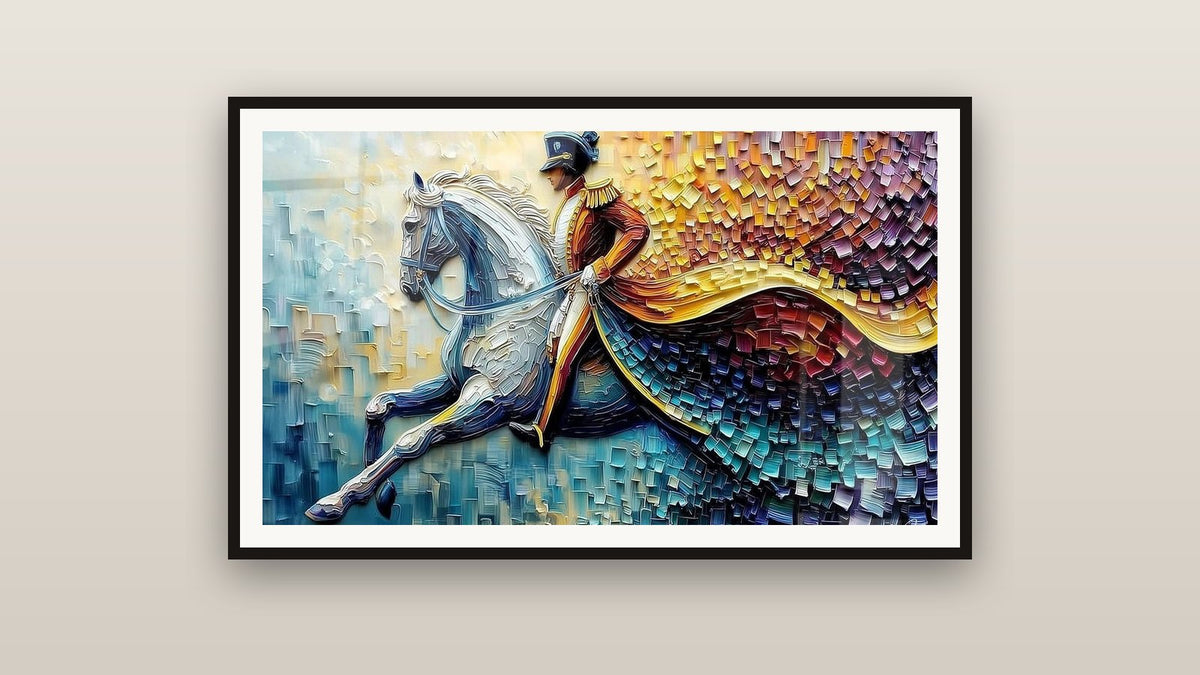
Napoleon painting on horseback: faithful reproduction or modern reinterpretation?
7 min read · by Walensky
NAPOLEON PAINTING
A rearing horse, a hand raised toward the summit of a snow-covered pass, a red cloak snapping in the wind. The image is engraved in every school memory. But when it comes to hanging this Napoleon on horseback in your living room, a question arises: do you want the emperor as David painted him, or as a contemporary artist might reinvent him?
- Jacques-Louis David painted five authentic versions of Bonaparte crossing the Great Saint Bernard Pass, all slightly different.
- An academic reproduction works well in a classic interior, with mouldings or panelling as a backdrop.
- Pop art, pixel art or expressive puzzle versions adapt to contemporary salons without giving up the Napoleonic figure.
David's original painting and its five authentic versions
Few people know it: there is not one single Bonaparte crossing the Great Saint Bernard, but five, all painted by David's hand between 1800 and 1803. The Malmaison, Versailles and Vienna museums hold examples, with variations in the horse's colour and the drape of the cloak.
This multiplicity changes how you approach the subject. You do not copy "the original"; you choose one interpretation among several, all legitimate. David himself, a true heir of neoclassicism, sought less resemblance than heroic staging: an emperor who dominates nature and history with a single gesture.
Napoleon actually crossed the Alps on a mule, not on a fiery horse. David preferred allegory to accuracy, a liberty that contemporary artists continue in their own way.
Faithful reproduction vs free interpretation: two decorating philosophies
Choosing between the two first means choosing a mood for the entire room, not just a wall.
Why choose a classic academic reproduction
Academic style demands rigour: muted colours, pyramidal composition, dramatic light on the face and the horse. In a room with mouldings, a marble fireplace or period parquet flooring, this fidelity creates immediate visual continuity. It naturally converses with the equestrian scenes of Géricault or Delacroix, who extended this fascination with the warhorse into nineteenth-century painting.
Why opt for a pop art or pixel art version
Conversely, pop art and pixel art divert the imperial figure to make it graphic, almost ironic. Flat areas of vivid colour, fragmented shards or digital halftone effects turn the emperor into a pop icon, just like a concert poster. This treatment suits a room with clean lines, a charcoal grey sofa and a matte white wall.
A pixel art portrait of Napoleon does not betray history; it translates it into the visual grammar of our era.

Concrete examples: from classic to contemporary
To visualise this gradation, let's look at a few representative pieces. On the academic side, the painting Napoleon Eagle's Gaze plays on a gold and red portrait, in a prestige vein quite close to classic imperial iconography.
At the other end of the spectrum, the Napoleon painting Pixel Storm fragments the emperor's face into orange and blue shards, in a resolutely digital and abstract language. In between, the painting Napoleon Empire Splashes offers a compromise: a stylised yet still legible portrait, carried by splashes of colour reminiscent of pop art without going all the way to total abstraction.
For fans of equestrian scenes rather than portraits, the painting Imperial Gallop Cavalry and the Napoleon painting Cavalier of the Winds revisit the composition of the rider in full charge, in blue and gold tones that directly evoke the spirit of David's canvas without copying it.

— Our selection


How to combine classic style with modern decor
A classic Napoleonic painting does not necessarily condemn you to an interior frozen in the past. The key lies in controlled contrast: pair a work dominated by gold or red with contemporary furniture with simple lines, rather than with other busy pieces.
- Position the painting so that the centre of the work sits at eye level, seated or standing depending on the room.
- Let the wall breathe around it: a visually dense Napoleonic frame needs bare space so as not to overwhelm the room.
- Favour raking light over a direct ceiling light, to reveal the contrasts of the composition.
The choice of medium also changes perception. A print on acrylic glass accentuates the contrasts and gilding of a classic portrait, with a glossy effect close to the rendering of a gallery. A version on Dibond aluminium softens the colours without reflection: a sensible choice opposite a window, and often preferred for pixel art or pop art versions, whose matte finish reinforces the graphic feel.
Trends: the return of historical icons in contemporary art
Historical figures are enjoying renewed interest in today's wall decoration, carried by a generation that likes to quote history without freezing it. Napoleon, in this respect, lends himself particularly well to détournement: his profile is recognisable in two strokes, his bicorne and cloak are enough to sign the image, even deconstructed into pixels.
The Napoleon painting Imperial Shadow illustrates this trend differently: a black-and-white treatment, almost photographic, that borrows from vintage rather than pure pop art. It is a third path for those seeking a powerful artwork without the chromatic weight of gold and red.

This taste for reinvented historical portraits goes well beyond Napoleon: it appears throughout the Famous paintings inspirations movement, where figures from art history resurface in contemporary graphic treatments. If the equestrian subject interests you beyond the imperial figure, the horse painting collection explores other approaches to the mount and rider in painting.

Also to discover
Napoleon Painting Regard Conquérant - Napoleon edition
From €228.90
Discover this painting →Frequently asked questions
How many versions of David's Napoleon on horseback painting exist?
Five authentic versions, all painted by Jacques-Louis David between 1800 and 1803, held in different European museums. They differ slightly in the colour of the horse and certain details of the composition.
Can a classic Napoleonic painting be paired with modern decor?
Yes, provided you play on contrast: minimal furniture and a neutral wall highlight a busy academic work without creating dissonance with the rest of the room.
What is the difference between a faithful reproduction and an artistic interpretation?
A faithful reproduction respects the composition and colours of the reference work. An artistic interpretation, in pop art or pixel art for example, keeps the subject recognisable but reinvents the palette, texture and visual construction.
Which Napoleon painting style should you choose for a contemporary living room?
Pop art, pixel art or expressive puzzle versions fit most naturally into a room with clean lines, thanks to their vivid flat colours and graphic treatment, closer to a poster than an academic portrait.
Conclusion
Let's return to that rearing horse on the Great Saint Bernard pass. Whether painted in David's manner, fragmented into pixels or burst into pop touches, it always tells the same ambition: to dominate history with a single glance. The question is not which version is most faithful, but which story you want your wall to tell. To explore the theme of warhorses in painting further, our analysis of war horses in Géricault and Delacroix sheds light on this age-old fascination from another angle. And to compare all available versions, the Napoleon painting collection brings classics and reinterpretations side by side, for a choice that truly suits you.
Explore our collections