

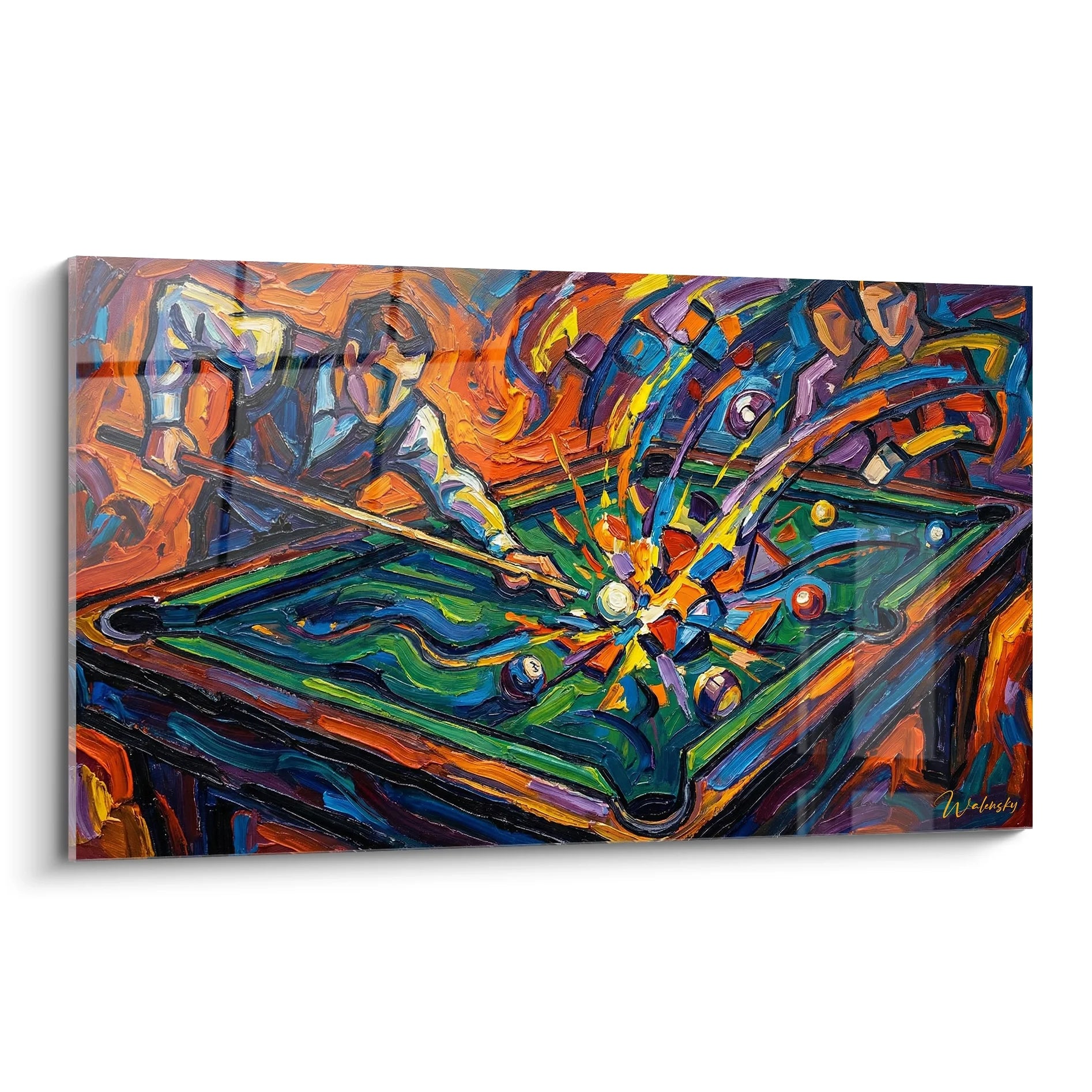






How do you recognise the expressionist style in a wall painting?
7 min read · by Walensky
PAINTING STYLE PAINTINGS
You're standing in front of a painting, in a shop or on a screen, and something grabs you without your being able to say what. The colors aren't the ones you'd expect, the shapes seem twisted, and the paint looks thick, as if it had just been applied. That unease, that tension that hits you in the face, is often the signature of Expressionism.
No need for a degree in art history to spot it. Just a method, five clues, and thirty seconds of careful observation.
The direct answerAn expressionist painting is recognized by five visual signs combined: colors that move away from reality, a nervous and visible brushstroke, distorted or exaggerated forms, a raised texture (impasto), and a composition that conveys tension rather than calm. If three of these five signs are present, you're probably looking at an expressionist work.- Expressionism prioritizes emotion over fidelity to reality: colors and forms are deliberately distorted.
- Five clues are enough to identify it: non-naturalistic color, visible brushwork, exaggerated forms, raised texture, and tense composition.
- The classic trap: confusing it with pure abstraction or Fauvism, two visual cousins that are close in appearance but different in intent.
Expressionism at a glance: what are we really talking about?
Expressionism is the art of painting what one feels rather than what one sees. The movement emerged in Germany and Austria at the beginning of the 20th century, driven by groups such as Die Brücke, but its principle goes well beyond that period: distorting reality to better express a raw, often uncomfortable emotion.
Edvard Munch, with his screaming face under a twisted orange sky, embodies this logic better than any textbook. The form bends, the color lies about reality, and it is precisely this lie that tells the truth of the emotion.
In Expressionism, a color never describes an object. It describes a state of mind.

Staff pick
Abstract painting artwork - Colorful expressionist mosaic - abstract painting style edition
From €273.90
Discover this paintingThe 5 visual clues that give away an expressionist painting
Here is the reading grid to apply in front of any wall artwork, whether old or contemporary.
Colors that disregard reality
A sky can be green, a skin can be blue, a face can veer toward blood red. If the hues seem chosen for their emotional charge rather than their accuracy, you're on the right track.
A visible, nervous brushstroke
The expressionist brushstroke does not try to go unnoticed. It shows itself, jerky, sometimes almost scratched. You feel the speed of execution, the urgency of the gesture.
Distorted or exaggerated forms
A body stretched too long, a face elongated, a perspective that deliberately limps: the distortion of forms is never a technical accident, it is a choice. It conveys an inner distortion rather than a drawing error.
A textured surface in relief (impasto)
Place your eye close to the painting, in raking light if possible. The impasto creates real physical relief, ridges of material that catch the light differently depending on the viewing angle.
A composition that creates tension
Unstable diagonals, tight framing, violent contrasts between light and dark areas: the composition itself contributes to the intended unease. Nothing is settled, everything seems on the verge of tipping over.
Three indicators out of five are usually enough to decide. A painting that ticks all five boxes is almost always a bold piece, best reserved for a wall that can carry that assertive character.
Concrete examples: spotting the style in current wall paintings
Expressionist logic did not stop in 1920. It still runs through contemporary wall art, often in a more abstract form but just as legible once you know the codes.
Picture a composition where a golden streak runs across the surface like a frozen vein of light, surrounded by deep black and navy blue: the material is thick, the gesture visible, the painterly tension obvious. This is exactly what the painting Golden and black pour with pink splashes captures.

Another example: an orange blast running across a grey mist sky, captured in full motion. The unstable diagonal, the brutal contrast between the bright area and the anthracite background, the almost textured grain of the splash: all the expressionist markers are there, transposed into a distinctly contemporary vocabulary.
To see these cues side by side across several works, our selection of expressionist paintings gathers pieces with pronounced impasto and bold colours:
What can be confusing
The classic pitfall: confusing expressionism with pure abstraction. Abstract Expressionism, born later in the United States with artists such as Jackson Pollock, pushes the logic to a total absence of recognisable subject. "Classic" Expressionism, by contrast, almost always keeps a trace of figuration, even distorted, the opposite of a realistic countryside landscape painting, where fidelity to the motif remains the priority.
Another frequent confusion: Fauvism. The two movements share vivid, non-naturalistic colours, but Fauvism remains joyful and decorative, whereas Expressionism seeks unease and tension.
— Our selection


Tips from a trained eye to go further
Seasoned collectors always follow the same reflex: look from a distance first, then move closer. From afar, you judge the overall emotional impact and the tension of the composition. Up close, you check the impasto and the gesture of the brushstroke.
- Look at the edges of the work: an expressionist piece often leaves traces of material right up to the edge, without an overly smooth finish.
- Look for contrasts of complementary hues (red-green, orange-blue): they heighten the emotional charge.
- Look for an absence of symmetry: an overly centred and stable composition is rarely expressionist.
For a living room that is looking for exactly that extra character, format matters almost as much as subject: an expressionist piece ideally occupies 60 to 75% of the width of the wall or sofa it hangs above, so the painterly tension breathes without overwhelming the room. If your interior leans towards minimalism, our selection of painting styles compatible with a clean Scandinavian decor can help you find the right balance.
If you are torn between this raw energy and calmer worlds, our article on how to recognise the stylistic signature of an abstract painter how to recognise the stylistic signature of an abstract painter will help you sharpen your eye for the nuances between gestures, materials and intentions.

Also to discover
Painting Mauve and orange impasto in motion - Floral bloom - Abstract painting style edition
From €242.90
Discover this painting →Frequently asked questions
What is the difference between expressionism and abstract expressionism?
Expressionism keeps a trace of a recognisable subject, even distorted. Abstract expressionism, by contrast, abandons all figuration: only the gesture, the colour and the material remain.
How can you tell whether a painting is handmade or printed?
Real relief under the finger and physical brushstroke traces reveal a hand-painted work. A printed painting visually reproduces the texture but remains smooth to the touch, whatever the medium, acrylic glass or Alu Dibond.
Which colours are typical of the expressionist style?
Deep reds, incandescent oranges, navy blues and raw yellows often dominate, used in brutal contrast rather than harmonious gradients.
Can an expressionist painting be minimalist?
Rarely. Expressionism relies on the accumulation of visual tension, and therefore on a certain density of material and color. A stripped-back subject and a plain background belong rather to minimalism or symbolism, two worlds you will find in our collection of symbolist paintings collection of symbolist paintings.
Conclusion
The next time a painting grabs you without your understanding why, try the thirty-second test: non-naturalistic color, visible brushstroke, distorted form, raised texture, tense composition. Three criteria out of five, and you will know how to name what you feel.
You can try this reading grid right now on our collection of expressionist paintings collection of expressionist paintings : spot the impasto, splashes and drips yourself before choosing the one that will hang on your wall. And if you want to compare with a world just as expressive but quieter, our guide on how to recognize the Modigliani style in a decorative painting how to recognize the Modigliani style in a decorative painting is a useful complement to this first lesson in discerning the eye.
expressionist paintingsExplore our collections


