

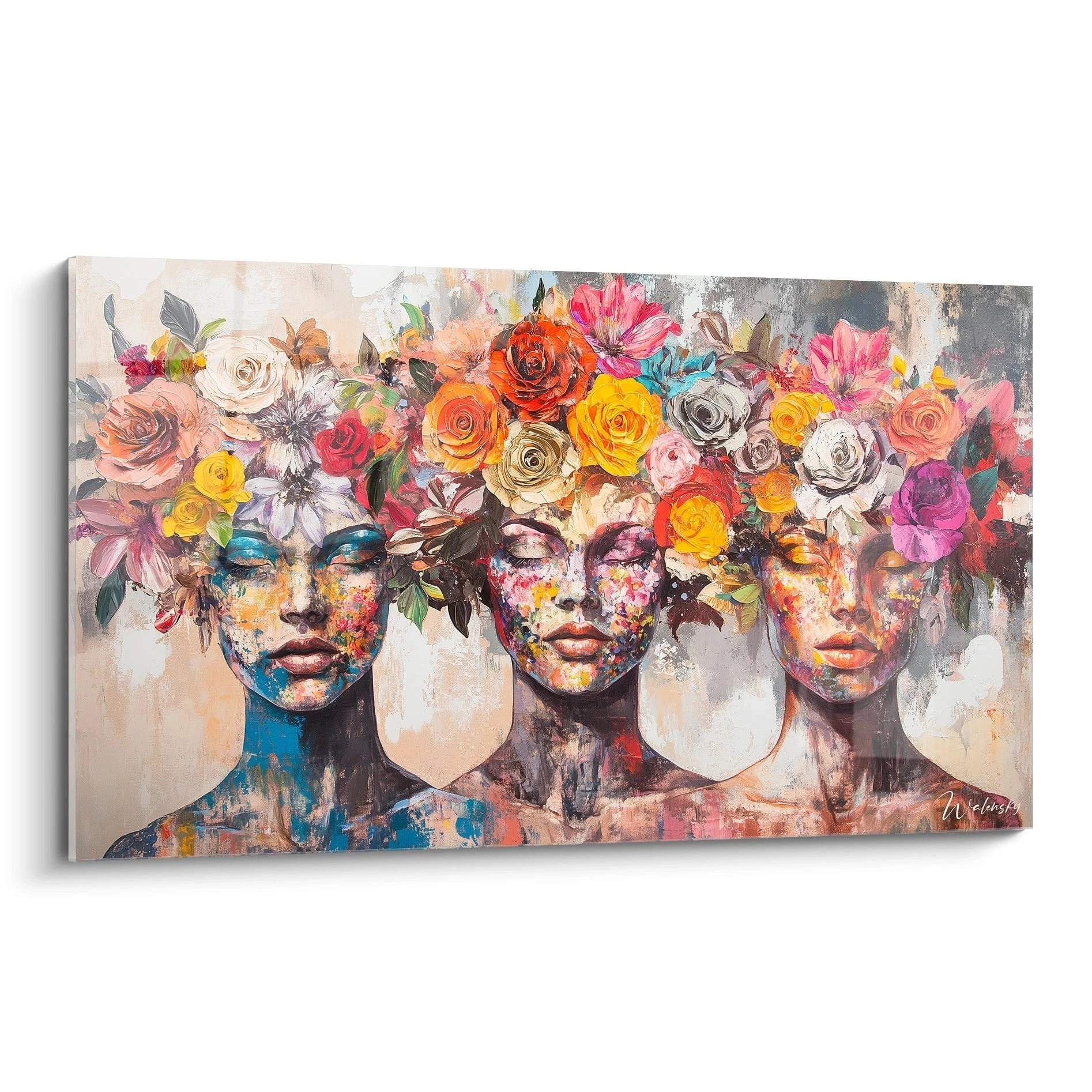






The painting as a starting point for a personal wall moodboard
11 October 2025 · 18 min read · by Walensky
You've been staring at that blank wall for weeks, unable to decide on the perfect decoration. Every time you think you've found inspiration, you're paralyzed by the fear of making the wrong choice or creating a set that lacks harmony.
You imagine combinations of objects, colors, textures, but nothing seems to come together naturally in your mind. This blurry vision of your ideal decor remains elusive, like a puzzle whose pieces refuse to fit.
You've tried Pinterest boards, decor magazines, even asked for advice from those around you, but these solutions remain virtual or too generic. They don't capture your unique personality or adapt to the real constraints of your space.
This is perfectly normal: your brain needs a tangible and evolving support to bring your ideas to life. True creativity is born from the physical manipulation of concrete elements, not from the accumulation of digital images.
By the end of this article, you will know how to transform a simple painting into a true creative laboratory where your decor ideas will take shape naturally, allowing you to create a personalized wall moodboard that reveals your unique style.
Why is your wall waiting for the creative spark that will change everything?
Every day that passes without creative action is a missed opportunity to reveal your personality in your interior. Like a musician who constantly postpones buying their first instrument, you risk seeing your ideas fade away for lack of support to concretize them. Decorative creativity needs fertile ground: a space for experimentation where your inspirations can take shape immediately.
💡 Inspiring testimonial: Sarah, an interior architect, tells how she unlocked her creativity by installing a large cork board in her living room. "For months, I was accumulating fabric samples, decor photos, scribbled notes. The day I pinned it all on this board, the connections were made instantly. My living room transformed in 3 weeks, with a coherence I would never have found otherwise."
Conversation with a decor expert
The golden rule of the wall moodboard: Just like a gardener observes their plantings before deciding on the final arrangement, you let your inspirations "grow" on your wall painting for a few weeks. Your eye gets used to it, the associations are revealed, and your personal style naturally emerges in 2 to 4 weeks of daily observation.

Let's discover together what is really blocking your creative momentum
Do you recognize yourself in these situations? You pin images on Pinterest but never manage to visualize the final result in your home. You buy a decorative object you love but leave it in its packaging because you don't know how to integrate it. You postpone your decorating projects because you can't see the whole before starting.
What's really happening is that your creative brain needs a physical workspace to make its connections. Screens give us the illusion of planning, but our decorative intuition works with our hands, our eyes, and the manipulation of real objects in space.
It's like wanting to learn to cook by only watching videos: you understand it intellectually, but your senses can't practice. Your decorative intelligence needs to touch, move, and compose with real materials.
The first hidden cause: the illusion of the virtual
Contrary to what one might think, accumulating digital inspirations paralyzes more than it helps. Our brain processes an image on a screen differently than a physical object in our real environment.
Imagine learning to drive only with a simulator: you master the theory, but as soon as you take a real steering wheel, everything changes. Proportions, distances, sensations change completely.
This disconnection between virtual and real explains why your impulsive decorative purchases often turn into disappointments. Your eye gets used to perfect and retouched images, but loses its ability to assess objects in your personal context.
🔍 Revelatory test: Take a decorative photo that inspires you on your phone. Now, close your eyes and try to describe precisely the colors, textures, proportions. You will see that your visual memory only retains the general impression, not the concrete details that make it possible to recreate the atmosphere.
The second hidden cause: the absence of visual dialogue
Many think that it is enough to choose elements that "look alike" to create harmony. In reality, the decorative magic is born from subtle conversations between elements that complement each other more than they look alike.
It's like composing a bouquet: the most beautiful arrangements combine flowers of different shapes and colors that create something unique together. A red rose alone is beautiful, but it is its association with greenery and white flowers that creates emotion.
Without space to experiment with these associations, you remain a prisoner of "safe" but predictable choices. Your interior lacks that little surprise that makes all the difference between "pretty" and "magnificent".
The third hidden cause: the forgetting of temporal evolution
Here's what almost no one notices: our taste evolves in contact with our daily decorative choices. A color that seems perfect today can tire us in a few weeks, while another, initially uncertain, becomes our favorite over time.
You can spot this phenomenon by observing your clothes: some pieces you adored in the store remain in the closet, while others, bought by chance, become your favorites. The same goes for decoration.
This lack of awareness of your evolving taste pushes you towards definitive choices too quickly, creating frustration and costly mistakes. You need a system that respects this natural temporality.
🎯 3 signals that your decor creativity needs space:
- You postpone your decor purchases due to indecision: Your intuition tells you that something is missing from your reflection, like an incomplete puzzle.
- Your Pinterest projects never come to fruition: The gap between virtual inspiration and reality paralyzes you, a sign that you need physical manipulation.
- You buy the same types of objects in a loop: Your decorative comfort zone shrinks due to a lack of free and secure experimentation.
The trigger element: the power of free composition
What really makes the difference is your ability to play with associations without constraint or judgment. Like a chef who mixes ingredients to discover new flavors, you need a space to test, move, remove, add elements until the magic happens. You will know you have found it when your eye can no longer detach certain elements from the whole, as if they were destined to be together.
The rule of 3 looks: A successful decor composition pleases you immediately, seduces you again the next day, and still moves you after a week. Test this rule by observing your arrangements during these three times to validate your choices before the final purchase.
| ❌ Classic method | ✅ Moodboard approach | 💡 Why it works | 🎯 Concrete benefit |
|---|---|---|---|
| Searching for the perfect style | Discovering YOUR unique style | Your personality is revealed through experimentation | A decor that truly resembles you |
| Buy then hope it works | Test then buy with confidence | You eliminate uncertainty before investing | Zero regrets, only lasting crushes |
| Following current trends | Creating your own personal trend | You mix your inspirations according to your sensitivity | An interior impossible to copy |
| Decorating room by room separately | Harmonizing the entire habitat | You develop a visual connecting thread | A natural consistency between all your spaces |
— Also to discover


The gentle method that transforms your wall into a creative laboratory
Rest assured, you're not going to overhaul your interior overnight. This approach respects your pace and hesitations, like a photographer gradually revealing their image in the developing bath. Your wall moodboard will bring out your personal style step by step, revelation after revelation, until your decor vision becomes clear and irresistible.
🎨 Overview of your creative transformation: We will first create your physical experimentation support (the canvas of your creativity), then we will develop your tangible inspirations on it (the palette of your possibilities), and finally we will refine your personal composition (the harmony of your choices). At each step, you gain clarity and confidence until you obtain your perfectly personalized decor plan.
Step 1: Create your visual experimentation space
Starting by installing your physical support is essential because it will free your brain from the constraint of memorizing everything. Like a writer who finally puts their ideas on paper, you will be able to externalize your inspirations and see them evolve. Once this base is established, you will immediately feel a creative relief: your ideas will finally have a place to exist concretely.
Your creative starter kit
- A large cork or magnetic board (minimum 80x60cm): Choose one large enough to accommodate your experiments without constraint. You will find it in stationery stores or online. Check that the surface is homogeneous and resistant. Avoid small formats that limit your creativity and make you start over when you run out of space.
- A decorative frame or border: It transforms your work tool into a decorative element in its own right. Choose a style that already integrates into your interior. This finish avoids the "bulletin board" aspect and enhances your creative approach in the eyes of those around you.
- Colored pins or decorative magnets: They allow you to visually organize your elements by themes or priorities. Their aesthetics contribute to the overall harmony and make handling more enjoyable, encouraging your regular practice.
Now, let's move on to the installation that will change your relationship with decor:
Installation of your creative laboratory
Choose the strategic location: Install your board in a place of daily passage where your eye will naturally rest several times a day. This repeated exposure allows your brain to process visual associations in the background. Favor a wall that is sufficiently lit to distinguish the nuances of colors.
⏱️ Time: 15 minutes | ✅ Successful when: You naturally pass by 3-4 times a day | ⚠️ Attention: Avoid dark corners where you will forget to look at your composition
Prepare the work surface: Clean and frame your support, then test the attachment of a few elements to familiarize yourself with the handling. This first handling demystifies the tool and reassures you about its ease of use. Start by pinning a simple element like a postcard to "christen" the space.
⏱️ Time: 10 minutes | ✅ Successful when: You can easily add/remove elements | ⚠️ Attention: Don't overload it from the beginning, gradualness is essential
Define your thematic zones: Mentally divide the space into sections: colors, textures, furniture, lighting, decorative objects. This initial organization avoids dispersion and facilitates coherent associations. You can materialize these zones with differently colored pins.
⏱️ Time: 5 minutes | ✅ Successful when: You know where to place each type of inspiration | ⚠️ Attention: Stay flexible, these zones will evolve with your discoveries
✅ Validation of your creative space: Your painting is well secured, easily accessible, and you are eager to add your first inspirations. You feel excited by the possibilities rather than intimidated by the task. If you feel a slight impatience to start collecting elements, that's perfect! This positive energy will carry you to the next step.
Step 2: Building your collection of tangible inspirations
You are now entering the creative gathering phase, where your eye will become more refined and your taste will become more precise. Unlike the digital collection, which remains abstract, you will be handling real objects, materials, and samples. This tactile dimension reveals preferences you did not suspect and creates unexpected connections between your inspirations.
Your palette of creative materials
- Paint samples, fabrics, wallpapers: Collect them for free from hardware and decoration stores. These real materials give you the exact color and texture, unlike screens which distort nuances. Collect more than you need to keep freedom of experimentation.
- Photos cut out from decor magazines: Choose images for their details (a chair, a lamp, an arrangement) rather than for the overall atmosphere. Glossy paper reveals textures and proportions better than a screen. Vary the styles to broaden your creative horizon.
- Miniature objects or real samples: Pieces of wood, small pebbles, fabrics, dried plants... These authentic elements enrich your sensory vocabulary and suggest ideas that an image would never have revealed.
Building your personal library
Collect without judgment for one week: Gather everything that attracts your eye without asking yourself if it is coherent. This phase of creative divergence nourishes your imagination and reveals your true attractions, sometimes surprising. Keep a small box with you to collect while you go out.
⏱️ Time: 1 week of passive observation | ✅ Successful when: You have 15-20 varied items | ⚠️ Attention: Don't sort yet, abundance stimulates creativity
First intuitive composition: Arrange your elements on the painting following only your instinct, without seeking logic. This spontaneous approach reveals your natural style before your mind analyzes it. Leave space between the elements to facilitate future rearrangements.
⏱️ Time: 20-30 minutes | ✅ Successful when: You feel pleasure looking at the whole | ⚠️ Attention: Don't intellectualize, trust your visceral feeling
Step 3: Refining your composition towards excellence
You are now reaching the level of curator of your own style, this rare ability to distinguish what truly suits you from what temporarily seduces you. Your moodboard becomes a faithful mirror of your decorative personality, allowing you to make purchasing decisions with unwavering confidence.
Revelation of your visual signature
Observe daily evolution: Look at your composition every day for a week, noting what you still like and what you start to tire of. This observation reveals your personal constants, those elements that resist time and form your decorative DNA.
⏱️ Time: 2 minutes per day for 1 week | ✅ Successful when: Certain elements become obvious | ⚠️ Attention: Note your feelings without analyzing them immediately
Create harmonious groups: Bring together elements that naturally "dialogue" and push away those that create visual tensions. This step develops your sense of harmony and reveals the associations that will make your interior unique and coherent.
⏱️ Time: 45 minutes | ✅ Successful when: Visual "families" emerge | ⚠️ Attention: Keep some "dissonant" elements that bring character
Validate by mental projection: Close your eyes and imagine each grouping of elements in a room in your house. Your body immediately indicates what resonates with you and what leaves you cold. This sensory validation finalizes your selection with certainty.
⏱️ Time: 15 minutes | ✅ Successful when: You visualize concretely your interior transformed | ⚠️ Attention: Trust your physical sensations more than your reflection
The rule of natural progression: Move on to the next step when you feel a creative certainty rather than an intellectual hesitation. Your intuition guides you better than external advice. Patience in this maturation guarantees assumed and durable definitive choices.
Congratulations! You now master the subtleties of the decorative eye that distinguish remarkable interiors from ordinary spaces. Here are some expert secrets that will transform your moodboard practice into a true art of living.
🎓 Pro technique - The rule of the golden triangle: Always organize your elements in groups of three with different heights, sizes or intensities. This natural asymmetry creates a visual dynamism that the eye finds irresistibly harmonious. Test by grouping a large, a medium and a small sample of the same color family: the effect is immediate.
"How long before I see the first results in my decor?"
"I'm afraid of spending weeks tinkering with my wall art without it actually changing my interior..."
This impatience is perfectly understandable! In reality, as early as the end of the first week, you will have identified 2-3 clear directions for your decoration. Unlike classic methods where you fumble for months, your moodboard quickly reveals your priorities. Many of our readers tell us that they made their first "perfect" decor purchase as early as the second week, with a confidence they had never felt before. The process saves you time by eliminating costly mistakes.
💡 Quick validation test: Photograph your moodboard each week and compare the images after a month. You will be surprised to see how much your choices have refined and clarified, giving you a clear decor roadmap.
— In the same spirit


The classic pitfalls that sabotage your creativity (and how to avoid them)
Attention, some well-intentioned habits can hinder your creative progress without you realizing it. These mistakes are so common that we see them in the majority of beginners, but they are easily avoidable when you know them.
- 🚫 Wanting to organize everything by color from the start: It's tempting to create neatly organized sections, but this rigid logic stifles your creativity. The most beautiful discoveries come from unexpected pairings. First, let your elements mix freely for 2 weeks before organizing. This "creative mess" is temporary but essential.
- 🚫 Immediately seeking perfect consistency: Many people too quickly remove elements that seem not to "go together". However, these apparent dissonances often reveal your originality. Keep the strange elements for at least a week: they sometimes become your favorites. Harmony arises from mastered diversity, not uniformity.
- 🚫 Copying a magazine ambiance exactly: Faithfully reproducing a photo deprives you of your unique personality. Use images as starting points, not as models to copy. Your moodboard should reveal YOUR style, not that of an anonymous decorator. Always mix several sources of inspiration.
- 🚫 Being afraid of constant change: Some are afraid to modify their composition once established, for fear of "undoing" their work. On the contrary, mobility is the strength of the moodboard! Change, test, experiment without guilt. Each modification refines your taste and brings you closer to your ideal style.
- 🚫 Neglecting the lighting of your wall art: A poorly lit moodboard distorts your perception of colors and textures, leading you to choices you will regret in real life. Check your composition under different lighting conditions: day, evening, artificial. This precaution avoids unpleasant surprises when you make purchases.
🛡️ Anti-error verification system: Each week, photograph your moodboard and ask yourself: "Do I recognize myself in this composition?" If the answer is yes, you are on the right track. If you hesitate, remove 2-3 elements and observe the effect. Monitor these warning signs: you avoid looking at your wall art, you postpone your home decor purchases, or you feel frustrated by a lack of clarity.
— Other selected pieces


Your most frequent questions about the wall mural moodboard
Excellent question! You can start with less than 30€ : a cork board (15€), a few colored pins (5€), and a simple frame (10€). Many even use the back of an existing large photo frame. The investment pays off with the first decor purchase avoided thanks to your new clarity. Don't seek material perfection: a basic but well-used support surpasses sophisticated equipment that is not used.
Rest assured! A 60x40cm moodboard is sufficient for a studio and blends discreetly into the decor with a nice frame. Prioritize a vertical placement (behind a door, in a hallway) to optimize space. Many of our urban readers testify that their compact moodboard has become an original focal point that intrigues and inspires their guests. The decorative effect largely compensates for the space occupied.
Absolutely! "Artistic sense" is not innate, it's a skill that develops through practice. Your moodboard will reveal and refine your natural taste that you probably underestimate. Start by collecting only what makes you smile, without asking yourself any questions. In 3 weeks, you will be surprised to discover your personal consistency. We regularly receive testimonials from people who thought they were "hopeless at decor" and are now developing coveted interiors.
That's excellent news! This change proves that the method is working: you are discovering facets of your personality that you did not know. Adapt your moodboard without guilt - it is made to evolve with you. Keep a photo of the old version to measure your progress. This flexibility prevents you from being stuck with choices that no longer suit you, unlike definitive decor investments based on impulses.
Your moodboard becomes your "shopping roadmap" ! Photograph it on your phone to take it to the store or online. Before each purchase, ask yourself: "Would this object have its place on my wall painting?" This simple question eliminates 80% of impulse purchases. Start with the elements that constantly reappear in your composition: they represent your absolute priorities. Investment naturally follows your creative certainties.
Your creative transformation is just beginning
In a few weeks, when you look at your transformed interior, you will realize that this simple wall painting has unleashed a creativity you never suspected. Your friends will ask you who decorated your place, and you will answer with pride that it is entirely your creation. This newly acquired confidence will radiate beyond decoration: you will approach all your aesthetic choices with a serene assurance.
Your moodboard will have taught you much more than decoration: how to trust your taste, how to take the time for creative reflection, how to harmoniously combine seemingly disparate elements. These skills will naturally transpose into your clothing, culinary, and even professional choices. You develop an "eye" that will accompany you throughout your life.
The most difficult part - understanding the principle - is now behind you. You just have to choose your support and start collecting your first elements. This weekend, you could have your creative space operational and feel that particular excitement of seeing your ideas take shape before your eyes.
🚀 Your first step towards decor excellence: Your unique style already exists within you, it just needs a space to express itself freely. Give it that chance today, and in a month, you will wonder how you could have decorated without this revolutionary method.
Also to read: 🎨 Read more articles on creative wall decor
Explore our collections


