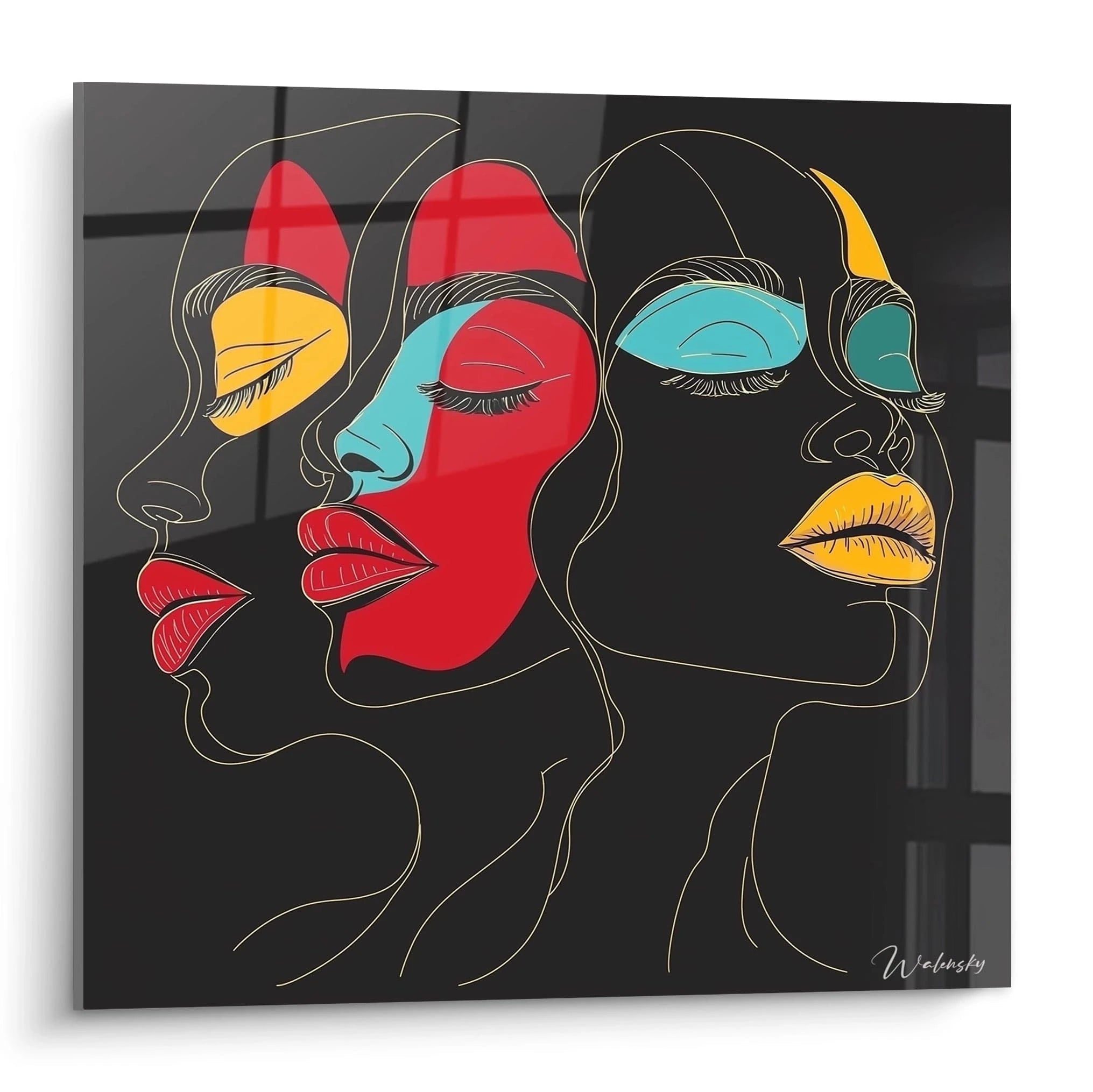






Mural painting for living room: good idea or dead end?
7 min read · by Walensky
PAINTING FOR LIVING ROOM
You've seen the photo on Pinterest. A living room bathed in light, an entire wall covered in a botanical fresco or architectural trompe-l'œil, and that feeling that the room breathes differently. You thought, "why not mine?" Then you started looking for an artist, and things got complicated.
Mural painting is dreamy, but it commits a wall, a budget, and sometimes a relationship of several weeks with a craftsperson. Before picking up the brushes or signing a quote, it's worth knowing exactly what it entails — and what exists alongside it.
- Mural painting (fresco, trompe-l'œil, interior street art) commits the wall and the budget for the long term.
- Between DIY and professional, the gap in cost and completion time is significant.
- A large-format painting offers a reversible alternative, hung in a few minutes.
Mural painting, a trend that keeps coming back in living rooms
Street art has moved out of the street and into interiors, and this isn't new. What's changing is how it's adapted: less raw graffiti, more soft mural frescoes, trompe-l'œil that enlarges a room, botanical motifs hand-painted across an entire wall.
Acrylic mural paint allows gradients and textures that a panoramic wallpaper doesn't always reproduce. It's appealing on paper. But a hand-painted wall is not a decorative accessory you change with the seasons: it's an almost architectural decision.
A mural isn't an object you place. It's a transformation you apply.
The practical constraints of mural painting nobody always tells you about
Behind the polished photos, there are realities people often discover too late: drying time, touch-ups, and the final price climbing once finishing work is counted.
Real budget: materials, artist, touch-ups
For a DIY project, budget for acrylic paint pots, suitable brushes, and sometimes a projector to transfer a complex motif onto the wall. It stays affordable, but the time spent is never zero — several weekends are not unusual for an ambitious design.
Hiring a craftsperson or mural artist completely changes the equation: the rate depends on surface area, motif complexity, and number of visits. You should also usually allow a margin for touch-ups, which are inevitable on a lived-in wall.
Reversibility: what happens when you move or change your decor
This is the point most often underestimated. A mural can't really be "removed." It has to be repainted, often requiring several coats of primer to mask vivid pigments, or it stays in place — for the next owner to decide.

Favorite
Lake Shimmering Under Morning Light Painting - Signature Edition
From €273.90
Discover this paintingDIY mural vs professional vs decorative painting alternative
Three paths, three different logics. Here's how they compare on the criteria that really matter before you start.
| Criteria | DIY mural | Professional mural | Decorative painting |
|---|---|---|---|
| Cost | Low (materials) | High (labour + materials) | From €273.90 |
| Completion time | Several days to weeks | A few days on site | A few minutes to hang |
| Skill required | Technique to acquire | None (subcontracted) | None |
| Reversibility | Difficult | Difficult | Total, movable at will |
A canvas doesn't have the monumental scale of a fresco covering a full wall. But it wins on every other front: controlled cost, zero risk, zero lease constraints. For anyone wanting a strong wall effect without the commitment, it's often the most sensible trade-off.
— Our selection


Recreating the effect of a mural without painting your wall
The idea behind a mural is often to create an immersive focal point — a wall that tells a story and draws the eye as soon as you enter the room. A large-format painting can play exactly that role, without a single drop of paint touching the wall.
The Lake Shimmering Under Morning Light painting illustrates this logic well: its warm tones and landscape composition create a visual breath comparable to a fresco, hung in minutes with fixings included.
Large-format paintings and wall compositions for an immersive effect
An XXL (160x90 cm) or 2XL (180x100 cm) format occupies enough surface to structure an entire wall, much like a fresco. The rule that works well: the artwork should cover about 60 to 75% of the width of the sofa or main piece of furniture in the living room for a balanced look.
For a more graphic, contemporary style, close to a geometric trompe-l'œil, the Urban Mosaic painting plays with abstract volumes that catch light differently depending on the chosen medium.
The matte, glare-free Alu Dibond medium suits a living room bathed in natural light, facing a window. Acrylic glass, which is more reflective, shines more in a room with controlled lighting.
How to combine an existing mural with the rest of your decor
If the wall is already painted, there's no need to rethink everything. The challenge becomes balancing the room around this centrepiece rather than drowning it under other elements that are too present.
- Keep furniture to neutral tones so the mural can breathe visually.
- Avoid placing a second strong motif directly opposite: a painting with discreet abstract patterns works better than a second fresco.
- Take care with lighting: raking light emphasises the relief of a trompe-l'œil, while diffused light softens a colourful fresco.
For ideas on styling around a wall that already has strong character, our article on wall decoration with paint for the living room details several possible combinations.

Also to discover
Stealth Spirit Painting - Abstract Art Edition
From €273.90
Discover this painting →Frequently asked questions
How much does a living room mural cost?
The price varies greatly depending on the method: materials only for DIY, or a full service with a professional, whose rate depends on surface area and motif complexity. In every case, allow a margin for touch-ups.
How do you make a mural yourself?
You need to prepare the wall (sanding, undercoat), transfer the motif in pencil or with a projector, then paint in zones with a suitable acrylic wall paint. Completion time depends largely on the complexity of the chosen design.
Can a mural be repainted easily?
Not really. Vivid pigments often require several coats of primer to be fully masked, which takes time and an extra paint budget when you change the decor.
What alternative to a mural for a strong decorative effect?
A large-format painting, placed as the centrepiece of the living room, recreates part of the immersive effect of a fresco without renovation work or irreversibility. It can be moved, changed, and hung in a few minutes.
A mural, however successful, is a decision you make for the wall, not just for yourself. If the desire is there but the commitment gives you pause, a large-format painting captures much of that visual power without ever locking you into a permanent choice. Discover our collection of living room paintings to find the equivalent without the risk.
Explore our collections