

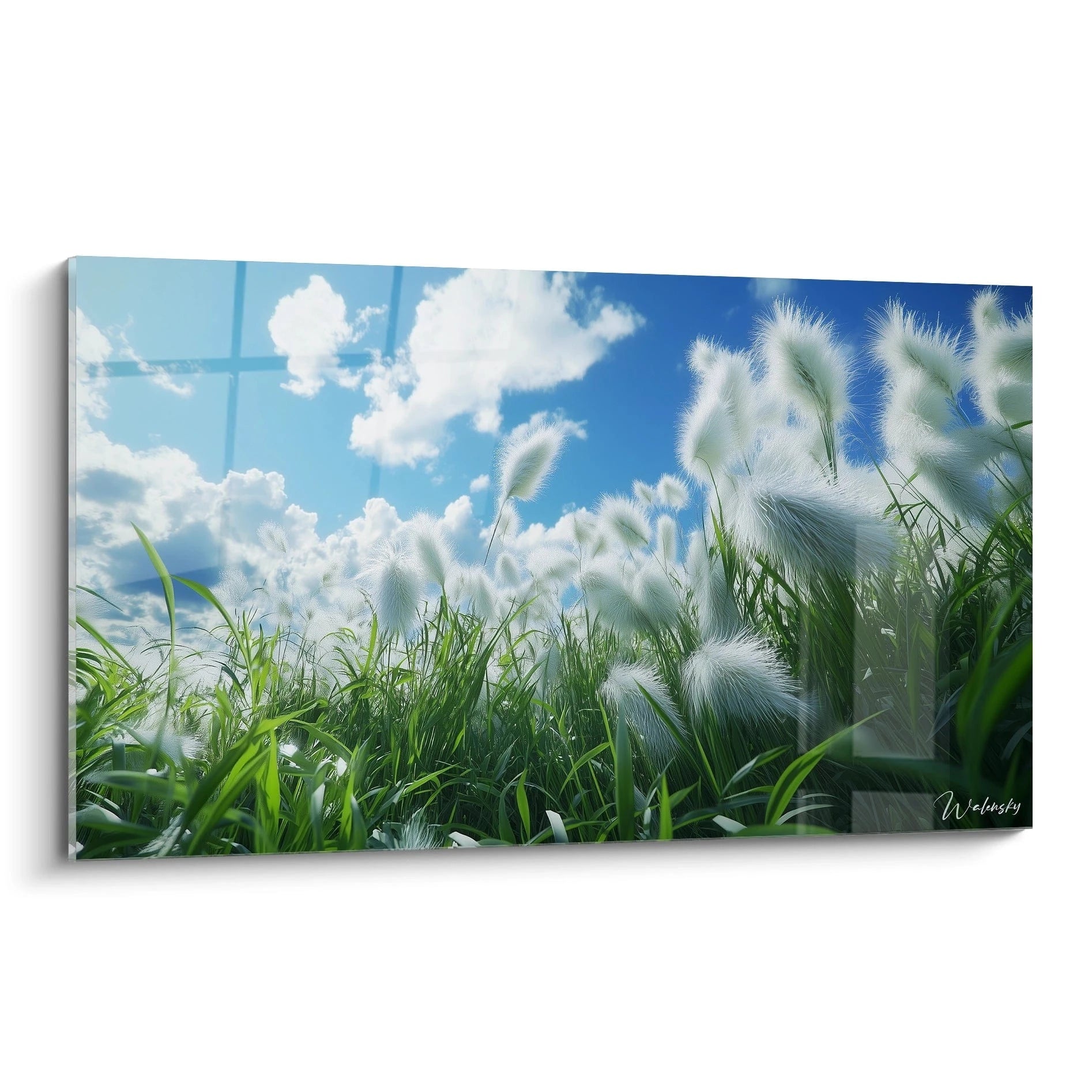






There is something strange that happens when you walk into a room adorned with a textile or felt painting. You slow down. You breathe differently. As if the material itself were resting a gentle hand on the shoulder of your gaze. This is no illusion — it is a sensory reality that interior design creators know well. Textile paintings and felt paintings offer an unmatched visual softness, a warmth that neither rigid canvas painting nor framed digital print can fully reproduce.
Here is what these singular works bring concretely: a texture that absorbs light rather than sending it back harshly, a naturally satin colour palette with soft contours, and a warm presence that instantly transforms the atmosphere of a space.
Are you looking to soften a child's bedroom that feels too cold, a living room that is too minimalist, or simply to create that cocooning feeling you can't yet quite name? You are not alone in this quest. Many find themselves facing white walls, smooth frames, and a persistent impression that something is missing — a material, a soul, an invitation to pause. The good news: textile and felt paintings answer exactly this lack. This article explains why, and how to choose.
When material becomes language: understanding visual softness
Visual softness is not a vague notion reserved for poets. It rests on very concrete perceptual mechanisms. Our brain constantly interprets what our eyes see, and associates it with tactile sensations in anticipation. This is what is called visuo-tactile synesthesia : when we perceive a soft surface, we unconsciously feel the urge to touch it, and this anticipation produces an immediate soothing effect.
A textile painting or a felt painting activates precisely this mechanism. The surface is neither smooth nor reflective. It is fibrous, slightly irregular, alive. The fibres catch the ambient light and diffuse it gently, without harsh glare or aggressive contrast. The gaze settles on it and lingers — effortlessly, without fatigue. This is the very definition of a visually restful space.
Felt painting vs textile painting: two families of softness
We tend to group these two worlds under the same label, but a felt painting and a textile painting do not offer quite the same visual experience.
Felt: absolute softness
Felt is a non-woven material obtained by compressing fibres. Its surface is uniform, matte, with no visible weave. A felt painting displays deep, non-glossy colours, clean cut-outs with slightly velvety edges, and a gentle presence reminiscent of a childhood toy or a throw draped over the sofa. It is an almost nostalgic softness. It is ideally suited to children's bedrooms, play areas, reading corners — anywhere one seeks to create an enveloping and reassuring atmosphere. The shapes cut from felt — animals, clouds, letters, enchanted forests — have something almost handcrafted that touches people immediately.
Woven textile : sophisticated softness
A woven textile painting, in linen, cotton, velvet or jute, plays on a more complex palette. The visible weave creates subtle depth. Light bounces differently depending on the angle, creating gentle variations that make the work come alive over the hours. This type of fabric painting fits with remarkable ease into adult interiors — living rooms, master bedrooms, workspaces — where it brings warmth without ever weighing the space down. It can carry embroidered, painted, printed or woven motifs, each offering a slightly different rendering but always visually soothing.

What classic painting cannot do
A framed poster under glass reflects. A photographic print can look cold. Even a fine oil painting, if varnished, sends back reflections depending on the time of day. These elements create what interior ambience specialists call visual tensions — moments when the eye catches, searches, and tires slightly.
Felt and textile paintings almost entirely eliminate these tensions. Their surface absorbs light without distorting it. There is no window reflection on felt. There is no blind spot on a linen painting. You can view the work from any point in the room, at any hour of the day, and the rendering remains constant — soft, stable, enveloping.
— Our selection


The psychological effect of fabric paintings on a room's atmosphere
It is no coincidence that wellness spaces — spas, sophrology practices, luxury hotel bedrooms — systematically incorporate soft materials on their walls. Environmental psychology has shown that multiplying soft textures in a confined space significantly reduces the stress perceived by its occupants.
A fabric or felt painting contributes to this effect by adding a light layer of acoustic absorption — the fibres very slightly dampen sound reverberation — but above all by creating a soothing focal point on the wall. Where a hard metal frame captures attention in an almost aggressive way, a felt painting invites the gaze without imposing itself. This is a decisive nuance in children's bedrooms, where visual overstimulation can hinder falling asleep.

— Also to discover


Choosing the right textile painting: the criteria that make all the difference
For visual softness to truly come through, a few points deserve attention:
- The colour palette : favour natural tones, terracotta, sage green, slate blue, soft ochre. Bright colours remain beautiful on felt, but choose them in harmony with the rest of the room.
- The scale : a textile painting that is too small on a large wall loses its impact. Don't be afraid of generous formats — soft material never overwhelms.
- The mounting method : felt and fabric paintings can be framed, fixed onto a wooden stretcher, or simply hung by a cord. Each solution offers a different rendering.
- Material coherence : a textile painting pairs naturally with cushions, throws, rattan. Think of the whole as a conversation between materials.
Ready to transform your interior walls into pure softness?
Discover our exclusive collection of paintings for children's bedrooms that bring warmth, visual softness and poetry to every living space.

Visual softness, a decorative choice that lasts
Imagine entering your child's bedroom in the evening and seeing this felt painting depicting a forest in soft hues or a pastel cloud. Imagine your living room where a large woven linen painting, with soothing geometric patterns, becomes that point of visual silence you needed without knowing it. Textile and felt paintings do not merely decorate a wall — they change the way one inhabits a space.
These are works that age gracefully, that welcome light without ever fighting it, and that continue to speak long after they are hung. Start with a single painting — let yourself be surprised by the effect that material can have on your daily life.
FAQ — Textile and felt paintings: your questions
Is a felt painting suitable for every room of the house?
Absolutely. Although felt paintings are often associated with the child's bedroom — and rightly so, since their softness is ideal for creating a reassuring and stimulating world without overstimulation — they also find their place very well in a living room with neutral tones, an entrance hall or a home office. Simply choose motifs and colours suited to the desired atmosphere. A felt piece in muted tones — khaki, soft rust, pearl grey — can dress an adult space with great elegance. The essential is to ensure coherence with the other textile elements in the room: rugs, cushions, curtains. The more a room plays on soft materials, the more naturally the felt painting integrates and reinforces that overall sensation of comfort.
How do you care for a fabric or felt painting?
This is a legitimate question, especially when young children live at home. The good news: felt and textile paintings are generally very simple to maintain. To dust, a gentle pass with a dry microfibre cloth or a soft brush is enough in the vast majority of cases. If the painting is framed under glass, cleaning the glass is done conventionally. For unprotected pieces, avoid direct moisture — felt does not tolerate being rubbed wet. For a light stain, a slightly damp swab applied gently often does the trick. Linen or cotton paintings mounted on stretchers can sometimes be dusted with a vacuum cleaner at very low power with a brush attachment. Each creator usually specifies their own care recommendations.
Can you combine several felt or fabric paintings on the same wall?
Yes, and this is in fact one of the most successful wall compositions there is. Textile and felt paintings lend themselves perfectly to gallery walls, those multi-frame compositions that create a true narrative moment on a surface. Their shared visual softness creates a natural coherence even when the motifs differ — a cloud, a letter, an animal, a geometric shape can coexist without visual confusion, provided a harmonious colour palette is worked out. Think about mixing formats: large, medium, small. Play with the spaces between the pieces — an airy composition breathes better than an overcrowded wall. And don't hesitate to pair felt paintings with natural wood or wicker elements to reinforce that soft, organic atmosphere that gives contemporary warm interiors all their charm.


