

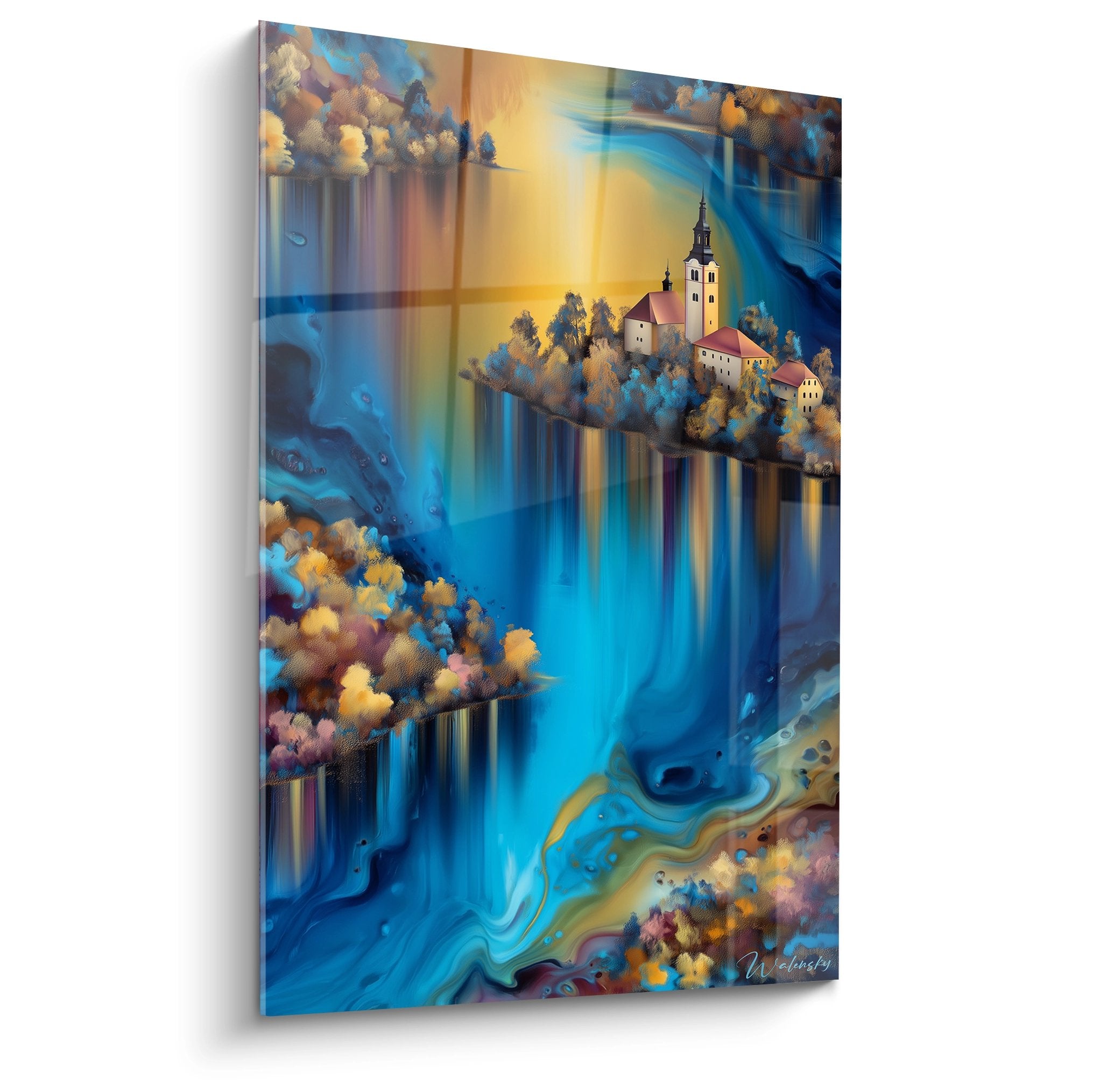






How do organic abstract artworks evoke natural forms?
June 8, 2026 · 9 min read · by Walensky
I spent fifteen years observing visitors in contemporary art galleries. And every time someone pauses in front of an organic abstract canvas, I see the same phenomenon: their shoulders relax. Their breathing slows. Something in them recognizes these curves, these flows, these undulations that feel familiar without their being able to say why. It is the memory of the living stirring awake.
Here is what organic abstract artworks bring to your interior: they create a visceral connection with nature without literal representation, they soothe the eye tired by urban straight lines, and they transform a space into a sensory refuge where the body instinctively feels at home.
Perhaps you have already felt this frustration: you are looking for a piece for your bedroom or living room, but landscapes seem too literal and geometric patterns too cold. You want something that breathes, that lives, that evokes nature without copying it. Something organic.
Rest assured: this quest for a living abstraction is not an aesthetic whim. It is a deep response to a biological need. Our brain has been programmed for millennia to recognize natural forms, and organic abstract artworks speak directly to that primitive part of ourselves.
In this article, I invite you to discover how these mysterious creations awaken within us the echo of the forms nature has been sculpting since the beginning of time.
The cellular memory of curves
There is a scientific reason why a rounded shape soothes us more than a right angle. Our ancestors survived by instantly distinguishing natural forms: the curve of a hill offered shelter, the undulation of a river promised water, the spiral of a shell revealed a universal mathematical structure.
Organic abstract artworks reactivate this ancestral memory. When you observe the swirls of an abstract canvas suggesting petals or waves, your nervous system recognizes these patterns. Without your being aware of it, your body identifies the Fibonacci spiral in a fluid composition, or the movement of wind in sinuous lines.
I have seen collectors moved to tears before certain organic abstractions. Not because they intellectually understood the work, but because their bodies remembered. Remembered water, the maternal womb, leaves stirring, everything that flows and breathes.
Forms that heal the gaze
In our urban interiors saturated with right angles and flat surfaces, the eye grows weary. The natural forms present in organic abstraction offer a visual rest comparable to a walk in the forest. Neuroscience confirms what artists know intuitively: observing curves lowers cortisol, the stress hormone.
An abstract canvas with organic forms in your bedroom is not merely a decorative choice. It is a biophilic window, a piece of stylized nature reminding your nervous system that it can relax.
The invisible water: fluidity and movement
Water is the first organic form that every abstract artist seeks to capture. Not water represented literally, but its essence: fluidity, transparency, perpetual motion.
When Helen Frankenthaler poured her diluted pigments directly onto unprimed canvas, she was not painting water. She was creating water. The colors mixed, merged, and formed uncertain boundaries like those of a tide. These organic abstract artworks evoke water without showing it: they reproduce its behavior.
In your interior, such a work brings what the Japanese call nagare : flow. It becomes a point of meditation where the eye can follow endless trajectories, drips, translucent overlays reminiscent of the shifting reflections of a lake.
Pigments that breathe
I have always been fascinated by how some artists use the organic pigments themselves: earth ochres, blues extracted from minerals, plant greens. These materials carry within them the chemical memory of the living. When they settle on the canvas following the laws of gravity and viscosity, they create authentic natural forms, not simulated ones.
A work made with this approach does not represent nature: it is nature. It obeys the same physical principles as sedimentation, erosion, and crystallization.

The secret language of cells
Zoom in closely enough on any living structure and you will discover abstract patterns: cell membranes with their amoeboid forms, neural networks resembling plant branching, pulmonary alveoli suggesting bubbles.
Artists who work organic abstraction at the microscopic scale create abstract artworks unsettlingly familiar. You cannot tell whether you are looking at a section of plant tissue or an imaginary composition. This ambiguity is precisely their strength: they suggest life at its most elementary level.
I installed such a work in a clinic a few years ago. Patients told me they felt inexplicably calmed in its presence. As if the image reminded them that their body, at the cellular level, belonged to a vaster, reassuring organic process.
The fractals of the living
Nature is fractal: the same patterns repeat at different scales. The branching of a tree reproduces that of its limbs, which reproduces that of its leaf veins. Organic forms in abstract art often exploit this property.
A canvas with organic fractal motifs creates a meditative depth. The eye can wander endlessly, always discovering new layers, exactly as on a forest walk where every glance reveals a new detail.
— Our selection


Between chaos and order: the dance of growth
What distinguishes natural forms from pure geometric shapes is their organized imperfection. A perfect circle does not exist in nature, but thousands of nearly circular forms do: pebbles polished by water, fruits, cells. Artists of organic abstraction master this subtle balance between structure and accident.
Joan Miró spoke of the murder of painting to describe his method: he let accidents occur, then integrated them into an intuitive composition. These stains, drips, and scratches became living organisms on the canvas. His organic abstract artworks seem to have grown rather than been painted.
In your bedroom, this type of work reminds you that cold perfection is not human. It validates imperfection, irregular growth, and the beauty of living processes that never follow exactly the same path twice.
Suspended metamorphosis
The most powerful organic forms are those that seem to be in the midst of transforming. Not frozen like a pinned butterfly, but captured in their becoming: the flower opening, the wave forming, the smoke rising.
This temporal quality makes organic abstract artworks fascinating companions in daily life. They are never quite the same depending on the light, your mood, the time of day. They live with you.

— Also to discover


The palette of the living: organic colors
There are colors our brain instinctively associates with life: chlorophyll greens, the deep blues of water and sky, earth ochres, the pinks and corals of flesh and flowers. Artists creating organic abstract artworks often work within these chromatic registers.
But beyond the hues, it is how the colors interact that evokes nature. Subtle gradations rather than brutal contrasts. Translucent overlays that create depth like layers of atmosphere. Imperceptible transitions found in a twilight sky or the skin of a fruit.
I have seen spaces completely transformed by introducing a single canvas with well-chosen organic colors. Suddenly the clinical white of the walls seemed to breathe. The room found an emotional temperature, a soothing presence.
Natural harmonies
Nature never creates visual cacophony. Even the most colorful plumage of a tropical bird follows precise harmonic rules. Successful organic abstract artworks intuitively respect these principles: golden proportions, softened complementarities, rhythmic transitions.
This is why they integrate so easily into an interior. They do not shout, they converse. They do not dominate, they enrich.
Ready to invite living forms into your everyday life?
Discover our exclusive collection of bedroom paintings with organic forms that will transform your space into a calming natural retreat.

In the same spirit
Painting When the Day Falls Asleep - Beach Landscape Edition
€233.90
Discover this painting →Your interior as an emotional ecosystem
Imagine yourself six months from now. You wake up and your gaze naturally settles on this organic abstract artwork with organic forms adorning the wall facing your bed. You no longer analyze it, you no longer try to understand it. It has simply become a familiar presence, like a tree you pass every morning on a walk.
Your guests stop in front of it, intrigued. What does it represent? they ask. And you smile, because you now know the question has no meaning. It represents nothing. It evokes everything: water, growth, movement, life itself in its most fluid and unpredictable form.
Organic abstract artworks do not merely decorate a space. They transform it into an emotional ecosystem where your body remembers it is part of the living. They create that invisible bridge between your urban interior and the part of you that has always needed nature, curves, and gentleness.
Begin by observing which room in your home feels most static, most cold. That is where an organic work will have the greatest impact. Choose it with your intuition rather than your head. If a form attracts you without your knowing why, it is probably resonating with your deep memory. Trust it.
Frequently asked questions
How do I choose an organic abstract artwork for my bedroom?
Start by identifying the natural forms that personally soothe you: are you drawn to fluid aquatic shapes, branching plant structures, or mineral curves? Then observe the dominant colors of your bedroom and look for a work that complements them harmoniously rather than contradicting them. Most important is your visceral reaction: if you feel immediate calm looking at the work, it speaks to your nervous system. Do not overthink the choice. Organic abstract artworks work at the level of intuition. Mentally test living with it: imagine looking at it each morning when you wake. If that thought brings you joy, you have found the right one.
Do organic forms suit all interior styles?
Absolutely. This is one of the great strengths of organic abstract artworks : their biological universality transcends decorative trends. In a minimalist Scandinavian interior, they bring warmth and life that can sometimes be lacking. In a more eclectic or bohemian space, they create visual coherence by recalling the shared natural origin of all elements. Even in an industrial loft with very geometric lines, an organic canvas offers the necessary counterpoint that humanizes the space. The key is choosing the right scale: a large room with high ceilings will welcome generous, expansive organic forms, while a small space will favor more delicate, airy compositions. Natural forms are our universal visual language; they find their place wherever humans live.
What is the difference between geometric and organic abstraction?
Geometric abstraction works with forms created by the human mind: perfect circles, squares, straight lines, precise angles. It evokes order, rationality, sometimes technology. It stimulates intellectually.Organic abstraction, on the other hand, borrows from nature: imperfect curves, balanced asymmetries, flows and gentle transitions. It speaks directly to the body before speaking to the mind. It soothes rather than stimulates. Concretely, before a geometric work by Mondrian you think. Before an organic work by Frankenthaler or Miró you feel. Both have their value, but organic forms are particularly recommended for rest spaces like bedrooms, as they facilitate the relaxation of the nervous system. If you hesitate, ask yourself: do I want a space that energizes or one that restores? The answer will naturally guide your choice between geometric and organic.
Explore our collections


