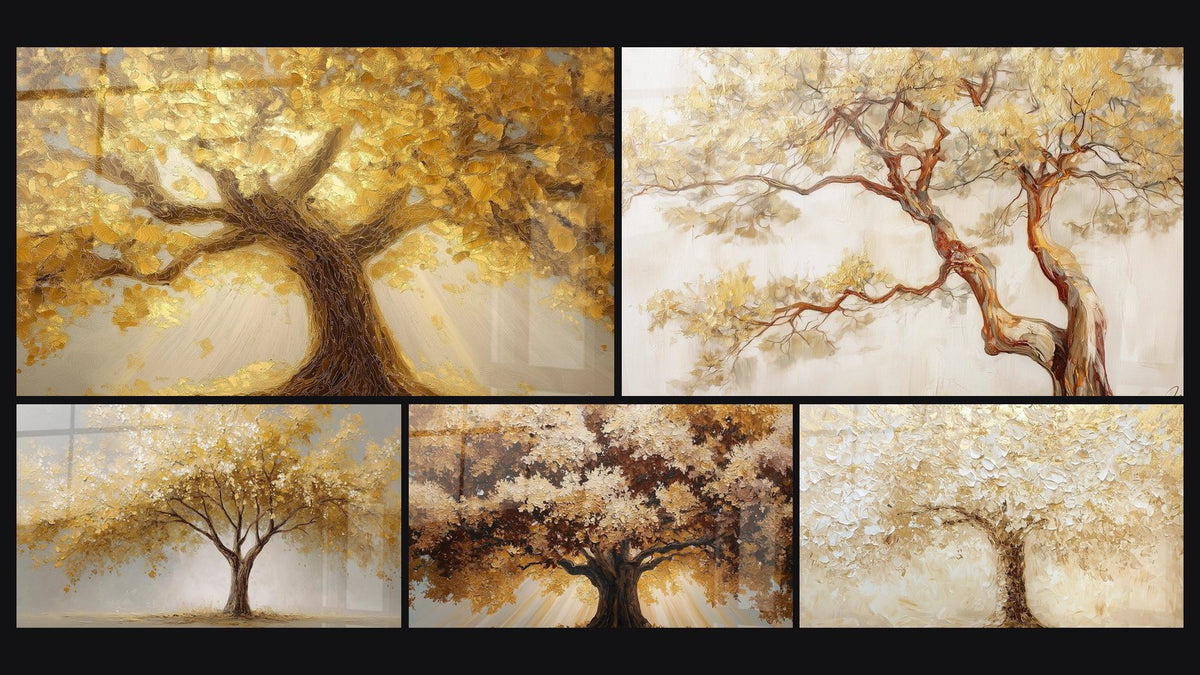
Rectangular gold painting: the calculation method to avoid choosing the wrong size
7 min read · by Walensky
BEST SELLERS
You've spotted a rectangular gold painting, the one that catches the living room light at 4 p.m., and now you're torn between two sizes on the product page. The 120x70 cm L seems reasonable. The 160x90 cm XXL makes you a bit nervous. That's normal: gold doesn't behave like other colours, and nobody has ever explained why.
The direct answerFor a rectangular gold painting, choose a size 10 to 15% smaller than you would for a classic matte painting, unless the room is dark or receives little natural light. In that case, the standard proportion (60 to 75% of the width of the wall or of the furniture beneath the artwork) still applies, because the gold compensates for the lack of brightness instead of amplifying it.- The reflective effect of gold visually amplifies the perceived size of a painting, especially in a bright room.
- The support (glossy acrylic glass or matte Alu Dibond) changes the result radically: same size, two different perceptions.
- In a dark or poorly lit living room, gold compensates for the lack of light rather than overwhelming it: you can aim bigger.
Why does gold change everything when choosing the size?
A matte painting absorbs ambient light and stays quietly within its visual frame. A gold painting, on the other hand, returns it, partially or completely depending on the support, and this simple optical phenomenon changes the way the eye measures the space it occupies.
This is known as the mirror effect: a surface that catches variations in daylight (a lamp switching on, a ray of sunshine sliding across the wall) constantly draws the eye, far more than a matte canvas. As a result, at identical dimensions, a gold painting on acrylic glass "occupies" more of the perceived space than a gold painting on Alu Dibond, whose matte surface reflects almost nothing.
Gold is not chosen in centimetres, it is chosen in reflections.
This nuance changes everything when you hesitate between two close sizes. It's not just a question of wall, but of colour contrast: an off-white wall already reflects a lot of light, and adding two reflective surfaces together can quickly become too much.
The 3-step calculation method: wall surface, light, viewing distance
Three variables are enough to settle between two hesitant sizes: the available hanging area, the room's light exposure, and the distance from which you look at the wall day to day.
Step 1: measure the actual hanging area
Take the width of the bare wall, or of the piece of furniture beneath which the painting will hang (sofa, sideboard, headboard). The classic proportion rule is that the artwork should occupy 60 to 75% of that width.
A 220 cm sofa therefore calls for a painting 132 to 165 cm wide. For gold, stay toward the lower end of this range; we come back to this in step 2.
Step 2: adjust for natural light exposure
A south-facing room, bathed in light from morning to evening, amplifies the reflective effect of gold. In that case, go down one notch from the raw calculation: choose the L format (120x70 cm) over the XL (140x80 cm) if you were torn between them, and favour the matte Alu Dibond finish, which absorbs rather than reflects.
Conversely, a room with little exposure, facing north or at the end of a dark corridor, can carry a more generous size: the gold brings light there instead of glaring. In this context, acrylic glass becomes an ally: its reflections make up for the lack of natural brightness.
Viewing distance matters too: at less than 2 metres (corridor, entrance), even a small difference in size shows far more than at 4 or 5 metres (large open-plan living room).

Favourite
DNA Painting luminous double helix - Golden genetics - DNA edition
From €273.90
Discover this paintingPractical cases: small bright living room vs large dark living room
Let's take two opposite scenarios with the same rectangular gold painting to understand why one calls for caution and the other for boldness.
Bright 18 m² living room, large south-facing bay window. The available wall measures 2.40 m. The raw calculation would suggest a width of around 160 cm. But direct light, combined with an acrylic glass support, would create an almost permanent mirror effect in the late afternoon. Here, it's better to step down to the L format (120x70 cm) in Alu Dibond, which softens the rendering without losing the gold's brilliance.
Dark 25 m² living room, single north-facing window. Same 2.40 m wall, same calculation logic. But this time, the lack of natural light justifies moving up a level: the XXL format (160x90 cm) on acrylic glass becomes relevant, because its gold reflections offset the gloom instead of overwhelming it.
Same painting, same wall, two opposite decisions. This is exactly what a generic calculation never captures.
— Also worth discovering


Gold-specific mistakes you don't see coming
Gold forgives size mistakes less than a matte colour does, because it amplifies every imbalance rather than diluting it.
- Aggressive reflections: an oversized acrylic glass piece facing a direct light source can create a distracting glare at the exact moment you settle onto the sofa.
- Overpowering the wall: on a dark wall (midnight blue, fir green), a very large gold format can create a colour contrast so strong that it overwhelms the rest of the room: the eye sees nothing but it.
- "Too much" effect in large sizes: two nearby gold surfaces (a gold mirror and a gold painting, for example) in the same field of vision visually saturate the space, even if each piece taken on its own is a reasonable size.
The African painting River of Copper illustrates this tension well: its warm, coppery tones work beautifully in L format in a bright room, but take on an entirely different dimension, more enveloping and almost theatrical, in XXL in a living room with dark walls.

Our most requested gold sizes and why they work
Some sizes come up more often than others, and it is never a matter of chance in proportion.
The L format (120x70 cm) dominates medium-sized living rooms with moderate light exposure: it benefits from the gold's brilliance without ever overwhelming the space. It is the safest format when in doubt, precisely because it sits at the lower end of the recommended range.
The Abstract Golden Geometry painting - Harmonious Spirals plays precisely on this register: its gold spirals on an orange background catch the light without excess from the L format, and gain decorative presence from the XL (140x80 cm) upward in darker rooms.

For a narrow wall where no large format fits, a made-to-measure piece from 80x46 cm lets you keep the gold effect without sacrificing proportion. our guide to choosing the size according to room dimensions walks through this calculation room by room if you want to go beyond the gold-specific case.
If you're still torn between two sizes after all this calculation, choose the smaller one on acrylic glass rather than the larger one on Alu Dibond: the gold brilliance often makes up for the difference in surface area.
A special case: the navy-dominant painting
The Golden Navy Anchor painting - Mysteries of the Depths combines deep blue with gold accents more subtle than fully gold pieces. It therefore tolerates more generous sizes (XXL, 2XL) even in a bright room, because the gold plays the role of an accent rather than the dominant surface.

Gold does not follow the same rules as the rest of your decor. A size that would be perfect in navy blue or black and white can become too present, or on the contrary too timid, once rendered in gold, depending on your room's light and the support you choose. The method remains simple: measure your wall, observe your light at the hours when you actually live in the room, and let the reflection decide what the tape measure cannot guess. our selection of gold paintings among our bestsellers gives you a good starting point for comparing sizes in real settings.

In the same spirit
Abstract blue and gold painting - Ocean Symphony - calligraphy edition
From €273.90
Discover this painting →