

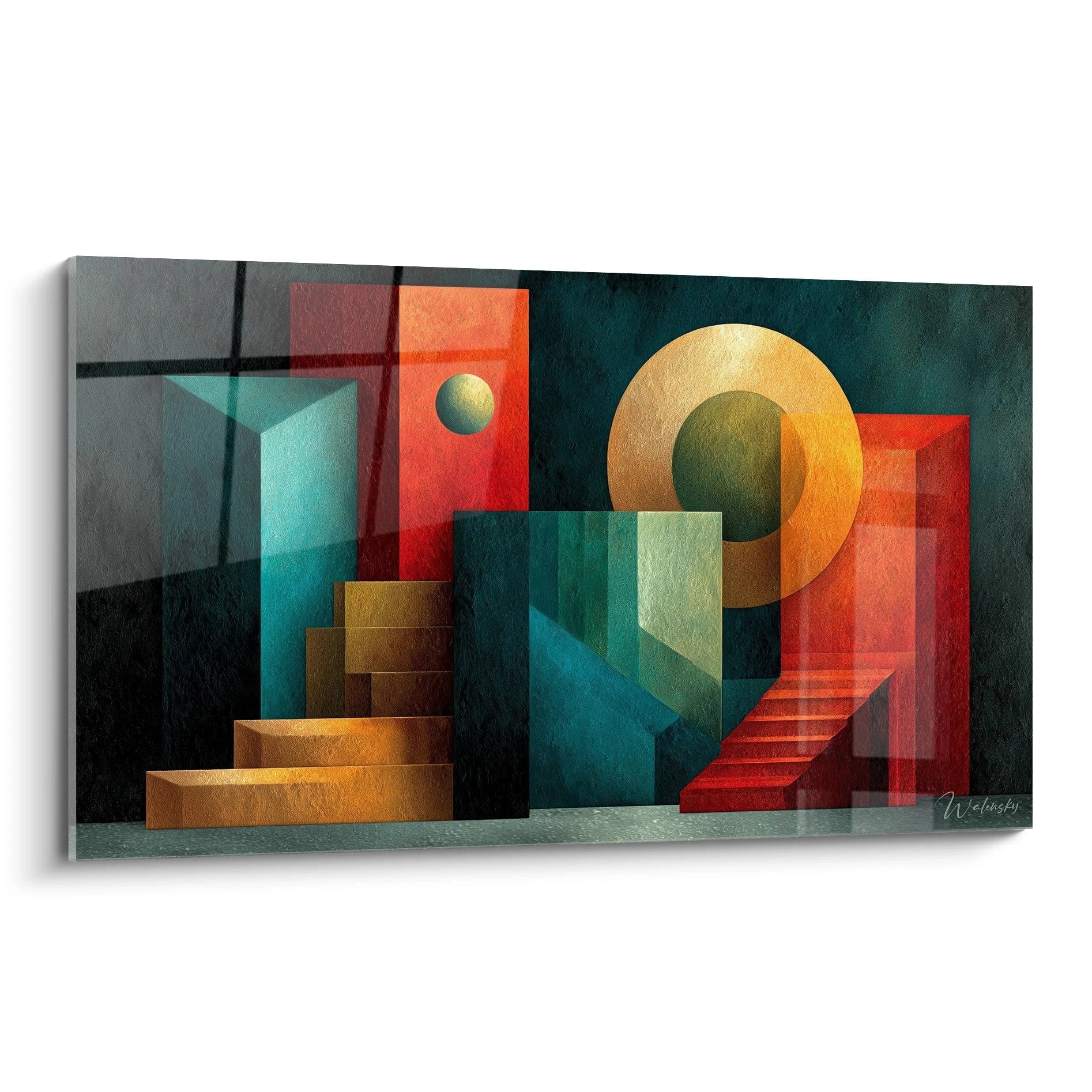






Hanging a Grid of Square Paintings Without Drilling: The Hook and Template Method
8 min read · by Walensky
CROCHET STYLE PAINTING
The living room wall is 2.4 metres wide, you have four square paintings in hand, and your landlord has been clear: not a single hole in these freshly painted walls. It's the classic renter's dilemma: wanting a gallery wall worthy of the name without ending up with eight misplaced holes and a shortened deposit.
Good news: a perfectly aligned grid of square paintings requires neither a drill nor hidden masonry skills. Just a method, a little paper, and the patience to check everything before fixing anything for good.
- Reinforced adhesive hooks support several kilos each: always check the stated load capacity against the actual weight of the painting.
- A spacing of 5 to 7 cm between square paintings gives a coherent gallery wall look, neither too tight nor too scattered.
- A paper template cut to the exact dimensions of the painting lets you test the entire composition before placing a single hook.
Why the classic hammer method doesn't always work
Hammering a nail, stepping back three paces, noticing it's crooked, filling the hole, starting again: this is the scenario that discourages most people before they've even taken out the spirit level. When renting, this method is simply forbidden or strongly discouraged by most leases.
The real problem isn't the hole itself, it's the mistake you can't undo. On a grid of four or nine square paintings, a single badly placed anchor point shifts the whole composition, and it's often too late to move it without leaving a mark.
A successful grid is decided before the first hole, not after.
Hence the value of reversing the order of operations: you validate everything on the wall, at full scale, and only then do you fix. This is exactly what paper templates combined with fixing systems that don't require traditional drilling make possible.
Hook and rail systems suited to square paintings
Two families of solutions dominate the market for hanging without a drill: adhesive hooks and notched wall rails. They don't meet the same needs, and the choice depends mainly on the weight of your paintings and how often you plan to change your composition.
Reinforced adhesive hooks: for what weight?
Modern adhesive hooks, based on self-gripping strips, support loads ranging from 2 to over 7 kg depending on the model. A square painting in the L format (100x100 cm) is usually light thanks to printing on acrylic glass or Dibond aluminium, two supports that weigh noticeably less than a classic board.
Always check the maximum load stated on the hook packaging, and allow a safety margin: a hook rated for 5 kg should ideally carry a painting of 3 to 3.5 kg at most to last over time, especially in summer when heat slightly softens the adhesive.
Notched wall rails: an advantage for adjustable grids
The notched rail is mounted with a minimum of anchor points, sometimes with structural adhesives that also don't require drilling, then allows several paintings to be hung at adjustable heights using cables or sliding rods. It's the most flexible solution for anyone who likes to reorganise their gallery wall through the seasons without ever touching the wall again.
The other advantage of the rail: it distributes the weight along its entire length rather than on a single point, which makes it particularly suitable for 3x3 grids made up of several fairly large square paintings.

Favorite
Bengal Cat Climbing Painting - The Feline Acrobat - Bengal cat edition
From €213.90
Discover this paintingCreating a paper template to calculate the perfect spacing
A paper template is simply a sheet cut to the exact dimensions of your painting, which you tape to the wall at the planned location. The idea comes from set design workshops: before hanging an artwork in a museum, its placement is always tested with tracing paper.
- Measure the width and height of each square painting precisely (for example 100x100 cm for an L format).
- Cut a sheet of kraft paper or newsprint to these exact dimensions.
- Tape the templates to the wall, keeping a regular spacing of 5 to 7 cm between each piece.
- Check horizontal and vertical alignment with the spirit level, template by template.
- Adjust, step back, look at the whole from the sofa or the entrance of the room before confirming.
Once the paper composition looks right to the eye, and only then, you place the hooks or rail at the marked locations. Zero improvisation, zero extra holes.
— Our selection

A concrete example: composing a 2x2 or 3x3 grid with paintings of the same format
Take a fairly wide living room wall, say two and a half times the width of a standard sofa. A 2x2 grid with four square paintings in the L format (100x100 cm) and 6 cm of spacing will occupy about 2.12 m wide by 2.12 m high: well within the recommended proportions, which suggest that a wall composition should occupy 60 to 75% of the width of the wall or furniture piece it hangs above. For an adult bedroom, choosing the right size of square painting follows similar proportion rules.
Aesthetically, opting for motifs that are coherent in colour but varied in subject creates a pleasant visual tension. A painting of Art Deco cranes in green and gold tones works very well alongside geometric motifs in the same colour range.

For a bolder grid, in the style of a contemporary gallery, you can also play the card of pure abstraction. A painting of stacked blue rectangles beside a kinetic illusion composition in the style of op art creates a rather spectacular, hypnotic effect on an office or entrance wall.

For a 3x3 grid, it's better to opt for more compact formats if the wall is no more than 3 metres wide, or to alternate the supports: acrylic glass for rooms where the light is controlled, matt Dibond aluminium facing a window that reflects too much glare. Mixing the two finishes in a single grid is possible, provided the colours remain coherent.
If you're looking for a more lively subject to break the geometric rigour of a grid, a street art painting in the style of a funfair carousel brings a touch of vivid colour that instantly lifts the whole. Colourful square paintings for a child's bedroom also work very well in this festive register.
— Also to discover


Tips for adjusting and securing the grid once hung
A grid that is straight on the day of hanging doesn't always stay that way three months later. Temperature and humidity variations affect adhesives, especially in poorly ventilated rooms.
- Recheck the level every two to three months across the whole grid, not just on a single painting.
- If a hook shows signs of weakness (slight sagging, an edge that lifts), replace it before it gives way rather than after.
- For the heaviest paintings in a 3x3 grid, double the fixing point with a second discreet hook for support, hidden behind the painting.
- Clean the wall surface regularly before repositioning an adhesive hook: dust noticeably reduces adhesion.
To go further on composing a wall with two artworks before tackling a larger grid, our article on pairing two paintings for a structured wall offers useful guidance on balancing colours and formats.

In the same spirit
Urban Carousel Painting - street art edition
From €213.90
Discover this painting →Frequently asked questions
How do you hang a painting without making a hole?
With a reinforced adhesive hook suited to the weight of the painting, or a notched wall rail itself fixed without drilling. Both solutions comfortably support the weight of a square painting printed on acrylic glass or Dibond aluminium.
What spacing between the paintings in a grid?
Allow 5 to 7 cm between each painting for a harmonious gallery wall look. Below that, the composition looks cramped; beyond 10 cm, it loses its grid effect and resembles scattered artworks.
Which adhesive hook should you choose for a heavy painting?
Opt for a hook rated for a load well above the actual weight of the painting, with a comfortable safety margin. For the largest formats, a notched rail distributes the weight better than a single isolated hook.
How do you keep a grid of paintings straight over time?
Check the alignment with a spirit level every two or three months, and replace any hook showing signs of weakness before it fails. Humidity and heat are the two quiet enemies of adhesive fixings.
A grid of square paintings has never needed dozens of holes in the wall to succeed. A paper template, a spirit level, a few well-chosen hooks, and the discipline of checking everything before fixing are more than enough to achieve a result worthy of a gallery. To compose yours without taking out the drill, head to the hook-style painting collection to find the square formats that will do the rest of the work.
Explore our collections


