

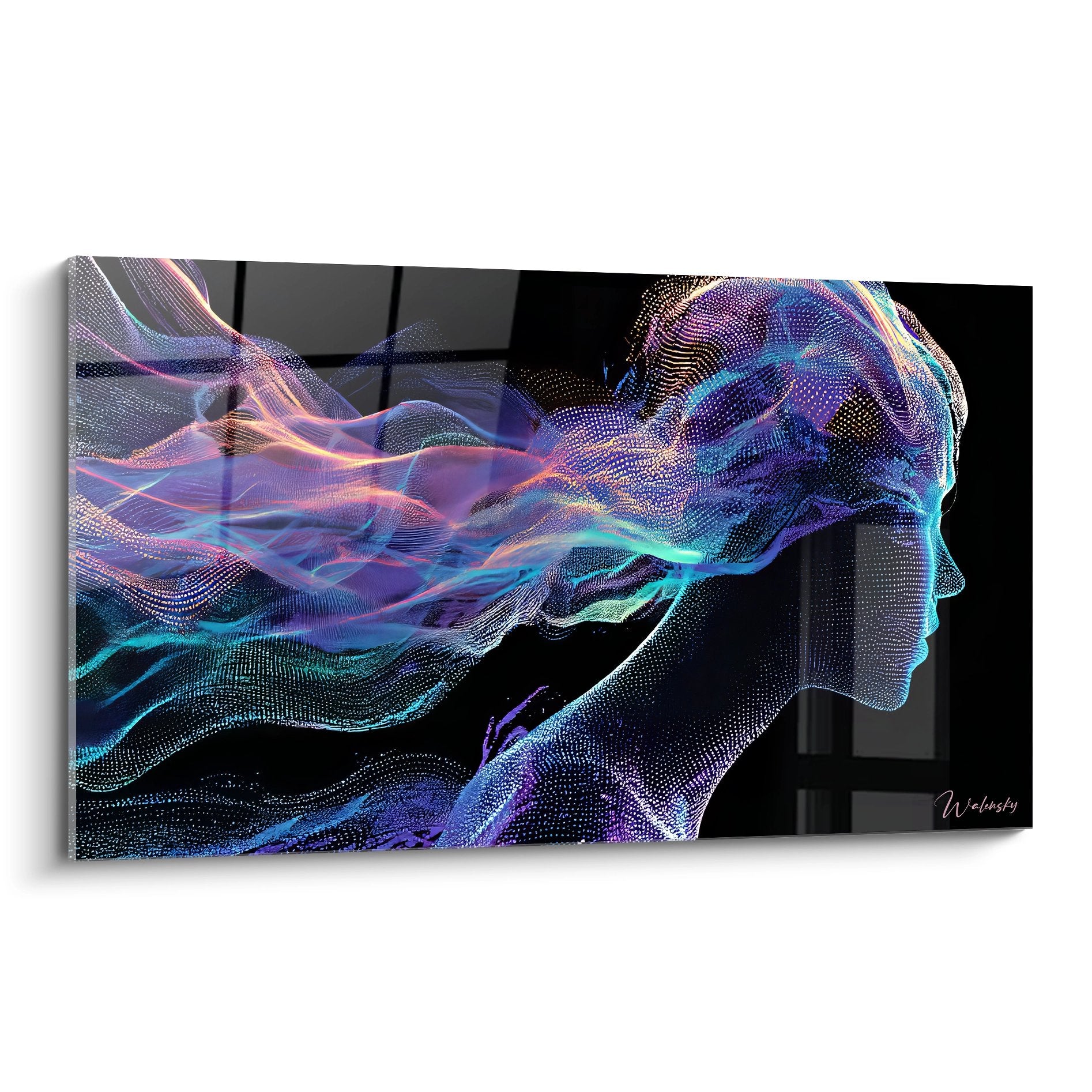






Panoramic Milky Way painting on black background for a hallway: depth effect or visual trap?
8 min read · by Walensky
SPACE PAINTINGS
A hallway is often the room we forget. We pass through it, never stay. Yet it's where many homes make their first impression, even before the living room. So when you think about hanging a panoramic Milky Way painting on black background there, the burning question comes quickly: will you create a window onto infinity, or simply add darkness to a spot that's already not particularly bright?
The direct answerA painting with a deep black background does not darken a hallway: when well placed and well lit, it creates a contrast that visually opens the space like a window rather than closing it. The risk only exists if the hallway is very dark and the painting has no dedicated lighting - in that case, the black background blends into the surrounding gloom instead of deepening it.- Deep black works like a hole in the wall: it gives depth, not darkness, provided there is a minimum of directed light falling on it.
- A hallway without a window needs a spotlight or LED aimed at the artwork, otherwise the contrast disappears into the ambient shadow.
- The panoramic format (120x40 cm and up) is precisely designed for narrow hallways: it fills the length without overwhelming the width of the wall.
Why the black background is so captivating in narrow hallways
The black background fascinates because it plays a trick on the eye: instead of blocking the wall, it seems to pierce it. In a passageway space, often narrow and often without a large window, this illusion of a window onto space is remarkably effective - provided you don't get the context wrong.
The paradox comes down to one sentence: a poorly exploited black background crushes an already dark hallway, but the same black background, well positioned and well lit, hollows out that same hallway as if it opened onto empty space. The difference doesn't lie in the painting itself, but in its immediate surroundings.
A black background is never neutral: it either absorbs or reveals, depending on the light you give it.
That is the whole point of a panoramic-format Milky Way painting: the subject - stars, nebulae, planets - exists only through contrast with that deep black. Without light to catch the luminous points and colour reliefs, the artwork loses its ability to create depth.
Hallway brightness: the criterion that changes everything
The question to ask before any purchase is not "do I like this painting" but "what light does my hallway receive, and at what time of day". This factor, more than size or subject, determines whether the black background will showcase or weigh down the space.
Hallway with natural light or spotlights
If your hallway benefits from a side window, a glazed door at the end of the line, or ceiling spotlights already installed, the deep black background becomes an immediate ally. Light, even indirect, is enough to bring out the swirls and luminous points of the artwork without any extra addition.
In this case, favour a acrylic glass support: its glossy surface slightly reflects ambient light and gives a deeper rendering, almost like a gallery piece, that fully plays the contrast card.
Hallway without a window: precautions to take
A windowless hallway, lit only by a ceiling bulb switched on as you pass, requires more rigour. The black background must never be left alone facing the surrounding darkness: it needs a dedicated light point, otherwise it blends into the wall instead of hollowing it out.
If your hallway has no light source within two metres of the planned location, plan an adjustable spotlight before hanging. Without it, even the most beautiful Milky Way painting will lose all its relief once night falls.
In this context, matt Alu Dibond remains relevant if you plan to add fairly strong direct lighting: its glare-free surface avoids parasitic halos under a powerful spot. This support also lends itself very well to minimalist wall decoration on dibond aluminium, where every finishing detail matters.

Favorite
Painting Two blue and gold planets with intertwined swirls - Twin celestial panorama - Planet Edition
From 242.90 €
Discover this paintingWhich Milky Way theme to choose based on the effect you want
Not all black-background artworks tell the same story. Some rely on the softness of an isolated satellite, others on the energy of a collision or a swirl of colours - and the depth effect changes radically depending on the choice. For a more graphic and colourful approach, a square astronaut floating painting in pop art style offers a dynamic alternative worth exploring.
For a hallway seeking contemplation rather than impact, an isolated moon over a mineral horizon creates an almost meditative calm. For a hallway leading to a living space that you want to energise, a composition with multiple planets and colour play creates more visual movement.
- A lone moon on black background: contemplative effect, ideal at the entrance of a calm hallway.
- Two planets or spheres interacting: dynamic effect, perfect for a hallway serving several rooms.
- A complete solar system : narrative effect, for lovers of a more scientific theme.
- A coloured light beam on anthracite background: the most spectacular effect, reserved for hallways that are already well lit.
For a hallway serving several rooms where you want a more assertive effect, the duo of interacting spheres works particularly well - the contrast between deep anthracite and warm tones catches the eye at every passage.
— Our selection


Pairing the painting with hallway lighting to showcase the black background
A black-background painting without dedicated light is a bit like a film projected in a lit room: the contrast collapses. Lighting is not an aesthetic option, it is a functional condition for this type of artwork.
Directional LED spotlights, aimed at 30-45 degrees towards the painting's surface, remain the most effective solution: they catch the artwork's luminous points without flattening the rest of the hallway under flat frontal light. Indirect lighting, such as a discreet LED strip above or below the painting, produces a softer, almost cinematic effect that further reinforces the illusion of an open window.
Avoid a single central ceiling light as the hallway's only light source. Prefer two low points - one spotlight on the painting, another further along - to break the tunnel effect and bring rhythm to visual circulation.
A mirror placed opposite, a few metres away, can also multiply the effect: it reflects the glow of the painting and gives the impression that the hallway stretches even further. It's an old decorator's trick, but it works particularly well with cosmic black backgrounds.
— Also to discover


Panoramic format and black background: avoid these common mistakes
Most disappointments come less from the choice of painting than from its installation. Three mistakes systematically recur in poorly planned hallways.
| Common mistake | Consequence | Solution |
|---|---|---|
| Hanging too high | The eye never meets the artwork while walking | Centring the painting at eye level, roughly 1.50 m from the floor |
| Format too short for the length of the wall | The artwork looks lost, the black background dilutes into the light wall | Choosing a panoramic format occupying 60 to 75% of the available width |
| No dedicated lighting | The contrast fades at night, the hallway looks darker | Adding an adjustable spotlight before hanging, not after |
For particularly long hallways, XL formats (150x50 cm) and beyond keep their legibility, whereas a format that is too short would give a postage-stamp effect on a large wall.
our collection of paintings designed for hallways

In the same spirit
Black and white ringed Planet painting - Cosmic resonance - Planet Edition
From 242.90 €
Discover this painting →Frequently asked questions
Does a black-background painting darken a hallway without natural light?
No, not in itself: it is the absence of dedicated lighting that darkens, not the painting. With a spotlight aimed at it, the black background instead creates a point of depth that structures the space rather than obscuring it.
What is the ideal height to hang a panoramic painting in a hallway?
This height applies to most domestic hallways, whether in L or XXL format - it is the centre of the artwork that matters, not its upper edge.
How to light a predominantly black painting in a hallway?
Opt for a directional LED spotlight angled at 30-45 degrees, optionally complemented by a discreet strip of indirect lighting. The goal: catch the light play across the artwork without flattening the rest of the wall under harsh frontal light.
Which format should you choose for a very long, narrow hallway?
Go for a panoramic format whose width covers 60 to 75% of the available wall section. For truly long corridors, XL (150x50 cm) to 3XL (180x60 cm) formats retain their impact without visually overwhelming the space.
A black background is not a risky bet for a hallway: it is a staging tool, provided it gets what it needs to work — a minimum of directed light, a format that respects the wall's length, and a hanging height that catches the eye in motion. Well conceived, it turns this passage you once walked through without a second glance into a true window onto infinity. To go further, our Space Paintings collection gathers other cosmic compositions designed for this kind of use — the galaxy painting collection lends itself particularly well. You can also explore our guide to the panoramic DNA painting for hallways or our method for integrating a panoramic nature painting into a hallway to compare approaches according to your tastes.
Explore our collections


