You've been staring at your blank wall for weeks, browsing countless decor sites without ever finding the perfect artwork to transform your living room into a space as refined as the Pinterest photos that inspire you.
Every evening, returning home, that white wall cruelly reminds you that your interior lacks that discreet sophistication that you admire in your friends' homes or in decor magazines. You can already imagine your guests noticing this subtle but important difference.
You’ve probably already bought several paintings: too busy, they create visual noise; too classic, they date your decor; too colorful, they clash with your future changes of ambiance. The result? They end up stored in a closet or sold on Le Bon Coin.
Rest assured, this isn't a matter of taste. The real difficulty lies in the lack of understanding of the power of minimalism in wall art: an approach that, contrary to popular belief, is not bland but constitutes the very essence of contemporary elegance.
By the end of this article, you will master the secrets of powerful minimalist artwork and know how to create that purified yet intensely expressive atmosphere that instantly transforms any space into a refined modern sanctuary.
Why is minimalism revolutionizing wall art in 2025?
The minimalist style in decor is no longer a passing trend but a permanent aesthetic revolution. In our era of constant visual overstimulation, chic, purified wall art acts as a deep breath for the soul. It's like choosing a signature fragrance rather than a blend: the impact is multiplied by the purity of the message. If you wait any longer, you risk missing this unique opportunity to create a timeless interior that will increase in value over the years.
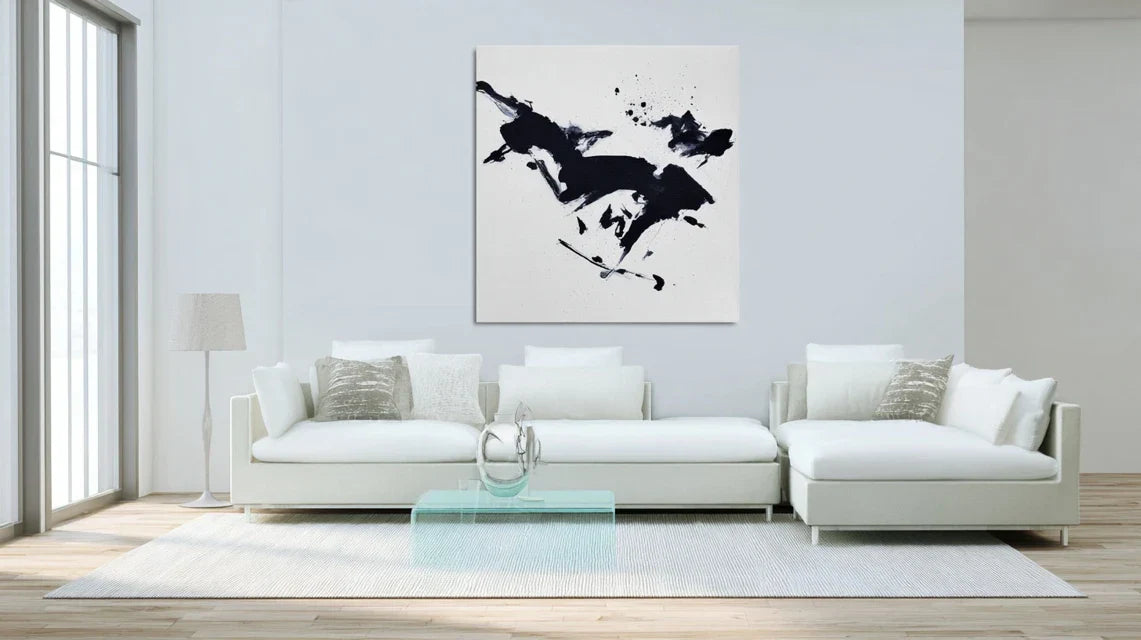
🏡 True story of a transformation: Sophie, a Parisian interior architect, recently told me how a single minimalist artwork with ochre and black tones had revolutionized her clients' Haussmannian apartment. "In 20 minutes of hanging, 150m² went from an outdated bourgeois style to a stunning modern loft," she confides. The work, though modest in size, had become the magnetic focal point of the entire room.
💬 Conversation with a decor expert
Minimalism in wall art isn’t just about decorating, it sculpts the space: A powerful minimalist artwork functions as an emotion amplifier. Rather than adding visual noise, it reveals your room's architectural beauty. Within 24 hours of hanging it, you’ll notice your gaze naturally settles on that area and the entire space feels more harmonious.
Understanding what truly makes a minimalist artwork irresistible
You may be feeling this frustration: you're drawn to minimalist interiors on Instagram but when you try to recreate that style at home, the result lacks warmth and soul. Or perhaps you hesitate between several artworks without being able to identify the one that will create that magnetic presence you’re looking for. Sometimes you even doubt whether a single artwork can truly transform the atmosphere of a room.
What you're experiencing is perfectly normal. The problem isn't your artistic sensibility, but a lack of understanding of the subtle codes of minimalism. Contrary to what one might think, creating a strong impact with few elements requires a much more advanced technical mastery than a loaded composition.
Imagine a Michelin-starred chef preparing a three-ingredient dish: each element must be perfect because there's nowhere to hide. That’s exactly the principle of a powerful minimalist artwork: every stroke, every color, every empty space has a precise function in the final emotion.
Texture: that detail which changes everything
Here’s what 90% of enthusiasts ignore: in minimalist art, texture is more important than color. While everyone focuses on shades, true connoisseurs first look at how light plays with the material. A smooth and shiny artwork creates a totally different emotion from a work with subtle reliefs, even with the same colors.
It’s like the difference between stroking silk or linen: your eye instinctively perceives these tactile nuances, even from afar. This sensory dimension explains why some artworks “speak” to you immediately while others leave you indifferent.
In your living room, this difference translates into a living presence that evolves according to the hours of the day. Instead of a static decorative element, you get a work that dialogues with natural and artificial light, creating an atmosphere that is constantly renewed.
🔍 Immediate test: Observe the photos of interiors that seduce you the most. Zoom in on the artworks: you’ll notice that 9 times out of 10, they present visible variations in texture, even subtle ones. This material depth is what creates that feeling of authenticity and understated luxury.
Negative space: the art of saying more with less
Most people think that a minimalist artwork is just “less color”. In reality, empty space is an active element of the composition, as important as the painted areas. It functions like silences in music: they give relief and intensity to the notes.
Consider the difference between a speech where every word jostles for attention and one punctuated by eloquent pauses. Negative space in refined wall art allows your eye to "breathe" and your brain to process emotion without saturation.
Concretely, when you hang a work that masters this balance, your guests immediately notice that "something has changed" in the room, without necessarily identifying what. This is the signature of a true minimalist painting: its influence extends beyond its own contours.
The magnetic focal point: where the gaze instinctively rests
Here's the best-kept technical secret: every powerful minimalist painting has a "visual anchor point" calculated according to the golden ratio. Even in the greatest sobriety, there is always a subtle element that captures attention and guides the eye in its discovery of the work.
This point can be an almost imperceptible variation in tone, a slight change in texture, or even the meeting of two geometric shapes. Art consists of making it discreet enough to preserve purity, but present enough to create this lasting fascination.
In your interior, this element functions like a subtle magnet that naturally attracts attention without ever tiring it. This explains why you can contemplate some minimalist works for minutes without getting bored, while others only hold your gaze for a few seconds.
3 signals that reveal false minimalism:
- The work seems "empty" rather than refined: True minimalism exudes a strong presence despite its simplicity, like a fragrance of quality that subtly but durably perfumes
- Your eye "glides" over the painting without stopping: This indicates the absence of a magnetic focal point, this subtle visual anchor that creates emotional engagement
- The feeling of incompleteness dominates: Unlike a simplified but complete composition, the painting gives the impression that "something is missing"
Chromatic coherence: beyond trendy colors
True chic refined wall art does not follow fashionable colors but creates its own timeless harmony. This is the difference between wearing a seasonal designer garment and owning an iconic piece that transcends decades without aging. This chromatic coherence acts as an invisible thread that unifies your space and gives it that sought-after aesthetic signature.
Golden rule to recognize authentic minimalism: When you look at the work, you should feel a sense of "fullness" despite its apparent simplicity. If it makes you want to stay in the room longer, it is a sign of successful minimalism. Test this impression from the first glance: it never lies.
| ❌ Failed Minimalism | ✅ Mastered Minimalism | 💡 Key Difference | 🎯 Impact at Home |
|---|---|---|---|
| Gives the impression of a "bare" wall | Creates a calming but strong presence | Subtle work on textures and proportions | Your guests feel immediately relaxed |
| Your gaze never lingers on it | Gentle and lasting fascination | Magnetic focal point presence | You enjoy contemplating your wall |
| Seems "cheap" despite the price | Exudes a sense of understated luxury | Quality of materials and finishes | Instantly enhances all your interior decor |
| Only suits a rigid decor | Adapts and sublimates all your changes | Timelessness of aesthetic choices | Total freedom to evolve your decor |
Your simple method for choosing the perfect minimalist artwork
Now that you understand the secret mechanisms of minimalism, let's move on to practice with a progressive and accessible method. Don't panic: like learning to cook, it just takes mastering the basics to then unleash your creativity. By following these steps in order, you will quickly develop this "eye" that makes all the difference. At the end of this process, you will be able to instantly identify the pieces that will transform your space.
🎯 Overview of your learning: We'll proceed like a professional interior architect: first analyze your space and your needs (foundations), then understand the aesthetic codes of minimalism (structure), finally master the art of hanging and staging (finishes). Each step will give you a lasting skill and visible results immediately.
Step 1: Analyze your space like a professional
Before falling for a work, you need to understand the personality of your wall and your room. It's like choosing an outfit: even the most beautiful dress in the world won't flatter you if it doesn't suit your figure and the occasion. This step will avoid you 90% of costly mistakes and give you the deep satisfaction of seeing your choice perfectly integrated from day one.
What you need for this analysis
- A measuring tape and your smartphone: To accurately measure the area and photograph under different lighting conditions. Take photos in the morning, afternoon and evening - a painting reveals its true personality according to the available light. Avoid "eyeball" estimates which cause 70% of disappointments upon delivery.
- An augmented reality decoration app: These free tools virtually project the artwork onto your wall in real time. They immediately reveal the ideal proportions and avoid unpleasant surprises. Search for "AR Furniture" or "IKEA Place" on your phone - technology is now doing the work of a decorator.
- A notebook (physical, not digital): To note your instinctive impressions facing each space. The brain processes information differently when written by hand, which reveals very valuable unconscious preferences for your future aesthetic choice.
Now let's move on to concrete action
Instructions for deciphering your space
Map the light zones: Observe your wall at three key times of day and note where shadows and reflections fall. A powerful minimalist artwork should play with these variations in light, not suffer from them. Position yourself at different points in the room to identify the main viewing angle - this is where the work will be most often contemplated.
⏱️ Time: 15 minutes per observation | ✅ Successful when: You can mentally draw a map of your wall’s shadows | ⚠️ Attention: Don't neglect evening artificial lighting - this is often where you will enjoy your artwork the most
Identify the architectural style of your room: Modern, classic, industrial or eclectic? This personality will dictate the type of minimalism that will thrive in your home. An industrial loft requires a more raw minimalism, while a Haussmann apartment will better accommodate refined purification. Photograph characteristic details (moldings, beams, materials) to keep this consistency in mind.
⏱️ Time: 10 minutes | ✅ Successful when: You can define your style in 3 words maximum | ⚠️ Attention: Resist the temptation to mix too many styles - harmony is born of coherence
Measure ideal proportions: Apply the rule of thirds: your artwork should occupy about 1/3 of the width of the wall or furniture it surmounts. For height, place the center of the work at 1m50 from the floor (eye level). These classic proportions work in 95% of cases and create that visual balance which characterizes interiors by professionals.
⏱️ Time: 5 minutes | ✅ Successful when: You have the exact dimensions noted | ⚠️ Attention: If you have very high ceilings (>3m), adjust the hanging height proportionally
✅ Validation of this first step: You should now have a clear vision of your space, its constraints and its assets. Test your knowledge: close your eyes and visualize your wall at three times of day. If you can do this easily, you are ready for the next step. If in doubt, repeat an observation session - this solid foundation will save you valuable time in your searches.
OUR RECOMMENDED PRODUCTS
Step 2: Decoding the emotions of minimalism
You are now moving to the next level: understanding the subtle language of minimalist artworks. This is where the magic really happens. Instead of choosing randomly from hundreds of options, you develop a reading grid that instinctively guides you towards the pieces that resonate with your sensitivity. This skill, once acquired, will stay with you for life and transform your relationship to art.
Your emotional decoding tools
- A selection of 20 visual references: Build a Pinterest board or photo album with minimalist interiors that resonate with you. Analyze what repeats: colors, shapes, atmospheres. These constants reveal your personal aesthetic DNA, more reliable than current trends. The "first glance" technique: Develop your instinctive reaction by timing your impressions. The first 3 seconds in front of a work reveal your true feelings, before the mind interferes with practical or social considerations. A precise emotional vocabulary: Learn to name your sensations: "soothing", "energizing", "sophisticated", "warm". This linguistic precision refines your ability to identify exactly what you are looking for in a chic, minimalist wall art.
Developing Your Sensitivity to Minimalism
The "three looks" method: In front of each candidate work, practice this sequence: overall look (general impression), detailed look (materials, finishes), contextual look (integration into your space). This systematic approach reveals the works that function at all levels, not just on the surface.
⏱️ Time: 2 minutes per artwork | ✅ Successful when: You feel a consistency between the three levels | ⚠️ Attention: Beware of pure aesthetic crushes that neglect practical integration
Test emotional durability: Return to observe your favorite works every 24 hours. A truly powerful minimalist artwork gains depth with each new contemplation. If the interest fades on the second visit, it is a sign of superficial seduction that will not last.
⏱️ Time: 5 minutes of re-contemplation | ✅ Successful when: The work reveals new details | ⚠️ Attention: Do not confuse familiarity and fatigue - a work can become familiar while retaining its emotional power
The perfect orchestration of your space
Create a dialogue with the architecture: Position your minimalist artwork taking into account the lines of force of the room (beams, windows, furniture). The work must be part of this natural geometry, not fight it. Use a laser level or smartphone app to perfectly align your hanging with existing architectural elements.
⏱️ Time: 30 minutes of careful installation | ✅ Successful when: The ensemble appears "natural" and balanced | ⚠️ Attention: A millimeter of tilt is immediately visible in a minimalist style - precision is crucial
Orchestrate complementary lighting: Even the most beautiful minimalist work needs lighting that reveals its subtleties. Invest in indirect lighting (adjustable spotlights or wall lights) that highlights textures without creating reflections. The goal: to ensure your artwork is always visible under the best conditions, from breakfast to dinner.
⏱️ Time: 1h of installation and adjustments | ✅ Successful when: The work retains its beauty under all lighting conditions | ⚠️ Attention: Avoid direct lighting that creates harsh shadows and distorts subtle colors
Perfect the immediate environment: Clear the area of any distracting elements (knick-knacks, plastic plants, utilitarian objects). Within a 2 meter radius around your artwork, keep only the elements that add to the overall harmony. This visual "breathing room" allows refined wall art to fully express its power.
⏱️ Time: 20 minutes of curation | ✅ Successful when: Your eye naturally focuses on the artwork | ⚠️ Attention: Don't create a sterile void - keep 1-2 elements that bring life (beautiful plant, art book, sculptural object)
Rule of progression to become an expert: Start by mastering a single work in a room before considering a collection. When you can change the ambiance of your living room with a simple lighting adjustment on your artwork, you have reached the professional level. It is at this point that you can consider extending your approach to other spaces.