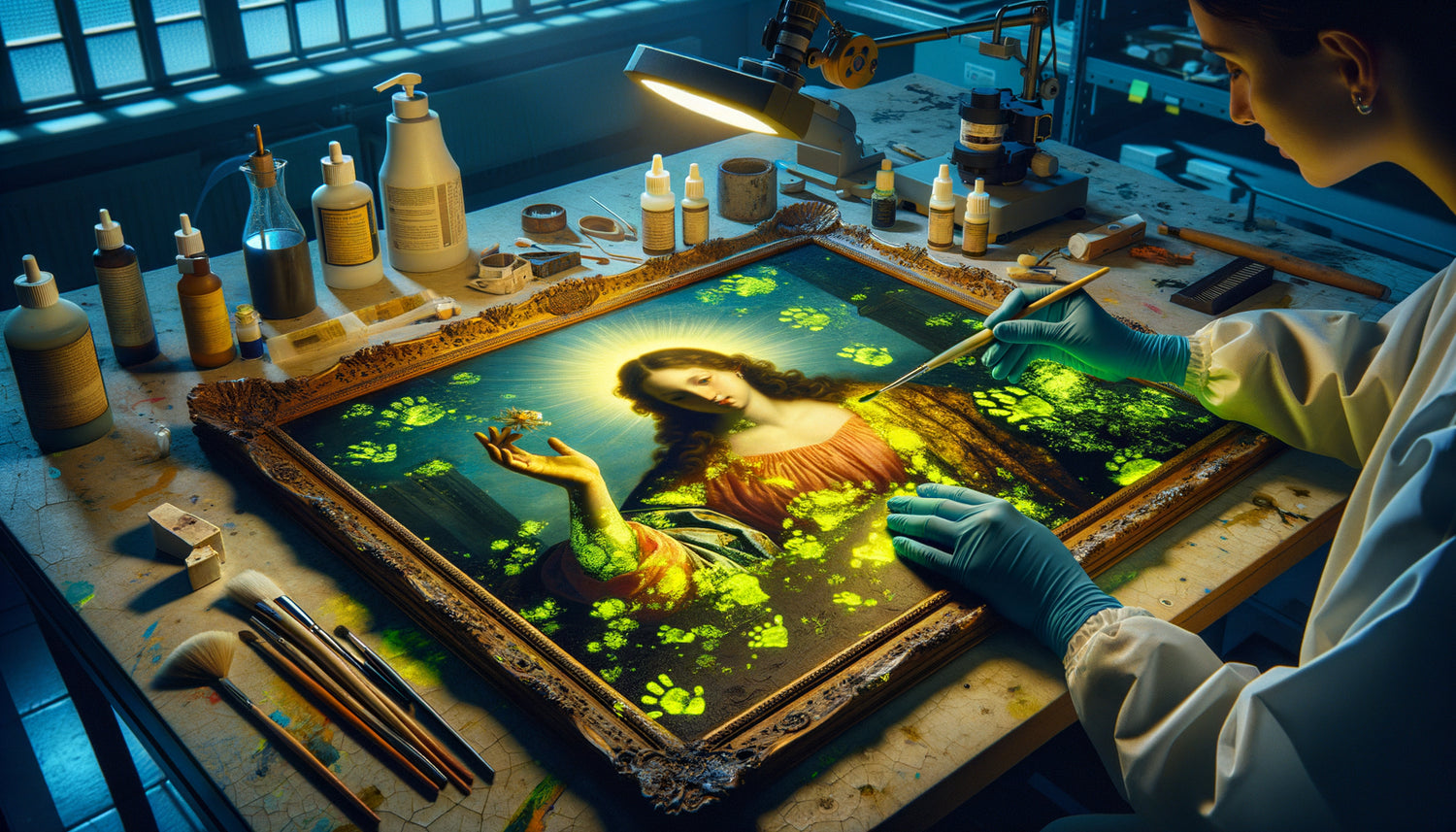
I still remember the day a collector walked into the workshop, carrying an XVIIIth-century portrait under his arm, convinced he held an intact treasure. Under raking light, I noticed this overly uniform texture on the subject's face. A repaint. His smile vanished. For twenty-three years that I have been restoring antique works, I have learned that paintings tell two stories: that of their creation, and that of all the hands that tried to "improve" them. Detecting these subsequent interventions is not only a technical matter; it's an investigation where every clue counts.
Here’s what detecting repaints brings: it allows you to reveal the real authenticity of a work, to precisely assess its heritage value, and to guide restoration decisions to respect the artist's original intention. You may be contemplating an antique painting in your home, or considering acquiring a family painting, but this uncertainty torments you: is it really the original work, or has it been retouched over time? This question is legitimate. Rest assured, restorers today have a palette of sophisticated tools, combining careful observation and cutting-edge technologies, to pierce these pictorial mysteries. I will reveal to you the methods we use daily to distinguish the hand of the master from subsequent interventions.
The restorer's eye: when observation becomes science
Before any technology, direct visual examination remains our first diagnostic tool. In the workshop, I always start by installing the painting under different lighting conditions. Raking light, directed parallel to the surface, reveals irregularities in the relief. A repaint applied over the original pictorial layer often creates a slight thickening, imperceptible in frontal light but evident at this particular angle.
The binocular loupe then becomes my ally. Magnified up to forty times, the surface reveals its secrets: the natural cracks of old varnish present a characteristic network, deep and regular, which crosses the pictorial layers. A repaint, on the other hand, abruptly interrupts this network of cracks or presents superficial fissures, different from the rest. It's like reading the geological strata of a miniature landscape.
I also observe the quality of the brushstroke. Each era, each artist has his gestural signature. A XIXth-century repaint on a XVIIth-century painting will present smoother touches, a different technique. These stylistic variations, subtle but real, speak to those who know how to listen.
The ultraviolet light: revealing invisible boundaries
When I turn off the workshop lights and switch on the UV lamp (emitting UV rays at 365 nanometers), magic happens. Under this black light, old varnishes emit a characteristic fluorescence, usually greenish or yellowish. Repaints, on the other hand, appear as dark patches that absorb UV rays instead of reflecting them.
This UV fluorescence technique is particularly effective because modern materials – synthetic pigments, acrylic binders, recent varnishes – have different optical properties from historical materials. A 19th-century restorer retouching a face with the colors of his time could not have imagined that one day, a simple lamp would betray his intervention.
I have thus discovered extensive repaints on entire skies, draperies repainted to follow aesthetic trends, "rejuvenated" faces by well-intentioned hands but which deeply altered the original work. Fluorescence does not lie: it instantly maps areas of intervention.

Imaging technologies: seeing beneath the visible surface
When the heritage or financial stakes justify it, we use scientific imaging techniques. X-ray radiography penetrates pictorial layers and reveals pigment density. Old lead whites, very opaque to X-rays, appear as bright white on the image, while repaints made with less dense modern pigments create more transparent areas.
The infrared reflectography penetrates differently into the material. Infrared radiations penetrate some layers of paint and reveal the underlying drawing, the pentimenti (artist's repentances), but also the subsequent retouching which has a distinct spectral signature. It is fascinating to see under a completed portrait the artist's hesitations, or conversely, the additions of a foreign hand.
More recently, multispectral photography captures the work under different wavelengths, from near UV to near infrared. Each spectral band reveals complementary information. By combining these images, we create a complete mapping of interventions, layer by layer. This technology, once reserved for major museums, is gradually becoming accessible to private restoration workshops.
Chemical analysis: identifying anachronistic materials
Sometimes, identifying a repaint requires a materials analysis. With the owner’s consent, we take a micro-sample – a few flecks of paint, invisible to the naked eye – to examine it in cross-section under a microscope. This cross-section reveals the succession of pictorial layers like the rings of a tree tell its story.
Spectrometry then identifies the chemical composition of the pigments. A Prussian blue (invented in 1706) on a painting supposedly from the 16th century? Impossible. Titanium white (marketed in the 20th century) under an 18th-century signature? Obvious repaint. These material anachronisms are irrefutable evidence.
Binders (the oil that agglomerates the pigments) can also be analyzed by chromatography. An oil polymerized for three centuries has a different chemical composition than one applied fifty years ago. These analyses, although costly, provide absolute scientific certainty.

Understanding the why: history of repaints
Detecting a repaint always raises the question: why? The motivations are multiple and often touching. In the 18th and 19th centuries, well-intentioned restorers repainted works according to the aesthetic tastes of their time, convinced of improving « outdated » paintings. I have seen Baroque skies overloaded simplified in the 19th century, complexions softened according to Neoclassical canons.
Other repaints hide deteriorations: a clumsily concealed tear, camouflaged chips. Some are attempts at commercial enhancement, adding an apocryphal signature or modifying a subject to make it more sellable. These interventions, although condemnable, are part of the work's biography.
Today, our restoration ethics have radically evolved. We prioritize legibility without falsification, the reversibility of interventions, respect for historical integrity. Detecting repaints is not just a matter of expertise: it is honoring the truth of the work.
What to do when you detect a repaint?
The discovery of a repaint is not necessarily bad news. Depending on its extent and quality, several options are available to the owner. If the repaint is limited and discreet, documented and historically interesting, we can choose to keep it as a testament to the life of the work.
If repainting significantly alters the readability of the original artwork, a removal may be considered. This delicate operation, which I regularly perform, uses selective solvents that dissolve the upper layers without affecting the original paint. It is a work of patience, millimeter by millimeter, under binocular microscope.
I have experienced extraordinary moments during these removals: a dull landscape regaining its vibrant colors, a face whose expression changes completely once freed from clumsy retouching. It's like giving voice to the artist after decades of silence.
Surround yourself with the authenticity of masters
Discover our exclusive collection of wall art inspired by famous artists that captures the purity of the original works without the compromises of time.
The future of detection: artificial intelligence and new frontiers
The field of repainting detection is evolving rapidly. Artificial intelligence algorithms are now being trained to recognize the characteristic patterns of repaints on thousands of multispectral images. These tools assist the restorer by automatically highlighting suspicious areas, considerably accelerating the initial diagnosis.
Optical coherence tomography (OCT), borrowed from ophthalmology, allows obtaining virtual stratigraphic sections without sampling, visualizing the internal structure of the pictorial layer in three dimensions. These advances open fascinating perspectives for the non-invasive study of works.
Despite these technologies, the restorer's eye and experience remain irreplaceable. Machines detect, but only humans interpret, contextualize, decide. This alliance between tradition and innovation defines contemporary restoration.
Conclusion: honoring the truth of artworks
Detecting repaints on old paintings is more than a technical expertise: it is an act of respect for past artists and a responsibility towards future generations. Each time I reveal a repaint, I remember that we are temporary guardians of these visual testimonies of humanity. Whether you are a collector, art lover or simply curious, understanding these processes enriches your view of old artworks. The next time you contemplate a masterpiece, you will know that it may conceal several stories, and that dedicated experts are working to distinguish the authentic from the added. If you own an antique artwork and wonder about its history, do not hesitate to consult a restorer: what is hidden beneath the surface could surprise you, amaze you, reconnect you to the original hand of the artist.
FAQ: Your questions about repainting detection
Does repainting always decrease the value of an antique painting?
Not necessarily. It all depends on the extent of the repainting and its historical context. Minor retouchings (a few square centimeters) carried out to stabilize the work generally do not significantly affect its value, especially if they are documented and reversible. On the other hand, extensive repaints that mask most of the original painting actually decrease its heritage and market value. Paradoxically, some historical repaints performed by famous restorers may have their own documentary interest. The important thing is transparency: a repainted work identified and documented is infinitely preferable to a concealed repainting that deceives the buyer. If you are considering buying an antique painting, always request a detailed condition report detailing previous interventions.
Can I detect a repainting myself on a painting I own?
You can perform some preliminary observations that will put you on the right track, even without sophisticated equipment. Examine your painting under raking light (a flashlight directed parallel to the surface): repainted areas often have a slightly different texture or thickness. Carefully observe the cracks with a magnifying glass: are they uniform over the entire surface or do certain areas show a different network of fissures? Also check the stylistic consistency: do some parts of the painting seem painted with a different touch? However, these observations remain superficial. For a reliable diagnosis, especially if the work has sentimental or financial value, consult a professional restorer who will have the appropriate analysis tools (UV, imaging, etc.). This expertise, generally affordable for an initial diagnostic, will give you certainty and advice tailored to your situation.
Is removing a repainting risky for the original work?
The removal of a repaint, when carried out by a qualified restorer, presents manageable but real risks, hence the importance of a thorough prior assessment. The main danger is to damage the original pictorial layer during the release, particularly if the repaint has been applied directly onto the original without an intermediate insulating layer. Modern restorers use selective solvents and retarding gels that allow precise control of chemical action, tested beforehand on discreet areas. The work is carried out under binocular microscope, gradually, constantly monitoring the reaction of the materials. Preliminary solubility tests are essential: they determine which solvents dissolve the repaint without affecting the original. In some cases, when the repaint is intimately linked to the original or when the latter is too fragile, the wisest decision may be to keep the repaint and document it. A good restorer will always present you with the options, the associated risks and their recommendations before any intervention.