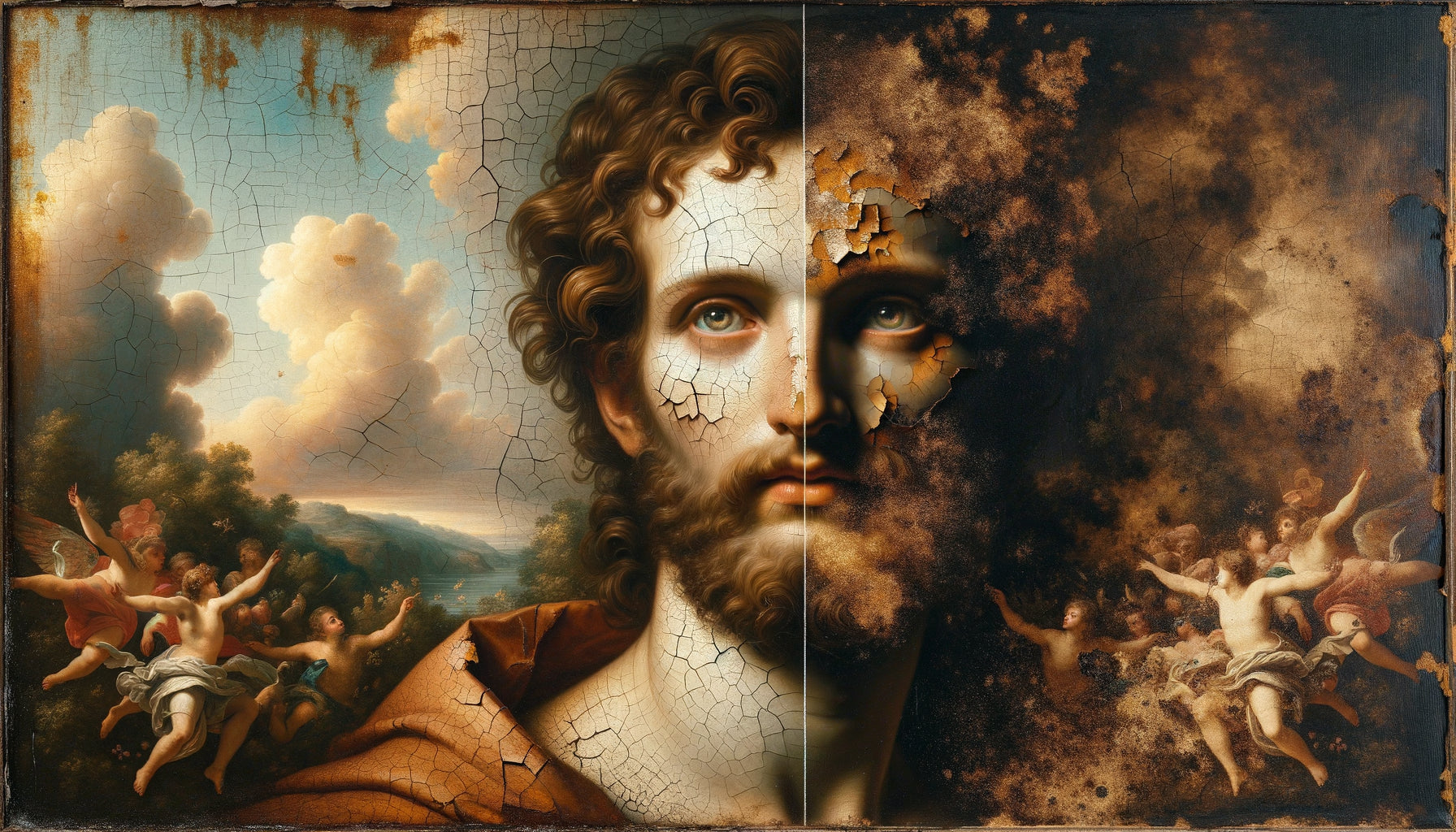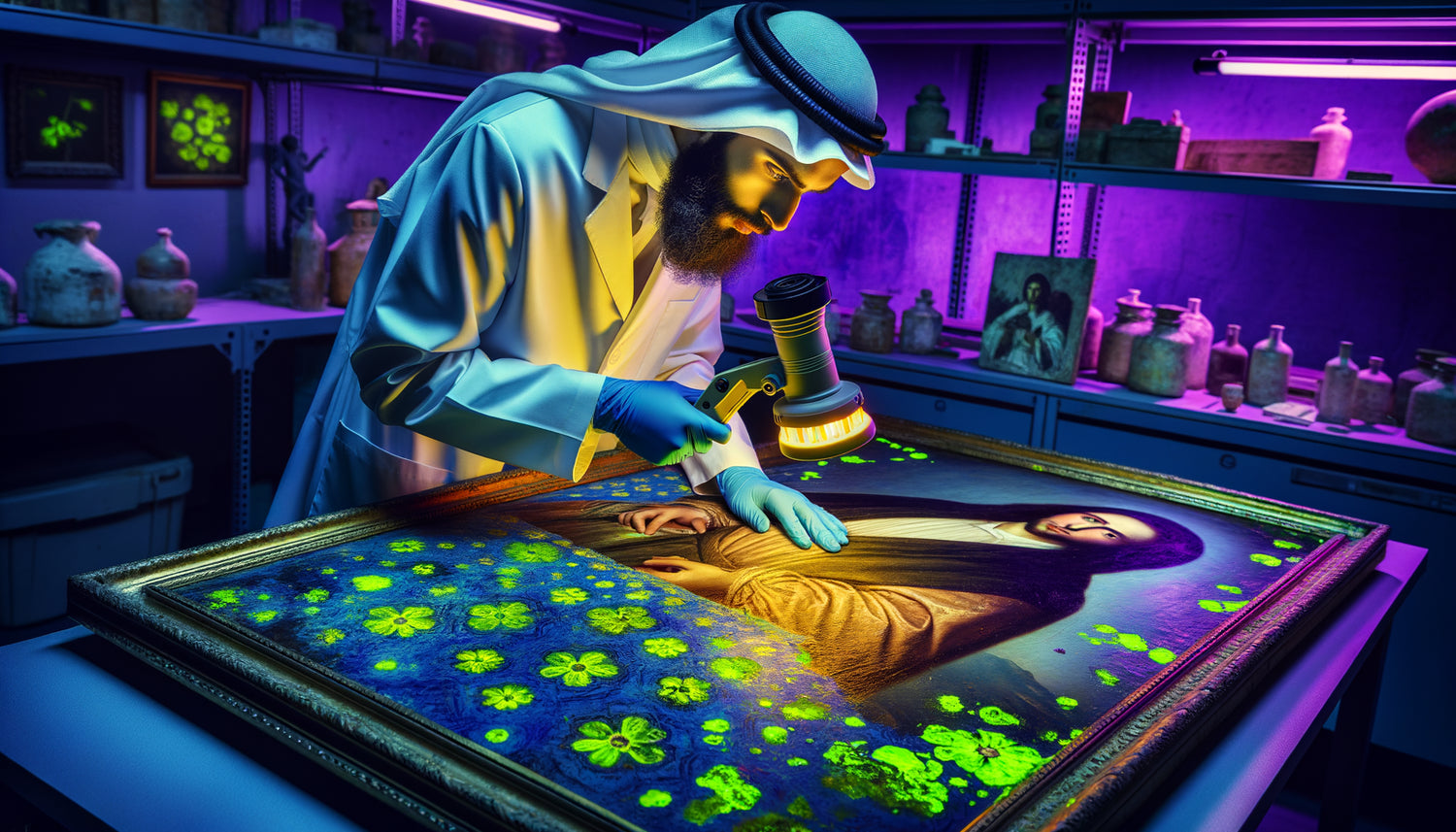
The scene repeats in my laboratory at least once a week: a collector enters with a painting inherited from their grandmother, convinced they hold a treasure. Then I turn off the lights, switch on my Wood lamp, and their face falls. Under the ultraviolet light, the supposedly antique varnish reveals suspicious purple stains, betraying clumsy repaints hidden beneath yellowed glazes. After twenty-two years of examining artworks in my workshop specializing in scientific expertise of old art, I have learned a fundamental truth: ultraviolet light never lies.
Here's what this technique reveals: it instantly unveils modern interventions on an antique painting, authenticates the real age of materials, and protects collectors from crude forgeries that flood the market. It has become my first step in examination, even before taking out my magnifying glass.
The problem? Many think that observing a canvas with the naked eye is enough to judge its authenticity. They look for cracks, inspect the signature, analyze the style. But modern counterfeiters master these details with disconcerting skill. I have seen copies so convincing that they fooled experienced experts… until examined under UV.
Rest assured: understanding this scientific magic does not require a doctorate in physics or sophisticated laboratory equipment. I will reveal to you the secrets that I apply daily to distinguish the original from the fake, honest restoration from concealed repaint.
Fluorescence: when pigments confess their age
Every time I explain the principle to a client, I start with this simple demonstration: I place two seemingly identical whites side by side under normal light. Then I turn on the ultraviolet lights. One remains dark, almost black. The other explodes in dazzling electric blue, like neon. The first? Lead white used until the early 20th century. The second? Modern titanium white, marketed after 1920.
Ultraviolet fluorescence is based on a fascinating phenomenon: certain molecules absorb invisible UV rays and re-emit this energy as colored visible light. Antique varnishes based on natural resins produce this characteristic verdâtre fluorescence, uniform like a luminous patina. Historic pigments react differently from modern synthetics, creating a true chemical fingerprint.
Restorers can immediately detect retouched areas. A recent repaint on an 18th-century canvas appears as a dark purple stain, absorbing UV rays instead of reflecting them. It's like looking at a snowy landscape where someone has traced paths with asphalt: impossible to miss.
The revealing spectrum of materials
In my daily work, I distinguish three categories of fluorescence. Antique varnishes glow with a homogeneous yellowish-green, sometimes orange depending on their composition. Modern synthetic varnishes remain dull or produce a characteristic violet blue. Recent repaints create zones of total absorption, black holes in the luminous uniformity.
I appraised a supposed Corot last year. Under normal light: impeccable. Under UV: a disaster. The entire sky was repainted, probably to mask moisture damage. The owner was totally unaware of this intervention, carried out perhaps fifty years earlier by an unscrupulous restorer.
The forensic scientist's equipment
Contrary to what one might imagine, identifying repaints under ultraviolet light does not require a laboratory worthy of NASA. My main setup fits on a revolving table: a portable 365-nanometer Wood lamp, a blackout curtain, and an improvised darkroom with removable panels.
Wood lamps emit long-wave ultraviolet rays, perfectly safe for works of art and eyes (unlike germicidal short-wave UV). I use a 100-watt model for detailed examinations, powerful enough to reveal the slightest retouching on surfaces up to two square meters. For on-site interventions, at collectors' homes or in museums, my portable 40-watt version slips into a backpack.
The professional observation technique
Here is my systematic protocol, honed over thousands of examinations. First, absolute darkness: even a leak of ambient light falsifies the observation. I wait two minutes for my eyes to fully adapt. Then, I position the UV lamp at 45 degrees, about 30 centimeters from the surface. This optimal distance reveals details without overexposing.
I systematically sweep the canvas by sections, from left to right, from top to bottom. Experienced restorers systematically photograph under UV with specific settings: high ISO (1600-3200), wide aperture (f/2.8), long exposure (1-4 seconds on a tripod). These images constitute irrefutable expert documents.
A crucial detail that I learned at my expense: some modern varnishes imitate antique fluorescence. Sophisticated forgers add fluorescent agents to their mixtures. That is why I always cross the UV examination with other analyses: radiography, infrared reflectography, microscopy.

Decoding the Light Map of Interventions
Imagine a canvas as a luminous palimpsest. Each restoration, each retouch, each cleaning leaves an invisible trace to the naked eye but glaring under ultraviolet light. Restorers detect thus the complete history of a work in minutes.
The fluorescence signatures that I instantly recognize? Cosmetic retouches appear as isolated purple spots, often on edges or worn areas. Extensive repaints create large dark patches that can cover 30 to 70% of the original surface. Fraudulent overpaintings – intended to transform an ordinary work into a masterpiece – show a total dichotomy between fluorescent old zones and modern absorbent additions.
I recently examined a Dutch landscape from the 17th century. Under normal light: magnificent. Under UV: astonishment. Someone had added entire figures in the 20th century to a scene initially deserted, probably to increase its market value. These ghost figures completely absorbed ultraviolet rays, violently contrasting with the ancient varnish which bathed in a golden fluorescence.
The Pitfalls of Interpretation
Attention: not every dark area is necessarily suspicious. Some historical pigments naturally absorb UV. True ultramarine blue, ancient vermilion, some organic lacquers do not fluoresce. I almost made a masterful mistake on a Velázquez by attributing dark areas to repaints, before realizing that it was simply his characteristic use of burnt umbers.
Old varnishes themselves evolve. A partial cleaning creates uneven fluorescence zones, perfectly legitimate. An ethical, documented restoration using reversible and localized materials does not tarnish the authenticity of a work. My role is to distinguish responsible conservation from dishonest forgery.
When Black Light Reveals Hidden Masterpieces
My most memorable case? A portrait blackened by centuries of grime and oxidized varnish. The owner was considering throwing it away. Out of professional curiosity, I ran it under UV light. Astonishment: the fluorescence revealed a nearly intact work beneath the dirt, with no significant repainting. After six months of meticulous cleaning, we discovered a 17th-century Flemish portrait of exceptional quality, ultimately valued at several hundred thousand euros.
UV light detection also works in reverse: it authenticates intact artworks. A perfectly homogeneous and consistent fluorescence with the presumed era, without suspicious areas, constitutes a powerful argument for authenticity. In the paranoid world of the art market, proving that a canvas has not been tampered with is as valuable as unmasking forgeries.
Museums systematically use this technique before any major acquisition. I have collaborated with several institutions to assess potential donations. In about 40% of cases, UV examination reveals undocumented interventions that significantly alter the heritage and financial valuation.
Applications beyond fine arts
My practice extends to antique furniture, polychrome sculptures, and gilded frames. On a secretary purportedly stamped Louis XV, ultraviolet light revealed that all the floral marquetry was reconstituted in the 20th century. On a medieval Madonna statue made of wood, I detected seven successive repainting campaigns, like the geological strata of its veneration through the centuries.
Discerning collectors now systematically integrate an ultraviolet light examination into their acquisition process. It has become a standard clause in pre-sale appraisals for pieces exceeding certain value thresholds.

Training your eye to read ultraviolet
After two decades of practice, I instantly recognize the characteristic patterns. But this skill is acquired gradually. I recommend passionate enthusiasts to start by observing reference pieces with documented history: unrestored works, known recent restorations, avowed modern copies.
Mentally construct a library of fluorescences. The lemon green of an old mastic varnish. The electric blue of zinc white. The total absorption of pure titanium white. The particular orange glow of certain alkyd resins. These signatures become, over time, as recognizable as familiar faces.
I regularly organize practical workshops where participants themselves manipulate the UV lamp on prepared samples. Nothing replaces tactile experience: adjusting the distance, the angle, understanding how fluorescence varies according to residual ambient light intensity.
The limits of the technique
Let's be honest: ultraviolets don't tell everything. They do not precisely date materials (it is impossible to distinguish a varnish from 1850 from a varnish from 1890 by fluorescence alone). They do not reveal deep underlayers (for that, X-radiography remains essential). They can be fooled by very sophisticated forgers using pigments and binders recovered from the past.
That is why I consider UV examination as the first step of a complete protocol, never as a definitive conclusion. It guides subsequent investigations, indicates where to focus more in-depth analyses, quickly eliminates gross fakes.
Surround yourself with authentic beauties
Discover our exclusive collection of wall art inspired by famous artists that captures the essence of masters with total transparency on their decorative nature, to embellish your interior without ambiguity.
The bright future of scientific expertise
Technologies are constantly evolving. New UV LED lamps are democratizing access to this expertise, with consumer models for less than two hundred euros. Smartphone applications even attempt to integrate UV filters (with still limited but promising results).
The UV photographic databases of museums are enriched daily, creating invaluable comparative references. I regularly consult these archives when examining a painting by a master whose direct experience I have little of. Comparing the fluorescent signature with authenticated works by the same artist considerably refines the diagnosis.
What fascinates me after so many years? Each examination remains an adventure. This week again, an anonymous canvas bought at a flea market revealed under UV perfect integrity suggesting a possible attribution to a minor Flemish master. The investigation continues, but ultraviolet light has opened the first door.
Imagine your next visit to an antique store, your next auction. You will never look at a painting the same way again. You'll wonder: what would it reveal under that magical light? What secrets does it hide beneath its golden varnish? This scientific curiosity transforms art collecting into a truly exciting investigation, where each acquisition becomes an enigma to solve.
Frequently Asked Questions
Can I examine my own paintings with a simple UV lamp?
Absolutely, and I strongly encourage you to do so! Invest in a portable 365 nm Wood lamp (available between 50 and 200 euros depending on the power). Work in complete darkness, let your eyes adjust for a few minutes, and hold the lamp 30-40 cm from the surface. You will be surprised at what you discover, even on familiar works. Photograph your observations to create a documentary file. However, interpretation requires experience. Does what you see justify professional expertise? If you notice suspicious areas on a valuable piece, consult a qualified restorer before drawing any definitive conclusions. UV examination is a great initial troubleshooting tool, accessible to all enthusiasts.
Do old restorations also appear under UV?
Excellent question that reveals the subtlety of this technique! Repaints carried out 150-200 years ago with materials from the period can indeed exhibit a similar fluorescence to the original, making their UV detection difficult. That is why I look for other clues: differences in texture in raking light, variations in the network of cracks, stylistic inconsistencies. However, even 19th-century restorations often used slightly different varnishes than those originally applied, creating perceptible nuances of fluorescence. UV examination works especially brilliantly for interventions from the 20th and 21st centuries, where modern synthetic materials stand out radically from ancient compositions. A well-documented historical restoration also adds to a work's provenance rather than devaluing it.
Does this technique damage old paintings?
No, rest assured! The longwave ultraviolet (UVA, 365 nm) used for the artistic examination are perfectly safe for artworks, even the most fragile ones. They are infinitely less energetic than shortwave germicidal UVs (UVC) or even simple sunlight. I regularly examine medieval illuminated manuscripts, delicate watercolors, antique textiles without any risk. Exposure during an examination lasts only a few minutes, compared to years of exposure to ambient light in an interior. Museums have been using this technique since the 1930s without ever having noticed any damage attributable to examination UVs. The only risk concerns your eyes: avoid looking directly at the UV light source, wear protective glasses if you are carrying out prolonged examinations. For the rest, you can examine your treasures in complete peace of mind.