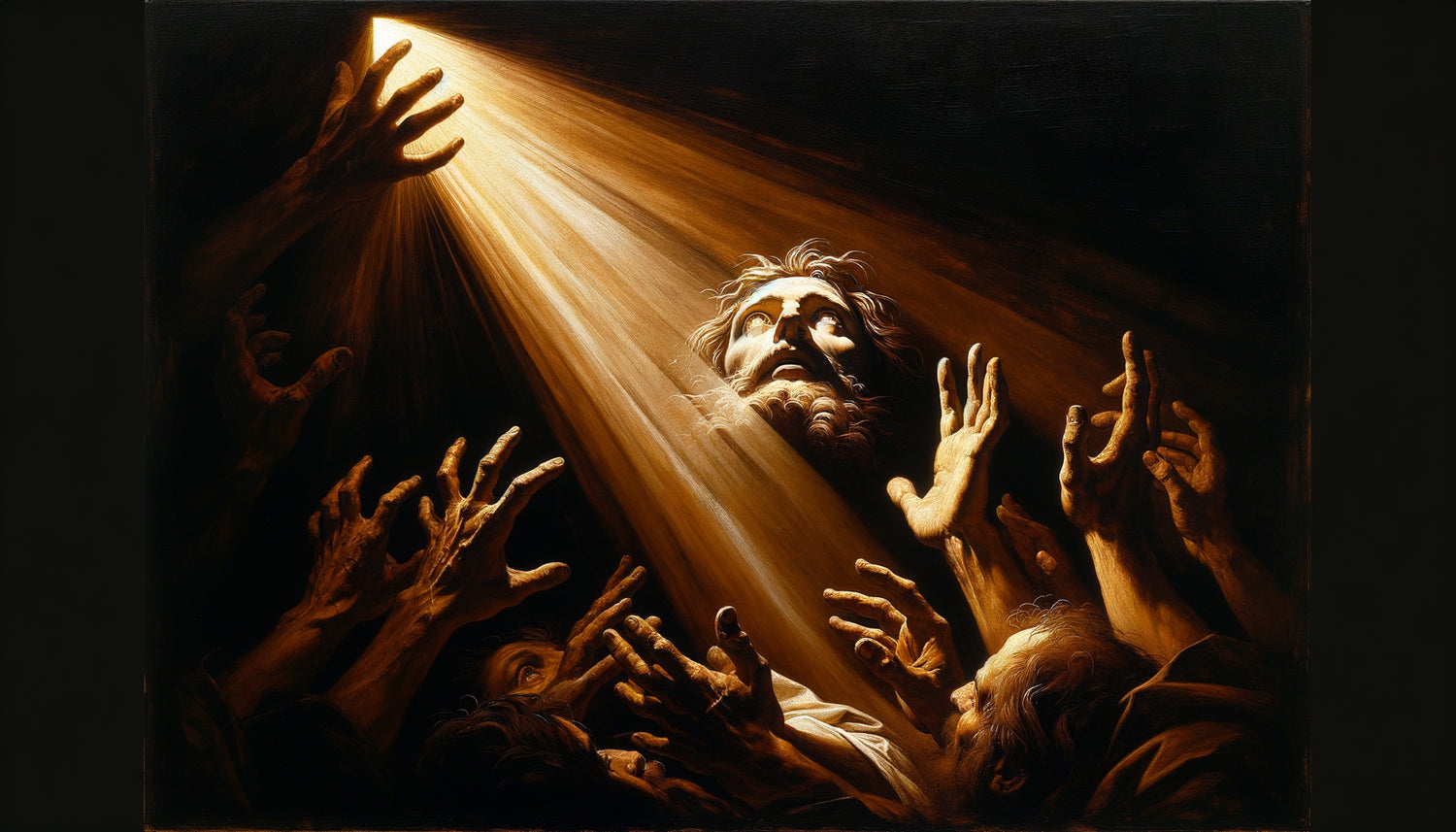
Imagine a beam of raw light piercing the darkness to reveal a distraught face, a trembling hand, a moment of pure humanity. This dramatic light that transforms your spaces today, that creates theatrical atmospheres in our modern interiors, finds its origin in the dark workshops of 17th-century Rome. A man there painted defying all conventions: Caravaggio.
Here's what Caravaggio’s luminous revolution brings us: a totally new understanding of contrast as an emotional tool, a chiaroscuro technique pushed to its paroxysm, and above all, a radically modern vision of space and presence. Three legacies that continue to inspire designers, decorators and creators of atmospheres four centuries later.
You admire these dark paintings from which luminous figures emerge? You wonder how a painter could create such emotional intensity with just light and shadow? You seek to understand why his works seem so contemporary, so cinematic?
Rest assured: the Caravaggesque revolution is not just a matter for art historians. It's a fascinating story of creative transgression, bold choices, and pictorial techniques that literally changed our way of seeing. A story whose principles can transform your own view of arranging your living spaces.
In this article, I’ll take you to discover the secrets of this luminous revolution that shook Western painting and continues to influence our contemporary aesthetics.
The audacity of black: when darkness becomes subject
When Caravaggio arrives in Rome in the 1590s, Italian painting is bathed in the golden and uniform light of late Renaissance. Backgrounds are clear, harmonious, scenes unfold in luminous architectures or sunny landscapes. No one imagines that a young Lombard painter will turn everything upside down by doing exactly the opposite.
His revolution begins with a radical gesture: plunging his canvases into darkness. Not an anecdotal, decorative black, but a deep, absolute black, which sometimes invades three-quarters of the composition. What academics consider emptiness, Caravaggio makes it a living matter, an oppressive or protective presence depending on the works.
In 'The Calling of Saint Matthew', this darkness is not a lack of light: it is the profane world, the space of doubt, the raw reality of a Roman tavern. And it is precisely this contrast that makes the ray of divine light so powerful, so overwhelming. Light no longer floats in an idealized space: it pierces, it reveals, it chooses.
Tenebrism as an emotional language
What Caravaggio invented was tenebrism: a technique where violent contrasts between light and shadow create an intense visual drama. Unlike traditional chiaroscuro, which gently models volumes, Caravaggio's tenebrism creates brutal breaks, supernatural appearances.
Observe 'The Supper at Emmaus': the characters literally emerge from the darkness, as if illuminated by a single, invisible source. This light sculpts faces, reveals every emotion, creates a stage space of astonishing modernity. One immediately thinks of theatrical lighting, a cinematic projector before the invention of cinema.
A physical light in a real space
The second revolution of Caravaggio lies in the very nature of his light. Where Renaissance painters used an ideal, symbolic, harmonious light, Caravaggio paints a physical light, identifiable, almost palpable.
His contemporaries are shocked: where does this light come from? You can almost point to its source, feel its warmth, guess that it comes from a high window, a candle, a side opening. This materiality was considered vulgar, too down-to-earth for religious subjects.
But it is precisely this luminous authenticity that makes his scenes so overwhelming. In 'The Crucifixion of Saint Peter', the raking light reveals the strained muscles of the executioners, the suffering of the saint, the brutality of the scene. Nothing is softened, nothing is idealized. Light becomes a witness to a raw, almost unbearable reality.
Shadows that tell as much as light
The other genius of Caravaggio? Understanding that shadows are not the absence of light, but a narrative element in their own right. His cast shadows are dense, precise, constructed. They create depth, spatial anchoring, a disturbing physical presence.
In 'Judith beheading Holofernes', the shadow projected onto the red curtain intensifies the violence of the act, creating a second phantasmagorical spectacle. This attention to shadows directly foreshadows the research of photographers and filmmakers on contrast and composition.

The baroque spotlight: isolate to magnify
Caravaggio invents what could be called 'spotlight effect': a light concentrated on a character, a gesture, a detail. This technique, omnipresent in our contemporary staging, revolutionizes the visual hierarchy in painting.
Look at 'Saint Jerome Writing': the saint's face and the manuscript are bathed in light, while the rest of the composition sinks into darkness. Our eye is guided with surgical precision. No frills, no distracting decor. The light decides what we must see, in what order, with what intensity.
This economy of means is fascinatingly modern. In the Baroque era when ceilings are covered with hundreds of figures, where the horror vacui reigns, Caravaggio chooses the radical option of emptiness, visual silence, concentration. His use of light creates a mental space as much as a pictorial one.
Imperfect models under an unrelenting light
But Caravaggio's true transgression goes beyond technique. By illuminating his characters in this way, with this raw and direct light, he reveals their most brutal humanity. His virgins have dirty feet, his saints are ordinary people, his angels look like the boys of the Roman streets.
This unfiltered light, without idealization, was scandalous for the time. Several of his paintings were rejected by patrons, deemed too realistic, too vulgar. Caravaggio's light does not magnify in the classical sense: it reveals, it exposes, it tells the truth.
In 'The Death of the Virgin', Marie's body is that of an ordinary woman, perhaps inspired by a drowned person from the Tiber according to legend. The flat lighting reveals every detail, every imperfection. It is precisely this raw humanity that makes the scene so moving, so modern, so universal.
A technique in the service of a democratic vision
Caravaggio's revolutionary use of light carries an almost democratic vision of religious painting. By illuminating ordinary models in this way, he suggests that the divine can dwell within everyone, that grace is not reserved for idealized beautiful forms.
This approach will profoundly influence the realism of subsequent centuries, from Rembrandt to European caravaggists, to the humanist photographers of the 20th century. Light as a revealer of human dignity: this is the deepest legacy of this pictorial revolution.

A luminous legacy that transcends centuries
Four hundred years later, the influence of the Caravaggesque revolution remains omnipresent. Every time a photographer chooses dramatic sidelighting, every time an interior designer plays on the contrast between dark areas and bright spots, it is the spirit of Caravaggio at work.
Fashion photographers, video game creators, exhibition designers: all inherit this understanding that light is not simply technical lighting, but a powerful emotional language. The Caravaggesque tenebrism has created a universal visual vocabulary of drama and intensity.
In our contemporary interiors, this lesson resonates particularly strongly. Ambient lighting, directional spotlights, assumed shadows: all choices that are inspired, consciously or unconsciously, by this 17th-century revolution. Caravaggio taught us that darkness is not the enemy of beauty, but its accomplice.
Let the light tell your story
Discover our exclusive collection of paintings inspired by famous artists that capture this magic of chiaroscuro and transform the atmosphere of your living spaces.
When technical genius meets creative boldness
The Caravaggio revolution would not have been possible without exceptional technical mastery. Contrary to popular belief, this dramatic tenebrism does not result from spontaneous inspiration, but from meticulous, almost scientific work.
Caravaggio worked in workshops with closed shutters, with a single controlled source of light. He positioned his models in precise staging, studied the shadows, adjusted the angles. Some historians believe that he even used mirrors and optical systems to accurately capture these complex lighting effects.
This technical rigor in the service of a radical artistic vision: perhaps that is the true lesson of Caravaggio. The revolution is not only in the idea, but in the obsessive execution, in the ability to transform an intuition into a coherent and reproducible visual language.
His influence was immediate and massive. As early as the 1610s, dozens of painters across Europe adopted his style, creating the Caravaggist movement. From Naples to Utrecht, from Spain to Flanders, this new way of using light in painting spread like wildfire, proof that Caravaggio had touched something universal, deeply human.
Your gaze transformed
From now on, when you observe a Caravaggio painting, you will see more than just a beautiful antique painting. You will understand the radicality of these choices, the audacity of these contrasts, the modernity of this light that sculpts emotion.
And perhaps, when arranging your interior, choosing your lighting, you will remember this lesson: light is never neutral. It tells a story, it chooses, it reveals. As Caravaggio understood four centuries ago, true depth, true presence, true beauty are born from the dialogue between light and shadow.
Dare your own contrasts. Embrace your shadows. Let light tell your story, as the Lombard master allowed his to illuminate the history of art for eternity.