Imagine an era when a brushstroke could seal an alliance, when a portrait was worth more than a diplomatic treaty, when art wasn't just about aesthetics but an instrument of absolute power. In the 17th century, court painters were not mere artists: they were the visual architects of monarchical grandeur, propagandists of divine power, silent diplomats of European courts.
Here's what the social function of court painters reveals: a mastery of image as a political tool, a role as an intermediary between the sovereign and eternity, and an ability to shape the collective memory of an era.
Perhaps you wonder how mere brush artisans could exert such considerable influence? How did their art transcend simple decoration to become a pillar of the monarchical system? This question is as fascinating as it is enlightening to our contemporary relationship with image and power.
Rest assured, understanding the social function of court painters in the 17th century does not require being a historian. Just look at their works as what they truly were: political manifestos, certificates of legitimacy, distorted mirrors of reality.
I invite you on a journey into royal workshops, where the image of absolute power was built, brushstroke after brushstroke.
Portraitists of Power: More Than Just Copyists
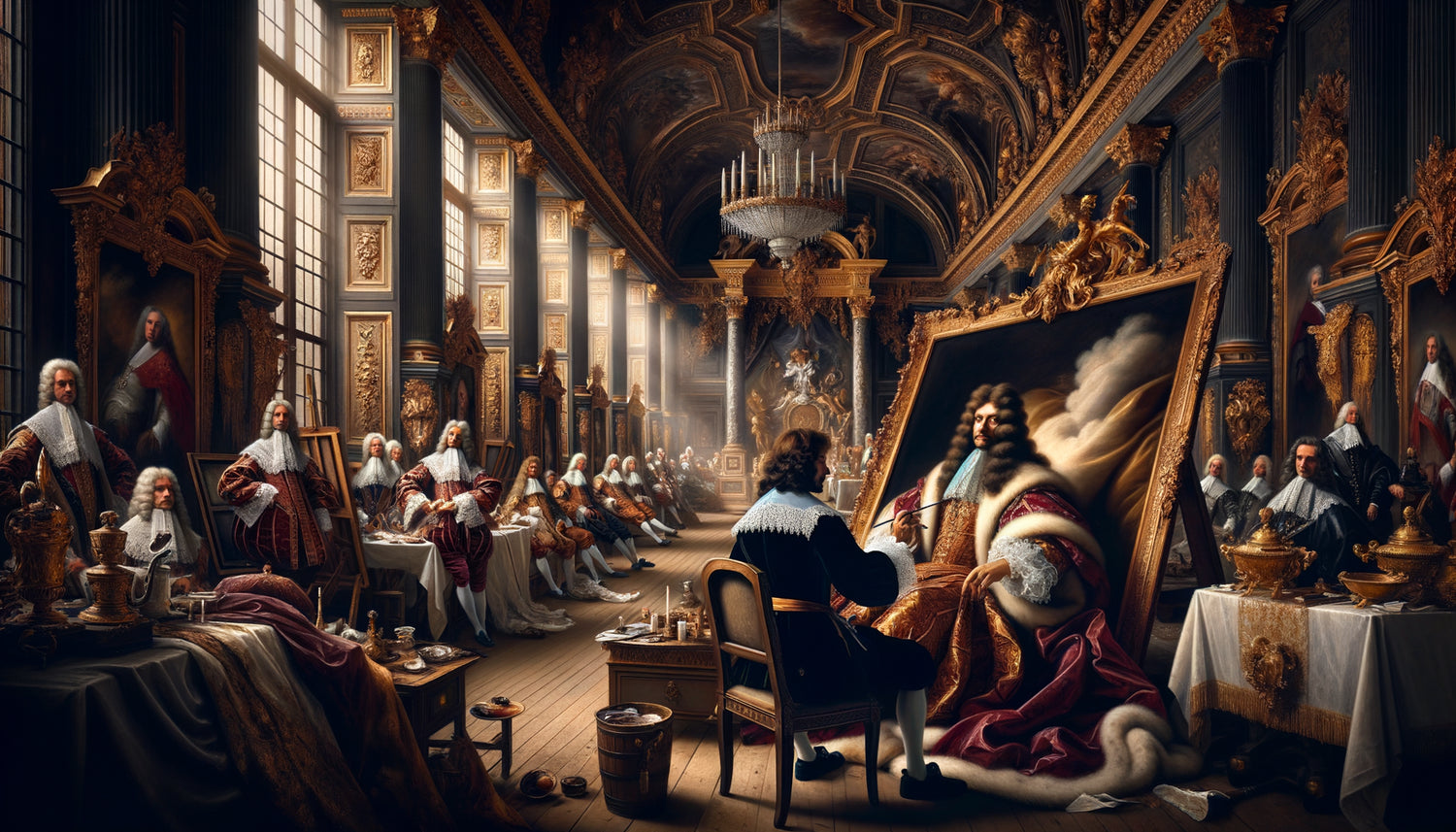
The primary function of court painters was to immortalize the royal figure in their most majestic and divine form. But this mission went far beyond simply recording physical features. These artists had to capture the very essence of monarchical power, transform a man into a symbol, a face into an icon.
Consider Diego Velázquez at the Spanish court or Charles Le Brun with Louis XIV. These court painters mastered the subtle art of idealization. Each portrait was carefully orchestrated: posture evoked natural authority, attributes of power (crown, scepter, ermine) recalled divine legitimacy, lighting created a quasi-supernatural aura.
This social function responded to a crucial political necessity. In Europe where most of the population was illiterate, image was the main vector of communication. A royal portrait hung in an audience hall, reproduced in engraving and distributed throughout the kingdom, was worth a thousand speeches. It reminded everyone who held power, from where they derived it, and why they should submit.
Diplomats of the Brush: When Art Seals Alliances
A little-known dimension of the social function of court painters lies in their diplomatic role. In the 17th century, before a prince married a foreign princess, before an alliance was forged between two crowns, portraits circulated.
Court painters were sent on missions to create a portrait of a future bride, capture the features of a potential ally, visually document the members of a distant royal family. These works traveled across Europe, preceding negotiations, sometimes influencing them considerably.
The Revealing Example of Rubens
Pierre Paul Rubens perfectly embodied this dual social function. As a court painter, he also served as a diplomatic emissary, negotiating peace treaties between Spain and England. His status as an artist opened all doors for him, granting him an apparent neutrality that facilitated the most delicate discussions. His palette served both diplomacy and aesthetics.
This social function transformed court painters into privileged observers of power, confidants of state secrets, witnesses to history unfolding. Their unique position, between art and politics, gave them access to the highest spheres while maintaining a creative distance.

Stagers of Royal Grandeur
The social function of court painters extended far beyond the individual portrait. They were the visual choreographers of royal ceremonies, the decorators of sumptuous festivals, the creators of ephemeral sets that transformed each court event into a political spectacle.
Charles Le Brun, first painter to Louis XIV, directed the Manufacture des Gobelins, overseeing the creation of tapestries, furniture, decorative objects which all told of the glory of the Sun King. Every visual element of the Palace of Versailles participated in the same project: to assert the absolute superiority of the French monarchy.
This dimension of their social function reveals a fundamental truth: in the 17th century, power first manifested itself visually. The splendor of palaces, the richness of costumes, the magnificence of decorations were not mere aesthetic whims but political tools. Court painters orchestrated this permanent staging.
Guardians of Dynastic Memory
Another crucial social function was to build and perpetuate the memory of dynasties. Court painters created historical series, galleries of portraits of ancestors, scenes glorifying military victories or the great achievements of the reign.
These works did not simply document history: they rewrote it, reinterpreted it, magnified it. A military battle became a resounding victory, a complex negotiation transformed into a diplomatic triumph, a mediocre sovereign appeared as an enlightened monarch.” [HTML] }”
This social function of memory-making served a specific political purpose: to anchor present legitimacy within a glorious continuity. By showcasing an unbroken lineage of powerful and wise rulers, court painters reinforced the idea that the current monarch naturally fit into this succession of greatness.

Between constraint and creativity: the paradox of court painters
The social function of court painters involved a constant tension between the demands of the patron and personal artistic expression. These artists had to satisfy the often strict expectations of their royal patrons while seeking to leave their mark on art history.
Some, like Velázquez, managed to transcend these constraints. His portraits of the Spanish Royal Family certainly captured the expected majesty, but also revealed a disturbing humanity, sometimes even a certain melancholy. Others, like minor portraitists, strictly adhered to conventions, producing stereotyped and impersonal images.
This duality profoundly defined their social function: they were simultaneously servants of power and independent creators, propagandists and artists, officials and geniuses. This ambiguous position conferred on them a unique status in the Ancien Régime society.
The lasting influence: when the 17th century illuminates our time
Understanding the social function of court painters in the 17th century helps us to decipher our own relationship with images and power. The mechanisms they perfected – construction of a public image, staging of authority, fabrication of collective memory – strangely resonate with our era of sophisticated political communication.
Official portraits of our contemporary leaders, carefully orchestrated photographs, media setups perpetuate, by other means, the visual strategies invented by these 17th-century artists. The social function has changed form, but the essence remains: controlling one's image is exercising power.
Let the history of art transform your interior
Discover our exclusive collection of paintings inspired by famous artists that bring the grandeur of old masters into your contemporary living space.
Conclusion : the invisible legacy of court painters
The social function of court painters in the 17th century reveals a timeless truth: art never exists in an apolitical vacuum. These artists were simultaneously creators, propagandists, diplomats, historians and stage directors. Their brush shaped more than just canvases: it built the visual reality of absolute power.
Today, when you contemplate a royal portrait from the 17th century, look beyond the masterful technique and formal beauty. You observe a sophisticated political tool, a coded message about the nature of power, a testament to the eternal importance of image in our societies.
This understanding transforms our gaze on ancient art and invites us to question the images that surround us today. What social function do they fulfill? What power do they serve? What memory do they build?