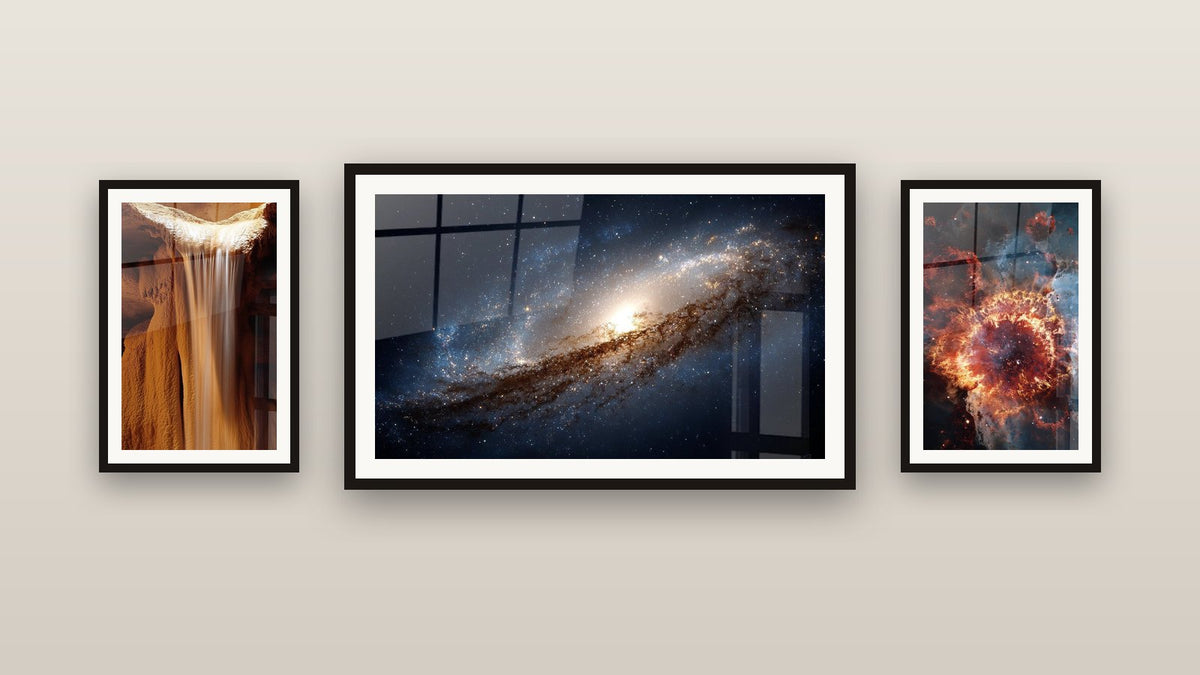
Create a stress-free space with a painting
11 October 2025 · 17 min read · by Walensky
After a tiring day, you return home hoping to finally relax in your living room.
But instead of that desired feeling of peace, your gaze falls on cold, impersonal walls that send the stress of the day back at you.
You may have tried scented candles, changed the lighting, or even rearranged your furniture, but nothing works: your interior fails to create that bubble of serenity you dream of.
This is perfectly normal, and it's not your fault. Most decor advice focuses on pure aesthetics, without considering the real psychological impact of visual elements on our daily well-being.
By the end of this article, you will know exactly how to transform any corner of your home into a true anti-stress sanctuary thanks to the therapeutic power of a carefully chosen and perfectly integrated painting.
Why doesn't your home calm you down as much as it should?
Wall art has a scientifically proven power on our nervous system, but most people completely ignore it. Every day you spend in a visually neutral environment is a missed opportunity to naturally reduce your cortisol and activate your well-being hormones.
Conversation with a decor expert
The golden rule of visual well-being: A painting becomes anti-stress when it resonates with your deep emotions, not when it follows conventional decor codes. Observable result in less than 48h: you will be surprised to find yourself smiling when you look at it.

Our selection
Futuristic Lunar Landscape Painting - Mysterious Horizon - Moon edition
233.90€
Discover this paintingFinally understand why you can't find peace at home
You feel that dull agitation upon returning home, that difficulty in "unwinding" even in your sofa, and sometimes even a slight anxiety that lingers in the evening?
This isn't a personality problem or a difficulty in managing stress. It's simply that your visual environment is working against you rather than supporting you.
Imagine your brain as a musician trying to play a soothing melody in a room where constant visual dissonances resonate : bare walls, cold colors, lack of harmonious focal points.
First hidden cause: the absence of a "visual anchor point"
Contrary to what one might think, it's not clutter that stresses people out the most, but the lack of visual hierarchy. Your eye constantly searches for a place to rest and doesn't find it.
It's like being in a conversation where no one speaks: the silence becomes more stressful than the noise. Your brain spends a tremendous amount of energy scanning an environment that offers it no visual respite.
As a result: you feel restless without understanding why, and your home becomes a source of micro-stress instead of being your refuge.
🧪 Instant test: Sit in your living room and look straight ahead for 30 seconds. If your gaze "wanders" without knowing where to fix, you have just discovered why you don't relax at home.
Second hidden cause: "chromatic fatigue"
Many people think that neutral colors automatically create a sense of calm, but the opposite is exactly what happens. Your brain needs gentle stimulation to regenerate, not sensory emptiness.
It's like feeding your body only with water: visual understimulation is as exhausting as overstimulation.
Your nervous system remains in a permanent "search mode", which maintains a background level of stress that is imperceptible but constant.
Third hidden cause: the "impersonal hotel" effect
Your primitive brain constantly evaluates whether a place is "safe" for you. An environment without visual personal markers activates your survival alerts at a low level.
Observe your level of relaxation in a hotel versus at your parents' house: visual familiarity directly influences your ability to let go.
Without elements that "really speak" to you, your home remains subconsciously perceived as a neutral territory rather than a protective cocoon.
🎯 The 3 alarm signals of your environment:
- You avoid looking at your walls: Sign that your brain has "given up" searching for positive stimulation - like closing your eyes in a room that is too bright
- You systematically turn on the TV when you get home: Automatic compensation for the lack of visual richness - your brain is craving color and movement
- You feel more relaxed elsewhere than at home: Paradoxical revelation that your cocoon is not playing its role as an emotional refuge
The trigger: the missing "emotional dialogue"
What really makes the difference is your environment's ability to "speak" positively to you. Like a friend who greets you with a smile, a painting that resonates with you creates a domino effect of well-being : muscle decompression, deeper breathing, more positive thoughts. You will easily recognize it: it's the painting that makes you instinctively smile even after you have seen it a hundred times.
The rule of emotional recognition: If a decorative element does not provoke a micro-positive emotion within 3 seconds of looking at it, it is neutral and therefore ineffective for your well-being. Instant test: observe your facial expression in the reflection of your phone.
| ❌ "Neutral" decoration | ✅ Therapeutic space | 💡 Mechanism | 🎯 Perceived benefit |
|---|---|---|---|
| White walls for safety | Controlled, colorful focal point | Gentle stimulation of the visual cortex | Immediate feeling of "home" |
| Fear of "doing decor wrong" | Choice guided by emotion | Activation of the reward system | Authentic daily pleasure |
| Waiting for magical inspiration | Progressive, structured method | Building confidence step by step | Personal mastery and pride |
| Focus on the opinion of others | Consistency with one's personality | Deep identity alignment | Authentic and lasting relaxation |
— Also to discover


The 3-Step Method to Create Your Anti-Stress Sanctuary
Rest assured: transforming your space into a haven of peace requires neither artistic talent nor a pharaonic budget. It's a progressive method that works like cooking: following the recipe in order guarantees the result. In a maximum of 3 weeks, you will have created an environment that actively works for your relaxation, like a silent therapist always present.
🎯 Overview of your transformation: Step 1 = Laying the emotional foundations (defining your relaxation profile), Step 2 = Choosing your "visual medicine" (selecting the perfect painting), Step 3 = Optimizing the therapeutic effect (placement and synergy). Each step brings you closer to immediate and measurable well-being.
Step 1: Create your "emotional map"
Starting by understanding your relaxation profile is like taking measurements before tailoring a suit : essential for a perfectly adjusted result. This step will already give you a liberating clarity on your true needs visually, different from those that may have been imposed on you.
What you need for this phase:
- A moment of calm (15 minutes): Not necessarily complete silence, but a receptive state of mind where you can connect with your real sensations. Avoid end-of-day periods that are too busy when your emotional discernment is hampered by fatigue.
- Your smartphone or a notebook: To note your spontaneous discoveries without filtering them - the first impression is always the most accurate. Writing anchors your intuitions and prevents them from being "corrected" by your rational mind.
- Access to some inspiring images: Pinterest, decor magazines, or even Google Images - your visceral reaction to different styles reveals your well-being DNA better than any aesthetic theory.
Let's move on to the concrete practice now:
How to discover your "relaxation signature":
Emotional scanner: Browse 20-30 images of paintings or atmospheres without thinking, noting your first bodily reaction (tension releasing, spontaneous smile, desire to breathe more deeply). Your body knows before your head what makes you feel good.
⏱️ Time: 10 minutes | ✅ Success when: You have identified 3-4 visuals that trigger immediate relaxation | ⚠️ Attention: Don't try to understand "why" you like it - rational analysis stifles emotional intuition
Projection test: For each visual that attracts you, imagine yourself in your living room looking at it after a difficult day. Which one instantly makes you feel relieved? That's your therapeutic compatibility indicator.
⏱️ Time: 5 minutes | ✅ Success when: You physically feel the difference between the options | ⚠️ Attention: Beware of "reasonable" choices - they are often less effective than inexplicable crushes
✨ Validation of the step: You should have identified your "family" of soothing colors and atmospheres (rather natural? graphic? soft? contrasting?). If in doubt, redo the test in a different state of mind. Congratulations, you now know your "instruction manual" for visual well-being!
Step 2: Select your "visual medicine"
Now that you know your profile, you can choose with confidence without second-guessing. This step is particularly rewarding because each tested painting immediately reveals whether it has the sought-after therapeutic potential. The snowball effect begins: you develop your "eye" and your confidence in your aesthetic choices.
Your priority selection criteria:
- Format adapted to your space: A painting that is too small disappears and has no therapeutic impact; too large, it can be oppressive. A practical rule: it should occupy between 1/3 and 2/3 of the width of the wall where you plan to install it to create the optimal visual balance.
- High-definition print quality: Your brain subconsciously detects blurry details or faded colors, which creates a stressful cognitive dissonance. Opt for premium supports (canvas, Dibond, plexi) that faithfully reproduce nuances - it's an investment in your daily well-being.
- Consistency with your emotional mapping: The painting should resonate with the discoveries of step 1 - even if it surprises you compared to your usual tastes. Trust your visceral reaction rather than decor conventions.
Infailible selection process:
Emotional impact test: When facing each option, observe your facial expression in the reflection of your screen after 5 seconds of contemplation. Does your face relax naturally? This is the most reliable indicator of the anti-stress effect.
⏱️ Time: 2 minutes per option | ✅ Successful when: Your smile appears effortlessly | ⚠️ Attention: Do not confuse "I like it" and "it really relaxes me" - the nuance is crucial
Integration simulation: Visualize the painting in your daily space at different times of the day (busy morning, tired return, relaxing evening). Does it remain pleasant in all contexts? A good therapeutic choice works even when you are stressed.
⏱️ Time: 3 minutes | ✅ Successful when: It retains its charm in your worst fatigue scenarios | ⚠️ Attention: Avoid visuals that you only like during the euphoria of shopping - test them also in "difficult day" mode
🎨 Choice confirmation: Your ideal painting should provoke a slight impatience to see it at your home. If you are still hesitating between two options, choose the one that makes you smile unconsciously. Emotional connection takes precedence over decorative logic!
Step 3: Maximize therapeutic effect
You now hold your transformative element, but its power depends entirely on its integration into your space. This is the step where you move from "I have a pretty painting" to "I have created an environment that heals me". The final result: a space where your stress melts away naturally, where your guests spontaneously comment on the soothing atmosphere, and which you are secretly proud of.
Strategic placement for maximum impact:
Relaxation triangle rule: Position the painting in your natural field of vision from your favorite resting position (sofa, armchair, bed). It should be visible without effort, at eye level when you are sitting. Visual effort cancels the relaxing effect.
⏱️ Time: 15 minutes of adjustments | ✅ Successful when: You naturally see it in a relaxed position | ⚠️ Attention: Too high strains the neck, too low forces you to lower your gaze - find the "Goldilocks" height
Enhancing lighting: Check that your painting receives soft and stable light at the times when you need it most (end of day). Indirect lighting avoids reflections while revealing colors. The magic happens in a warm dimness.
⏱️ Time: 10 minutes of testing | ✅ Successful when: The colors remain vibrant in dim light | ⚠️ Attention: A beautiful painting in full daylight can become invisible in the evening without supplemental lighting
Creating the setting: Clear the space around the wall painting of all competing elements (other frames, colored objects, visual clutter). It must reign supreme on its territory to maximize its therapeutic impact. The fewer distractions there are, the better it can do its job.
⏱️ Time: 20 minutes | ✅ Successful when: Your gaze naturally goes to it | ⚠️ Attention: Do not completely clear the space - just keep the essentials that dialogue harmoniously
🌟 Final effectiveness test: Sit in your arranged space and close your eyes for 30 seconds. When you open them, your wall painting should be the first thing you notice, and immediately trigger a micro-relaxation. If this is the case, congratulations: you have just created your personal therapeutic bubble!
The rule of well-being progression: The anti-stress effect intensifies during the first 15 days then stabilizes. You know it’s working when you no longer consciously “see” the wall painting but consistently feel its benefit. Patience and observation: your environment is now working for you.
You now master the fundamentals of domestic art therapy. Here are the optimization secrets that few people know, to maximize the long-term effect and subtly impress your surroundings.
💡 Expert-level tip: Subtly change the lighting angle of your wall painting according to your mood or the season. Warmer light stimulates autumnal cocooning, cooler light boosts springtime energy. This micro-personalization reinforces the therapeutic effect because your brain perceives an environment that "adapts" to you.
Frequently asked question from our readers
"Does it really work if I know nothing about art?"
It’s exactly because you know nothing about art that it will work perfectly! Your "naive" eye is not polluted by artistic codes and goes straight to the essential: what makes you feel good. Great collectors will tell you: their first "love at first sight" purchase often remains their favorite, because it was guided by pure emotion. Start small with a single wall painting in your main relaxation space. The daily well-being experience will quickly give you confidence to refine your choices. Your instinct for well-being is worth all the world's art history courses.
🎯 Reassuring immediate action: First test with a temporary reproduction (print on taped paper) for a week. You will see the effect without commitment, and this will give you the confidence to invest in the definitive version.
— In the same spirit


Our eye-catching selection
Waterfall Painting No.1 - Landscape Edition
233.90€
Discover this painting →The 5 mistakes to avoid at all costs (but it's normal to make them)
These mistakes are so common that even experienced decorators make them. Preventing you now avoids months of frustration and re-purchases.
- 🎨 Choosing with your head rather than your heart: You are tempted to take the wall painting that "goes well" with your furniture rather than the one that moves you. Result: a beautiful decorative object without a therapeutic effect. Solution: Reverse the logic - adapt the small elements to the wall painting that makes you feel good, not the other way around. It’s very common at first!
- 📏 Underestimating the necessary size: Out of fear of exaggerating, you opt for a format that is too small and goes unnoticed. A painting should have a physical presence sufficient to create the desired impact. Solution: Trace the dimensions on the wall with masking tape before ordering. You will be surprised to see that you need more space than you thought.
- 💡 Neglecting ambient lighting: Your superb painting becomes invisible in the evening because you only thought about daylight. A painting that is not lit in the evening cannot play its anti-stress role at the time when you need it most. Solution: When purchasing, plan for a soft light source (spotlight, table lamp) to highlight it.
- 🏠 Placing it in the "beautiful" place rather than the "good" place: You hang the painting facing the entrance to impress visitors, but you never see it from your relaxation area. Solution: ALWAYS prioritize your daily comfort - your well-being comes before the "wow" effect on guests.
- ⏰ Abandoning too quickly if the effect is not immediate: Your brain needs 7 to 15 days to integrate a new visual element into its mapping of "home". Solution: Give yourself at least 2 weeks before making a definitive judgment. Note your feelings day after day - improvement is often gradual and subtle.
🛡️ Your anti-error verification system: Each week, ask yourself these 4 questions: "Does my painting still make me smile when I discover it?", "Do I naturally see it in my relaxation position?", "Do my loved ones comment on the soothing atmosphere of the room?", "Have I noticed that I relax faster than before?" If one answer is no, adjustment needed!
— Other selected pieces


Your most frequently asked questions about anti-stress art
Expect to spend between €50 and €200 for a therapeutic quality painting, depending on the format and support chosen. The effect is felt from the first few days and is optimized over 2-3 weeks. To maximize your wellness investment, choose a generous size rather than 3 small paintings - the unit impact is stronger. Concrete example: "Claire invested €120 in a 70x50cm painting and noticed that she fell asleep more easily from the first week."
With the right tools, it's easier than assembling an IKEA piece of furniture! Most of our paintings include the appropriate fixing system. For fragile walls, use suitable plugs or drill-free systems (rails, high-resistance adhesives). Reassuring tip: Start by tracing the location in gray pencil and have a loved one validate it before drilling. Or ask a handy friend - it takes a specialist about 15 minutes.
Therapeutic art often transcends classic aesthetic tastes. Start by identifying your shared "relaxation emotions" together (nature, travel, serenity...) rather than your preferred styles. First test in your personal space (office, bedroom) to demonstrate the effect, then propose extension to common areas. Often, the wellness effect felt by one naturally convinces the other - even if it wasn't their first aesthetic choice.
An effective anti-stress painting works like a favorite melody: you don't get tired of it because it makes you feel good, not just because it's beautiful. The therapeutic effect deepens over time - you'll discover details you missed, depending on your mood and the light. Reliable indicator: If after 6 months you still smile when you look at it, it was perfectly chosen. If it becomes invisible, it was only aesthetic, not therapeutic.
Quite the opposite! A small space actually benefits even more from a well-chosen focal point because it structures and visually expands the room. The trick: opt for colors that "breathe" (blues, greens, natural tones) rather than colors that "advance" (bright reds, oranges). Practical rule: One impactful painting is better than several small, scattered elements that fragment the space. Your small home will appear larger and more harmonious.
Your transformation begins now
In 3 weeks, imagine coming home after a difficult day. As soon as your eyes fall on your painting, you feel your shoulders relax, your breathing deepens, a micro-smile stretches your lips. Your home has become that soothing cocoon you dreamed of, a refuge that truly regenerates you instead of sending you your stress. Your loved ones notice the calming atmosphere without knowing exactly why, and you are secretly proud to have created this harmony.
More than just a decor change, you have developed your confidence in your aesthetic choices and your ability to create well-being. These skills radiate into other areas: you more easily dare to personalize your office, choose your clothes according to your emotions, trust your instinct in your daily decisions.
The hardest part was understanding the mechanism - now that you know, your first step is to revisit your space with a fresh eye. Visualize the ideal place for your future painting, imagine yourself contemplating it during your favorite moment of relaxation. This vision becomes reality as soon as you take action.
✨ Your home awaits you: Every day spent in an environment that doesn't emotionally nourish you is a missed opportunity for well-being. You deserve a space that takes care of you - and you now have all the keys to create it.
Also read: 📖 Read more articles on home art therapy
Explore our collections