Imagine yourself facing a canvas where dead fish seem more alive than in the ocean. That's exactly what Édouard Manet achieves with his still lifes featuring fish, true masterpieces that shake up 19th-century art and usher in modern painting.
When Manet transforms his fish into an avant-garde revolution
Manet doesn't paint fish by chance. For this French master, the still life represents the touchstone of the painter. He even declares that he wants to become "the Saint Francis of the still life" - an ambition that makes his contemporaries smile but reveals a prophetic vision of 19th-century art.
Unlike painters of his time obsessed with grand historical subjects, Manet finds in his fish total freedom of expression. His still lifes featuring fish represent nearly one-fifth of his production (Source: Musée d'Orsay), a remarkable proportion that testifies to his revolutionary commitment to this artistic avant-garde.
Émile Zola observes it justly in 1867: even the most virulent detractors of Manet recognize that he "excels at painting inanimate objects." This forced recognition reveals the undeniable impact of his pictorial innovation on his contemporaries.
The revolutionary technique that changes everything in modern painting
Manet literally revolutionizes the way of painting with his fish. He abandons the traditional method of his master Thomas Couture - those tedious successive layers on a dark background - to invent the alla prima technique, a true pictorial innovation.
This approach consists of applying opaque paint directly onto a light background, allowing a work to be completed in a single session. A revolution! This method, subsequently adopted by all the Impressionists, becomes the standard of modern painting and heralds the Impressionist revolution.
His quick and visible brushstrokes shock an audience accustomed to the impeccable finishes of history painters. But that's exactly what this French master is looking for: this brutal spontaneity that makes his fish vibrate with a paradoxical life, characteristic of the nascent artistic avant-garde.
"Eel and red mullet": the masterpiece that revolutionizes still lifes
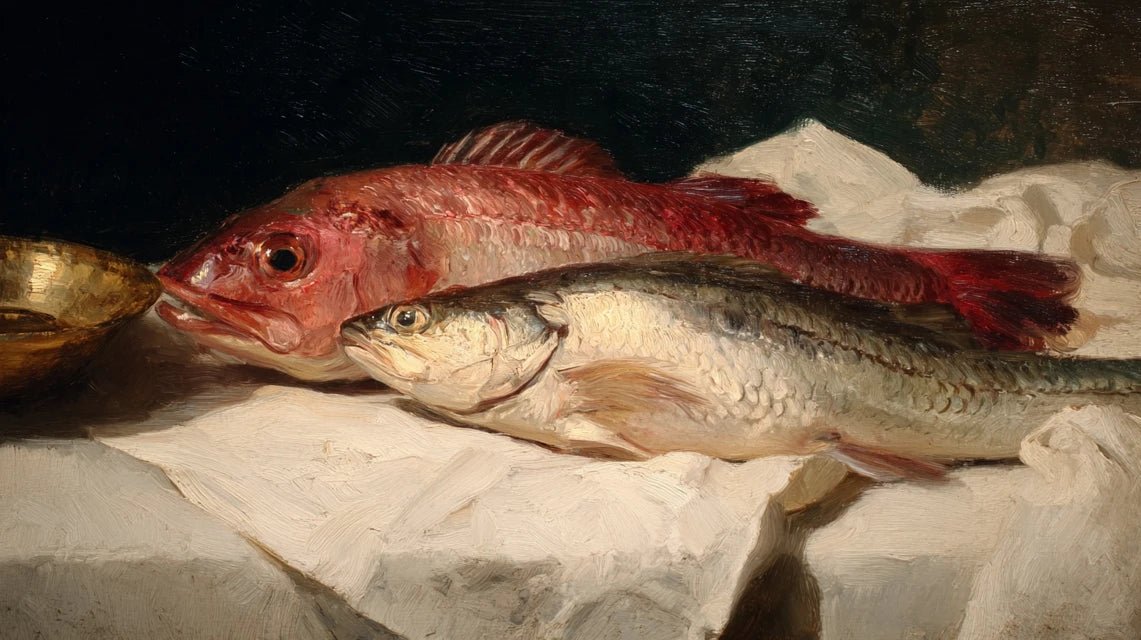
In 1864, Manet painted "Eel and red mullet" (38 x 46.5 cm, Source: Musée d'Orsay), a work that crystallizes his revolutionary genius in 19th-century art. On this modest canvas is played the future of modern painting.
The composition strikes with its striking simplicity: an eel with a dark, serpentine body against a red mullet with flamboyant scales. This contrast on the pristine white linen creates a hypnotic visual tension, a signature of this nascent Impressionist revolution.
Manet captures textures with astonishing precision thanks to his innovative pictorial approach. The smooth skin of the eel dialogues with the scales of the red mullet in an economy of means that astounds his contemporaries. No artifice, no trompe-l'oeil: just the truth of painting.
To discover how contemporary art perpetuates this revolutionary tradition of animal representation, explore this collection of animal paintings
The Revolutionary Equality of Subjects in Manet's Still Lifes
With his still lifes with fish, Manet blows up the centuries-old hierarchy of pictorial genres of 19th century art. No more time when a fish was worth less than a mythological hero in this artistic avant-garde!
By refusing "any hierarchy within the painting itself", this French master grants his fish a dignity equal to the most noble subjects. This conceptual revolution overturns four centuries of academic traditions and foreshadows the Impressionist revolution.
His fish become the true protagonists, no longer simple decorative elements. This promotion of everyday life to major art announces all the avant-gardes of modern painting of the 20th century.
The Eternal Legacy of Manet's Fish on Modern Painting
The influence of Manet's still lifes with fish crosses the centuries. As early as the 1890s, critics recognized in them "the advent of a painting solely concerned with itself", freed from the "tyranny of the subject" and characteristic of this major innovative pictorial approach.
This emancipation opens wide the doors to modern art. Manet's fish foreshadow abstraction in the 20th century by proving that art can exist for itself, establishing the foundations of modern painting.
The Art Institute of Chicago carefully preserves his "Fish" (1864, 73.5 x 92.4 cm, Source: Art Institute of Chicago) as a testament to this revolution. These works by the French master definitively establish the foundations of artistic modernity.
- Alla prima technique adopted by all Impressionists
- Definitive abolition of the hierarchy of artistic genres
- Direct influence on Cézanne, Monet and the School of Paris
- Foreshadowing of modern pictorial autonomy
FAQ: Manet and Still Lifes with Fish
Q: Why did Manet favor still lifes with fish?
R: Manet considered the still life as "the touchstone of the painter". The fish offered him total freedom of technical experimentation, far from the constraints of traditional historical subjects.
Q : Quelle est la technique révolutionnaire de Manet dans ses poissons ?
R : Manet invente la technique "alla prima" : peinture directe en une seule séance sur fond clair, abandonnant les couches successives traditionnelles. Cette méthode sera adoptée par tous les impressionnistes.
Q : En quoi "Anguille et rouget" révolutionne-t-il l'art ?
R : Cette œuvre de 1864 abolit la hiérarchie des genres en donnant aux poissons une dignité égale aux sujets nobles, préfigurant ainsi l'art moderne et l'autonomie picturale.