

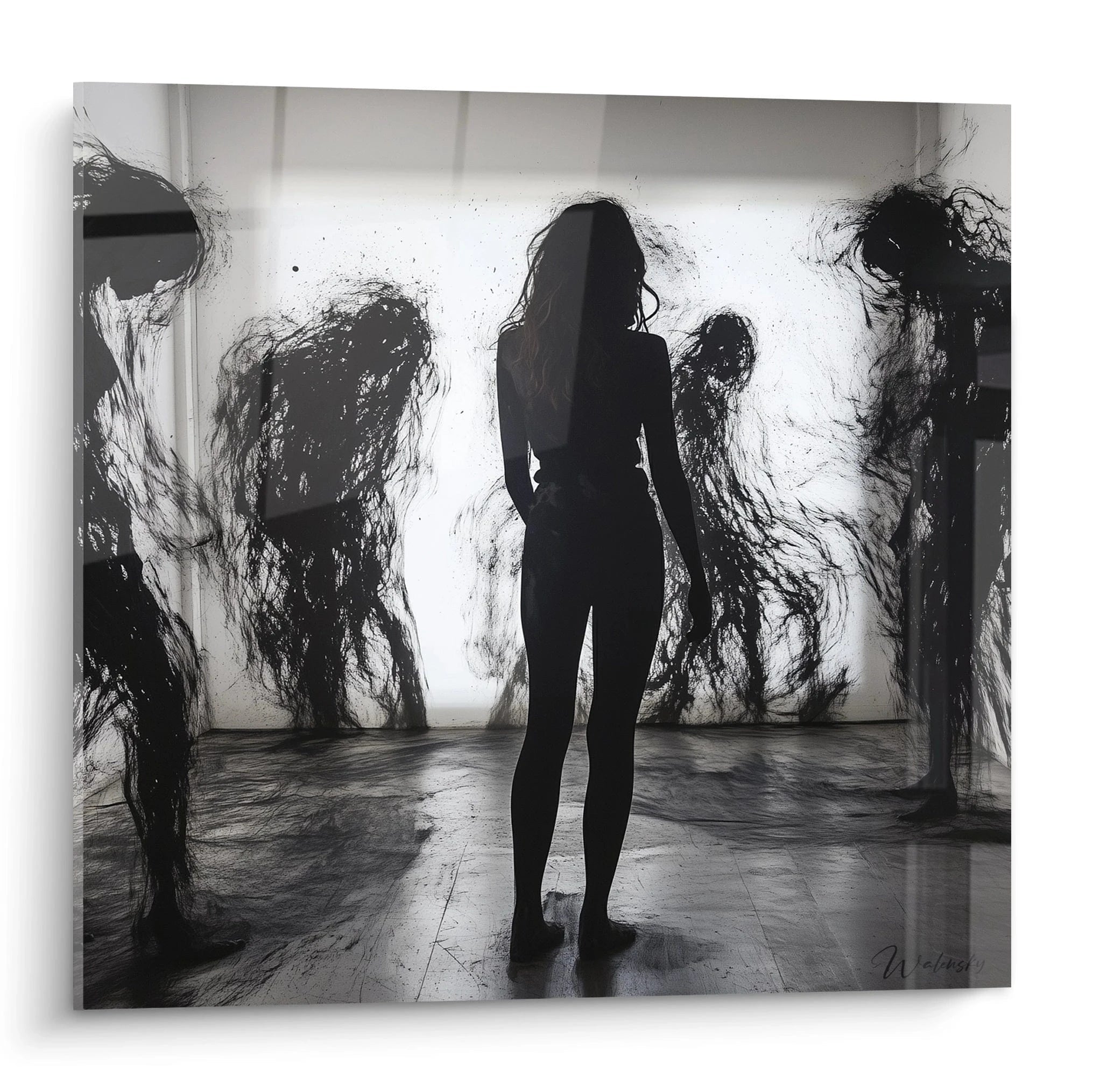






I have spent fifteen years watching collectors pause before abstract canvases. Some are magnetically drawn to generous impasto, those ridges of paint you can sense even from a distance. Others prefer smooth surfaces like mirrors, where color seems to float without material anchor. This difference is not merely technical: it completely changes the emotion an abstract work conveys in your interior.
Here is what visible brushwork and smooth surface bring to abstract expressiveness : physical presence versus contemplative depth, gestural energy versus meditative serenity, tactile vibration versus refined simplicity. Two opposing visual languages for radically different atmospheres.
Many of my clients confess their frustration: they fall in love with an abstract canvas online, then are disappointed on receiving it. The work seems flat and characterless to them, or on the contrary too busy for their zen space. The problem? They did not anticipate the impact of pictorial matter on the room's atmosphere.
Rest assured: understanding this difference between visible brushwork and smooth surface requires no artistic training. It is a matter of feeling, of harmony with your universe. I will reveal how these two approaches transform abstract expressiveness and, above all, how to choose the one that will enhance your decor.
Visible brushwork: when matter tells the story of the gesture
Visible brushwork in abstract art is that trace of the brush, the knife, sometimes even the artist's fingers, that remains perceptible on the canvas. We speak of impasto when paint is applied in thick layers, creating a true relief. This technique completely transforms abstract expressiveness by adding a sculptural dimension.
Imagine a canvas where each brushstroke casts a shadow depending on the angle of the light. In the morning, your abstract painting reveals golden nuances in its paint ridges. In the evening, under side lighting, the hollows deepen into mysterious shadows. Visible brushwork captures natural light and literally makes the work come alive throughout the day.
This material approach to abstract expressiveness carries a raw, almost wild energy. One feels the speed of the gesture, the creative urgency, sometimes even a form of controlled violence. Artists of abstract expressionism such as de Kooning or Soulages masterfully exploited this power of matter to convey intense emotions.
The sensory impact in your interior
A canvas with visible brushwork immediately transforms a space. In a contemporary living room with clean lines, it brings the organic contrast that warms the atmosphere. Visitors are irresistibly drawn: they want to come closer, observe these ridges, perhaps even pass a finger gently nearby (without touching, of course!).
This texture creates a powerful physical presence. Where a smooth canvas blends into the decor, the impasto work asserts itself as a sculptural element. It dialogues with raw materials: aged wood, natural stone, industrial metal. It is the ideal choice for injecting character into a minimalist space that would lack soul.
Smooth surface: the contemplative elegance of pure abstraction
At the opposite end, the smooth surface erases every trace of the creative process. The paint is applied in thin layers, often with a roller or through successive glazes. No relief, no roughness: just color in its absolute purity. This technique transforms abstract expressiveness into a meditative experience.
Pioneers such as Mark Rothko or Barnett Newman demonstrated that a smooth surface could generate an emotion as intense as a generous impasto. But differently. Where visible brushwork captures you through its tactile energy, the smooth surface draws you into a fascinating optical depth.
This approach creates what I call a chromatic vibration. Without relief to distract the eye, you perceive the subtle variations of hue and the imperceptible transitions between colored zones. Your gaze literally plunges into the canvas, as if the color were not laid on the surface but emanated from within the support itself.
A refinement suited to sophisticated spaces
The smooth surface naturally harmonizes with high-end contemporary interiors. It dialogues with noble materials: polished marble, glass, glossy lacquer. In a bedroom, it encourages visual calm. In an office, it stimulates concentration without disrupting attention.
This technique also offers a practical advantage often overlooked: maintenance. A smooth canvas accumulates less dust than a textured surface and is easier to clean. For collectors concerned with preserving their investments, this is an important criterion.

How these two approaches transform abstract expressiveness
The difference between visible brushwork and smooth surface is not limited to an aesthetic question. It fundamentally changes the way the work communicates its emotional message.
With visible brushwork, abstract expressiveness belongs to the register of action, of frozen movement. You almost feel the artist's physical effort, the intensity of the creative moment. It is a painting that speaks of process, transformation, deployed energy. It suits dynamic personalities and lovers of raw authenticity.
The smooth surface, by contrast, directs abstract expressiveness toward pure contemplation. The absence of material texture leaves all the room to the emotional resonance of colors and forms. It is a painting that speaks of essence, of the absolute, sometimes of spirituality. It suits introspective temperaments and lovers of discreet refinement.
The importance of architectural context
I regularly work with clients who have invested in a magnificent abstract canvas... completely unsuited to their space. A work with generous impasto in a loft with cathedral ceilings? Perfect. The same piece in an apartment with low ceilings? Overwhelming.
The visible brushwork requires distance to be fully appreciated. Allow at least 2.5 meters of viewing distance. It works wonderfully in spacious areas: entrance hall, main living room wall, above a king-size bed.
Conversely, the smooth surface tolerates closer proximity better. It reveals its subtlety even at one meter. It is the ally of small urban spaces, corridors, and home offices where you spend a lot of time close to the walls.
Toward a contemporary hybridization of techniques
Today's artists no longer confine themselves to this binary opposition. Many create works that combine smooth areas and textured passages, playing on the contrast between these two registers of abstract expressiveness.
This hybrid approach offers the best of both worlds: the visual dynamism of visible brushwork draws the eye to specific areas, while smooth surfaces create breathing spaces, contemplative pauses. The gaze thus travels between tension and calm, matter and immateriality.
Some creators even use mixed techniques: smooth acrylic in the background, thick oil for accents, resin to unify the whole. These experiments push traditional boundaries and considerably enrich the vocabulary of contemporary abstract expressiveness.

Choosing according to your decorative project and your sensibility
Beyond technical considerations, the choice between visible brushwork and smooth surface reveals your intimate relationship with art. Ask yourself these questions:
Are you drawn to the authenticity of the making? If you love raw materials, furniture with a visible history, artisanal objects, visible brushwork will resonate naturally with your sensibility. It extends this aesthetic of the trace, of the preserved gesture.
Do you seek simplicity and the essential? If your décor favors clean lines, open spaces, and assumed minimalism, a smooth surface will blend harmoniously. It does not disturb the visual serenity you have built.
What emotion do you want to evoke? Visible brushwork energizes, stimulates, and captivates. A smooth surface soothes, invites meditation, and fosters concentration. Consider the function of the room: a space for social life versus a personal sanctuary.
Ready to find the work that matches your sensibility?
Discover our exclusive collection of abstract paintings that skillfully combines visible brushwork and smooth surface for an expressiveness perfectly suited to your interior.
The transformed experience of your everyday life
Imagine tomorrow morning, coffee in hand, discovering how the raking light of sunrise makes the shadows dance over the relief of your abstract canvas. Or perhaps you prefer that evening moment when, in the half-light, the smooth color fields seem to radiate their own light, creating that meditative atmosphere that helps you unwind.
The difference between visible brushwork and smooth surface in abstract expressiveness is not just a matter for specialists. It is an invitation to know yourself better, to identify what moves you deeply. Abstract art, far from being hermetic, then becomes a mirror of your sensibility, a natural extension of your world.
Start simply: visit a gallery, observe your instinctive reaction to different textures. Does your hand instinctively reach toward the relief? Does your gaze get lost in the smooth surfaces? Your body already knows what your mind is discovering. Trust it to choose the work that will transform your space into a truly personal place.


