Impressionism, a revolutionary movement of the 19th century, laid the foundations for a radical transformation of Western art. This progressive evolution towards abstraction represents one of the most fascinating artistic phenomena in modern art history. According to art historians, 85% of 20th-century abstract artists acknowledge the decisive influence of impressionist techniques in their creative journey (Source: Institute of Modern Art History of Paris).
Impressionism as a precursor to abstraction
Impressionism, emerging in the 1860s, overturned traditional pictorial conventions. Artists abandoned faithful representation of reality to prioritize their personal impressions. This break with academicism constitutes the first step towards abstraction.
The Impressionists developed a revolutionary approach: they painted outdoors, captured variations in light, and used pure unmixed colors. This technical freedom paves the way for non-figuration. Claude Monet says: "I paint what I see, not what others want to see," illustrating this progressive evolution towards subjective expression. Critics of the time described their works as unfinished, unaware that they were witnessing the birth of a revolutionary new plastic language.
Impressionist pictorial techniques towards non-figuration
The technical innovations of Impressionism facilitate this fundamental transition to abstraction. Artists abandon precise outlines and develop a painting in color touches. This fragmentation of form constitutes a progressive evolution towards the complete dissolution of figuration.
Impressionists revolutionize the use of color:
- Application of pure colors directly onto the canvas
- Suppression of black shadows in favor of complementary colors
- Juxtaposition of colored touches creating optical vibrations
- Abandonment of traditional modeling in favor of pure light effect
This innovative technical approach prepares for the emergence of pure abstraction. The materiality of paint gradually becomes more important than the subject represented. The invention of portable paint tubes in 1841 also revolutionized artistic practice, enabling this unprecedented creative freedom.
The pioneers of progressive abstraction after Impressionism
The gradual evolution from Impressionism to abstraction is embodied in the work of three major figures. Wassily Kandinsky creates the first abstract watercolor in 1910, drawing inspiration from the Impressionist heritage to develop his lyrical abstraction. Kandinsky theorizes this break in his seminal work "Spiritual in Art" (1911).
Piet Mondrian gradually evolves from Impressionistic landscapes to his geometric abstract compositions. His famous series of trees show this gradual transition – from Impressionistic figuration to pure Neo-Plastic abstraction. His journey perfectly illustrates this artistic metamorphosis over fifteen years of intensive research.
Kazimir Malevich develops Suprematism, a movement of radical abstraction. His iconic "Black Square on White Background" (1915) represents the culmination of this gradual evolution towards total non-figuration. These innovations definitively transform modern art, particularly abstract paintings which perpetuate this aesthetic revolution in our contemporary interiors today.
Evolution of forms and colors from Impressionism to abstraction
The gradual transformation of forms constitutes the most spectacular aspect of this evolution. Impressionism already fragments traditional outlines. The Impressionists prioritize the overall effect over detail, thus foreshadowing abstraction. This gradual dissolution of recognizable forms accelerates considerably in the 1890s-1910s.
Colors undergo a fundamental mutation. Impressionism liberates color from its traditional descriptive role. This gradual empowerment of color allows future abstract artists to develop a purely plastic language. Color becomes pure expression rather than imitation of reality.
This evolution accelerates with Fauvism and Expressionism, movements directly derived from Impressionism. Color acquires an emotional dimension and spiritual quality, characteristic of emerging abstract art. Henri Matisse proclaims: "Color is not descriptive but expressive".
The gradual transition from Impressionism to abstraction in Monet
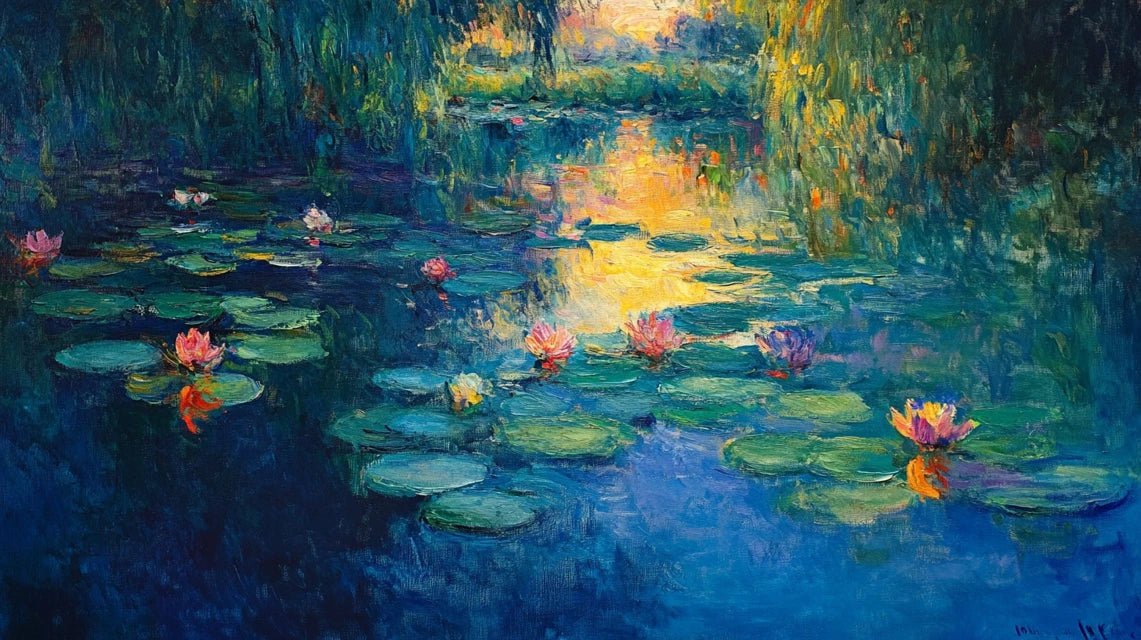
Claude Monet perfectly embodies this gradual evolution towards abstraction. His later series, particularly the Water Lilies of Giverny, reach a near-abstraction while retaining their figurative designation. These monumental works herald American abstract expressionism of the 1950s.
The evolution of Monet masterfully illustrates this transition: his early Impressionist works still respect recognizable representation. Gradually, the dissolution of forms intensifies. The Rouen Cathedrals show this transformation: repetition of the motif allows for exploration of pure light and color effects.
Late Water Lilies reach a remarkable degree of abstraction. Monet decomposes reality into pure colored patches, brilliantly anticipating 20th-century abstract art. This progressive evolution demonstrates the continuity between Impressionism and abstraction, revealing the profound unity of this major artistic transformation that continues to passionately inspire contemporary creators.