









Minimalist Tree of Life Wall Art
The Tree Painting of Minimalist Life embodies the perfect meeting between ancestral symbolism and contemporary aesthetics. This collection celebrates the essence of this universal emblem through refined compositions where every line counts. Our minimalist tree of life art creations transform this millennial symbol into modern and timeless works. Perfect for enhancing your interior, these tree of life decorative paintings bring serenity and harmony to your living spaces with refinement.
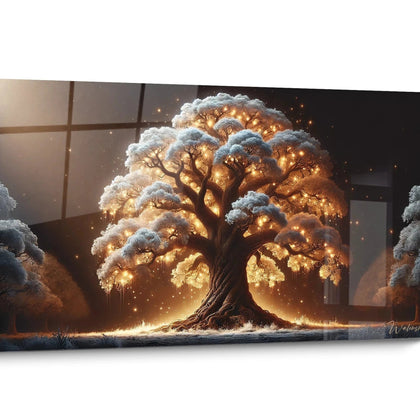
 Majestic Tree with Golden and Beige Tones on Luminous Background - Golden Serenity - Tree of Life Edition273,90 €
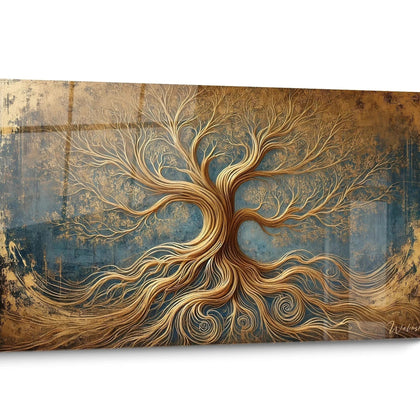
 Ancient Tree Wall Art - Life Tree Zen Edition273,90 €
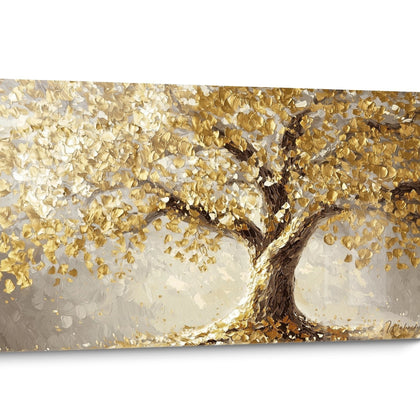
 Majestic tree painting with golden foliage on light beige background - Autumn serenity - Tree of life edition242,90 €
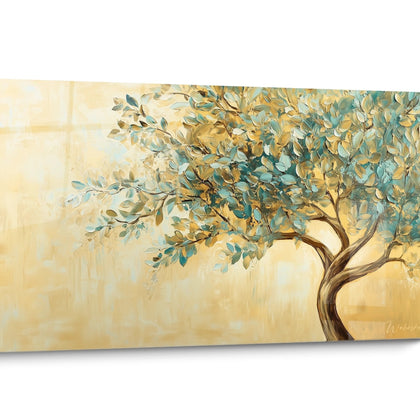
 Majestic tree artwork with green and golden tones on light beige background - Timeless Serenity - Tree of life edition242,90 €
 Twisted tree artwork with golden branches on turquoise and cream background - Golden Serenity - Tree of Life Edition242,90 €
 Tree painting with golden branches on pearlescent white background - Autumn light - Tree of life edition273,90 €
 Solitary tree with golden foliage on misty background - Golden Serenity - Tree of Life Edition273,90 €
 Majestic Tree Painting with Golden and Beige Tones on Nuanced Background - Golden Serenity - Tree of Life Edition273,90 €
 Majestic Tree Painting with Golden Foliage on Luminous Beige Background - Golden Light - Tree of Life Edition273,90 €
 Golden branch painting with beige tones and textured relief - Precious Boughs - Tree of life edition273,90 €
 Majestic Tree Artwork with Golden and Ochre Tones on Luminous Background - Eternal Wisdom - Tree of Life Edition273,90 €
 Majestic Tree Artwork with Golden and Beige Tones on Cream Background - Ancestral Wisdom - Tree of Life Edition273,90 €
 Majestic tree wall art with blue-grey and golden tones on canvas - Natural serenity - Tree of life edition273,90 €
 Majestic tree artwork with golden foliage on pearlescent gray background - Autumn light - Tree of life edition273,90 €
 Golden Winding Branches on Cloudy Gray Background - Golden Wisdom - Tree of Life Edition273,90 €
 Tree Wall Art with Golden and Soft Green Leaves on Light Beige Background - Golden Serenity - Tree of Life Edition273,90 €
 Solitary tree with blue-green foliage on pearlescent beige background - Contemplative Serenity - Tree of Life Edition273,90 €
 Solitary Tree Painting with Golden Foliage on Beige Background - Autumn Serenity - Tree of Life Edition228,90 €
 Eternal Roots Wall Art - Zen Tree of Life Edition273,90 €
 The Legacy of Souls Wall Art - Zen Tree of Life Edition273,90 €
 The Spirit of Nature Wall Art - Zen Tree of Life Edition273,90 €
 Ephemeral Harmony Wall Art - Zen Tree of Life Edition273,90 €
 Tree and Wind Fusion Wall Art - Tree of Life Zen Edition273,90 €
Explore further
In Minimalist Tree of Life Wall Art

All about Minimalist Tree of Life Wall Art
- Presentation Painting Tree of Life Minimalist
- Refined Aesthetics
- Contemporary Ambiances
- Acquisition Guide
The minimalist tree of life painting embodies a contemporary approach to ancestral symbolism, transforming a universal motif into a sober and refined visual statement. This purified representation eliminates the superfluous to retain only the very essence of the symbol: pure lines, essential geometric shapes, and a deliberately restricted color palette. Perfectly suited to modern spaces where every decorative element must justify its presence, this type of wall decoration harmoniously integrates into architectural interiors that prioritize functionality and visual clarity. The revisited tree of life according to the principles of minimalist design creates a meditative focal point without saturating the space or disrupting the visual balance sought in contemporary environments.
The Visual Expression of Sophisticated Simplicity
Formal Reduction in Service of Meaning
The minimalist tree of life painting is distinguished by its ability to condense a complex symbol into a few essential lines. This reductionist approach favors clean lines, often monochromatic, where each graphic element has a precise function in the overall composition. The stylized branches are limited to their most schematic expression, creating a tree that more closely resembles a conceptual diagram than a naturalist representation. This minimalist aesthetic transforms the symbolic tree into a contemporary ideogram, perfectly aligned with the visual codes of modern architectural spaces that reject excessive ornamentation.
Why choose a monochrome palette for this universal symbol?
The chromatic restriction characteristic of the minimalist tree of life painting paradoxically amplifies its spatial presence. By limiting the palette to shades of black, white, gray, or a single hue, the work acquires a visual authority that compensates for the absence of ornamental details. This color sobriety facilitates integration into environments with neutral tones, typical of industrial lofts, contemporary offices, or Scandinavian residences. Monochromatism also allows to focus attention on the very structure of the tree, on its fundamental geometry, reinforcing the meditative dimension of the symbol.
The Impact of Imposing Formats in Minimalist Space
In a decorative philosophy where every element must count, choosing a large-format minimalist tree of life painting is a major strategic decision. XXL formats transform this purified motif into a true visual architecture, capable of structuring an entire wall without resorting to an accumulation of decorative objects. This approach responds to a fundamental principle of minimalism: better one powerful element than several small ones. For those seeking a transition between total abstraction and recognizable symbolism, exploring an abstract tree of life painting can offer an alternative with greater formal freedom while retaining the conceptual essence of the motif.
The Discreet Materiality of Contemporary Supports
The effectiveness of a minimalist tree of life painting also relies on the neutrality of its physical support. Matte surfaces, invisible or non-existent frames, and concealed fixing systems contribute to this desire for material erasure in favor of the symbolic message. This apparent dematerialization creates the illusion of a floating composition, where the symbol seems directly inscribed on the wall rather than presented as a brought-in object, reinforcing the architectural integration sought in minimalist spaces.
Harmonization with Contemporary Environments
Zen and Productive Workspaces
The minimalist tree of life painting finds a particular resonance in contemporary offices and coworking spaces where concentration and mental clarity are priorities. Its calming presence, devoid of excessive visual stimulation, helps maintain an environment conducive to reflection without creating distractions. Companies adopting a refined organizational culture frequently choose this type of wall decoration for their meeting rooms or strategic reflection areas, the symbol of growth and connection aligning perfectly with the values of professional development and team cohesion.
How to integrate this symbol into a Scandinavian residence?
The Nordic aesthetic, with its love of bright spaces, light surfaces, and functional lines, constitutes the ideal setting for a minimalist tree of life painting. In these interiors where natural wood meets pristine white, a schematic representation of the tree in matte black creates a controlled contrast that visually structures the room without breaking the overall harmony. The large bay windows characteristic of Scandinavian architecture particularly benefit from the presence of such a focal element that dialogues with the visible outdoor nature while offering a conceptualized version of vegetation.
The Alliance with Purified and Functional Furniture
In a living room furnished with sofas with geometric lines, metal coffee tables, and modular shelves, the minimalist tree of life painting acts as a philosophical convergence point that humanizes the space without overwhelming it. This wall decoration brings the symbolic and emotional dimension often absent from strictly functional interiors, reminding that minimalism does not necessarily mean absence of meaning or depth. Monumental formats work particularly well above low furniture compositions, creating a verticality that balances the dominant horizontal lines of contemporary furniture.
Visual Meditation in Wellness Spaces
Yoga studios, meditation centers, and therapy spaces widely adopt the minimalist tree of life painting for its intrinsic contemplative qualities. Its formal simplicity facilitates visual concentration, allowing the eye to follow the essential ramifications without getting lost in superfluous details. This characteristic makes it an ideal visual support for mindfulness practices, where the ability to focus attention on a simple but meaningful element is a fundamental exercise. The stylized tree thus becomes a Western mandala, offering a visual anchor for relaxation or guided visualization sessions.
Selecting the Optimal Minimalist Tree of Life Painting
Decision-Making Criteria for a Thoughtful Purchase
Acquiring a minimalist tree of life painting requires a rigorous evaluation of several functional and aesthetic parameters. Beyond the immediate visual appeal, it is necessary to analyze the stylistic coherence between the degree of graphic simplification of the work and the level of purification of your space. Some minimalist interpretations retain a suggestion of schematic foliage, while others reduce the tree to its pure branched structure. This distinction considerably influences the final visual impact and must correspond to your personal vision of minimalism: do you prefer a subtle evocation or a radical abstraction of the natural motif?
Which format to prioritize to maximize the visual impact?
In minimalist logic, imposing formats offer a decisive advantage: they allow limiting the number of decorative elements while effectively filling the wall space. A minimalist tree of life painting of generous dimensions becomes the sole protagonist of an entire wall panel, eliminating the need for multiple compositions that would fragment attention. For main living spaces like the living room or professional reception area, XXL formats create an architectural presence that dialogues with the volumes of the room itself. Conversely, more modest formats are better suited to transitional spaces or reading corners where a discreet but meaningful presence is sought.
Assessment of Minimalist Execution Quality
Technical perfection is of paramount importance in minimalist aesthetics where every imperfection becomes immediately visible. Carefully examine the crispness of the lines, the uniformity of the color planes and the precision of the contours: in a clean composition, these execution details constitute the difference between a successful work and a mediocre product. High-definition printing techniques on rigid supports generally guarantee superior color fidelity and dimensional stability, essential for preserving the visual integrity of graphically simple compositions that cannot hide defects behind complexity.
Investing in Symbolic Durability
A quality minimalist tree of life painting represents a long-term decorative investment, transcending fleeting trends thanks to its conceptual timelessness. Unlike ephemeral trends, minimalism constitutes a fundamental aesthetic approach that crosses decades without losing its relevance. This longevity justifies a slightly higher budget for impeccable finishes and materials guaranteeing resistance to aging. Also consider that in a minimalist interior, this painting will likely become the main focal point, concentrating visual attention disproportionately compared to its actual surface area: its intrinsic quality therefore deserves particular attention.
Frequently Asked Questions about the Minimalist Tree of Life Painting
Is a minimalist tree of life painting suitable for small spaces?
Absolutely, minimalism being particularly well-suited to compact spaces. A vertical format effectively exploits the available height without visually encumbering, while the simple graphics avoid problematic perceptual saturation in small surfaces. The absence of complex details maintains a sense of ventilation essential in restricted spaces.
Does this type of decoration work in an interior with existing decorative elements?
The minimalist tree of life painting has a remarkable ability to adapt thanks to its formal neutrality. It can serve as a visual calming element in a more cluttered environment, creating a resting area for the gaze. However, its potential is fully expressed in already purified contexts where its aesthetic philosophy finds a coherent echo throughout the layout.
What is the main difference with traditional representations of the symbol?
While classic interpretations favor ornamental richness and profusion of symbolic details, the minimalist tree of life painting operates a radical conceptual distillation. It retains the philosophical essence of the symbol while systematically eliminating superfluous decorative elements, creating an intellectualized version that solicits more contemplative reflection than immediate visual wonder.
Further reading
Our articles on this topic
- The Tree of Life: A Universal Symbol of Genealogy to Spirituality
- Why is a nature artwork perfect for bringing freshness to a minimalist room?
- Pairing a Wall Art with a Minimalist Ambiance
- Transform Your Space with Contemporary Minimalist Art
- Minimalist Paintings: The Essence of Visuals in the Service of Elegance


