




Black and White Realistic Animal Wall Art
Our Painting Black and White Animals Realistic celebrates the natural beauty of the animal kingdom in its purest form. Each Realistic monochrome animal painting accurately captures the details, textures, and expressions of wild and domestic creatures. This Black and white animal wall decoration brings sophistication and character to your space. Perfect for lovers of naturalist art, this collection transforms your walls into an elegant contemporary gallery.
 Silent Strength Wall Art - Black & White Edition273,90 €
 Polar bear painting - Wild gaze - Black and white animals edition273,90 €
 Polar Bear Painting - Arctic Majesty - Black and White Animals Edition273,90 €
 Giraffe Painting - Majestic Portrait - Black and White Animals Edition273,90 €
 Majestic Deer Painting - Noble Portrait - Black and White Animals Edition273,90 €
 Giraffe Portrait Wall Art - Captivating Gaze - Black and White Animals Edition228,90 €
 Zebra Portrait Profile Artwork - Intense Gaze - Black and White Animals Edition273,90 €
 Meerkat Painting No. 1 - Animals Edition273,90 €
 Chimpanzee Painting No. 2 - Animals Edition273,90 €
 Chimpanzee Painting N°1 - Animals Edition273,90 €
 Wild Pride Artwork - Black & White Edition273,90 €
Explore further
In Black and White Realistic Animal Wall Art


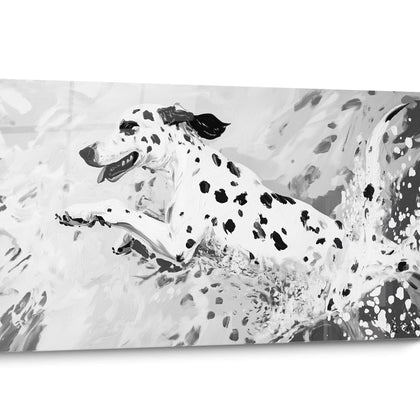


All about Black and White Realistic Animal Wall Art
- Realistic Black and White Animal Wall Art Presentation
- Photographic Rendering and Striking Details
- Visual Impact in Large Formats
- Authentic Materials and Textures
Realistic black and white animal wall art captures the raw essence of wildlife with exceptional photographic fidelity. Every anatomical detail, every texture of fur or feather is reproduced with precision that transforms your wall into a genuine animal gallery. These large-format works prioritize the documentary approach where authenticity prevails over stylization, offering total immersion in the monochrome wild universe.
Anatomical Precision in Service of Emotion
A realistic black and white animal painting stands out for its ability to reproduce every morphological characteristic with scientific accuracy. Artists specializing in this genre meticulously study bone structure, subcutaneous musculature, and exact proportions of each represented species. This anatomical rigor achieves renderings where a feline's gaze reveals its natural depth, where a lion's whiskers appear in their true fineness.
Why choose faithful representation over stylized ?
Photographic realism creates an immediate emotional connection with the observer. Unlike abstract or geometric approaches found in a minimalist black and white animal painting, faithful representation engages empathy by presenting the animal as it exists in its habitat. This authenticity particularly resonates with nature documentary enthusiasts, biologists, and collectors seeking pieces with educational value. Monumental formats amplify this connection by revealing details invisible to the naked eye: the crystalline structure of a raptor's eye, the microtonal variations of winter fur.
Species that thrive with realistic monochrome treatment
Certain creatures benefit particularly from hyperrealistic black and white treatment. Large terrestrial mammals like elephants reveal the topography of their thick skin, each wrinkle telling decades of existence. Primates offer troubling facial expressivity when captured with precision, their anthropomorphic features creating an introspective mirror. To explore other expressions, black and white animal portrait art offers tight framing on animal faces. Wild ungulates like the majestic deer display their pronounced musculature under lateral lighting, while arctic carnivores like wolves reveal the density of their winter coat in subtle gray shades.
Rendering techniques for maximum truthfulness
Realistic reproduction demands specific capture and processing methods. Wildlife photographers use long focal-length lenses to isolate the subject with shallow depth of field, creating this background blur (bokeh) that concentrates attention. Conversion to monochrome is never simple desaturation: each color channel is individually adjusted to optimize tonal contrast. Transition zones between light and shadow receive special treatment to avoid "poster" effect and preserve three-dimensionality. On XXL formats exceeding two meters, this attention to detail becomes crucial as the eye scrutinizes each section of the image acutely.
Monumental Scale for Tangible Animal Presence
How do imposing dimensions transform perception ?
A realistic black and white animal painting in large format creates a confrontation experience rather than simple observation. When a three-meter grizzly occupies your main wall, its physical presence literally modifies the room's atmosphere. Life-scale or amplified proportions generate a sensation of spatial cohabitation with wild fauna. This immersion is sought in professional spaces like specialized veterinary clinics, environmental NGO headquarters, or high-end lodges where client experience must evoke naturalistic adventure. Unlike modern black and white animal wall art that plays on graphic restraint, monumental realism pursues visceral impact.
Which placement to optimize realism ?
Realistic works require unobstructed frontal visibility. A continuous wall without adjacent windows avoids disruptive reflections that would break the photographic illusion. Recommended viewing distance equals 1.5 times the artwork's diagonal to embrace the overall composition while allowing approach to examine details. Double-height spaces particularly valorize vertical framing of standing animals: upright bears, extended giraffes, herons in hunting posture. Lighting must reproduce natural observation conditions: unidirectional light source simulates raking sunlight that sculpts anatomical reliefs.
Visual dynamics specific to realistic animal art
Unlike black and white animal movement art capturing kinetic action, static realism relies on latent tension. A resting feline contains all explosive hunting power. Compositions gain intensity through inclusion of hyperrealistic contextual elements: grass blades in foreground creating natural depth of field, atmospheric particles (mist, snow) adding temporal dimension, geological substrates (rocks, bark) anchoring the animal in its biotope. This visual stratification guides the gaze in depth rather than surface, an essential characteristic to maintain interest facing imposing formats.
Which interior environments suit hyperrealistic animal art ?
Neutral-dominant interiors amplify the impact of realistic works. Anthracite gray walls create a museum gallery effect where the artwork seems to float in darkness. Spaces with raw materials (polished concrete, natural stone, aged wood) resonate with the authenticity of animal representation. Typical industrial loft arrangements offer necessary volumes and streamlined aesthetics avoiding visual competition. Executive offices favor this register to project an image of controlled power, while contemporary residential spaces adopt it to create striking contrast with minimalist architecture.
Textures and Depth: The Materiality of Monochrome Realism
Which reproduction techniques preserve fine details ?
The quality of a realistic black and white animal painting depends directly on its ability to render microstructures. Giclée printing processes using mineral pigments offer an extended tonal range with up to twelve distinct gray shades, where standard prints plateau at four. This chromatic richness restores subtleties of wolf fur where downy undercoat coexists with protective guard hair. Rigid supports like brushed aluminum add metallic dimension that sublimes smooth-textured subjects (reptiles, amphibians), while matte surfaces absorb light for velvety renderings ideal for mammals. For aquatic effects, black and white aquatic animal art offers treatments specific to marine creatures.
Contrast management for striking realism
Realistic black and white is never binary but exploits the entire spectrum of intermediate values. Soft transition zones (subtle gradations in a stormy sky, progressive cast shadows) create volume. Brutal contrasts reserved for focal points (specular reflection in an eye, direct light zone on a muzzle) attract the gaze along calculated visual paths. This tonal hierarchy distinguishes professional work from flat reproductions. On large formats, balancing dark and light masses structures composition: a predominantly dark subject (black panther) requires luminous background to avoid visual absorption, while light subject (polar bear) asserts itself on neutral to dark ground.
How to evaluate authenticity of realistic representation ?
Several criteria distinguish mastered realism from mere photographic copy. Anatomical proportion accuracy verifies through comparing skull/body ratios, limb length, joint positioning to species standards. Authentic behavioral details certify naturalistic observation: a raptor never presents relaxed talons in flight, a cervid never simultaneously shows velvet and hardened antlers according to season. Lighting respects luminous physics: wet surfaces (nose, eye) present specular highlights, dry coats diffuse reflections. This documentary rigor separates educationally valuable work from simple thematic decoration, justifying investment in pieces suitable for both residential and scientific institutional settings.
Decorative associations that strengthen naturalistic immersion
The environment accompanying a realistic painting must extend its documentary intent. Furniture with organic lines (driftwood, ergonomic forms) creates conceptual continuity with represented life. Textiles with natural textures (raw linen, bouclé wool, vegetable-tanned leather) evoke tactilely what the work presents visually. Accent lighting must reproduce natural viewing conditions: neutral color temperatures (4000-5000K) avoiding dominant casts that would alter monochrome perception. For coherent collection, exploring black and white animal art allows discovery of different approaches to animal subjects in grayscale.
Does a realistic black and white animal painting suit spaces with variable lighting ?
Monochrome hyperrealism remarkably adapts to changing luminous conditions. Unlike color works whose perception varies with ambient light temperature, gray values remain stable from morning to evening. Fine details remain perceptible even in dimmed lighting thanks to composition's intrinsic contrast, while bright light reveals textural subtleties without chromatic saturation.
What durability to expect from large-format realistic animal art ?
Prints using pigmentary inks offer fade resistance exceeding one hundred years indoors, certified by accelerated aging tests per ISO 18909 standard. Rigid supports eliminate deformation or buckling risk that would affect critical planarity for realism. Anti-UV and hydrophobic surface treatments preserve visual integrity even in moderate humidity environments, making these works suitable for daily living spaces.
Can realistic animal art be installed in professional healthcare settings ?
Realistic black and white animal representations are particularly recommended for medical and therapeutic environments. Their calming and documentary character reduces patient anxiety while positively stimulating attention. Veterinary clinics, psychology practices, and rehabilitation centers adopt these works for their ability to create emotional connection without visual agitation, monochrome providing necessary serenity for care spaces.


