I welcomed Sophie to my studio one Tuesday morning in March. She had just moved into a bright apartment overlooking the Seine, but something was off. "The white walls reflect the stress of my days," she confided in me. Three weeks later, a large zen painting depicting a lotus flower rose at dawn transformed her living room into a sanctuary. It wasn't just decoration – it was a visual breath.
Here's what a zen painting with a lotus flower brings to your living room: a soothing presence that slows the pace, a focal point that structures the space without weighing it down, and that touch of contemporary spirituality that elevates the atmosphere. These three benefits make all the difference between a functional interior and a place where you truly recharge.
The problem? Faced with an abundance of proposals – from minimalist stylized lotuses to hyperrealistic compositions, from panoramic formats to triptychs – we find ourselves paralyzed. How do you choose when every variation seems to promise serenity? You may be afraid of falling into the cliché of Asian-inspired decoration a little bit trite, or conversely, of opting for a work that is too conceptual and will only speak to you.
Rest assured: choosing a zen painting with a lotus flower for a living room responds to specific criteria that I am going to share with you. After twelve years designing meditative spaces for individuals and wellness centers, I have identified the keys to ensure that this millennial symbolism integrates properly into our contemporary interiors. You will discover how to select the work that resonates with your space and your need for rejuvenation.
The symbolism of the lotus: far beyond a simple decorative motif
Understanding what the lotus flower represents radically changes the way you choose it. In Buddhist and Hindu traditions, the lotus embodies purity emerging from the mud – this ability to transform difficulties into beauty. For a living room, a space of transition between the outside world and the intimacy of the home, this symbolism makes perfect sense.
I systematically guide my clients towards zen paintings showing the lotus in its natural context : a few drops of water pearling on the petals, an elegant stem, sometimes a bud accompanying the blooming flower. This composition tells a cycle, a continuity. It brings a contemplative dimension that is not offered by an isolated lotus on a neutral background, however elegant it may be.
The colors of the lotus also carry specific meanings. The pink lotus evokes compassion and an open heart – perfect for a family living room. The white lotus symbolizes mental purity and is suitable for clean, almost monastic spaces. The blue lotus, which is rarer, speaks of wisdom and knowledge – it finds its place in living room libraries. As for the red lotus, vibrant with vital energy, energizes contemporary spaces without sacrificing serenity.
Format and composition: how the artwork dialogues with your architecture
The question of format determines the emotional impact of your zen painting. I have noticed that my clients consistently underestimate the necessary size. In a living room with generous volumes, a small 60x40 cm painting gets lost, even when hung at the ideal height. You should dare to use large formats starting from 120 cm wide which create a real contemplative window.
For living rooms with high ceilings (over 2.80 m), I prefer vertical compositions showing the lotus on its entire stem, from the submerged roots to the open flower. This verticality naturally guides the eye upwards and amplifies the feeling of space. Conversely, in apartments with more compact volumes, horizontal or square formats anchor serenity at eye level.
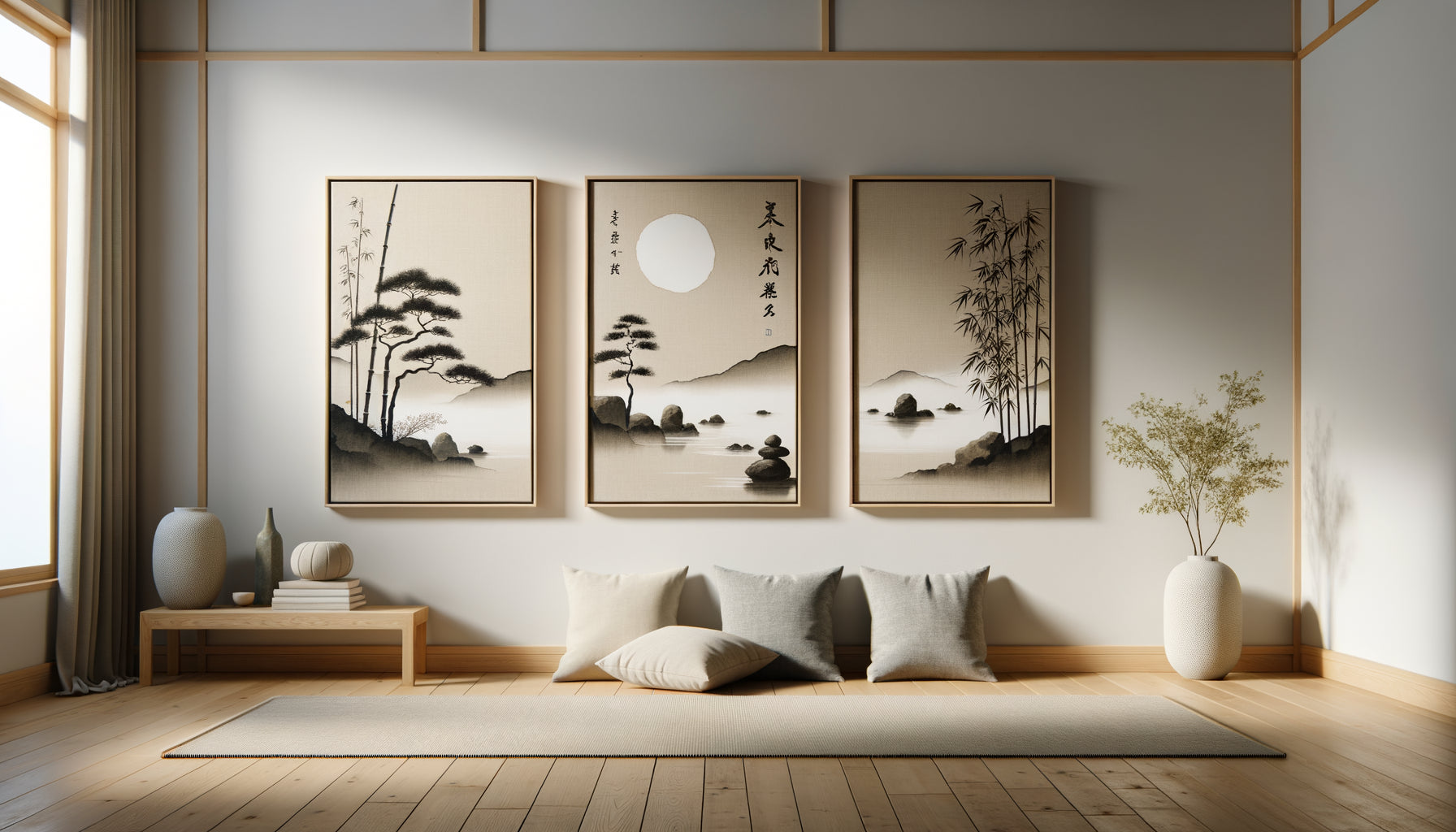
The triptychs with lotus flowers constitute a fascinating option for large walls. They create a visual rhythm, a breathing space between the panels. I particularly like those that follow a narrative progression: the bud, the flower blooming, complete flowering. This temporal sequence introduces a meditative dimension – your eye naturally travels from panel to panel.
Strategic placement in the living room
The zen painting with lotus flower is not hung haphazardly. It must be visible from your main seating area – sofa or reading chair – without needing to turn your head. This immediate visual accessibility allows for those micro-contemplative pauses that, added together, change the quality of your presence at home.
I systematically avoid placing these works facing a bright window: reflections interfere with contemplation. Prefer a wall perpendicular to sources of natural light, where flat lighting will reveal textures and nuances. If your painting includes golden details or shiny surfaces, this side lighting will make them vibrate subtly throughout the day.

Styles and techniques: from minimalism to contemplative expressionism
The stylistic choice of your zen artwork profoundly influences the atmosphere. Hyperrealistic photographic representations of the lotus capture a clinical, almost scientific beauty. They are suitable for very clean interiors, with defined architectural lines, where the painting functions as a window onto nature rather than an artistic interpretation.
Conversely, zen paintings with expressionistic influences – visible brushstrokes, marked contrasts, controlled drips – bring a different meditative energy. They recall that serenity is not the absence of movement, but harmony in flow. These versions are particularly suitable for contemporary living rooms where industrial design and the search for meaning coexist.
Between these two poles, aquarelle interpretations of the lotus offer accessible poetry. The delicately blended contours, subtle gradations from pink to cream, the lightness of water suggested create an instant soothing softness. These works wonderfully dialogue with natural textiles – linen, cotton, wool – and light woods.
For lovers of contemporary art, geometric or abstract versions of the lotus reinterpret the floral form into minimalist compositions. A few essential curves, a play of full and empty spaces, a restricted palette: these zen paintings function as modern mandalas. They simultaneously satisfy the aesthetic need and the search for symbolic depth without ever falling into cliché imagery.
Color palettes: matching the lotus to your existing interior
The classic mistake is to choose a zen painting in isolation, without considering the colors already present in the living room. Yet, chromatic harmony directly conditions the soothing effect sought. I systematically apply the rule of three tones: your painting must reproduce at least one dominant color from the room, introduce a complementary one, and contain a neutral accent.
In a living room with beige and gray tones – a very common palette in contemporary housing – a lotus painting in dusty pink on a pearl gray background creates continuity while bringing that touch of warmth that prevents the space from feeling cold. The occasional touches of gold or copper present in these compositions echo brushed brass lighting.
For bolder interiors using sage green, terracotta or duck blue, look for zen paintings showing the lotus in its ecosystem: lily pads, aquatic reflections, twilight sky. These contextual elements offer an expanded palette that facilitates harmonious integration. A white lotus on a background of deep greens and navy blues brings a zen brightness that structures the space without dominating it.
Backgrounds: Intense black or diaphanous clarity?
The treatment of the background radically transforms the presence of a zen painting. Black or very dark backgrounds create a spectacular effect of concentration: the lotus seems to emerge from the void, float in space. This contemplative dramaturgy is suitable for sophisticated living rooms, intimate atmospheres, carefully orchestrated indirect lighting.
Light backgrounds – off-white, beige, pale gray – generate an impression of space and lightness. They amplify natural light and are perfect for small living rooms or north-facing rooms. The lotus flower stands out gently, without ever assaulting the eye. This option also facilitates the evolution of your decor: a neutral background tolerates changes in furniture or textiles.
A third path, particularly appealing, is to choose zen paintings with atmospheric backgrounds: morning mists, abstract aquatic reflections, subtle gradients evoking dawn or dusk. These backgrounds create a meditative depth, inviting the eye to travel beyond the flower itself.

Materials and finishes: the tactile impact of your choice
The materiality of a zen painting influences its integration far beyond the purely visual aspect. Canvas prints offer a textile texture that naturally dialogues with upholstery fabrics. The grain of the canvas softens the image, giving it an organic warmth. For living rooms favoring natural materials – wood, stone, plant fibers – this option creates sensory coherence.
Acrylic or plexiglass prints bring a fascinating luminous depth. The lotus flower seems suspended between several planes, almost holographic. This technology is particularly suitable for design interiors with clean lines, where technical prowess becomes an integral part of the artwork. The absence of reflection from the high-quality acrylic allows optimal visibility from all angles.
For a more artisanal approach, textured or relief zen paintings – palette knife painting, application of material, inclusions of metallic leaves – create a dialogue between traditional bidimensionality and sculpture. These unique pieces capture light differently depending on the time and viewing angle, becoming true visual companions that one never tires of.
Transform your living room into a sanctuary of serenity
Discover our exclusive collection of Zen paintings that bring this soothing presence your interior needs.
Creating a wall composition around the lotus
A zen painting with a lotus flower does not exclude the company of other decorative elements, provided certain principles are respected. The fundamental rule: preserve a visual breathing zone of at least 20 cm around the main artwork. This margin avoids saturation and maintains the desired contemplative effect.
I particularly appreciate asymmetrical compositions combining a large lotus painting and, on an adjacent wall, a floating shelf supporting a few zen objects – Tibetan bowl, balanced pebbles, natural candle. This arrangement creates a spatial dialogue without visual competition. The eye naturally circulates between passive contemplation (the painting) and potential interaction (the objects).
If you absolutely want to create a gallery wall, limit yourself to a maximum of three elements whose zen painting remains the focal point. Complementary pieces should reprise natural themes – bamboo, stone, water – in significantly smaller formats. This clear visual hierarchy preserves the meditative function of the lotus flower.
Lighting: reveal the meditative depth
Even a beautifully chosen zen painting loses 70% of its impact without appropriate lighting. I systematically install a rail with adjustable LED warm white (2700-3000K) spotlight positioned 30-40 cm above the frame, with a 30 degree angle. This configuration eliminates reflections while revealing subtle nuances.
For lovers of adaptable atmospheres, dimmable spotlights allow you to adapt the lighting of the painting according to the moment: bright light during the day to counterbalance external brightness, reduced intensity in the evening to create a soft and enveloping presence. This flexibility transforms your zen painting into a true mood regulator.
A seductive alternative: LED strips concealed behind the frame, creating a luminous halo that detaches the artwork from the wall. This levitation effect is particularly suitable for minimalist compositions on dark backgrounds. The lotus flower then seems to float in space, accentuating its contemplative and almost spiritual dimension.
Beyond aesthetics: living with your zen artwork
Choosing a zen artwork with a lotus flower for your living room is inviting a meditative presence into your daily life. Unlike purely decorative works that you eventually stop seeing, these compositions continue to capture attention – not aggressively, but as a discreet call to contemplative pause.
I encourage my clients to create a daily observation ritual: thirty seconds each morning where the gaze rests on the artwork before starting the day. This seemingly innocuous micro-practice anchors an intention of calm that spreads throughout the following hours. The lotus thus becomes much more than a decorative element – it functions as a visual reminder of your aspirations for greater serenity.
The evolution of your relationship with the artwork is also a valuable indicator. If, after a few months, the work seems invisible or leaves you indifferent, then it does not correspond to your deep need. Conversely, if you regularly discover new details – a shade of pink previously imperceptible, a subtle play of shadows – you have found the right piece, one that will nourish your contemplative need for years to come.
Ultimately, the best zen artwork with a lotus flower for your living room is not necessarily the most technically sophisticated or the most expensive. It is the one that, from the first glance, slows your breathing by a beat. The one in front of which you will spontaneously stop, even when rushed. The one that imperceptibly transforms the quality of your presence at home. This alchemy between a work and its inhabitant cannot be decreed – it is felt, immediately and without ambiguity.
FAQ: Your questions about zen artworks with lotus flowers
Does a lotus artwork feel too cliché in a contemporary living room?
This concern is legitimate and I hear it regularly in my workshop. The key lies in the artistic treatment rather than the motif itself. A lotus photographed in close-up with a quasi-scientific approach, a lotus reinterpreted in minimalist geometric shapes, or a lotus treated in a sophisticated monochrome palette have nothing cliché about them. Simply avoid overly literal reproductions of traditional Asian paintings if your interior is resolutely modern. The lotus has a universal symbolic power that transcends styles when the work is well chosen. I have installed lotus artworks in industrial lofts, Haussmann apartments, Scandinavian houses – each time, it is the artistic treatment that determines success, never the motif itself.
What size artwork to choose for a 25m² living room?
For a living room of this size, I recommend a minimum format of 100x70 cm, ideally 120x80 cm or larger. The classic mistake is to undersize the work out of fear that it will overwhelm the space – quite the opposite happens. A painting that is too small gets lost on the wall and does not fulfill its function as a soothing focal point. To determine the optimal size, measure your wall: the artwork should occupy approximately 60-75% of the width of your main sofa. If you opt for a triptych, calculate the total dimension including the spaces between the panels. In a 25m² living room, you have plenty of space for a generous work that will create this sought-after contemplative window. Remember: a zen painting with lotus flower works through gentle presence, not shy discretion.
Can a lotus painting be combined with other Asian decorative elements?
The answer depends entirely on the effect you want to achieve. If you want to create a truly coherent zen space, yes, but sparingly and intentionally. I suggest the rule of three: no more than three Asian references visible simultaneously within the same field of vision. For example, your lotus painting, a cushion with a discreet Japanese pattern, and a Korean ceramic pot. Beyond that, you risk the “souvenir shop” effect which completely dilutes the meditative power sought. If your decor is eclectic with multiple influences, the zen painting can perfectly function as a unique contemplative reference, surrounded by Scandinavian, industrial or bohemian elements. The lotus flower has sufficient symbolic strength to stand on its own – it does not need an Asian context to deploy its soothing effect.