


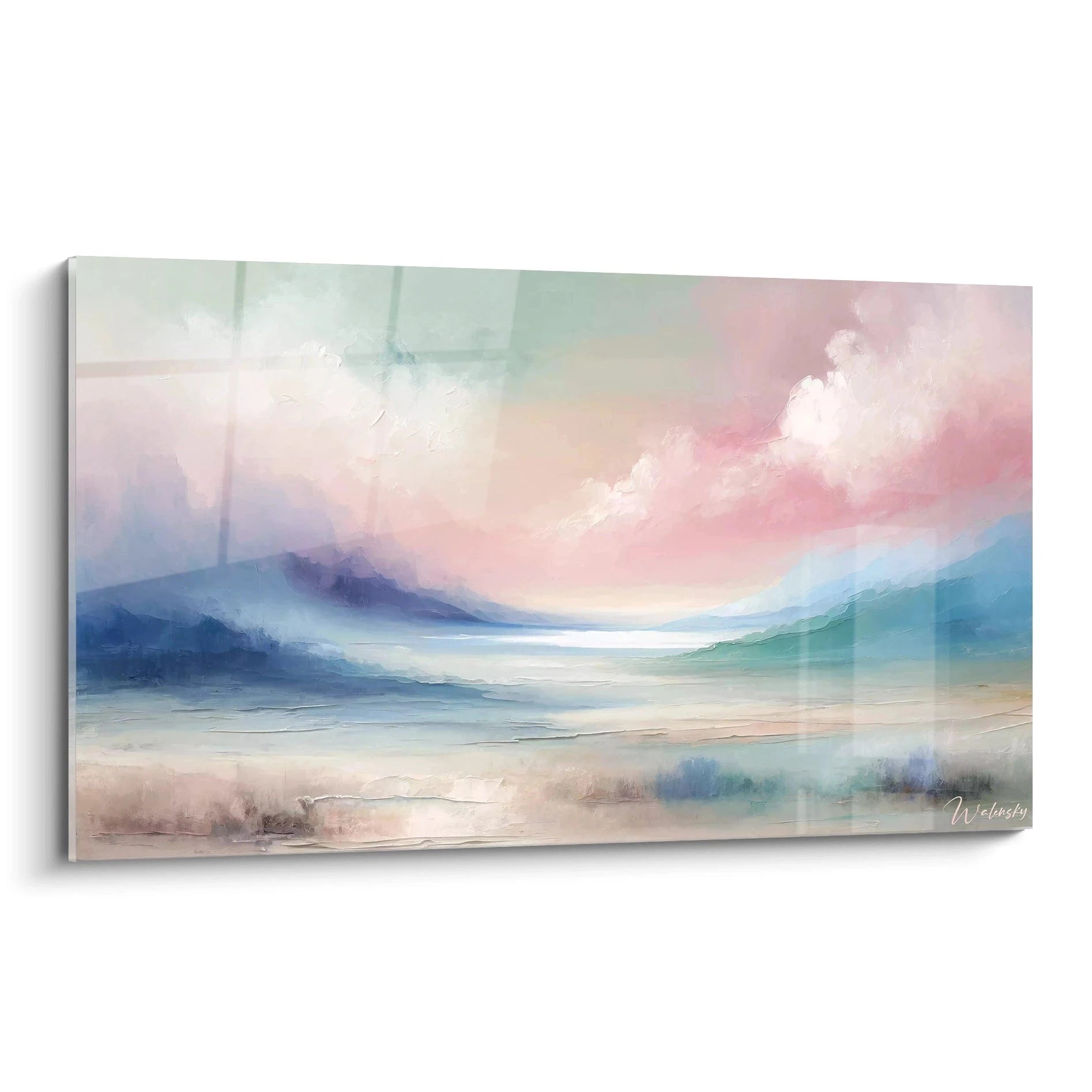

How to Position a Zen Artwork to Optimize Its Calming Effect?
January 1, 2026 · 11 min read · by Walensky
I spent eight years in a Kyoto monastery studying the art of ma – that inhabited void that breathes between things. Back in France, I have devoted my practice to translating this spatial philosophy into our Western interiors. A client called me one Tuesday morning, exhausted: "I bought a magnificent Zen painting, but it has no effect on me. I feel like it's... dead on my wall." That day, I realized that beauty alone is not enough. A Zen painting only soothes if it dialogues with the space, the light and your daily energy flow.
Here's what a thoughtful placement of your Zen painting brings: a visual breath that slows your heart rate, a spatial anchor that structures your day, and an invitation to conscious presence every day. Many buy their artwork with enthusiasm, then place it randomly – above the sofa because "that's how it is," facing a blinding window, or in a passageway where no one ever stops. The result? A dull frustration, the feeling of having wasted your emotional and financial investment.
Rest assured: repositioning a Zen painting requires neither work nor esoteric knowledge. Simply a new attention to what your spaces already whisper. In the lines that follow, I share the principles of spatial harmonization that I have applied for fifteen years, this subtle alchemy between sacred geometry and ergonomics of sight. You will transform your Zen painting into a true tool for emotional regulation.
The eye level height: where your eyes naturally seek calm
In Zen temples, nothing is hung by chance. The kakemono – these vertical paintings on silk – are positioned at a very precise height: the center of the work reaches the eye level of a person meditating sitting. This millennial rule contains a profound physiological wisdom. When your gaze naturally rests on a soothing image, without muscular effort up or down, your parasympathetic nervous system spontaneously activates.
Specifically, for a Zen painting in a living room where you are often seated, position the center of the work between 120 and 135 cm from the floor. If you hang your painting in a bedroom where you mainly contemplate it lying down, go down to 100-110 cm. I have observed spectacular changes in my clients simply by lowering their painting by 20 centimeters – suddenly, the work "spoke to them."
In an entrance or hallway where you remain standing, the standard height of 145-150 cm works perfectly. But here's the secret: always test with a sheet of paper before drilling. Tape a newspaper page at different heights, step back, sit down, stand up. Your body instinctively knows where your eye seeks rest. Trust it before trusting the measuring tape.
Orientation to light: orchestrating shadow and clarity
Light is the silent breath of a zen artwork. I have seen magnificent works killed by positioning them facing a south-facing bay window – the reflection transformed the serenity of a bamboo landscape into a blinding mirror. Conversely, a painting relegated to a perpetually shadowy area loses all its chromatic vibration.
The golden rule: position your zen artwork perpendicularly to your main light source, never directly in front or completely behind it. If your window faces south, hang your work on the east or west wall. Natural light then caresses the surface without creating reflections, revealing subtle nuances – that ink-blue grey, that off-white lotus flower.
For north-facing rooms with constant diffused light, you have more freedom. But be careful of direct artificial lighting: a violent halogen spotlight turns a minimalist composition into an interrogation. Opt for indirect lighting, a reading lamp directed at the ceiling, or better yet, warm white (2700-3000K) LED lights with dimmer. In the evening, you can adjust the light intensity according to your emotional state.
The cycle of the sun: your unexpected ally
Observe where the sun travels in your room throughout the day. A zen artwork positioned on a wall that receives the soft golden light of the morning becomes a visual awakening ritual. The same painting on a wall bathed in the slanting light of the evening naturally accompanies you towards nocturnal slowing down. This chronobiology of light is not anecdotal: it synchronizes your circadian rhythm with your visual environment.


Spatial breathing: how much empty space around your artwork
Emptiness is not absence – it is the presence of possibility. In zen aesthetics, this is called ma, that time-space which allows each element to exist fully. A zen artwork cluttered with other frames, wedged between a shelf and a wall sconce, instantly loses its soothing power. It becomes just another decorative element, drowned in visual noise.
Allow your zen artwork a minimum of 30 centimeters of free space on all sides – more if your room allows. This emptiness isn't wasted wall space, it’s the breathing room that lets your gaze settle without distraction. I had a client who removed three small photo frames around her cherry blossom artwork. She wrote to me two weeks later: “It’s as if I’ve turned down the volume on my home.”
If you have multiple zen artworks, resist the temptation to create a gallery wall. Prioritize one focal artwork per wall, or at most a diptych composition with generous spacing. Accumulation is the enemy of contemplation. A single perfectly placed stone in a zen garden says more than a hundred piled stones.
— Our selection

Energy anchoring zones: where to position according to the function of the room
Each room has areas of different intensity. In a living room, the wall facing the main sofa is a passive contemplation zone – ideal for a large zen artwork with cool tones (blues, greens, grays) that invites letting go. This is where your eyes naturally rest at the end of the day, when your body releases its tensions.
In a bedroom, the wall facing the bed deserves consideration. Some feng shui masters advise against images within the direct field of vision of the sleeper, considering that it activates the mind. I nuance: a minimalist zen artwork – black ink on a white background, solitary bamboos, ensō circle – can conversely structure your last conscious vision before sleep. Simply avoid compositions that are too dynamic (breaking waves, galloping horses) which stimulate rather than soothe.
For an office or workspace, position your zen artwork slightly to the side of your screen, in your peripheral vision. Not directly behind your screen (you will never see it) nor facing you (constant distraction). This lateral position allows for micro-contemplative pauses: your gaze naturally drifts towards the image during transitions between tasks, offering brief mental breaths without interrupting your concentration.
Transition spaces: underestimated opportunities
Don't ignore hallways, landings and entrances. These areas of rapid passage are paradoxically excellent locations for vertical zen artworks (kakemono format). Why? Because you cross them several times a day, creating unconscious micro-recentering rituals. Each passing becomes a three-second micro-meditation – these silent accumulations sculpt your inner state more than you imagine.

The art of subtle contrast: harmonizing with your wall palette
A zen painting in cool tones on a terracotta wall creates a visual tension that cancels out its soothing effect. This is not a matter of 'decorative rules' but of visual perception physiology: our brains expend cognitive energy reconciling violent contrasts. This micro-visual fatigue opposes the desired tranquility.
To optimize the zen effect, work in monochromatic or analogous harmonies. A painting with beige and white hues on a cream or natural linen wall. Black inks on a pearl gray wall. Bamboo greens on a very pale sage green background. This chromatic continuity creates what I call 'visual transparency' – the artwork seems to emerge from the wall rather than adhere to it.
If your walls are colored and you don't want to repaint, use a large neutral mat (cream, linen, soft gray) that transitions between the painting and the wall. This chromatic airlock softens contrasts and refocuses attention on the artwork. The frame itself should be as discreet as possible – light natural wood, brushed matte metal, or even no frame at all for canvases stretched over frames.
— You may also like


The contemplation distance: creating space for the gaze
A detail often overlooked: the distance between your usual position and your zen painting determines its optimal size. Too large seen too close, it invades the visual field and causes sensory saturation. Too small seen from too far away, it disappears and loses all presence.
The formula of art galleries: multiply the diagonal of the painting by 1.5 to obtain the minimum comfortable contemplation distance. A painting measuring 80x60 cm (diagonal of 100 cm) requires a minimum viewing distance of 150 cm. But for a truly soothing effect, I recommend multiplying by 2 – this allows your peripheral vision to embrace the entire work without micro-eye movements.
In a small space, don't overload with a large format. It is better to have a zen painting of 40x40 cm perfectly proportioned to your limited viewing distance than a 120x80 cm that forces you to move your head to grasp it. Serenity arises from the evidence of proportions, never from the 'wow' impression of an oversized format.
Your space deserves the visual breath you're seeking
Discover our exclusive collection of Zen wall art that transforms your walls into sanctuaries of daily serenity.

When moving changes everything: adjust according to the seasons of your life
Here's a practice I brought back from Japan and which always surprises my clients: a Zen wall art is not condemned to an eternal position. In traditional Japanese houses, kakemono change with the seasons, family events, moods. This rotation isn't instability – it’s vitality.
If you are going through a period of intense anxiety, temporarily move your Zen wall art into your bedroom, facing the bed, so that it structures your moments of falling asleep and waking up. During periods of overflowing creativity, migrate it to your workspace. After a breakup or bereavement, reposition it in your main living area, where it accompanies you throughout daily life.
This spatial fluidity reconnects you to the original intention of Zen: conscious adaptability rather than rigid attachment. Always keep a repositioning kit within reach (level, pencil, fixings suitable for your walls) to allow these intuitive adjustments. Sometimes moving your wall art three meters on the same wall is enough to transform everything.
Conclusion: the silent art of the right placement
Close your eyes for a moment. Visualize your interior transformed: that Zen wall art which now dialogues with the morning light, that perfect height which captures your gaze exactly when you need it, that breathing space surrounding it like an invisible halo. You return home after a chaotic day, and there, even before putting down your bag, your nervous system begins to regulate itself. It's not magic – it’s the sacred geometry of attention.
Start this weekend. Take down your Zen wall art, test three different locations, sit in front of each for five minutes. Your body will tell you which one resonates. And if you hesitate, remember this millennial principle: the right placement is the one where you forget the wall art to see only what it evokes – silence, space, presence. When the container disappears in favor of the content, you have found.
FAQ: Your questions about positioning Zen wall art
Can I position multiple Zen wall arts in the same room?
Yes, but with discernment. Multiplication doesn't amplify the calming effect – it dilutes it. If you want several artworks, create distinct contemplative zones rather than an accumulation on a single wall. For example: a large zen painting facing the sofa, and a smaller format in the reading corner. The eye then has multiple destinations for rest without visual cacophony. Always maintain a 60% empty space to 40% visual elements ratio on your walls. And prioritize thematic consistency: if you mix zen pebbles, bamboo forests, and Tibetan mandalas, you create a cultural and aesthetic confusion that neutralizes the calming effect. Choose a visual family – rooted minimalism, plant nature, or sacred geometry – and remain faithful to it in the same room.
My zen painting loses its colors in the sun, what should I do?
This is the silent drama of many poorly positioned artworks. Direct UV rays irreversibly degrade pigments, even on high-quality prints. Immediate solution: move your painting out of direct sunlight, or install a UV filtering curtain (technical voiles exist, transparent but protective). For exposed locations that you cannot avoid, invest in anti-UV glass for the frame – it filters 99% of harmful rays while preserving the readability of the artwork. Radical alternative: adopt the Japanese principle of seasonal rotation. Store your zen painting in a dark place three months out of the year (especially summer), and temporarily replace it with another artwork. This rotation preserves your pieces and renews your perspective – double benefit for a millennial practice that has proven its worth.
At what height should I position a zen painting above a piece of furniture?
This configuration is delicate as it creates a visual relationship between two masses: the furniture and the painting. Leave 15 to 25 cm of space between the top of the furniture and the bottom of the frame – never less, otherwise they visually “stick” together and create a heavy block. No more than 30 cm either, as the painting then seems to float without anchorage. The final height mainly depends on the furniture: above a thin console (30-40 cm high), you can hang the painting higher. Above an imposing buffet (90 cm), the painting must remain relatively low to maintain cohesion. Always test this perception rule: standing 2 meters away, the painting and the furniture should form a balanced composition, neither crushed nor disjointed. And be careful: a piece of furniture overloaded with objects cancels out the zen effect of the painting. If you position your artwork above a buffet, radically clear it – a maximum of three objects, generous spacing, neutral tones. The furniture then becomes a pedestal, not a competitor.
Explore our collections


