That morning, in my art therapy studio in Geneva, a client exhausted by months of professional stress collapsed into tears in front of a simple canvas depicting a bamboo forest under the mist.
Here's what zen paintings with natural landscapes bring to your space: they instantly reduce visual cognitive load, harmonize your heart rate through contemplation, and create a mental refuge accessible with a single glance. After twelve years of helping people find peace through the visual arts, I have precisely identified which natural compositions generate the most beneficial physiological responses.
You are probably looking to transform your interior into a soothing sanctuary, but faced with an infinity of options – majestic mountains, tumultuous oceans, dense forests – how do you choose the landscape that will truly speak to your nervous system? What color palette, what composition, what natural element will trigger this precious descent into calm?
Rest assured. The science of visual well-being has advanced considerably in recent years. We now understand why some zen landscapes act as natural anxiolytics while others, despite their beauty, lack that therapeutic dimension. I am going to share with you the discoveries I have accumulated from hundreds of people seeking serenity.
You will discover which natural elements possess the most powerful calming properties, how visual composition influences your inner state, and above all, how to identify the zen painting that will truly transform your daily experience of space.
Aquatic landscapes: the fluidity that soothes the mind
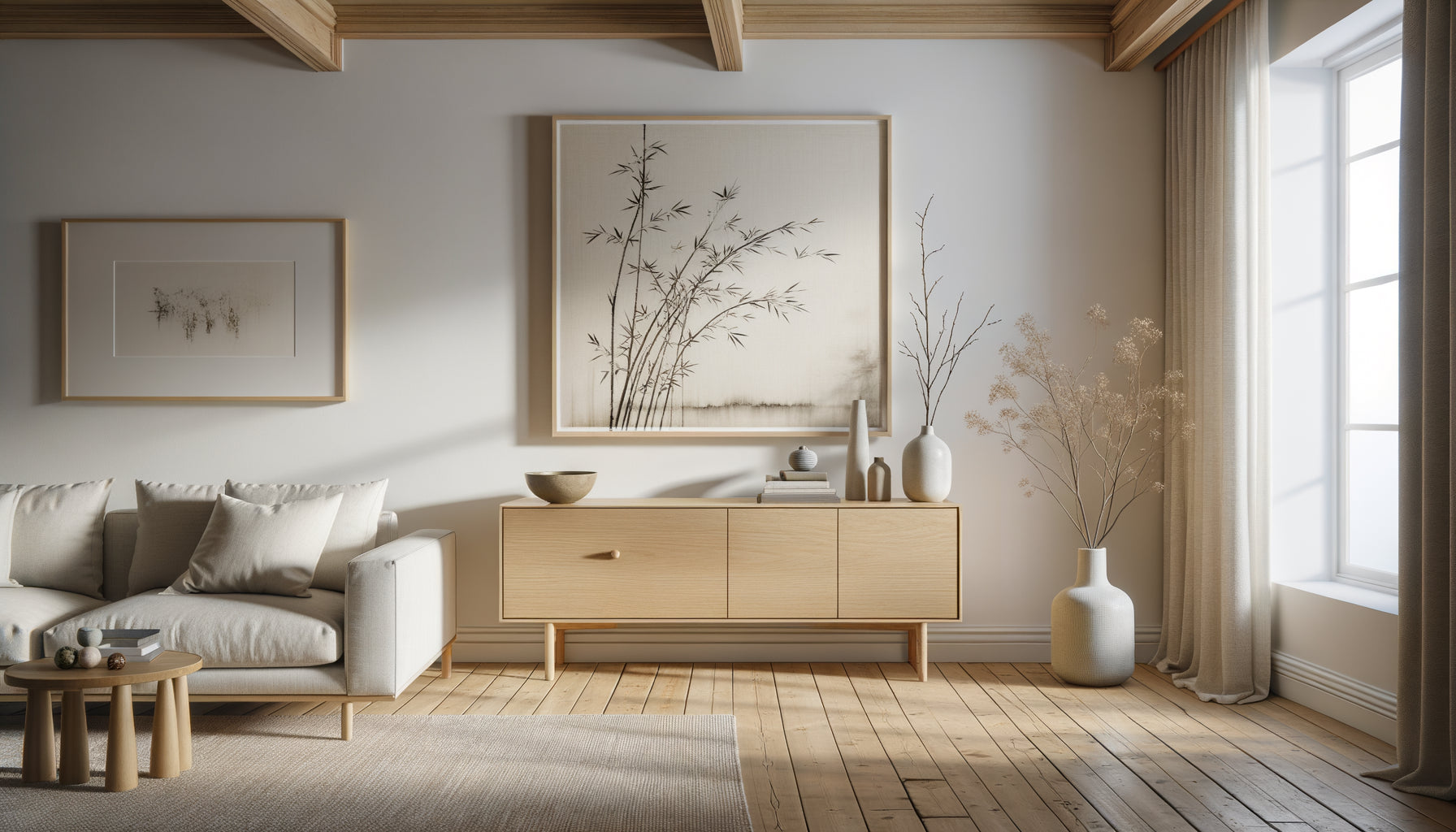
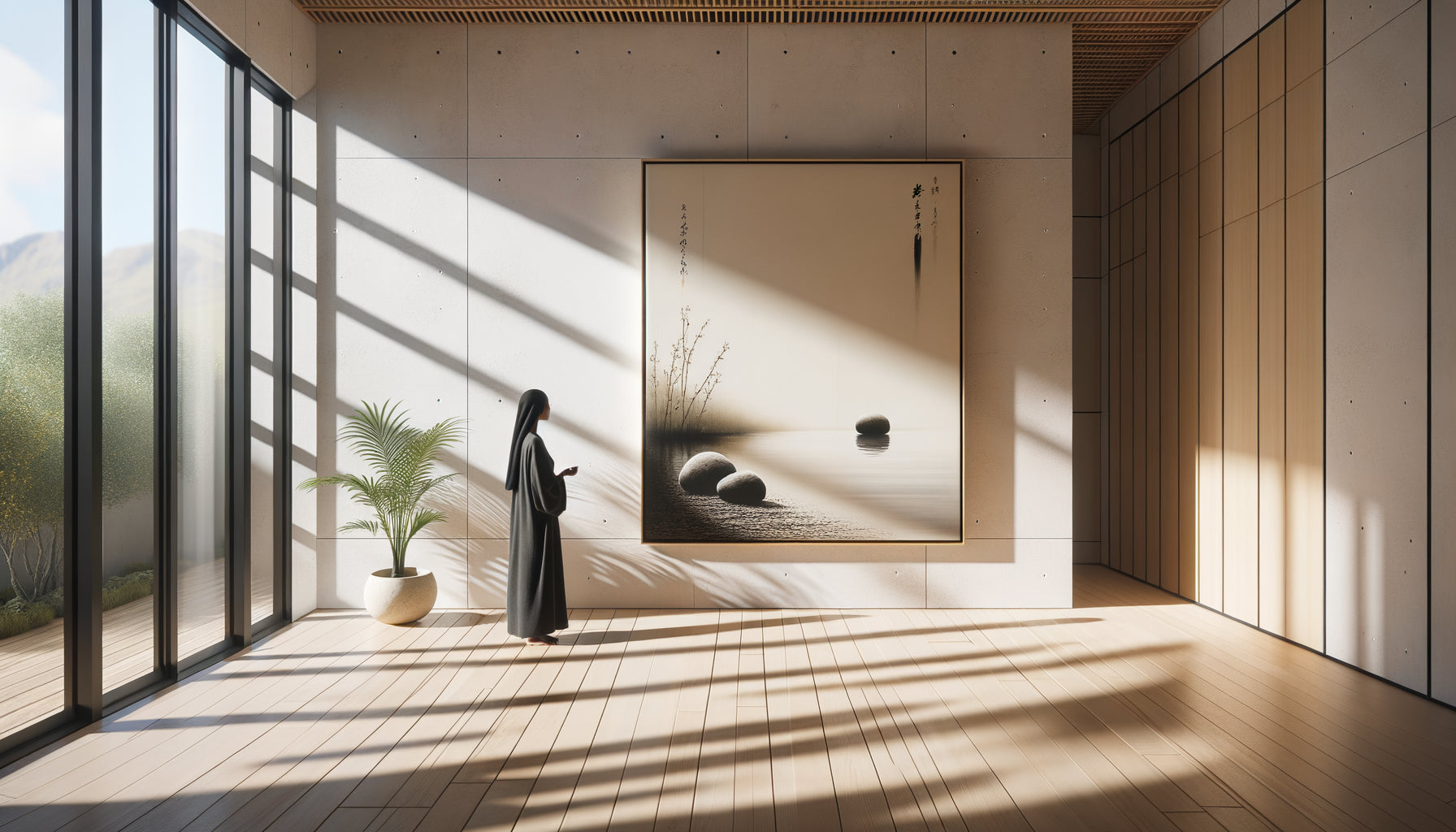
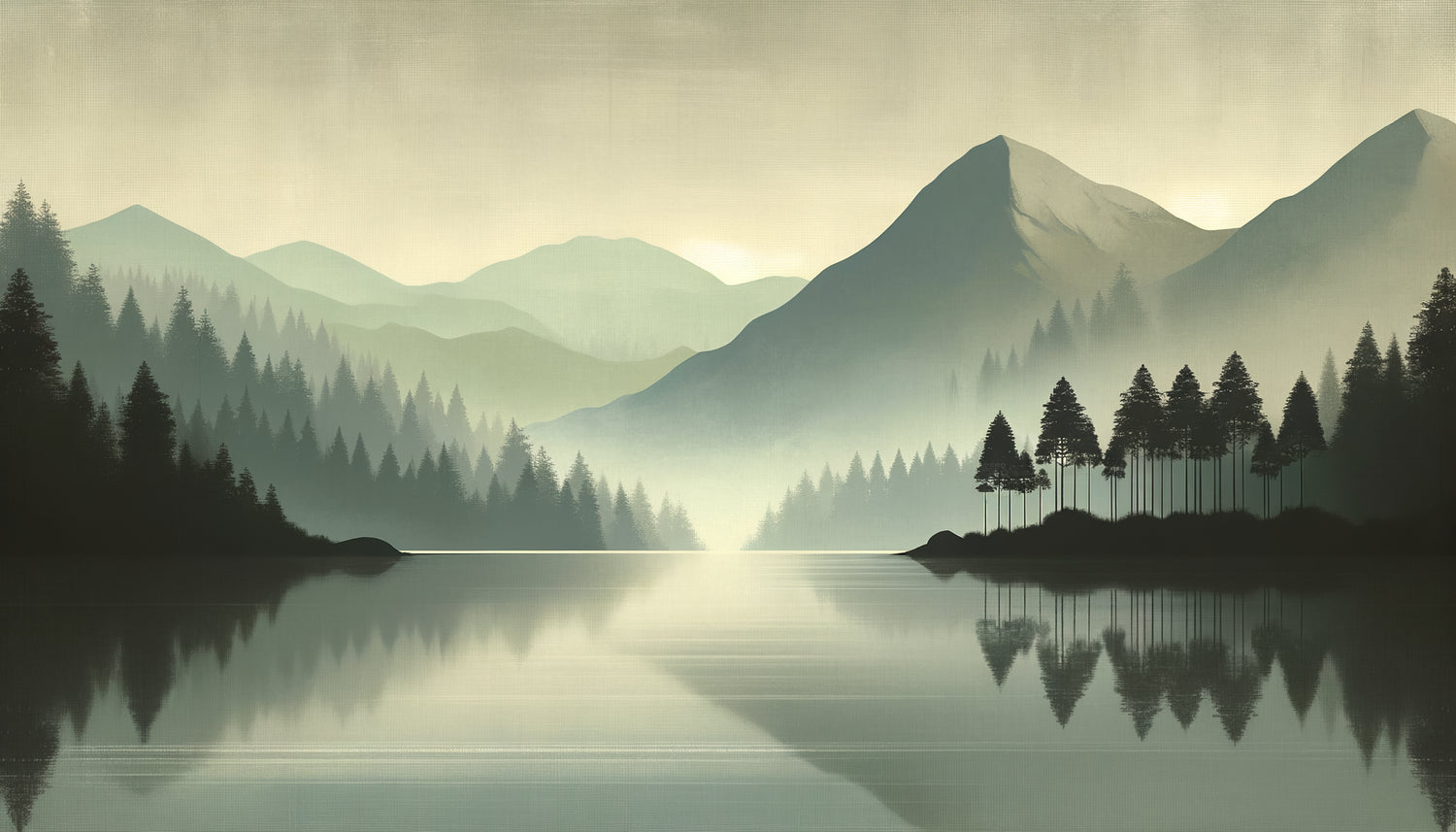
Water remains the most powerful natural element for inducing a meditative state. In my practice, zen paintings depicting I’ve noticed a marked preference for minimalist ocean scenes – this perfectly horizontal horizon line separating sea and sky in shades of blue-gray. The absence of distracting elements, the hypnotic repetition of gentle waves, the vastness that puts our concerns into perspective: these zen paintings work particularly well in bedrooms and meditation spaces. Celadon blue and pearl gray tones possess a visual frequency that slows down brain activity. Avoid electric blues or bright turquoise which, despite their beauty, maintain an activation level that is too high. The most relaxing zen landscapes incorporate subtle gradients, those imperceptible transitions between shades that prevent the eye from bumping into abrupt contrasts. The repeated verticality of trunks has a structuring effect on the psyche. Japanese bamboo forests represented in the mist are probably the quintessential zen motif for inducing calm. This multiplication of parallel lines creates a regular, almost metronomic visual rhythm that subtly synchronizes our breathing. I often encourage my anxious clients to turn to bright undergrowth with soft green tones. The filtered light through the foliage, these oblique rays traversing the canopy, generate a feeling of gentle protection. You are enveloped but not enclosed, sheltered but not isolated – exactly the balance that an overstimulated nervous system seeks. Forest paths disappearing into the distance activate a particular contemplative dimension. This path that vanishes into the depth of the zen painting invites a form of mental journey, an effortless escape that frees the mind from its circular ruminations. Favor compositions where the path meanders rather than straight perspectives too directional. Zen landscapes of mountains emerging from the morning mist, particularly in the aesthetic of Asian inks, possess a dreamlike quality deeply soothing. These dark masses floating in an ocean of white create a suspension of time, a simplified geometry that rests the eye from the complexity of the modern world. The gradation of values from near to far – these successive layers of mountains gradually lightening – naturally induces a feeling of space and perspective. Your gaze travels into the depth without encountering an obstacle, your breathing unconsciously amplifies to accompany this vastness. These zen paintings work remarkably well in workspaces where one needs to maintain concentration and serenity simultaneously. The imposing presence of the peaks anchors the mind, while the dissolving mist prevents it from becoming tense. The representations of Japanese stone gardens – these minimalist compositions of rocks, raked sand, and a few touches of moss – embody the very essence of visual rest. Each element has been thought to create an asymmetrical balance, this concept of wabi-sabi where beauty lies in imperfect simplicity. A single cherry blossom on a neutral background, a mossy stone near a water point, three bamboo stalks against a rice paper background – these ultra-purified zen paintings perfectly match contemporary minimalist interiors. They offer a contemplation point without ever saturating the visual space, respecting this fundamental principle: emptiness is as important as fullness. In my therapeutic practice, I always insist on this notion: a zen painting that rests must contain at least 40% of negative space – these areas of solid color, mist, empty sky. These visual breaths allow your gaze, and therefore your mind, to settle without being constantly solicited by new stimuli. The zen landscapes capturing golden hours possess a particular luminosity that stimulates serotonin production. These warm tones – peach orange, powdery pink, lavender purple – envelop the space with a deeply comforting visual tenderness. Opt for horizontal compositions with subtle chromatic gradients rather than spectacular sunsets with incandescent reds. The difference is crucial: you are looking for tranquility, not aesthetic excitement. A pastel sky above a calm body of water, a few tree silhouettes gently silhouetted – that's the recipe for a truly restful zen painting. For a bedroom, opt for zen landscapes with cool tones – deep blues, celadon greens, pearl grays – which promote sleep. Horizontal aquatic scenes or misty forests are perfect. In a home office or workspace, majestic mountains bring structure and inspiration without dispersing attention. Vertical compositions also balance the horizontality of screens and desks. For a meditation or yoga space, purified zen gardens or bamboo groves create the ideal contemplative atmosphere. Look for works where emptiness dominates, allowing the mind to unfold freely. Shared living spaces particularly benefit from zen landscapes with warm and welcoming tones – those sunrises over forested landscapes that inspire softness and conviviality. Transform your daily life into a sanctuary of serenity Just yesterday, a customer wrote to me that since he had installed a zen painting depicting a mountain lake in his office, his end-of-day migraines had practically disappeared. It's not magic – it's the recognition that our visual environment directly impacts our biology. Choosing a restful natural landscape for your space is offering yourself an accessible anchor point at any time. When the day gets hectic, when thoughts swirl, you have an immediate refuge: that still lake, that silent forest, those immutable mountains hanging on your wall. Start by identifying which natural element resonates most deeply within you. Close your eyes and visualize the landscape where you feel most at peace. Is it near water? Surrounded by trees? Facing a clear horizon? Your intuition already knows the answer. All that remains is to transform this inner vision into daily presence, into that zen painting that will remind you, every day, that calm is never further than a glance. Absolutely, and that's precisely their strength. Zen paintings of natural landscapes possess this chameleon quality that allows them to integrate harmoniously into very different decorative universes. In a contemporary minimalist interior, a refined composition of misty mountains in monochrome tones brings a touch of serenity without weighing down the space. For Scandinavian style, forests of white birches with light tones create a perfect continuity with blond woods and natural textiles. Even in a more traditional or bohemian environment, an aquatic zen landscape with soft hues integrates elegantly. The key is to choose colors that dialogue with your existing palette, and a level of detail adapted to the density of your decoration. A space already loaded will benefit from an ultra-refined composition, while a minimalist interior can accommodate more detailed landscapes without risking saturation. The ideal size depends less on absolute dimensions than on proportion in relation to your field of vision. For a truly soothing effect, the zen painting should occupy enough space to capture your gaze effortlessly, but without dominating to the point of creating a feeling of oppression. In a bedroom, aim for a format that covers about one third to half the width of the wall above the bed – generally between 90 and 150 cm for a double bed. For a meditation space, a square or slightly vertical format of 80 to 100 cm creates a perfect focal point at eye level when sitting. In a living room, panoramic horizontal formats work wonderfully, particularly for aquatic or mountainous zen landscapes where horizontality reinforces the feeling of calm. An empirical rule that I apply: position yourself in the place where you spend most of your time in the room, and the painting should comfortably occupy your peripheral vision without requiring head movement to grasp the whole thing. It is this encompassing but non-invasive presence that maximizes the therapeutic effect. Yes, but with a clear intention and thoughtful visual consistency. The common mistake is to juxtapose too different zen landscapes – a dense forest next to a mineral desert, a dynamic waterfall near a still lake – creating a visual cacophony that precisely cancels out the sought-after soothing effect. If you want to create a multiple composition, respect these principles: maintain a chromatic harmony (same family of tones, same color temperature), prioritize a thematic unity (different views of the same type of landscape – three perspectives of a bamboo forest for example), and preserve a stylistic coherence (same artistic treatment, same level of detail). Triptych formats work particularly well with panoramic zen landscapes – a mountain scene that unfolds over three panels creates a powerful immersion. Alternatively, in a hallway or on a gallery wall, you can align a series of small sizes representing a natural progression: the four seasons of the same lake, or different hours of the same mountain. The key remains the same: to create a visual continuity that guides the eye in a fluid movement rather than making it bounce in contradictory directions.The color palette of soothing water
Forests and bamboo groves: vertical grounding

Foggy mountains: silent majesty
Zen gardens and minimalist compositions: imperfect perfection
The importance of negative space

Sunrise and sunset: the gentle transition
How to choose according to your space and needs
Discover our exclusive collection of zen paintings that invite calm into every gaze, carefully selected for their authentic soothing properties.Create your personal visual refuge
Frequently asked questions about zen paintings with natural landscapes
Does a zen painting with natural landscape suit all decoration styles?
What size zen painting should be chosen to maximize the soothing effect?
Can multiple zen paintings with different natural landscapes be combined?