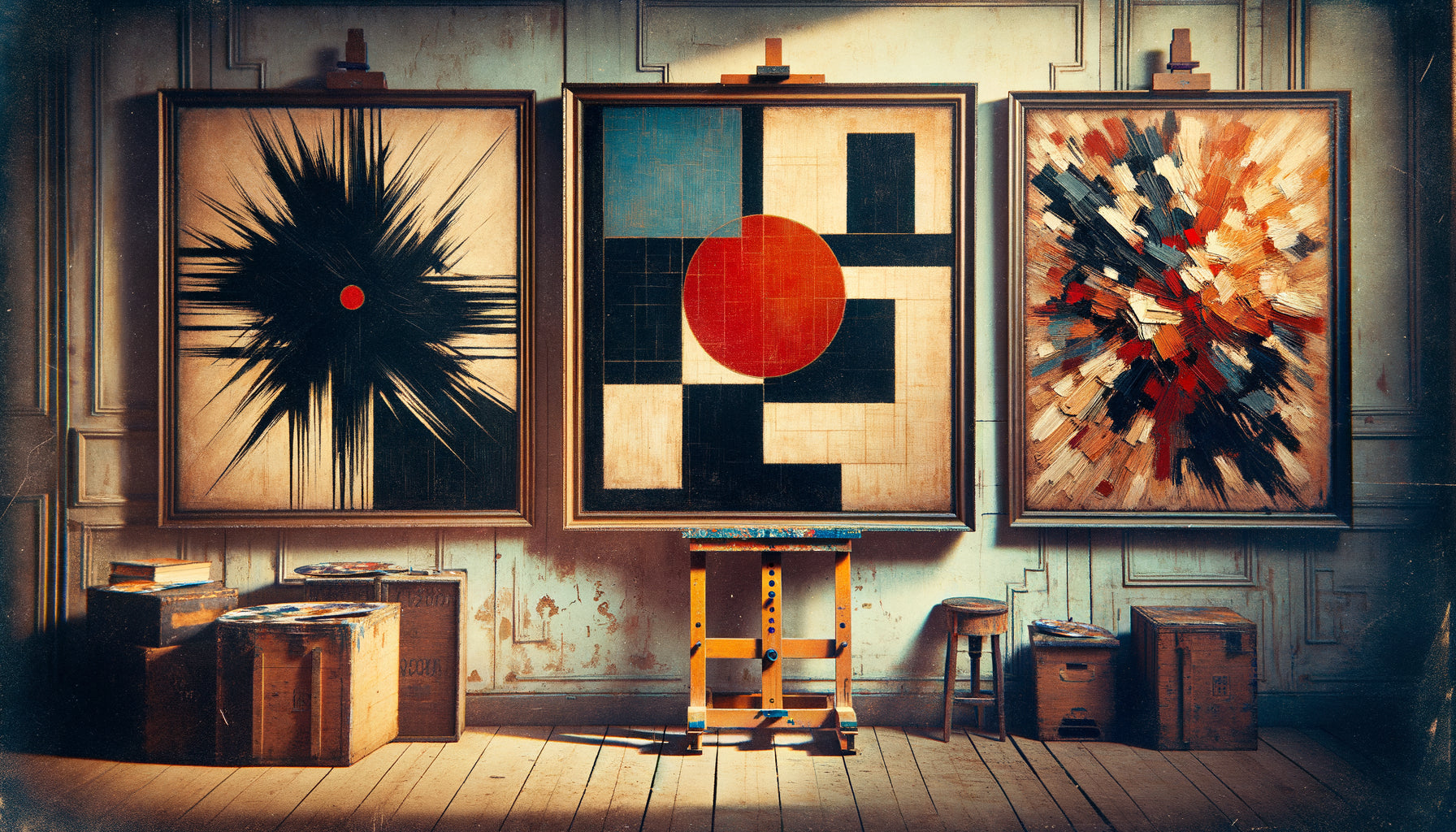
One October morning, opening the shutters of my Parisian workshop, I discovered something that chilled me to the bone: a fine crack ran through the face of an Art Deco poster from the 1920s, freshly acquired from an antique dealer on the Left Bank. The heating, abruptly switched back on after summer, had dried out the atmosphere in just a few days. This painful experience taught me a fundamental lesson: humidity is not a technical detail reserved for museum conservators, it's the keystone of any vintage art collection worth its name.
Here's what maintaining an optimal humidity level brings to your vintage wall murals: durable preservation of fragile supports, protection of pigments and period varnishes, and the guarantee that your emotional and financial investment will last through the decades without alteration.
You searched for this retro poster for months, unearthed a signed lithograph in a Provençal flea market, or inherited this family portrait painted in the 1950s. But no one explained to you that these treasures live, breathe, and react invisibly to climatic variations in your interior. The frustration is immense: we invest in beauty, we compose our decoration with care, and an invisible enemy silently threatens our most precious pieces.
Rest assured: understanding and mastering ambient humidity does not require laboratory equipment or a pharaonic budget. With some precise knowledge and simple actions, you will offer your vintage wall murals the ideal conditions to cross time as dignifiedly as they have survived until now.
The magic comfort zone: between 45% and 55% relative humidity
After restoring and advising dozens of collectors in the preservation of their works, I came to a conviction: the ideal humidity level for vintage wall murals is between 45% and 55%. This range is not arbitrary: it represents the perfect balance where organic materials – canvas, paper, wood, animal glue – retain their natural flexibility without ever absorbing too much water.
Imagine the paper fibers of a vintage poster as a microscopic sponge. Too dry, they become brittle and rigid, causing irreversible cracks. Too humid, they swell, deform, and create a fertile ground for mold. The zone between 45% and 55% relative humidity corresponds to the hygroscopic equilibrium point where these old materials maintain their structural integrity.
This recommendation is perfectly aligned with international museum standards. The Louvre, the Metropolitan Museum, the Tate Gallery: all maintain their reserves within this precise range. Why deprive ourselves of it in our interiors? Your vintage wall murals deserve the same attention as a museum work, because for you, they are worth it.
The invisible enemies: when air becomes hostile
Last winter, a collector contacted me, distressed: her three vintage lithographs from the 1960s all had suspicious brownish spots. Measuring the humidity in her living room, the verdict was inescapable: 68%. Her Haussmannian apartment, poorly ventilated and facing north, had become a tropical greenhouse for her precious wall art. Above 60% humidity, the risk of mold and foxing (those characteristic rust spots) literally explodes.
Conversely, a rate below 40% dries out organic supports with an unsuspected violence. I have seen wooden frames split apart, papers warp irreparably, canvas paintings lose their tension to the point of detaching from the frame. Modern apartments, with their efficient insulation and central heating, paradoxically create Saharan atmospheres in winter: 25% to 35% humidity is not uncommon, and that's catastrophic for vintage wall art.
Sudden variations are perhaps the most insidious danger. A painting that goes from 30% to 70% humidity in a few days undergoes mechanical stresses comparable to freeze-thaw cycles. Materials expand and contract, creating tensions that end up breaking fibers, cracking varnishes, peeling pictorial layers. Stability is better than perfection: it's better to maintain a constant 50% than to oscillate between 45% and 55% several times a week.

Measuring to protect: the essential equipment of the informed collector
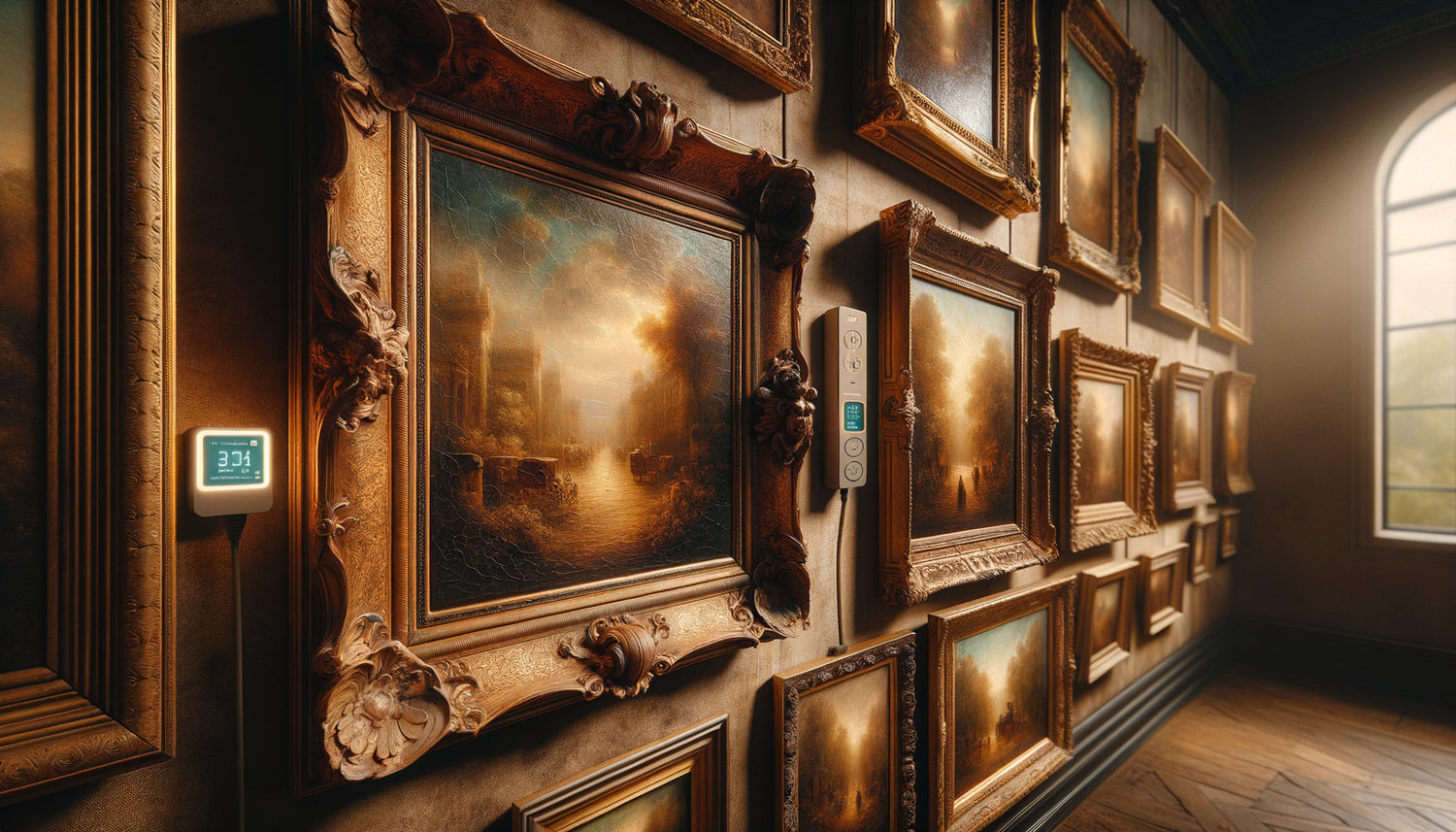
It is impossible to preserve what you do not measure. My first recommendation to any vintage wall art enthusiast is to invest in a quality hygrometer. No need for high-tech instruments: a simple digital hygrometer costing 20-30 euros, placed at eye level with your works (neither too close to a window nor glued to the radiator), will give you reliable data.
I personally use models with memory of minimum and maximum values. This function is invaluable: it reveals nocturnal variations or during your absences. You may discover that your living room, comfortable at 48% during the day, drops to 32% at night when the heating is running full blast. This information transforms your approach: you go from intuition to precise knowledge.
For more involved collectors, connected data loggers allow you to track changes over several weeks via an application. I've identified that one customer was displaying their vintage posters in a room where the humidity dramatically dropped every Sunday... when they used their wood-burning stove for ambiance. Thanks to this discovery, they reorganized their display and saved their collection.
Strategic Placement of Your Wall Art
Not all walls are created equal. A vintage artwork hung on a north-facing exterior wall will experience much more pronounced humidity variations than a piece placed on an interior partition wall. I systematically avoid locations near sources of steam (kitchens, bathrooms) or heating vents that create hostile microclimates.
Practical Solutions for Regulating the Atmosphere
In the face of excessive humidity, several options are available to you depending on the extent of the problem. For moderate excesses (58-62%), daily ventilation often suffices: 10 minutes of open windows in the morning, even in winter, renews the air and expels excess moisture. Paradoxically, cold outside air, once warmed indoors, becomes drier and lowers relative humidity.
Beyond 65%, an electric dehumidifier becomes essential. Modern models are silent, aesthetically pleasing, and automatically regulate the atmosphere. I recommend a unit with an integrated hygrostat: you set your target (say 50%), and the appliance switches on automatically when needed. For a standard room of 20-25m², a 12 liter/day model is more than sufficient.
Conversely, in dry atmospheres (less than 40%), a cool mist humidifier becomes your best ally. Avoid inexpensive ultrasonic models that create a white deposit on surfaces: opt for evaporative or cool mist humidifiers. A simple trick I apply: placing bowls of water on radiators. Slow evaporation increases ambient humidity by 3 to 5 points without sophisticated equipment.
Indoor plants are also natural humidity regulators. Ferns, papyrus, spathiphyllums transpire and humidify the air. But be careful: too many plants in a small room can create the opposite effect in summer. Balance remains the golden rule.

The Cycle of Seasons: Anticipate to Preserve
Your vintage wall art pieces endure the seasons with you, and each brings its own specific challenges. Autumn and winter are critical periods: central heating drastically dries out the atmosphere. From October, I activate my humidifiers and monitor my hygrometers daily. Increased vigilance from October to March effectively protects against drought-related damage.
Spring and summer pose the opposite problem, especially in humid regions or during prolonged rainy episodes. I tend to switch to dehumidification mode as soon as the hygrometer exceeds 58% for more than 48 hours. This responsiveness prevents the permanent installation of excessive humidity that would favor mold on your vintage pieces.
The transitional seasons are treacherous: heating is forgotten, windows are thrown open, drafts laden with moisture are created. I have taken to noting in my agenda two annual alerts (mid-October and mid-April) to systematically check my climatic parameters and adjust my equipment before conditions become problematic.
Beyond humidity: the complete preservation ecosystem
Relative humidity never works alone: it constantly interacts with temperature. The golden rule: 18-22°C associated with 45-55% humidity. These two parameters form an inseparable couple. A temperature of 25°C at 50% humidity does not provide the same comfort to materials as a temperature of 19°C at the same rate: warmer air can contain more water vapor and creates different stresses.
Light, particularly UV rays, inexorably degrades the pigments and supports of your vintage wall art. Even with perfect humidity, a poster exposed to direct sunlight will lose its colors. I systematically combine climate control and light protection: blinds, anti-UV glazing, LED lighting without ultraviolet rays. This global approach multiplies the lifespan of your works.
Air quality also counts. Pollution, cooking fumes, fine particles settle on surfaces and accelerate degradation, especially in humid environments where they adhere better. An air purifier with a HEPA filter in the room housing your vintage wall art is a worthwhile investment for urban collectors or smokers.
Your collection deserves the excellence of preservation
Discover our exclusive collection of Vintage art that have been selected for their exceptional state of preservation and timeless decorative potential.
Protect to pass on
Each vintage wall art piece you protect today is a fragment of history that you will pass on tomorrow. This 1930s advertising poster, this family portrait painted in 1955, this psychedelic lithograph from 1968: they have survived decades of uncertainty to end up in your hands. Maintaining 45-55% relative humidity is not a cold technical gesture, it's an act of cultural transmission.
Start today: install a hygrometer, observe your data for a week, gradually adjust. You will quickly discover that this attention becomes natural, almost meditative. Every morning, checking my instruments, I reconnect with my collection, take the pulse of my space, and confirm that my precious vintage artworks are breathing in the best conditions.
Your works will thank you silently, year after year, by preserving their vibrant colors, their intact support, their intact magnetic presence. And when the time comes to pass them on in turn, you will have the satisfaction of bequeathing pieces as beautiful as they were when you discovered them.
Frequently Asked Questions about preserving vintage artworks
My hygrometer displays 38% in winter, is that really dangerous for my vintage artworks?
Yes, 38% is below the recommended threshold and exposes your vintage wall art to a real risk of drying out. At this level, the fibers of paper, canvas or wood lose their natural elasticity and become fragile. You may not see anything the first year, but the damage accumulates insidiously: micro-cracks in the varnishes, warping of paper supports, cracking of antique frames. Invest in an air humidifier and aim to increase between 45-50%. Even a gradual improvement from 38% to 43% will significantly reduce risks. Remember: central heating in winter is the main enemy of ambient humidity, so this monitoring becomes crucial from October to March.
Can I hang my vintage artworks in my bathroom?
It's a question I hear regularly, and my answer is nuanced. If your bathroom has effective mechanical ventilation (MV) and you use it systematically during and after each shower, some robust vintage wall art (posters under glass, hermetically framed lithographs) may survive. But honestly, humidity peaks of 80-90% during even brief showers create significant mechanical stresses. I've seen too many works damaged to recommend this practice. If you care about a vintage aesthetic in the bathroom, opt for modern reproductions printed on waterproof supports rather than risking your authentic originals. Reserve your precious pieces for living rooms where you actually control humidity.
Should you invest in a dehumidifier or a humidifier to start?
Excellent strategic question! The answer depends on your climate and your home. First step: measure your current humidity for two full weeks, noting day-night variations and differences between rooms. If you are consistently above 58%, the dehumidifier becomes a priority – this is common in ground floors, oceanic regions, or poorly ventilated apartments. If you are below 42%, especially in winter with central heating, the humidifier is essential. In my Parisian experience, 70% of collectors need winter humidification and occasional spring dehumidification. My advice: first identify your dominant problem for a full month, then invest in the corresponding equipment. A good device costs 80-150 euros, which is derisory compared to the value of your vintage wall art and the irreversible damage it prevents.