


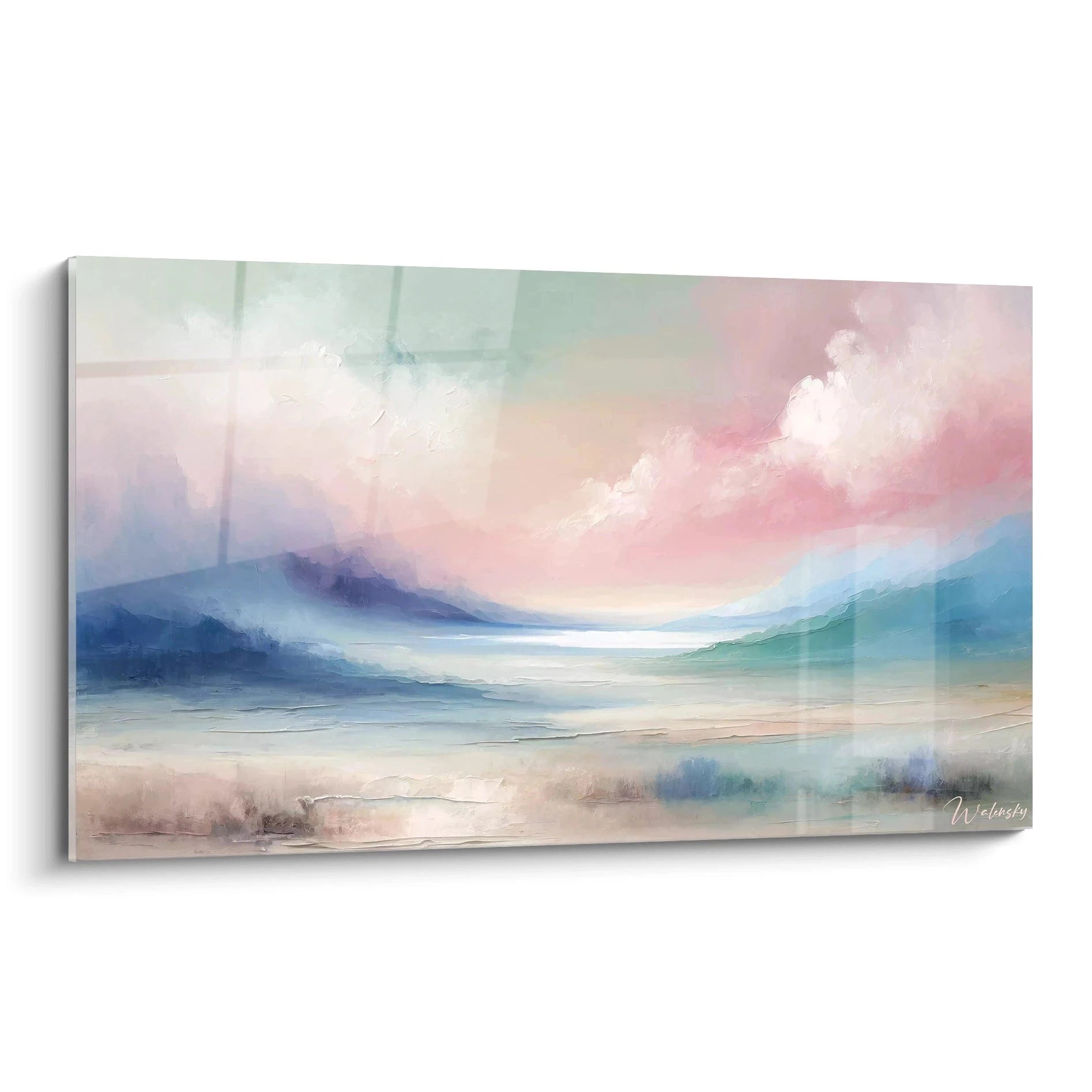

Relief and 3D Techniques: Add Volume to Your Wall Decor
October 11, 2025 · 20 min read · by Walensky
You’ve been looking at your walls for months, thinking they desperately lack character, but every time you hang a traditional painting, the effect remains stubbornly flat and impersonal.
You feel this frustration of seeing your living room look like all the others, despite your efforts to choose works that you like. In the morning, when natural light streams through the room, your paintings remain inert, without that magic that transforms a space into a true personal haven.
You’ve already tried adding more frames, playing with sizes, or even investing in more expensive artworks. Yet, the “living art gallery” effect you imagined never materializes.
This is perfectly normal: two-dimensional wall decoration has its physical limitations. It cannot create that dynamic interaction with light and space that makes all the difference between a decorated wall and a wall that tells a story.
By the end of this article, you will know exactly how to transform your walls into true habitable sculptures that capture and reflect light to create a unique atmosphere that evolves throughout the hours.
Why does the third dimension revolutionize your perception of space?
Every day spent with flat walls is a missed opportunity to create natural shadow games that transform your interior. Imagine a wall sculpture that, at sunrise, projects geometric patterns onto your floor, then reveals other facets in the evening light. Without relief, your walls remain passive spectators of your daily life instead of becoming their main actors.
🎨 Architect's revelation: Sarah, a Parisian interior designer, tells how a client desperate for a “soulless” living room completely transformed the atmosphere by replacing three classic paintings with a single wooden sculpted artwork. The effect was immediate: guests only talked about this centerpiece that seemed to dance with the light of the candles during dinners.
Conversation with a decor expert
The golden rule of dimension: the more depths your eye finds to explore, the richer and more habitable the space seems: Just like when you look through a forest, the different planes create an infinite perspective. Observable result: your guests naturally spend more time contemplating and discussing in this room, in just a few days.

Our highlight
Mountain Painting Dream of Altitude - trompe-l'oeil edition
233,90€
Discover this artwork →What does your frustration with "flat" walls really reveal?
Do you recognize yourself in these three situations? You regularly change your paintings hoping to finally find "the right one", you feel disappointed every time you turn on the lights in the evening because the atmosphere remains bland, or you avoid certain viewing angles of your living room because they reveal the flatness of the decor.
What's really happening is that your brain instinctively seeks the visual and tactile complexity that characterizes natural environments. The problem isn't your taste or budget, but the absence of this third dimension that allows light to create continuous variations.
It’s like trying to reproduce the charm of a fireplace with a simple photo: without the movement, reflections and dancing shadows, emotion cannot be born.
First secret: your eye needs "micro-visual journeys"
Contrary to what is believed, it's not the beauty of the work that creates emotion, but its ability to make your gaze travel in space. A flat painting, even magnificent, offers a limited visual path: your eye goes around it in seconds and moves on.
Imagine the difference between flipping through a book and exploring a cave: in one case, your attention quickly slips away, in the other, each angle reveals new surprises that keep your curiosity awake.
This discovery changes everything in your approach to decor: instead of looking for "the right image", you will create “the right path” for your gaze, transforming your walls into permanent invitations to contemplation.
🔍 Immediate test: Look at your most decorated wall for 30 seconds while counting how many times your eye returns to the same point. If it's more than 3 times, it’s a sign that your decor lacks dimensional anchor points to maintain visual interest.
We often think that good lighting is enough to create the atmosphere, but flat light remains invisible. It's exactly the principle of theater spotlights: they only reveal their magic when encountering the volumes and textures of the sets.
Think of a ray of sunshine in an empty room versus the same ray passing through a forest: in the first case, you see just an illuminated area, in the second, each leaf, each branch becomes a prism that decomposes and multiplies the light.
That’s why your attempts at improvement by lighting alone have failed: without volumes to catch and modulate this light, it remains uniform and characterless, creating that "cold showroom" impression rather than a cozy cocoon.
Third hidden key: your brain seeks the "temporal signature"
What no one tells you is that your brain subconsciously associates the richness of a space with its ability to transform over time. A relief artwork changes appearance depending on the hour, the season, even your position in the room.
Observe your reaction in a Gothic cathedral or facing a sculpture: you want to return because you know it will reveal something else to you depending on the moment. This "promise of rediscovery" is what’s missing from your current walls.
This temporal signature transforms your daily life: instead of experiencing visual monotony, you begin to anticipate with pleasure the variations in atmosphere that your walls will offer you throughout the day.
3 signals that your decoration lacks temporal dimension:
- The "invisible habit" syndrome: You no longer notice your paintings after a few weeks because they always offer the same image, like a photo you would eventually stop seeing
- The "uniform lighting" effect: Your luminaires create a flat atmosphere because no volume comes to structure the light, resulting in office lighting rather than habitat lighting
- The "golden hours" disappointment: These magical moments of sunrise and sunset do not transform your interior because the grazing light has nothing to reveal about your flat surfaces
The real turning point occurs when you understand that your wall decoration can become an architectural element in its own right. Like a domino effect, as soon as a surface develops dimensional character, it positively influences the entire perception of space. Your eye begins to search and suddenly finds details that you had never noticed in the rest of the room: moldings, reflections on objects, textures of furniture.
Universal rule of decorative dimension: a single relief artwork well positioned transforms the perception of the entire room: Placed on the main wall visible from the entrance, it instantly redefines the level of sophistication of the whole. Immediate test: photograph your room before and after installation, the difference will be striking even in image.
| ❌ Limiting belief | ✅ Liberating reality | 💡 Mechanism | 🎯 Concrete benefit |
|---|

How to create your first dimensional artwork without risk?
The good news is that you don't need to revolutionize all of your decor at once. Just as when learning to cook, you start by mastering a basic recipe before embarking on complex dishes. Your progress will be natural: testing a first piece, observing reactions and sensations, then gradually enriching your dimensional collection. The final result will surprise you: an interior that tells your unique and evolving story.
🎯 Overview of your transformation: Three steps like building a garden: first plant the master tree (main artwork), then develop the complementary beds (secondary elements), finally refine the details that make the difference. Each step brings you visible satisfaction and naturally prepares you for the next.
Starting by identifying your strategic wall is like choosing the location of a fireplace in a house: it will radiate throughout the space. This first step will give you the immediate satisfaction of seeing your room take on a strong personality, even with just one well-chosen element.
Selection criteria for your master wall
- Maximum visibility: Choose the wall you see first when entering the room. It sets the tone of the overall atmosphere. Avoid walls hidden behind sofas as they lose their impact of "space revelation". Simple test: standing at the entrance, the wall that naturally attracts your gaze is the right candidate. Exposure to natural light: Prefer a wall that receives indirect daylight, never in direct sunlight which would create harsh contrasts. The grazing morning or evening light beautifully reveals reliefs. Key principle: observe at what time of day this wall becomes most visually appealing. The neutrality of the background: Opt for a wall that is currently sparsely decorated or with elements that can be easily moved. A "blank" wall in terms of decoration allows your new artwork to express itself fully. The goal is to create a unique focal point rather than visual competition.
Now, let's move on to concrete action to bring this wall to life
Precise gestures for success in this first step
Measure and visualize the impact: Take the exact dimensions of your wall and define an area 80cm to 120cm wide that will be dedicated to your main artwork. This optimal proportion creates a visual balance without overwhelming or losing impact. Temporarily delineate this area with masking tape to visualize the final effect and adjust if necessary.
⏱️ Time: 15 minutes | ✅ Successful when: The delineated area immediately attracts attention from the entrance | ⚠️ Attention: Avoid placing it too high (center at seated eye level) as you would lose visual intimacy
Test the light interaction: At different times of the day, observe how natural light plays on this area. Note the "magic" hours when shadows and reflections would be most beautiful. This study will guide you towards the optimal relief type: deep for soft lights, more subtle for intense exposures.
⏱️ Time: 2 days of observation | ✅ Successful when: You identify at least 2 moments when this area naturally becomes attractive | ⚠️ Attention: Do not rely solely on artificial lighting, daylight reveals the true personality of reliefs
Define your dimensional style: Choose between geometric relief (clean lines, marked angles), organic relief (fluid curves, natural shapes), or mixed relief (harmonious combination). Your instinct is the best guide: the one that makes you want to reach out and touch it is the right one. This decision determines the entire future atmosphere of the room.
⏱️ Time: 30 minutes of reflection | ✅ Successful when: You can explain in 2 sentences why this style suits you | ⚠️ Attention: Resist the temptation to mix all styles, coherence creates impact
✨ Validation of your solid foundation: Your chosen wall attracts attention, benefits from good natural lighting, and you have a clear vision of the desired style. Signs of success: you are looking forward to the final result and you begin to imagine how your guests will react. If you still hesitate, take another day to let your vision mature, it's normal and even recommended for such a structuring choice.
— Our selection


OUR RECOMMENDED PRODUCTS
Step 2: Mastering Dimensional Hanging
Now that your foundation is solid, you move to the artisan level: transforming your vision into a tangible reality. This step is more technical but also more rewarding because you finally see your project take shape. The effect will be immediate and spectacular, creating that sense of "space revelation" that you have been looking for since the beginning.
Professional equipment for a lasting result
- Fixing system adapted to the weight: For relief works, opt for specialized wall fixings that support 2 to 3 times the actual weight. Classic dowels are not enough because the relief creates a lever effect. Favor load-sharing systems that protect your wall while ensuring safety. Essential investment: allow €15-25 for a reliable system that will last decades.
- Laser level or precision bubble: The slightest inclination is immediately visible on a dimensional work because shadows reveal any misalignment. A digital level guarantees you millimeter accuracy essential. The physical principle: the more relief the artwork has, the more visible and annoying horizontal errors become.
- Adjustable accent lighting: Provide a spotlight or wall sconce that reveals volumes in the evening. Indirect lighting from the ceiling or floor creates spectacular dramatic effects. The visible benefit: your artwork becomes a decorative element day AND night, multiplying its impact.
Professional installation method
Careful preparation of the support: Precisely locate the studs or fixing points with a metal detector. Mark all fixing points before drilling the first hole. This preparation avoids surprises and guarantees a durable and secure installation.
⏱️ Time: 45 minutes | ✅ Successful when: All points are marked and checked for level | ⚠️ Attention: A plasterboard wall requires specialized dowels, never direct fixing
Installation in secure steps: First install the main fixing points, test the solidity, then proceed to the final positioning of the artwork. Ask for help with heavy pieces: a damaged work during installation is a permanent regret. Check the level at each adjustment step.
⏱️ Time: 1h to 1h30 | ✅ Successful when: The artwork is perfectly stable and horizontal | ⚠️ Attention: Never force a fixing that resists, readjust the position instead
Revealing lighting optimization: Test different artificial lighting angles by temporarily moving a lamp around your artwork. The optimal angle reveals the reliefs without creating harsh shadows. Note this position to permanently install your accent lighting.
⏱️ Time: 30 minutes of experimentation | ✅ Success when: The lighting subtly reveals all details without glare | ⚠️ Attention: Avoid direct frontal lighting that "flattens" all your relief efforts
🎉 Celebrate your technical achievement: Your artwork is perfectly installed, stable and highlighted. Validation test: invite a friend to discover the piece, their spontaneous "wow" confirms the success of your installation. Take a before/after photo to objectively measure the transformation, you will be surprised by the extent of the change.
Step 3: Creating complete dimensional harmony
You are now at expert level: orchestrating a coherent ensemble where each element dialogues with the others. This mastery definitively distinguishes you from amateur approaches and creates that unique decorative signature of which you will be proud for years. The final result: a space that tells your story with sophistication and originality.
Elements of advanced composition
- Dimensional dialogue elements: Add 2-3 smaller pieces that echo your main artwork without competing with it. These "accompanying notes" create a consistent visual melody. Golden rule: never more than 30% of the size of the main artwork to maintain visual hierarchy.
- Complementary materials: Introduce textures that enrich without repeating: if your main artwork is made of wood, add metal or ceramics. The variety of materials creates a tactile richness that the eye perceives even from afar. Principle of success: maximum 3 materials to avoid dispersion.
- Mastered scale games: Create a harmonious dimensional progression: large central element, medium satellite elements, small finishing details. This hierarchy naturally guides the gaze in a pleasant and relaxing discovery path.
The finishes that make the difference
Overall orchestration: Arrange your secondary elements following the rule of odd numbers and visual triangles. Each piece must have its "breathing space": never a rigid alignment, always variable spacing that creates rhythm. Step back regularly to check the overall balance.
⏱️ Time: 1 hour of composition | ✅ Success when: The ensemble seems natural and fluid | ⚠️ Attention: Resist the temptation of "more is more", elegance is born of measure
Refining multiple lighting schemes: Create several lighting atmospheres: daytime lighting with dimmer, warm evening lighting, subdued intimacy lighting. Each atmosphere reveals different facets of your dimensional composition. Test all scenarios before finalizing.
⏱️ Time: 45 minutes of adjustments | ✅ Success when: You have 3 distinct but coherent atmospheres | ⚠️ Attention: Avoid colored lighting that distorts the perception of reliefs
Personalizing the final signature: Add a unique detail that reflects your personality: a small personal sculpture, a travel object, a handcrafted creation. This personal element transforms beautiful decor into a true expression of your identity. It tells your story to your guests.
⏱️ Time: Personal reflection | ✅ Success when: This element makes you smile every time you see it | ⚠️ Attention: Stay within the general scale and style, personalization should not break the harmony
🌟 Completion of your overall vision: Your dimensional composition tells a coherent story, adapts to different lighting conditions and reflects your personality. Ultimate validation: you feel genuine pride and your guests spontaneously ask questions about your creative process. Photograph the final result under different lighting conditions to create your personal decor portfolio.
Rule of dimensional progression: each new piece must enrich the whole without upsetting it: Add one element at a time, live with it for a few days, then decide if additional enrichment is necessary. Objective criteria: harmony remains obvious, each piece retains its personality, the whole gains sophistication. Perfect balance: creative boldness and visual serenity coexist naturally.
Now that you have mastered the fundamentals, let's discover the secrets of professionals who transform a beautiful achievement into a decorative masterpiece. These subtleties make the difference between a talented amateur and a true connoisseur of dimensional art.
🎯 Pro technique - "Luminous breathing": Experts create visual rest areas between relief elements by playing with distances and heights. This technique, inspired by cathedral architecture, allows the eye to "breathe" between discoveries, avoiding visual fatigue while maintaining interest. Concrete application: always leave at least 40cm of “empty” space around each strong element to give it its full expressive power.
Question from a passionate reader
"I love the concept but I'm afraid of getting bored faster than with paintings that I can easily change..."
This concern is very understandable and reveals a thoughtful approach! In reality, the opposite happens: a dimensional artwork evolves visually with the seasons, the hours, even your moods, creating a "permanent collection" of different atmospheres. Unlike a painting that always shows the same image, the relief offers you daily discoveries. Moreover, the sophistication of a well-thought-out dimensional composition grows over time, like a good wine that reveals new flavors. You develop a deep relationship with these works which become visual companions rather than simple decorations.
💡 Longevity test: Start with a modular piece or an evolving composition where you can add seasonal elements. Observe your feelings after 3 months: you will probably notice that your attachment has strengthened rather than diminished, contrary to "disposable" decorations.
— You may also like


The 5 mistakes that can ruin all your efforts (and how to avoid them)
After supporting hundreds of dimensional projects, I have identified the recurring pitfalls that turn a beautiful intention into an expensive disappointment. The good news? These errors are easily avoidable when you know them, and even professionals made them at the beginning of their journey.
- ⚠️ The "dimensional bidding" trap: Wanting to create relief everywhere all at once out of enthusiasm. Guaranteed result: a visually exhausting space that looks like a showroom rather than a home. Simple solution: start with ONE master wall, live with it for a month, then gradually enrich it. This error affects 70% of passionate beginners, so it's perfectly normal to feel this desire!
- 💸 The "all at once" budget mistake: Investing the entire decor budget in a single spectacular room while forgetting the overall harmony. Frequent consequence: a magnificent but isolated artwork that creates imbalance in the room. Balanced approach: distribute your budget with 60% for the main room and 40% for harmonious accompaniment. This distribution guarantees a consistent result and avoids regrets.
- 🔧 Neglecting the "it will hold fine" fixing: Underestimating the importance of a professional fixing system to save 20-30€. Real risk: falling artwork, material damage and permanent stress. Safety rule: always invest 10% of the price of the artwork in its fixing, it is an essential peace of mind insurance. A poorly fixed system spoils daily enjoyment through latent worry.
- 💡 The "I’ll deal with lighting later" oversight: Install the artwork first and think about lighting later. Inevitably resulting problem: technical constraints that limit possibilities and disappointing compromises on the final effect. Effective method: plan the lighting from the design stage, even if installation takes place in two phases. This anticipation multiplies the visual impact of your investment.
- 👥 The "I’ll figure it out myself" creative isolation: Rejecting advice or help due to personal pride when even professionals work as a team. Common consequences: avoidable technical errors, less accomplished result, unnecessary stress. Winning approach: consult at least one expert to validate your major choices; this avoids 90% of disappointments. Asking for advice accelerates your learning rather than slowing it down.
🛡️ Your safety checklist before installation: The artwork integrates harmoniously with the existing decor, the fixing system is generously sized, lighting is planned, the budget includes finishing touches. Warning signs to watch out for: feeling rushed, a tight budget down to the cent, "solo" installation of heavy items, choices based solely on the lowest price.
— In the same vein


Your most frequently asked questions about dimensional artworks
For your first successful realization, allow 2-3 weeks of reflection and planning, then one day for installation. True mastery comes gradually: after 6 months, you will have developed your eye for proportions and lighting. Acceleration tip: start by observing dimensional installations in public places (hotels, design restaurants) to educate your gaze more quickly.
For a main room, allow €300-€800 for an enlightened amateur result, €800-€1500 for a professional level. This budget includes the main artwork, accompanying elements, secure fixing and suitable lighting. Economical strategy: spread your acquisitions over 6-12 months to smooth out the investment and refine your choices over time.
For artworks weighing less than 5kg on a standard wall, a skilled DIYer can manage with the right tools and fixings. Beyond that, or for plasterboard/stone walls, professional installation avoids risks and guarantees durability. Smart compromise: have the fixings installed by a pro and position the artwork yourself – it combines safety and economy.
Your new daily life with walls that tell your story
In a few weeks, you'll discover the unique pleasure of living in a space that dialogues with light. Every morning, while drinking your coffee, you’ll observe how the first rays reveal new details in your reliefs. Your guests won't be able to resist approaching to understand better these games of shadows and materials that transform your walls into true habitable sculptures. This discreet but profound pride in owning a unique interior, designed and created according to your tastes, will nourish your daily well-being.
Beyond the aesthetic aspect, you will have developed a genuine artistic eye that will transform your way of perceiving all spaces. This sensitivity to volumes, materials and lighting will enrich your travels, cultural visits, even your way of arranging other rooms. You will have acquired a visual language that will allow you to express your personality in a sophisticated and timeless way.
The most beautiful thing about this approach is that the technique was ultimately just a pretext to reveal your natural artistic sensitivity. Now that you understand the mechanisms of relief and light, start by observing your main wall with this new expert gaze. Already imagine the effect of your first dimensional artwork, and let this vision guide you towards the first concrete step.
🌟 Your transformation starts now: You have all the keys to create an interior that truly reflects you. The beauty of this approach is that it reveals as much about your space as it does about your creative personality. Your future satisfaction will be equal to the boldness you put into this unique project.
Also read: 🎯 Explore our other technical guides

More selected pieces
Origami Painting Dance of Paper - origami edition
233,90€
Discover this artwork →Explore our collections


