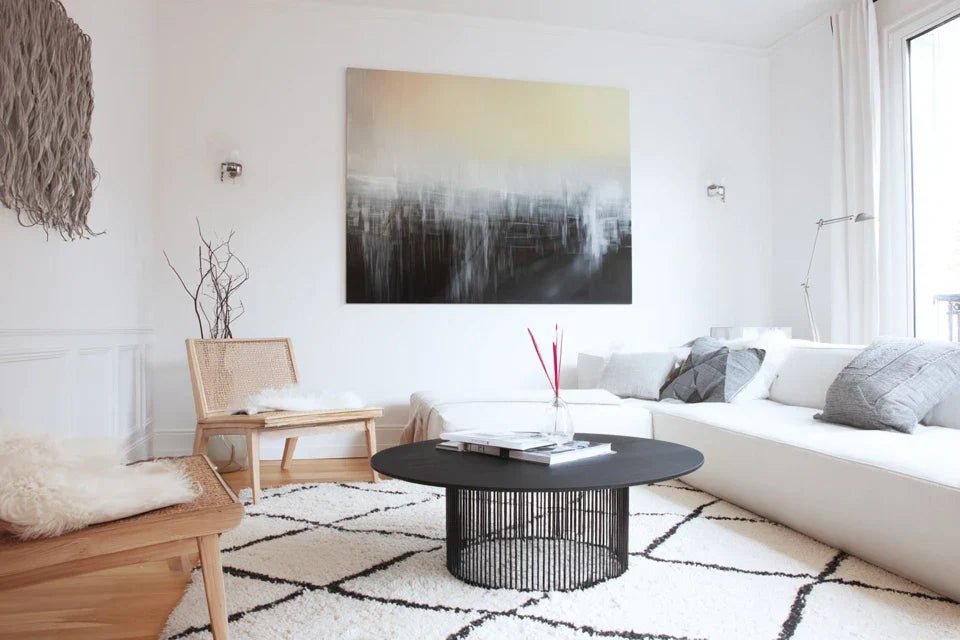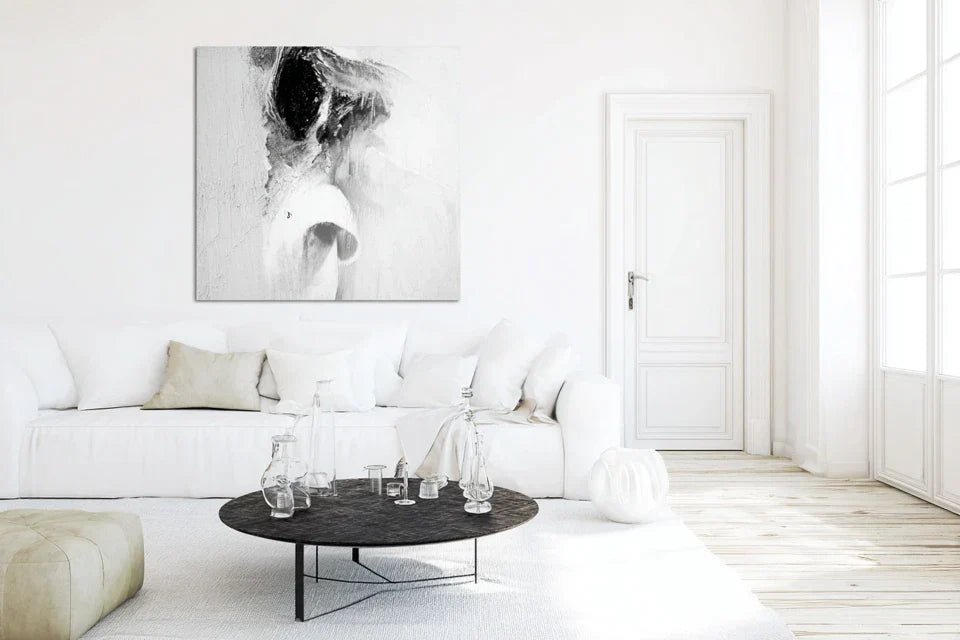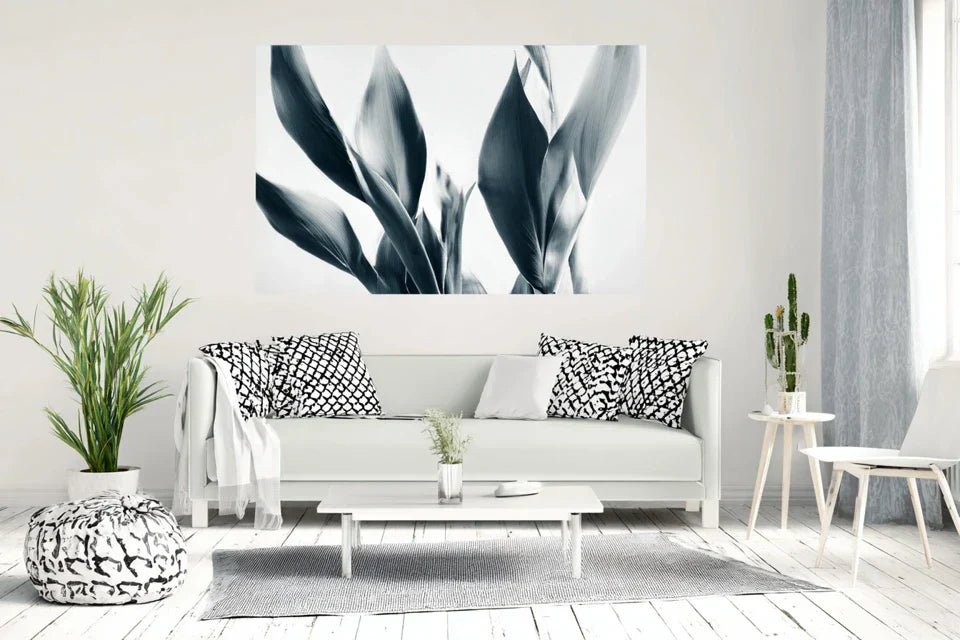
You come home after a long day, you push open the door to your living room and... nothing. The white walls reflect the same emptiness back at you as yesterday, the same lack of soul that has weighed on you for months.
You look around these impersonal spaces, these bare walls that scream your need for authenticity and beauty. Every day, this feeling grows: your interior doesn't resemble you, doesn't tell your story, doesn't reflect your values.
You’ve already tried a few hastily purchased posters, soulless reproductions found in big-box stores. But deep down, you know that’s not it. These temporary solutions have only accentuated your frustration of living in a decor lacking personality and depth.
This disappointment is normal and absolutely not your fault. The problem comes from trying to decorate instead of expressing yourself, filling spaces instead of creating an atmosphere that nourishes you emotionally.
By the end of this article, you will know exactly how to transform your interior into a personal sanctuary thanks to durable wall art, and you’ll already visualize that feeling of pride when your guests stop, admiringly, in front of your walls.
Why has wall art become the modern expression of a conscious lifestyle?
We live in an era where every purchase is a vote for the world we want to build. Waiting any longer means accepting impersonal spaces when you could create an inspiring environment every morning. It’s like planting a tree: the best time was 20 years ago, the second-best time is now.
🏡 Authentic testimonial : Sarah, a Parisian interior architect, recounts: "I accompanied a couple who had been living in an apartment with bare walls for 3 years. They said they were waiting 'the right moment' to decorate. When we installed their first artwork - an abstract painting in terracotta tones - I saw their faces light up. She told me: 'For the first time, I feel like I’m home.' It wasn't just decoration; it was a reconnection with their identity."
💬 Conversation with a decor expert
Durable wall art isn't a purchase, it’s an emotional investment: Unlike fleeting trends, a piece chosen with intention grows with you and enriches your daily life for decades. In 30 days, you won’t be able to imagine your walls without it.
What's Really Preventing You From Creating the Interior of Your Dreams
You will certainly recognize yourself in these three situations: you go around in circles in stores without ever finding "the" piece that makes you vibrate, you constantly postpone due to fear of making the wrong choice, or you impulsively buy items that end up boring you in a few months.
What's really happening is that you are looking for perfection in a system that can’t give it to you. Traditional decor circuits offer standardized solutions for deeply personal needs. It's like trying to find the right shoe size in only one option.
Imagine you were looking for a friend: you wouldn't choose them from a catalog, but by natural affinity. With art, it’s the same - emotional connection always precedes technical considerations.
🔍 The Real Reason For Your Hesitations: The Fear of an Expensive Mistake
Contrary to what everyone believes, the problem isn't your indecision but the lack of clear personal criteria. You’ve been taught to decorate according to external rules instead of listening to your aesthetic instinct.
It's like learning to cook only with recipes: you know how to follow instructions, but you never develop your own taste. Result: you constantly doubt your personal choices.
This aesthetic insecurity costs you more than a failed purchase: it deprives you of the daily joy of living in a space that resembles you. And it reinforces your dependence on external opinions instead of building your creative confidence.
🧭 Revealing test: Close your eyes and visualize the artwork you would hang if no one else but you had to see it. This mental image reveals your true tastes, freed from social judgment.
🎭 The Illusion of “Perfect Style” That Paralyzes You
The decor industry makes you believe that there are predefined styles that you must conform to. In reality, the most striking interiors mix influences according to the personality of their inhabitants.
Your personal style is like your fingerprint: unique and constantly evolving. Wanting to freeze it into a category is like wearing clothes of only one color for your entire life.
This search for a “coherent” style prevents you from exploring and growing aesthetically. It turns your decor into a social performance instead of making it an intimate pleasure.
🕰️ The Trap of “Waiting for the Perfect Moment”
You postpone your art purchases waiting for the move, renovation, or ideal budget. Meanwhile, you live in an environment that doesn’t emotionally nourish you.
You can detect this pattern when you say "when I have...", "after...", or "it is necessary that...". These phrases reveal a postponement of your present well-being.
The impact? Every day spent in a neutral environment is one less day to enjoy the beauty that could enrich your daily life and that of your loved ones.
🎯 3 signs that you are ready to take action:
- You photograph interiors that inspire you: Your eye is forming and developing clear preferences, a sign of a mature aesthetic sensibility
- You feel a lack when returning home: This dissatisfaction is a powerful engine that indicates your environment no longer matches your personal evolution
- You invest in other aspects of your well-being: Sport, nutrition, personal development... Wall art is the logical continuation of this overall approach
⚡ The trigger: understanding that art transforms the inhabitant as much as the habitat
What really makes the difference isn't the price or size of the artwork, but its ability to create a daily emotion. It’s the domino effect: a striking piece transforms your view of the entire space, then your ability to create beauty in your life. You can identify it when a work makes you smile inwardly, even after weeks.
Golden rule of personal wall art: If a piece makes you think "I would like, but..." stop at the "I would like". The rest are fears that dissolve with the first successful hanging.
| ❌ Subdued decoration | ✅ Personal expression | 💡 The difference | 🎯 Felt benefit |
|---|---|---|---|
| I choose according to current trends | I choose according to my lasting emotions | Emotion resists time, fashion fades | Constant pleasure vs. rapid fatigue |
| I wait for the perfect budget to redo everything | I start with a piece that really counts | The emotional impact is not proportional to the budget | Immediate transformation of the atmosphere |
| I want everything to match perfectly | I accept blends that touch me | Harmony comes from common emotion, not color | Authenticity vs artificiality |
| I seek the approval of others | I cultivate my own visual pleasure | Your gaze counts more than visitors’ | Growing creative confidence |
How to create an authentic interior with durable wall art
Rest assured, you don't need to revolutionize your decor overnight. We will proceed like a patient gardener: plant the right seeds, nourish them with intention, and watch your space flourish naturally. The result? An interior that tells your story and recharges you every day.
🗺️ Your roadmap in 3 steps: First, we will identify your personal vision (the emotional foundations), then we will select your first meaningful works (the structure), and finally we will create the overall harmony that makes everything breathe naturally (the soul of your interior).
🌱 Step 1: Revealing Your Personal Aesthetic Identity
Starting with this introspection is crucial because it avoids impulsive purchases you'll regret. It’s like knowing your terrain before building: it guarantees solid foundations. Once this step is complete, you will feel the liberating clarity of knowing exactly what resonates with you.
🧭 What You Need for This Exploration
- A visual notebook or a digital photo album: Something to collect your inspirations without losing them. The ideal is a format that you naturally consult (phone or notebook always within reach). Avoid overly scattered Pinterest boards: focus on YOUR true favorites, not what accumulates likes.
- Moments of active contemplation: Not passive daydreaming, but moments where you consciously analyze what attracts you to a space. The principle is to notice what makes you slow down or look up. The quality criterion: these moments create a small shiver of inner recognition.
- Your first emotional reaction: That immediate sensation before your mind rationalizes it. It’s your most reliable compass, the one that never lies and reveals your true authentic tastes.
Now, let's move on to practice with a method that reveals your deep preferences
🎯 How to Proceed Concretely
Create your "visual emotions journal": For one week, photograph or note everything that makes you stop visually - even a play of shadows on a wall. The goal is to capture the emotion before analysis. The important technical detail: also note the context (light, moment, mood) as it influences your perception. It's simpler than it seems: just follow your instinct.
⏱️ Time: 5 minutes per day for 7 days | ✅ Successful when: You have 15-20 items that create the same feeling of "I like it" | ⚠️ Attention: Don't censor your "bizarre" tastes - that’s often where your true aesthetic personality is hiding
Analyze your emotional constants: Spread out your captures and look for what comes back: colors, atmospheres, styles, emotions. Don't look for rational logic but patterns of feeling. You will discover your true preferences, often different from what you thought you liked.
⏱️ Time: 30 minutes of sorting | ✅ Successful when: You identify 3-4 characteristics that come back constantly | ⚠️ Attention: Resist the temptation to like everything - your "no's" are as revealing as your "yes"
Test your hypotheses in real conditions: Go see artworks physically (galleries, exhibitions, even stores) and observe your authentic bodily reactions. Your body doesn't lie: it relaxes in front of what suits you and tenses up in front of what bothers you.
⏱️ Time: 2h of targeted visit | ✅ Successful when: You feel clear differences in attraction | ⚠️ Attention: Ignore price tags during this phase - emotion first, budget later
🎉 Validation of your aesthetic identity: You should now be able to describe in 3 sentences what really touches you in wall art. If it's blurry, repeat the exercise focusing on your sensations rather than your thoughts. This clarity is your passport to assumed and lasting choices.
OUR RECOMMENDED PRODUCTS
🎨 Step 2: Select your artworks with intention and durability
Now that you know your aesthetic compass, we're going to use it to choose intelligently. This step is more strategic because you no longer succumb to temptations, you direct your choices. The snowball effect begins here: each well-chosen artwork facilitates the choice of the next.
🛠️ Your tools for informed selection
- Your personal criteria identified in step 1: Your personal reading grid, more reliable than all generic advice. Use it as a filter that eliminates 80% of the options to focus on what really matters. Avoid giving in to "exceptions" that dilute your vision. An understanding of durable materials: Quality canvases, resistant inks, noble supports that last through the decades without degrading. The principle of operation: invest in durability rather than immediate effect. The quality index: you can imagine the artwork in 10 years without it looking dated. A realistic but ambitious budget: Enough to acquire something that really moves you, without compromising your financial balance. It's better to wait and have a strong piece than to accumulate average artworks that clutter without enriching.
🔍 Your methodical selection process
Apply the "72 hour emotion" rule: When an artwork attracts you, wait 3 days keeping its mental image. If it still makes you smile inwardly after this period, it's a strong sign of lasting compatibility. This pause avoids impulsive purchases that clutter more than they enrich.
⏱️ Time: 3 days of maturation | ✅ Successful when: The emotion persists or intensifies | ⚠️ Attention: Don't confuse rational hesitation and emotional cooling
Assess the impact in your real space: Visualize precisely the artwork on your walls, with your lighting, your furniture. Take photos of your walls and imagine adding it. A piece that positively transforms the energy of the room is a good emotional investment.
⏱️ Time: 15 minutes of mental projection | ✅ Successful when: You clearly visualize the improvement | ⚠️ Attention: A piece must enrich what already exists, not compete with it