

Composez votre galerie d'art

Des tableaux qui racontent votre histoire
Code d'initiation
ART10
10% offerts sur votre première acquisition
Découvrir la collection

What materials to use to protect a high-end painting during transport

Quels matériaux utiliser pour protéger un tableau haut de gamme lors d’un transport
⏱️ Reading time : 8 minutes

You've just acquired this exceptional work of art that brightens up your living room, but the thought of having to move it fills you with dread. What if it cracks? What if the frame breaks? What if years of savings go up in smoke because of inadequate packaging?

You can already imagine the corners being damaged, the canvas sagging, or even worse, that irreparable scratch running through your masterpiece. Your hands tremble at the thought of handling your artistic investment without professional protection materials.

You may have already tried bubble wrap, recycled cardboard, or even moving blankets. The result? Anxiety persists, and you know deep down that these makeshift solutions are not up to par for your valuable artworks.

It's perfectly normal to feel this concern! The problem isn’t your caution, but the lack of reliable information on the real professional materials used by art transporters. Most general advice ignores the specificities of high-end paintings.

In the next few minutes, you will discover exactly which protection materials professionals use to transport artworks, how to choose them according to your type of painting, and above all, how to pack like an expert. You’ll regain that total peace of mind knowing your artistic investment is perfectly protected.

Why protecting your paintings can't wait?

Every day that passes without adequate protection exposes your artworks to variations in humidity, micro-impacts, and UV rays. It’s like leaving a classic car out in the rain: damage accumulates silently. The longer you wait, the more you risk losing the opportunity to preserve your artistic heritage in its optimal condition.

🎨 Expert testimony: Sarah, a Parisian gallery owner, still remembers the collector who lost €15,000 in a single scratch. "He had used classic plastic film which reacted with the fresh paint. Inadequate protection can cause more damage than no protection at all.”

💬 Conversation with a decor expert

"My painting isn't that valuable, bubble wrap should be enough..."
Be careful! Classic bubble wrap contains plasticizers that can migrate to the paint. It’s like cleaning a diamond with bleach!
"But movers always use bubble wrap..."
Classic movers are not trained in artworks. Specialized carriers use specific, neutral materials: Tyvek, acid-free polyethylene foam...

The golden rule of art transportation: All materials in contact with the artwork must be chemically neutral and reversible. Think museum conservation: we protect for 100 years, not for 100 kilometers!

What's really happening to your artworks

Your precious painting is already undergoing three major attacks: temperature variations create canvas expansion, humidity causes the support to warp, and micro-vibrations progressively crack the pictorial layer. Even in your living room, these phenomena operate silently.

What happens isn't visible to the naked eye at first. It’s like the erosion of a cliff: grain by grain, your investment degrades. The problem is not your negligence, but the lack of a professional protective barrier between the artwork and its environment.

Imagine your skin exposed to the sun without cream: damage accumulates before it becomes visible. Your paintings work exactly the same with humidity and temperature variations.

The real cause of damage: the effect of condensation

Contrary to what is thought, it's not shocks that most damage paintings, but micro-condensations. When warm air meets a cold surface (your canvas), invisible droplets form and penetrate the layers of paint.

It’s exactly like condensation on a windshield: it forms inside, where you can't wipe it away. On your painting, this humidity creates microscopic blisters that permanently weaken the adhesion of the paint.

This discovery will transform your approach: instead of looking for only mechanical protection, you will understand why humidity regulation is a priority. No more unpleasant surprises upon unpacking!

🔍 Instant test: Bring your hand close to your painting for 30 seconds. Do you feel a temperature difference? This is a sign that your artwork is undergoing temperature variations that create these invisible condensations.

The mistake of "breathable" materials

Many think that paintings should be allowed to “breathe” with porous materials. In reality, a stable work of art needs a constant environment, not permanent fluctuations.

It’s like trying to put a baby to sleep with the windows open in a storm: the intention is good, but the result is catastrophic. Barrier materials create a protective cocoon that maintains stable conditions.

This revelation explains why your previous attempts with "natural" fabrics haven't worked. You will discover that modern technical films offer superior protection without stifling the artwork.

The trap of over-protection

The other extreme is to wrap so tightly that the pressure deforms the canvas. It’s a understandable reflex: the tighter it is, the better it's protected, right?

You can check this by observing the pressure marks on your old packaging. These traces reveal that your canvas has undergone mechanical stress during transport.

This constant pressure creates permanent deformations in the frame and can even cause the pictorial layer to crack at points of contact. Your protection then becomes the main cause of damage.

🎯 The 3 warning signs to watch out for:

  • Traces de pression sur les bords: Indicate excessive tightening that gradually deforms the frame
  • Condensation after unboxing: Reveals a thermal shock caused by unsuitable materials
  • Persistent chemical smell: Signals the migration of compounds from the packaging to the artwork

The trigger factor: the quality of the first contact

What really determines the success of your protection is the first layer in direct contact with the artwork. Like a foundation, if it fails, all protection collapses. This layer must be chemically neutral, anti-static and perfectly smooth. It's your artistic life insurance: ensure it by checking that it leaves no residue to the touch and does not generate static electricity.

The 24-hour rule: If your protective material still emits an odor after 24 hours of ventilation, it is not suitable for artworks. The nose never lies when detecting dangerous volatile compounds.

❌ Common misconception ✅ Professional reality 💡 Why it works 🎯 Concrete benefit
The tighter, the better protected Calibrated space avoids pressure The canvas retains its natural tension No deformation upon unboxing
Bubble wrap protects against everything Only neutral materials are suitable Avoids chemical reactions Preservation of artistic value
You need to let the artwork “breathe” Climate stability is paramount Eliminates destructive variations Zero condensation, zero stress
All plastic films are equal Each material has its own characteristics Precise adaptation to the type of artwork Optimal custom protection

Your professional protection system in 3 steps

Worry no more! The method you are about to discover follows the same logic as a millefeuille of protection: each layer has its specific role. Like a pastry chef layering textures, you will build an invisible armor around your artwork. In the end, you will have the same peace of mind as a museum curator shipping a Monet.

🛡️ Overview of your artistic armor: First the neutral contact layer (chemical protection), then thermal insulation (climate regulation), finally the outer shell (mechanical protection). Logic from the inside out, like dressing a child for skiing!

Step 1: The contact layer - Your first line of defense

This step determines everything else! It's like choosing a quality primer before painting: invisible but fundamental. This initial protection creates a chemical barrier between your artwork and the outside world. You will immediately feel this peace of mind knowing that nothing can contaminate your investment.

Professional contact materials

  • Tyvek film (special conservation): Resembles ultra-thin white paper but is tear-resistant. Creates a barrier against moisture while allowing water vapor to pass through. Available from professional art suppliers. Make sure it is marked "museum grade". Avoid construction Tyvek which contains additives.
  • Crosslinked polyethylene foam: Microbubble white foam, not the large bubbles of bubble wrap. Acts as a stable air cushion without chemical migration. Recognize quality by its odorlessness after 24 hours. Transforms vibrations into absorbed energy instead of transmitting them. Metallized polyester film: Ultra-thin silver film resembling aluminum foil but without toxicity. Regulates temperature variations by reflecting heat. Essential for artworks sensitive to UV and thermal shocks.
Now, let's move on to the reassuring practical application

Serene application of your first layer

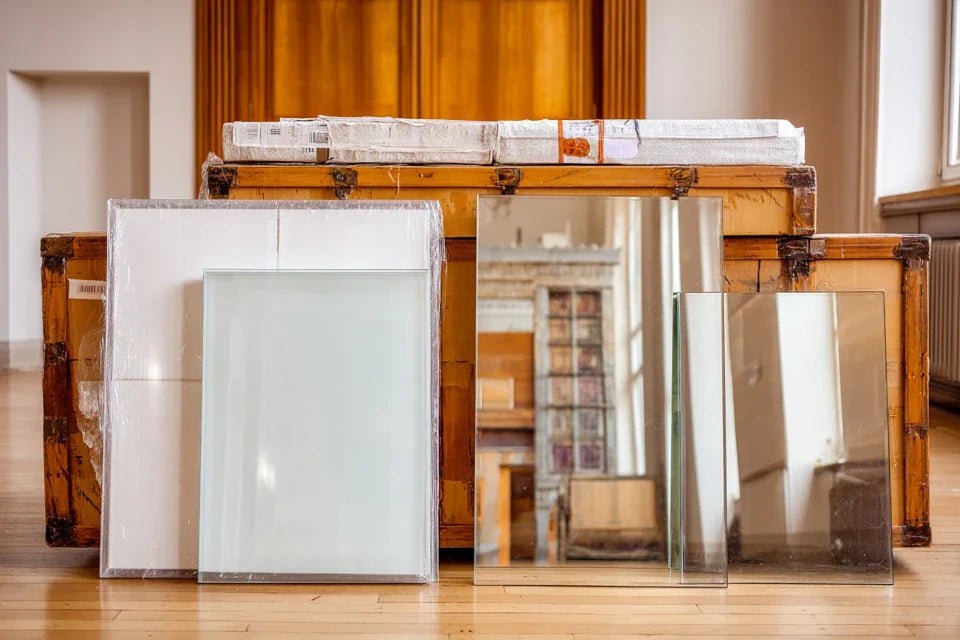
Preparation of work surface: Spread a clean white sheet over a table larger than your artwork. This neutral base prevents any particle transfer onto the artwork. Check for creases that could create pressure points. It's simpler than it seems!

⏱️ Time: 5 minutes | ✅ Successful when: Perfectly flat and clean surface | ⚠️ Attention: Avoid colored surfaces that may bleed under pressure

Cutting the contact film: Cut your Tyvek, leaving a 10 cm margin on each side. This margin allows for folding without tension on the edges of the frame. Use clean scissors and cut in one smooth stroke to avoid frayed fibers.

⏱️ Time: 3 minutes | ✅ Successful when: Clean cut without fraying | ⚠️ Attention: Too tight = tension on corners, too wide = unsightly creases

Bubble-free application: Place the film starting from the center, then smooth towards the edges as if sticking a giant sticker. The Tyvek naturally follows shapes without forcing. Fold the edges without tightening, just hold them in place.

⏱️ Time: 8 minutes | ✅ Successful when: No bubbles, uniform contact | ⚠️ Attention: Never pull on a stretched film, reposition it entirely instead

>

✅ Verification of your first layer : Your artwork should be evenly wrapped, without tension or marked creases. You can gently tap the surface: no hollow sounds should be heard. If in doubt, start over: this step conditions everything else!

OUR RECOMMENDED PRODUCTS

Step 2: Thermal insulation - Your climate regulator

Now that your protective base is in place, you will create a stable climatic bubble around your artwork. This is where the magic happens: no more temperature variations that cause condensation and expansion! This step will give you absolute assurance that your painting travels in its own perfect microclimate.

Your climate regulation arsenal

  • Closed cell insulating foam: Dense yellow or white foam, firmer than classic foam. Creates an effective thermal barrier without absorbing moisture. Available in different thicknesses from packaging specialists. The 20mm thickness offers the best protection/bulk compromise.®
  • Metallized bubble film: Professional version of bubble wrap with aluminized surface. Reflects 97% of radiant heat while cushioning impacts. Check for "food grade" marking, which guarantees the absence of chemical migration.
  • Silica gel desiccant sachets: Small white sachets that passively regulate humidity. Maintains a stable humidity level even during significant external variations. Simple calculation: 1 sachet of 10g per square meter of artwork surface.
  • Building your climate cocoon

    Positioning humidity regulators: Place the silica gel sachets in the four corners, never in direct contact with the artwork. They must be in the same confined space but separated by the contact film. This is your miniature air conditioning system!

    ⏱️ Time: 4 minutes | ✅ Successful when: Sachets evenly distributed | ⚠️ Attention: Direct contact = risk of irreversible white stain

    Application of thermal insulation: Cut the insulating foam with a 5cm margin and position it as a protective cover. It should completely surround your painting without exerting pressure. Temporarily secure with painter's tape.

    ⏱️ Time: 12 minutes | ✅ Successful when: Complete insulation without compression | ⚠️ Attention: Foam that is too compressed loses its insulating properties

    Step 3: The outer shell - Your final shielding

    You’ve reached expert level! Your artwork already has its chemical and climate protection; all that remains is to create an armor against mechanical shocks. This final step will give you unwavering confidence: your painting can withstand all the vagaries of transport as if it were traveling in a mobile safe.

    Professional Transport Shielding

    • Triple Fluted Corrugated Cardboard: Ultra-resistant cardboard with visible honeycomb structure on the edge. Absorbs multidirectional shocks while remaining lightweight. Tested resistance: supports 200kg per m². Choose it in natural (kraft) color without colored printing.
    • High Density Cushioning Foam: Very firm black or gray foam that returns to its shape after compression. Perfectly fills empty spaces in the packaging. A finger pressure should barely deform it. Avoid yellow foams that are too soft and permanently settle. Professional Retractable Plastic Film: Thick (minimum 200 microns) transparent film that tightens under heat. Holds the entire assembly together without localized pressure points. Recognizable by its tear resistance and uniform glossy appearance.

    Assembling Your Mobile Fortress

    Construction of the transport crate: Cut your corrugated cardboard to form a custom-made case with bottom, four sides and lid. Leave 3cm of free space around the painting for cushioning. Assemble with reinforced tape in a cross pattern for maximum strength.

    ⏱️ Time: 20 minutes | ✅ Successful when: Rigid structure without play | ⚠️ Attention: Poorly assembled corners = point of rupture under stress

    Precise cushioning with foam: Insert high density foam blocks so that your painting is perfectly immobilized without pressure. Test: it should not move in any direction even when shaking the crate vigorously. This is your final resistance test!

    ⏱️ Time: 15 minutes | ✅ Successful when: Total immobilization without constraint | ⚠️ Attention: Insufficient foam = destructive swaying during transport

    The rule of secure progression: Each layer must be perfect before moving on to the next. A defect in layer 1 cancels out the effectiveness of layers 2 and 3. Take your time: better 2 hours of preparation than 2 months of restoration!

    Congratulations! You now master the three pillars of professional art protection. You will discover some expert subtleties that make the difference between correct protection and exceptional protection. These details will give you the advantage of those who transport artworks worth millions of euros!

    🎯 Curator's tip: Always place a small piece of pH neutral paper between the corners of the frame and the protective film. This technique avoids pressure marks that appear on gilt after several moves. Invisible but remarkably effective!

    💭 "What if my painting has a non-standard shape?"

    "My artwork has a very thick and sculpted frame, does your method still work?"

    Excellent question! It's even simpler with pronounced reliefs. The flexible materials we use naturally follow all shapes, unlike rigid packaging. A baroque frame is protected exactly like a flat frame, but with even more efficiency because the foam naturally finds its place in the decorative recesses. You can even perfectly mold the protection on sculpted details!

    🔧 Compliance test: Run your hand over the finished packaging: you should feel the reliefs of the frame perfectly through the protection. This is a sign that your materials faithfully follow the shape without creating dangerous voids.

    The pitfalls to absolutely avoid when packing

    Now that you know the right method, watch out for common mistakes that can ruin all your efforts! These errors are so common that even experienced professionals sometimes make them. I want to spare you these costly pitfalls.

    • 🚫 Mixing acidic and neutral materials: It's tempting to use standard tape to "reinforce"! In reality, the acidity of standard tape migrates to the artwork and creates irreversible brown stains. Use only acid-free tape or painter's tape. This mistake concerns 80% of beginners, you are warned!
    • 🚫 Packing a painting that is still wet: Urgency often leads to packing before the paint is completely dry. Result: the paint sticks to the protection and tears when unpacking. Always wait at least 48 hours after the last touch-up, even for a "touch-dry" paint.
    • 🚫 Neglecting acclimatization after transport: Unpacking immediately after transport in cold weather causes a fatal thermal shock. Leave the packaging closed for 2h at room temperature before opening. It's like letting a bottle of wine breathe before serving!
    • 🚫 Reusing protective materials: Understandable but risky economy! Materials lose their properties after one use: elasticity, chemical neutrality, absorption capacity. A used material can contaminate a healthy artwork. Invest in new materials for each important transport.
    • 🚫 Trusting "universal" materials: It's tempting to believe that a single product protects all types of artworks! In reality, oil on canvas, acrylic on wood, watercolor on paper each have their specific requirements. Always adapt your protection to the exact type of your artwork.

    🛡️ Your pre-transport safety checklist: Check for chemical odors after packaging, test stability by lifting the crate 10cm and gently placing it back down (no sliding noises), ensure "FRAGILE" labeling is visible on all sides, confirm that the packaging resists slight pressure from the flat of your hand without deformation.

    🎁 Special offer for readers

    Because you took the time to inform yourself, enjoy 10% discount on your first order:

    ART10
    ⏰ Valid 72h after reading • Applicable to all our products

    Your essential questions about artwork protection

    💰 "What budget should I allocate to properly protect a 100x80 cm painting?"
    Allow between 25€ and 45€ in materials for complete professional protection. Tyvek costs around €3/m², insulation foam €8/m², corrugated cardboard €12/m². Optimize by ordering exact quantities from a specialist supplier rather than retail. Concrete example: Marie protected her masterpiece 80x60 cm painting for €32 in materials, avoiding €2500 of restoration after a failed transport with bubble wrap.

    ⏱️ "How long does it take to professionally pack?"
    Allow 45 minutes to 1h15 for a first packing following each step scrupulously. With experience, you will go down to 30 minutes. Never rush: every minute invested in protection saves you hours of stress and potentially thousands of euros in repair. The golden rule: it's better to be late with an intact artwork than on time with a damaged one!

    🌡️ "Can my painting withstand winter transport at -5°C?"
    Absolutely, with adequate thermal protection! Insulation foam and metallized film create an effective barrier down to -15°C. The real danger is not the cold itself, but the thermal shock upon unpacking. Pro technique: leave the packaging closed for 3h in your heated interior before opening. Thus, the temperature rises gradually without condensation. Even museums use this method for their winter loans!

    🔍 "How do I know if my painting needs special protection?"
    Three simple criteria: high sentimental or financial value (+ de 500€), mixed technique or fragile materials (gilding, impasto, recent varnish), age over 20 years. If you answer "yes" to a single criterion, use the complete method. For exceptional works (+ de 5000€), add an anti-UV film and a disposable humidity sensor. Expert tip: photograph your artwork before packing to document its initial condition.

🚚 "Can I trust specialized carriers?"

True art transport specialists use exactly the materials we just discovered! Check their certification (museum approval in France, for example), ask to see their packaging materials, and require specific artwork insurance. Indicative price: €150 to €300 for a Paris-Lyon transport of a 100x80cm painting. Be careful with "specialists" who still use bubble wrap: move on immediately!

Your new artistic peace of mind

In a few weeks, you will look at your precious artworks with a totally different eye. Never again that nagging anxiety about having to move them. You will know exactly what to do, with which materials, in what order. Your collector friends will ask for your advice, impressed by your newly acquired expertise. You will become the person who perfectly masters artistic protection.

This skill goes far beyond simple transport: you now understand the real enemies of your artworks on a daily basis. Humidity, temperature variations, incompatible materials hold no secrets for you. This knowledge transforms your approach to conservation, giving you that serene confidence of true connoisseurs.

The hardest part was distinguishing good information from decorative folklore! Now that you know the professional materials and their correct application, all you have to do is get your first protection kit. Start this week: protecting your first artwork using this method will give you immense satisfaction!

🎯 Your first step in protection: Your artistic investment deserves this exceptional protection. Every day without adequate protection puts your artworks at unnecessary risk. You now have all the keys to act like a professional!

Read more

Déménagement express : protéger ses tableaux sans matériel professionnel
Comment emballer un tableau en verre pour un déménagement sans risque ?